Why in News?
JAXA announced on October 20, 2026, that Martian Moons eXploration (MMX) had launched aboard H3, separated successfully and entered its predetermined orbit.
- The launch took place from Japan’s Tanegashima Space Center; spacecraft separation and orbital injection were confirmed.
- MMX plans to collect at least 10 grams of surface material from Phobos, one of Mars’s two moons.
- The mission overview schedules Earth return in 2031; arrival, landing, sampling and capsule recovery remain future operations.
- The scientific question concerns moon formation: whether Martian moons came from captured asteroids or debris produced by a giant impact.
- Returned grains would connect laboratory analysis with observations of their original setting, strengthening interpretation of material moving through the Solar System.
UPSC Relevance
Prelims Relevance
- MMX: JAXA mission targeting sample return from Phobos.
- Phobos and Deimos: the two Martian moons.
- Quasi-satellite orbit: an orbital path around Mars similar to Phobos’s, permitting nearby observations.
- Origin hypotheses: captured asteroid versus giant-impact debris.
- Sample return: collection outside Earth followed by delivery to terrestrial laboratories.
Mains Relevance
GS Paper 3
- How robotic sample return complements remote sensing in planetary science.
- Scientific uncertainty and staged technological validation in deep-space missions.
Essay
- Scientific progress depends on testing competing explanations against material evidence.
Background and Context
Why Phobos Can Reveal How Martian Moons Formed
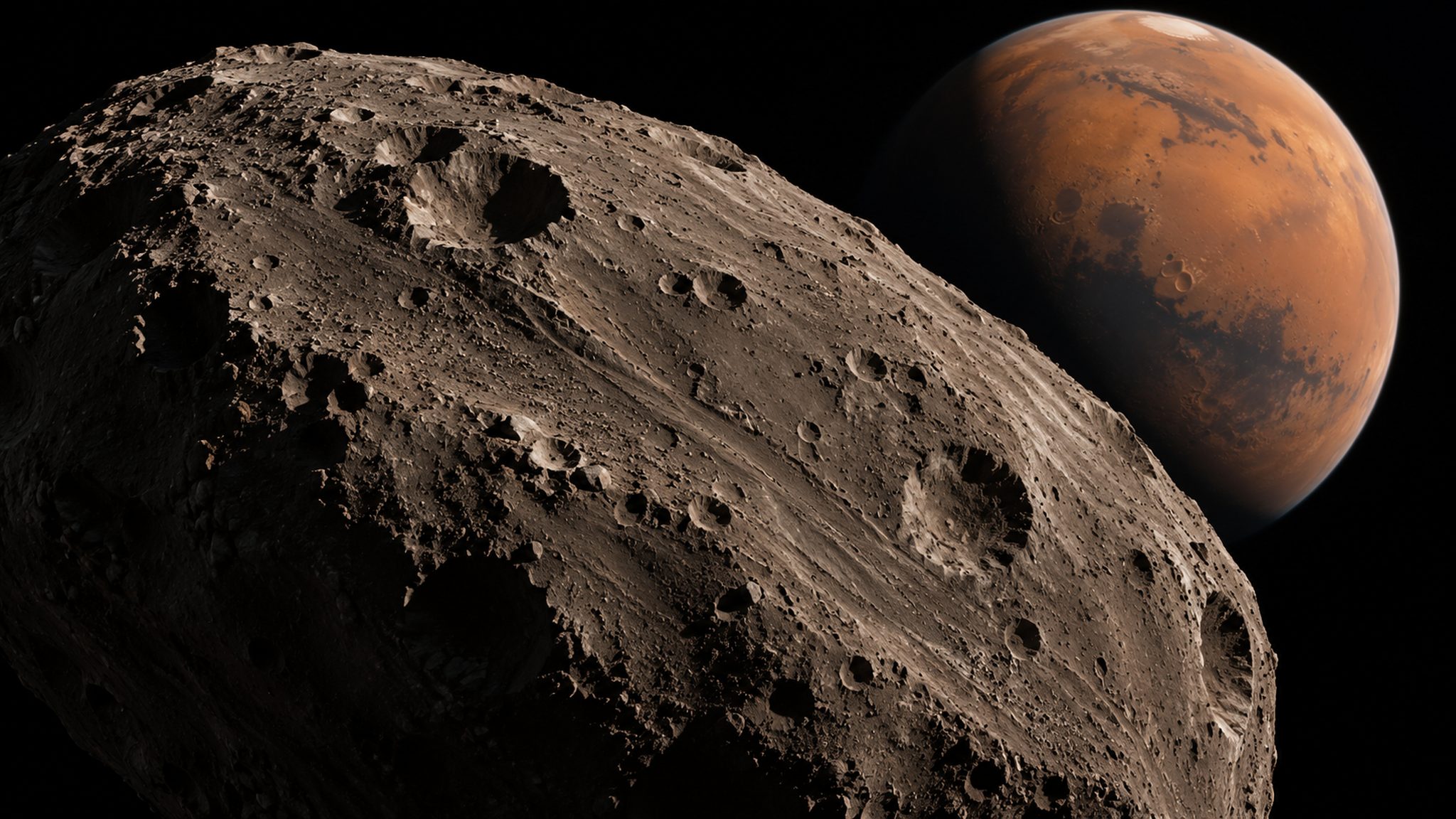
Phobos is both the sampling destination and a test case for competing explanations of how small bodies became moons.
- The capture hypothesis treats the moons as asteroids originating in the outer Solar System that were subsequently captured by Mars’s gravity. Their material would preserve clues to that earlier history.
- The giant-impact hypothesis instead proposes that a massive collision with Mars scattered debris into orbit. That material then assembled into moons, connecting their origin directly to an episode in the planet’s evolution.
- Composition matters because the hypotheses describe different source materials and formation processes. JAXA plans to combine observations from the spacecraft with detailed examination of returned grains to investigate which explanation fits the evidence.
- A small-body target offers access to the Martian system without retrieving material directly from Mars’s surface. JAXA identifies the planet’s stronger gravity as a significant technical obstacle for landing and sample return.
- Preservation is a scientific expectation, not a result already established by MMX. Phobos is thought to have changed relatively little, making its material potentially informative about the history of the wider Martian system.
How the Planned Sampling Sequence Works
The mission separates reconnaissance, surface investigation and return so that observations can guide the next operation.
- Quasi-satellite operations begin after arrival near Mars: the spacecraft follows an orbital path similar to Phobos’s. This geometry supports close observations of the moon while the mission operates within the Martian system.
- Landing-site selection relies on observations of Phobos’s shape and candidate locations. Terrain, spectroscopy and chemical composition help connect the choice of sampling location with both operational feasibility and the scientific questions being investigated.
- The rover precedes the main spacecraft in the planned surface sequence. It investigates the Phobos surface before the main spacecraft lands to collect material, making these distinct operations rather than a single completed touchdown.
- Sample collection is intended to bring surface grains and rock material into the return chain. Success requires more than reaching Phobos: the spacecraft must perform the landing, secure material and carry it away.
- The return capsule is planned to separate near Earth and enter the atmosphere, with recovery in Australia. Launch confirmation establishes departure success; it cannot establish successful sampling, capsule entry or recovery in advance.
What Returned Samples Could Establish
Remote observations describe the larger setting; returned material lets researchers examine parts of that setting in greater detail.
- Remote sensing surveys Phobos and helps identify where material comes from. Laboratory study of returned samples adds detailed analysis of the physical material, making the two approaches complementary rather than interchangeable scientific methods.
- Context remains essential: a sample must be interpreted alongside observations of its collection site and the moon as a whole. A grain’s properties alone do not automatically explain every feature of planetary history.
- Deimos observations provide a wider view of the Martian moons, but the planned material collection targets Phobos. Observing another moon does not mean the mission intends to return samples from both moons.
- Habitability research includes investigating how water and organic material moved through the Solar System. Such work concerns the conditions for prebiotic chemistry; it is not equivalent to finding organisms or proving past Martian life.
- Technology development is a separate mission outcome: round-trip travel, landing, sampling and long-distance communication extend small-body exploration capabilities. These engineering objectives can be assessed independently of which moon-origin hypothesis the eventual evidence supports.
Way Forward
Judge Each Milestone Against Its Evidence
- Report launch, arrival, sampling and return separately, using agency confirmation for completed operations and conditional language for planned ones.
- Interpret sample results with collection-site observations and competing origin hypotheses, rather than treating an isolated finding as a complete history.
- Separate research on water and organics from claims of life detection; the evidentiary questions are different.
Conclusion
- MMX links a concrete target to a testable question: Phobos samples could help distinguish capture from impact origins when assessed with remote observations. The launch begins that investigation; the decisive material evidence has not yet returned.
- For planetary exploration, mission stage determines the claim. A successful launch is an engineering milestone, planned sample return is a future operation, and a conclusion about moon origins must await observations and analysis.
UPSC Practice Questions
Prelims MCQ 1
With reference to the Martian Moons eXploration mission, consider the following statements:
- Its planned sample collection targets Phobos.
- Its quasi-satellite operations involve an orbital path around Mars similar to that of Phobos.
- Successful launch confirms that samples have been recovered on Earth.
How many of the above statements are correct?
(a) Only one (b) Only two (c) All three (d) None
Answer: (b) Only two
Explanation:
Statements 1 and 2 are correct. Launch is distinct from the later planned landing, collection and Earth recovery stages.
Prelims MCQ 2
Which explanation corresponds to the giant-impact hypothesis for the origin of the Martian moons?
(a) Asteroids were captured intact by Earth and transferred to Mars. (b) Solar radiation condensed directly into solid moons. (c) Debris from a massive collision with Mars accumulated into moons. (d) Material returned from Phobos has already proved the presence of life.
Answer: (c) Debris from a massive collision with Mars accumulated into moons.
Explanation:
The giant-impact hypothesis proposes a collision with Mars followed by assembly of orbiting debris into moons. It is distinct from the captured-asteroid hypothesis.
UPSC Mains Questions
- Explain how sample-return missions complement remote sensing in investigating planetary origins. Illustrate with the objectives of MMX.
- Distinguish the scientific objectives and technological milestones of a deep-space mission. Why should launch success be assessed separately from sample recovery?
Sources: JAXA launch result and JAXA MMX mission overview.
Frequently Asked Questions
What is the MMX mission?
MMX is JAXA’s Martian Moons eXploration mission. It aims to observe the Martian system, collect material from Phobos and return that material to Earth for detailed analysis of the moons’ origins.
Is MMX collecting samples from the surface of Mars?
No. The planned collection site is Phobos, a moon of Mars. Observations of Mars and Deimos support wider scientific objectives, but they should not be confused with surface sampling on the planet.
Why are Phobos samples useful?
The samples could help distinguish whether the Martian moons formed from impact debris or were captured asteroids. Their interpretation requires laboratory analysis together with remote observations of Phobos and the sampling location.
Has MMX already returned samples?
No. JAXA confirmed launch, separation and orbital injection on October 20, 2026. Arrival, surface operations and sample recovery remain planned; the mission overview schedules return to Earth in 2031.
Tell Google you want more of this.
Add Anantam IAS as a preferred sourceOne tap, and this site shows up more often in your own Top Stories, AI Overviews and AI Mode. Remove it any time.