Why in News?
Recent research projects that Atlantic Meridional Overturning Circulation (AMOC), which regulates climate across the globe, could slow by up to 59% by 2100 under high greenhouse gas emission scenarios.
The AMOC collapse would have potentially catastrophic consequences for global weather systems, including a severe weakening of India’s summer monsoon.
| UPSC Relevance: GS-1 Geography: Geophysical phenomena; Changes in Critical Geographical Features GS-3 Environment and Biodiversity: Climate Change Prelims & Mains: Atlantic Meridional Overturning Circulation (About, Mechanism, Consequences of AMOC collapse) |
What is Atlantic Meridional Overturning Circulation?
- The Atlantic Meridional Overturning Circulation (AMOC) is a vast system of ocean currents in the Atlantic Ocean.
- AMOC functions like a planetary-scale conveyor belt, redistributing heat, salt, carbon dioxide, and nutrients across the globe. It is a critical component of the broader global thermohaline circulation, the ‘Great Ocean Conveyor Belt’.
Mechanism of Functioning of AMOC:
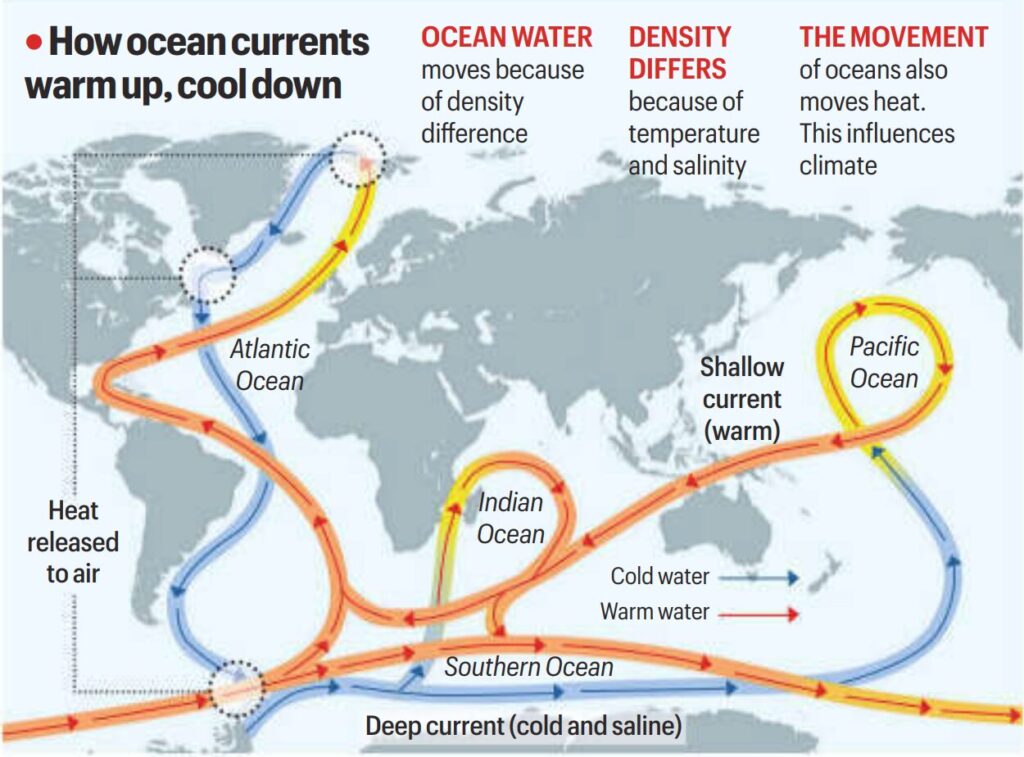
AMOC operates on the principles of thermohaline circulation driven by differences in water temperature (thermo) and salinity (haline).
- Warm and salty surface water from tropical regions flows northward towards Greenland through the Atlantic Ocean. In the cold Arctic region, this water cools and becomes heavier (denser). As a result, it sinks deep into the ocean.
- The cold deep water then slowly moves southward beneath the ocean surface. After a long time, it rises again, gets warmed in tropical regions, and the cycle continues. A single parcel of water (one cubic metre of water) may take nearly 1000 years to complete the full cycle.
This circulation transfers huge amounts of heat around the Earth. AMOC is the reason why Europe has a mild climate, and it heavily influences rainfall in Africa, the Americas, and Asia.
Causes of AMOC’s Weakening:
The AMOC conveyor belt relies on a delicate balance of temperature and salinity. Human-induced climate change is disrupting this through:
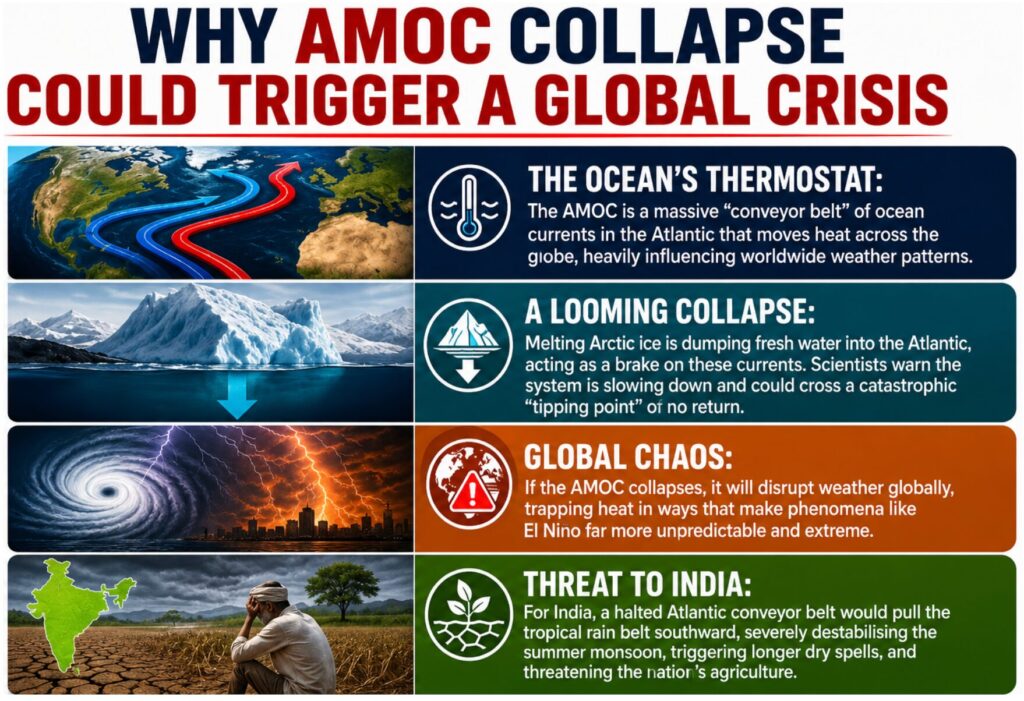
- Arctic Ice Melt and Freshwater Influx: Accelerating loss of the Greenland Ice Sheet and Arctic sea ice is dumping massive volumes of freshwater into the North Atlantic. Fresh water is lighter (less dense) and less salty, so it does not sink. This acts like a brake on the entire AMOC system.
- Reduced Salinity Contrast: Freshwater dilutes the salinity of North Atlantic surface water, reducing density gradients needed to drive deep-water formation.
- Ocean Warming: Rising ocean temperatures reduce the temperature-driven density difference between equatorial and polar waters.
AMOC is classified as one of the most important tipping points in the Earth’s climate system. A tipping point is a threshold beyond which change becomes self-reinforcing and potentially irreversible. Just like a chair tilted past its balancing point, once the AMOC crosses a certain threshold, it could irreversibly collapse into a new, sluggish state.
The consequences would be catastrophic, triggering extreme sea-level rise in North America and severe weather disruptions globally.
Global Consequences of AMOC Collapse:
- ITCZ Southward Shift: The Inter-Tropical Convergence Zone (ITCZ), the main rain belt of the tropics, would shift southwards. This would fundamentally alter rainfall distribution across Africa, Asia, and the Americas.
- Reduced Carbon Absorption: Thermohaline circulation absorbs ~25% of anthropogenic CO₂ emissions. A weakened AMOC would reduce the ocean’s carbon sink capacity, releasing stored CO₂ and creating a dangerous positive feedback loop.
- Southern Hemisphere Warming: Heat that cannot be transported northward would accumulate in the tropics and Southern Hemisphere, accelerating warming there.
- Intensify El Niño: Weaker AMOC will make El Niño events more unpredictable and extreme. Powerful El Niños would trigger droughts in the Americas and suppress rainfall over South Asia.
- Impact on Europe (Extreme Winters): Northwestern Europe could cool by 3-10°C (paradoxically, even amid global warming). Shorter growing seasons and extreme cold would devastate European agriculture.
- Impact on America:
- Sea Level Rise: AMOC normally pulls water away from the US East Coast. Without it, sea levels could rise by up to 1 metre along the northeastern United States coast (dynamic sea level rise).
- Hurricane Intensification: A weakened AMOC allows heat to accumulate in tropical Atlantic waters, potentially generating stronger and more frequent Atlantic hurricanes.
Impacts of AMOC Collapse on Indian Summer Monsoon:
The Indian Summer Monsoon is the backbone of India’s agriculture, supplying approximately 75% of the country’s annual rainfall.
- ITCZ Displacement: A weakened AMOC would cool the Northern Hemisphere, shifting the ITCZ southward and away from the Indian subcontinent, reducing moisture convergence over India.
- Weakened Monsoonal Winds: Altered temperature gradients diminish the land-sea pressure differential that drives the southwest monsoon winds from the Arabian Sea into India. Multi-model studies project ~18% decline in Indian Summer Monsoon annual rainfall if AMOC collapses.
- Shorter Wet Seasons: Models consistently project shorter wet seasons and longer dry spells for India, reducing the effective agricultural window.
Furthermore, an unpredictable El Niño, worsened by the AMOC’s decline, would only compound these climate risks, trapping Indian farmers between extreme droughts and erratic, destructive floods.
The only way to prevent an AMOC collapse is aggressive global greenhouse gas emission cuts by adopting the Paris Agreement’s 1.5°C pathway.
UPSC PYQ 2015
Q. What explains the eastward flow of the equatorial counter-current?
(a) The Earth’s rotation on its axis
(b) Convergence of the two equatorial currents
(c) Difference in salinity of water
(d) Occurrence of the’ belt of calm near the equator
Answer: (b)
UPSC Mains PYQ 2022:
Q. What are the forces that influence ocean currents? Describe their role in the fishing industry of the world.
UPSC Mains PYQ 2015:
Q. Explain the factors responsible for the origin of ocean currents. How do they influence regional climates, fishing and navigation?
Tell Google you want more of this.
Add Anantam IAS as a preferred sourceOne tap, and this site shows up more often in your own Top Stories, AI Overviews and AI Mode. Remove it any time.