Why in News?
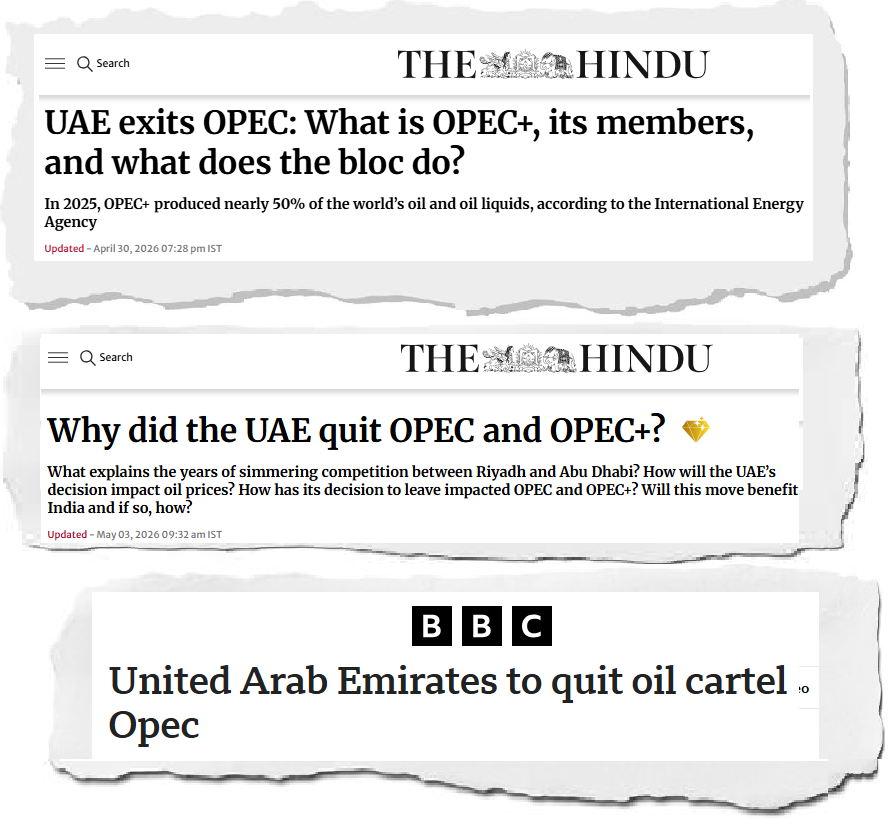
The Organization of the Petroleum Exporting Countries (OPEC) has suffered a major setback after the United Arab Emirates announced its withdrawal from both OPEC and OPEC+ in April 2026. The decision comes amid heightened geopolitical tensions in West Asia, particularly the ongoing Iran-related conflict and disruptions around the Strait of Hormuz.
The development has triggered debates regarding the future of OPEC, stability of global oil markets, regional rivalries in West Asia, and implications for major oil-importing countries such as India.
UPSC Relevance
GS-II: International Relations, India and West Asia, Global Energy Politics, Climate Transition, Multipolar World Order
GS-III: Energy Security, Economy, Infrastructure, Globalisation
What is OPEC?
The Organization of the Petroleum Exporting Countries was established in 1960 by Iran, Iraq, Kuwait, Saudi Arabia, and Venezuela to coordinate petroleum production policies and stabilise global oil prices.
Objectives of OPEC
- Coordinate oil production policies among member countries.
- Ensure stable oil prices in global markets.
- Protect the interests of oil-producing nations.
- Ensure regular supply of petroleum to consumers.
- Secure fair returns on investments in the petroleum industry.
Currently, OPEC controls nearly 30% of global oil production, while the broader OPEC+ grouping accounts for around 40% of global supply.
What is OPEC+?
OPEC+ is an expanded grouping formed in 2016 that includes OPEC members along with major oil producers such as Russia, Kazakhstan, Mexico, Oman, and others.
The grouping was formed mainly to coordinate production cuts and stabilise prices after oil market volatility.
Difference Between OPEC and OPEC+
| Feature | OPEC | OPEC+ |
| Nature | Core oil cartel | Expanded alliance |
| Members | Primarily Middle Eastern, African and Latin American oil exporters | OPEC + non-OPEC producers |
| Key Member | Saudi Arabia | Saudi Arabia + Russia |
| Main Objective | Manage oil supply | Wider global production coordination |
Why Did the UAE Leave OPEC?
Desire for Production Flexibility
The UAE has heavily invested in expanding its oil production capacity and wants to produce more oil without being constrained by OPEC quotas.
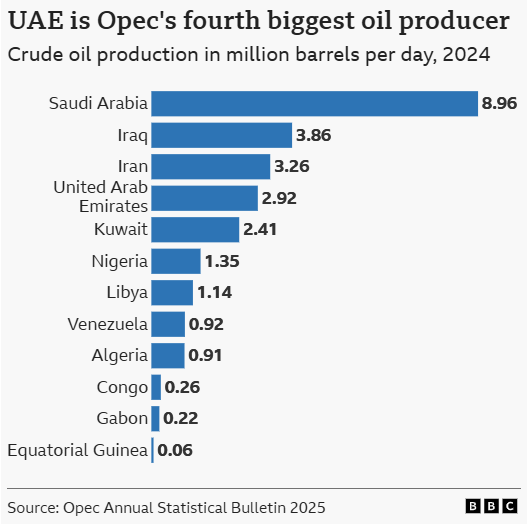
The country reportedly aims to raise production capacity close to 5 million barrels per day.
Differences with Saudi Arabia
There have been long-standing disagreements between the UAE and Saudi Arabia regarding production limits, regional influence, and strategic priorities.
The UAE increasingly viewed Saudi-led quota restrictions as harmful to its economic interests.
Geopolitical Realignment in West Asia
The UAE has pursued an assertive foreign policy, strengthening ties with the United States and Israel after the Abraham Accords.
Its strategic calculations increasingly diverged from some OPEC members, especially Iran and Saudi Arabia.
Impact of Iran Conflict
The ongoing Iran conflict and disruptions around the Strait of Hormuz created supply shortages and volatility in global oil markets.
The UAE argued that it required greater agility and independent decision-making to respond quickly to changing market conditions.
Economic Diversification
The UAE’s economy is becoming increasingly diversified through finance, logistics, tourism, renewables, and sovereign wealth investments.
As a result, its economic interests are no longer fully aligned with traditional cartel-based oil management.
Why is the Strait of Hormuz Important?
The Strait of Hormuz is one of the world’s most critical oil transit routes.
Importance
- Nearly one-fifth of global oil trade passes through it.
- Connects the Persian Gulf to the Gulf of Oman and Arabian Sea.
- Essential for oil exports from Saudi Arabia, Iraq, Kuwait, UAE, and Qatar.
- Any disruption immediately affects global oil prices.
Recent tensions and attacks in the region have highlighted the vulnerability of global energy supply chains.
Implications of UAE’s Exit
Weakening of OPEC’s Cohesion
The UAE was one of OPEC’s largest and most technologically advanced producers.
Its exit weakens cartel discipline and may encourage other countries to prioritise national interests over collective quotas.
Reduced Pricing Power of OPEC
OPEC’s ability to influence oil prices depends on coordinated production cuts.
If more members disregard quotas, cartel influence over global markets could decline further.
Greater Oil Market Volatility
Instead of stable prices, the global oil market may witness sharper fluctuations due to geopolitical tensions and competitive overproduction.
Intensification of Gulf Rivalries
The move reflects growing strategic competition among Gulf countries, especially between the UAE and Saudi Arabia.
It also signals changing power dynamics in West Asia.
Impact on Global Energy Transition
The exit may accelerate competitive oil production in the short term, but it also reflects how countries are repositioning themselves for a future beyond oil dominance.
Implications for India
Energy Security Concerns
India imports nearly 85% of its crude oil requirements, with a substantial share coming from West Asia.
Instability in oil-producing regions directly affects India’s energy security.
Impact on Inflation and Economy
Higher oil prices can:
- Increase import bills.
- Widen the current account deficit.
- Raise transportation and logistics costs.
- Trigger inflationary pressures.
Strategic Importance of West Asia
The development reinforces the need for India to maintain balanced relations with:
- Saudi Arabia
- UAE
- Iran
- Israel
Push Towards Energy Diversification
The crisis underlines the importance of:
- Renewable energy expansion.
- Strategic petroleum reserves.
- Green hydrogen initiatives.
- Diversification of crude import sources.
Challenges Before OPEC
Internal Divisions
Member countries increasingly prioritise domestic economic interests over cartel discipline.
Rise of Non-OPEC Producers
Countries such as the United States, Brazil, and Canada have significantly increased production, reducing OPEC’s dominance.
Energy Transition
Global movement towards renewable energy and decarbonisation threatens long-term oil demand.
Geopolitical Fragmentation
Conflicts in West Asia complicate coordinated energy governance.
Way Forward
Reforming Global Energy Governance
OPEC and OPEC+ need more flexible and transparent mechanisms to accommodate changing geopolitical and economic realities.
Strengthening Energy Security
Countries like India must:
- Diversify import sources.
- Increase renewable energy capacity.
- Build resilient supply chains.
- Expand strategic oil reserves.
Accelerating Green Transition
Global dependence on fossil fuels can be reduced through:
- Solar and wind energy.
- Electric mobility.
- Green hydrogen.
- Energy-efficient infrastructure.
Regional Stability in West Asia
Diplomatic efforts to reduce tensions in the Gulf region are essential for stabilising global oil markets and trade routes.
Prelims Practice Questions
1. With reference to OPEC+, consider the following statements:
- OPEC+ includes both OPEC and non-OPEC oil-producing countries.
- Russia is a member of OPEC+.
- OPEC+ was created mainly to coordinate production cuts and stabilise oil prices.
Which of the statements given above are correct?
(a) 1 and 2 only
(b) 2 and 3 only
(c) 1 and 3 only
(d) 1, 2 and 3
Answer: (d)
2. The Strait of Hormuz is strategically important because:
(a) It connects the Mediterranean Sea and Red Sea
(b) A significant share of global oil trade passes through it
(c) It is the largest natural gas reserve region in the world
(d) It separates Europe and Africa
Answer: (b)
3. Which of the following countries are members of OPEC?
- Saudi Arabia
- Iran
- Russia
- Venezuela
Select the correct answer using the code below:
(a) 1, 2 and 4 only
(b) 1 and 3 only
(c) 2 and 4 only
(d) 1, 2, 3 and 4
Answer: (a)
Mains Practice Questions
- Discuss the strategic significance of the Strait of Hormuz in global energy politics
- “The UAE’s exit from OPEC reflects the changing geopolitics of energy in West Asia.” Discuss.
- Examine the implications of instability in West Asia for India’s energy security and economic stability.
- Critically analyse the relevance of OPEC in an era of renewable energy transition and rising non-OPEC oil production.
Tell Google you want more of this.
Add Anantam IAS as a preferred sourceOne tap, and this site shows up more often in your own Top Stories, AI Overviews and AI Mode. Remove it any time.