Context:
The Periodic Labour Force Survey (PLFS) for July–September 2025 has revealed contrasting trends — a decline in rural unemployment and a rise in urban joblessness, reflecting seasonal and structural shifts in India’s employment landscape.
UPSC Relevance:
Economics
UPSC PYQ:
Q. Most of the unemployment in India is structural in nature. Examine the methodology adopted to compute unemployment in the country and suggest improvements. (2023)
Q. The nature of economic growth in India in recent times is often described as jobless growth. Do you agree with this view? Give arguments in favor of your answer. (2015)
India’s Economic Prospects
- India’s economy has reached a valuation of $4.19 trillion, positioning it as a key player in the global growth scenario and on track to become the world’s third-largest economy.
- However, this progress is facing a significant threat from a proposed 50% tariff by the United States on $40 billion worth of Indian exports. This could have a substantial impact, potentially reducing India’s GDP by nearly 1%.
- While China has been able to absorb U.S. tariffs due to its scale and diversified exports, India is more vulnerable. The U.S. accounts for 18% of India’s exports, and increased tariffs could result in a 30-35% cost disadvantage for Indian goods against competitors like Vietnam.
Key Findings from PLFS:
- Rural unemployment fell from 4.8% to 4.4%, indicating greater absorption of labour during the kharif agricultural season.
- Urban unemployment rose from 6.1% to 6.2% (males) and 8.9% to 9.0% (females) due to slower expansion in non-farm sectors.
Nature of Employment:
Rural areas:
- Self-employment dominates — rose from 60.7% to 62.8%.
- Seasonal work in agriculture explains the decline in joblessness.
Urban areas:
- Regular wage/salaried employment marginally improved from 49.4% to 49.8%.
- Tertiary sector (services) remains dominant, employing 62% of workers, slightly higher than the previous quarter.
About Unemployment:
Unemployment is when an individual who is not employed and is seeking employment, cannot find work.
Key Terms:
- Labour Force: It includes all the people who are presently employed or are searching for jobs.
- Workforce: It includes all the people who are presently employed.
- Unemployment Rate= (Labour Force – Work Force)/Labour Force * 100
- Labour Force Participation Rate (LFPR) = (Labour Force/ Working Age Population) * 100
- Employment-to-Population ratio (EPR): (Workforce/ Working Age Population) * 100
- Worker Population Ratio (WPR): Number of persons employed per thousand persons.
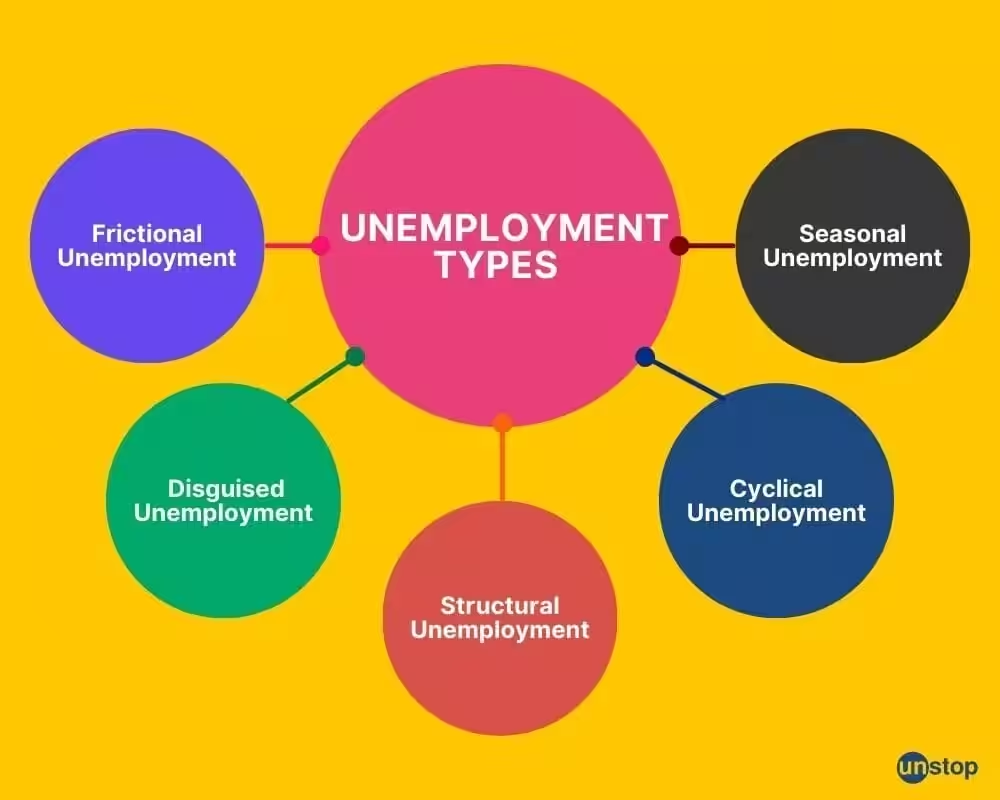
Why Rural Unemployment decline and urban unemployment rise:
- Seasonal Employment Cycles
- The fall in rural unemployment aligns with seasonal agricultural cycles, not structural job creation.
- Post-harvest, rural joblessness typically rises again — showing hidden unemployment and underemployment trends.
- Urban Distress
- The urban informal sector continues to absorb the majority of new entrants but with low wages and no social security.
- Rising joblessness in cities reflects sluggish manufacturing recovery, limited formal job creation, and urban migration pressure.
About Female Labour force:
Periodic Labour Force Survey:
Published by the National Statistical Office (NSO). Replaced the earlier quinquennial (5-year) Employment Unemployment Surveys (EUS) surveys in India. It involves quarterly employment survey in Urban areas and Annual Survey in the Rural Areas.
Tell Google you want more of this.
Add Anantam IAS as a preferred sourceOne tap, and this site shows up more often in your own Top Stories, AI Overviews and AI Mode. Remove it any time.