Why in News?
The UN Secretary-General António Guterres argues that unequal power relations and divisions among major powers have paralysed the United Nations Security Council. His central concern is that an institution reflecting the distribution of power in 1945 increasingly lacks legitimacy in today’s world.
The Pact for the Future, adopted in 2024, committed countries to reforming the Council, particularly by addressing Africa’s historical exclusion. However, this commitment has not itself changed the Council’s membership or veto rules.
| UPSC Relevance: GS-2 International Relations: International Institutions Prelims: United Nations, United Nations Security Council Mains: United Nations Security Council: Need & Challenges |
What is the UNSC?
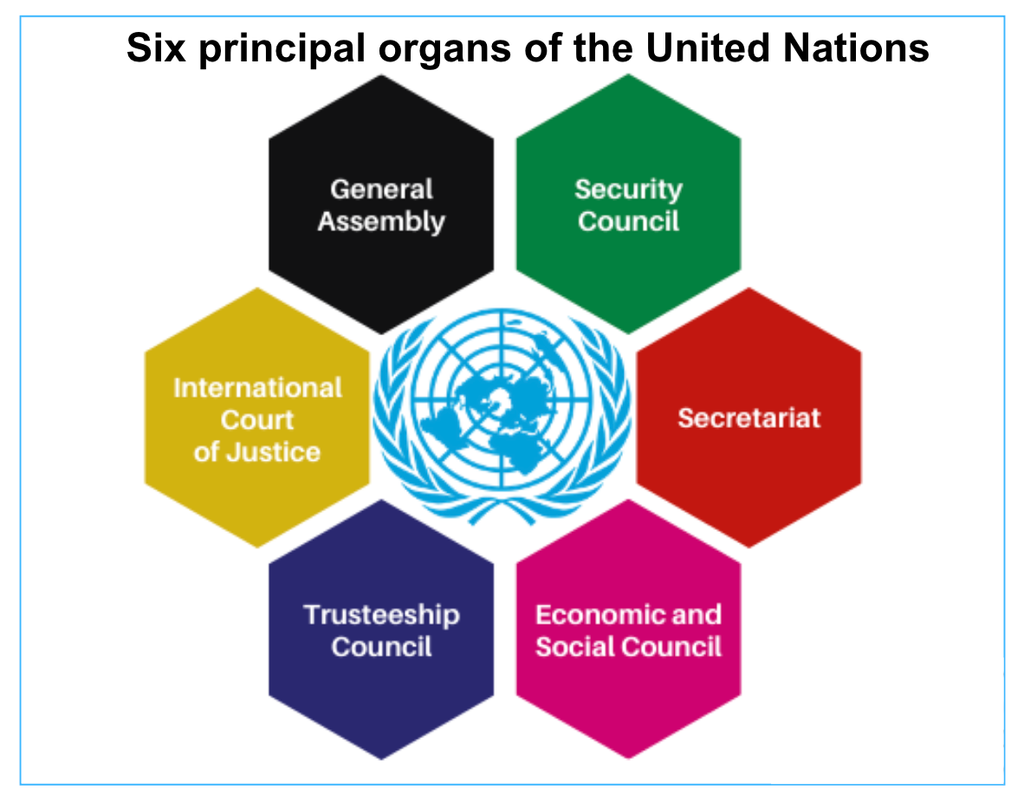
The United Nations Security Council (UNSC) is one of the UN’s six principal organs, entrusted with primary responsibility for maintaining international peace and security.
- Composition: Fifteen members: five permanent and ten elected members.
- Permanent Five (P5): China, France, Russia, the United Kingdom and the United States.
- Elected members: Chosen by the General Assembly for two-year terms; retiring members cannot be immediately re-elected.
- Presidency: Rotates monthly in English alphabetical order.
- Principal functions: Peaceful settlement of disputes, sanctions, authorisation of military action and establishment of peacekeeping operations.
- Other responsibilities: Recommends admission of new UN members and appointment of the Secretary-General to the General Assembly.
How does voting work?
- Procedural matters: Require at least nine affirmative votes; the veto does not apply.
- Substantive matters: Require at least nine affirmative votes and no negative vote by a permanent member.
- Abstention by a permanent member is not a veto, including on recommendations for admission of new members.
Why does the UNSC need reform?
- Its composition no longer reflects global realities: UN membership expanded from 51 countries in 1945 to 193, while the Council expanded only once- from 11 to 15 members in 1965. Permanent membership remained unchanged. Thus, decolonisation and the emergence of new centres of economic and political influence have not produced a corresponding redistribution of permanent decision-making power.
- Africa and Latin America lack permanent representation: Africa has 54 UN member states, yet no permanent seat; Latin America and the Caribbean also lack permanent representation. These regions participate through elected seats but cannot continuously shape decisions on equal institutional terms with the P5.
- The Ezulwini Consensus and Sirte Declaration articulate Africa’s demand for at least two permanent seats, with veto rights while the veto exists, and five non-permanent seats in total. This is a demand for authority over decisions affecting the continent, beyond symbolic inclusion.
- The veto can turn collective security into selective security: A permanent member can block action against itself or a strategic partner, even when most Council members support action.
- Ukraine: In 2022, Russia vetoed a draft resolution deploring its aggression despite 11 votes in favour.
- Gaza: In 2025, the United States vetoed a ceasefire draft supported by the other 14 members. These cases demonstrate how a single state’s strategic preferences can override broad agreement within the Council.
- Contributions and decision-making authority are misaligned: Countries supplying personnel, resources, and operational experience do not necessarily enjoy a proportionate role in setting mandates. India has contributed nearly 300,000 personnel across more than 50 UN peacekeeping missions, yet has no permanent seat.
- Legal authority does not ensure enforcement: The Council can adopt binding decisions, but implementation depends on states supplying cooperation, resources and political support. It has no standing UN army capable of independently enforcing every decision. Consequently, reform must address the gap between adopting a resolution and securing compliance, particularly when powerful states resist implementation.
- Sanctions require stronger fairness and accountability: Asset freezes and other targeted sanctions can seriously affect individuals. Opaque listing procedures, inadequate disclosure of reasons and weak opportunities for review undermine legitimacy. Security measures need due process, effective review and safeguards against arbitrary listing.
- Exclusion and paralysis weaken multilateralism: When states regard the UNSC as selective or inaccessible, they have greater incentives to pursue unilateral action or exclusive coalitions. This can fragment international responses and weaken confidence in common rules. At the same time, cyber operations, attacks on maritime infrastructure and emerging military technologies demand expertise and coordination extending beyond traditional great-power bargaining.
Major reform proposals:
- G4- India, Brazil, Germany and Japan: Seek expansion in both permanent and non-permanent categories and support one another’s permanent membership claims.
- African position: Seeks at least two permanent and five non-permanent African seats, with equal privileges for new permanent members.
- Uniting for Consensus- includes Italy, Pakistan, Mexico and others: Opposes adding new national permanent seats and favours expansion through elected membership, including proposals for longer terms.
- L.69: A cross-regional developing-country group supporting expansion in both categories and stronger Global South representation.
The disagreement is therefore over the distribution of power within a reformed Council, even where countries agree that reform is necessary.
India’s case and current position:
Why does India have a strong claim?
- Demographic legitimacy: The world’s most populous country has no permanent voice.
- Sustained engagement: India has served eight elected terms, most recently 2021-2022.
- Peacekeeping contribution: Its long operational experience strengthens its claim to participate continuously in mandate formulation.
- Diplomatic reach: Engagement across competing blocs can support negotiation and coalition-building.
- Global South priorities: India advocates greater developing-country participation in global decision-making.
In its April 2026 UN Intergovernmental Negotiations (IGN) on Security Council reforms, India supported a 26-member Council, expansion in both categories, and the African reform model. It also rejected a permanent-membership arrangement in which some permanent members possess veto rights while others do not, and sought a stronger role for troop-contributing countries.
Why has reform remained difficult?
- The P5 control the amendment threshold: Under Article 108, amendments require adoption by two-thirds of General Assembly members and ratification by two-thirds of UN members, including all five permanent members. With 193 members, the two-thirds threshold is 129.
- Existing powers risk losing influence: Enlargement dilutes agenda-setting authority; veto reform directly affects their privileged position.
- Regional rivalries obstruct agreement: Governments may support reform generally while opposing the permanent elevation of a regional competitor.
- The veto creates a dilemma: Extending it may increase opportunities for deadlock; withholding it creates unequal permanent-member categories.
- Representation and efficiency must be reconciled: A larger Council can be more legitimate but may require better procedures to prevent slower negotiations.
- Negotiations lack an agreed final bargain: The IGN process, operating since 2009, continues to confront differences over membership categories, veto, regional representation, Council size and working methods, and relations with the General Assembly.
Way Forward:
- Combine membership reform with procedural reform: Expand representation, especially for Africa and other underrepresented regions, while improving decision-making and implementation.
- Move towards a negotiated text: Consolidate proposals into a text with clearly identified disagreements and review milestones, making progress measurable.
- Encourage voluntary veto restraint: The France-Mexico initiative proposes restraint in situations involving mass atrocities. This can be pursued without waiting for the Charter amendment.
- Strengthen General Assembly scrutiny: Resolution 76/262 (2022) provides for an Assembly debate within 10 working days of a veto, subject to the emergency-special-session exception. It increases political accountability but does not overturn the veto.
- Use “Uniting for Peace” when appropriate: Resolution 377 A(V), 1950 enables the Assembly to recommend collective measures when permanent-member disagreement blocks Council action.
- Improve participation and transparency: Involve elected members, affected countries, regional organisations and troop contributors earlier in drafting resolutions and peacekeeping mandates.
- Make sanctions and mandates more accountable: Ensure evidence-based listings, accessible review, humanitarian safeguards, adequate resources and periodic assessment of results.
- Build a wider Indian coalition: Link India’s candidature with African representation and meaningful opportunities for small and medium-sized states, making reform a shared institutional project.
The veto originated as a bargain to keep major powers inside the collective-security system. Abolishing it without their cooperation could weaken participation, while merely adding seats would not eliminate geopolitical rivalry.
A credible UNSC must combine representative membership, restrained use of privilege and enforceable responsibility. India should pursue reform as a means of strengthening collective security and the legitimacy of global governance.
UPSC PYQ 2022
Q. With reference to the United Nations General Assembly, consider the following statements:
- The UN General Assembly can grant observer status to non-member States.
- Intergovernmental organisations can seek observer status in the UN General Assembly.
- Permanent Observers in the UN General Assembly can maintain missions at the UN headquarters.
Which of the statements given above are correct?
(a) 1 and 2 only
(b) 2 and 3 only
(c) 1 and 3 only
(d) 1, 2 and 3
Answer: (d) All three statements are correct.
Mains PYQ 2015:
Q. Discuss the impediments India is facing in its pursuit of a permanent seat in the UN Security Council.
Practice MCQ:
Q. With reference to voting in the UNSC, consider the following statements:
- Article 108 requires ratification of Charter amendments by all five permanent UNSC members.
- A permanent member’s abstention necessarily prevents a substantive resolution from being adopted.
- A retiring non-permanent member is eligible for immediate re-election.
Which of the statements given above is/are correct?
(a) 1 only
(b) 1 and 2 only
(c) 2 and 3 only
(d) 1, 2 and 3
Answer: (a). Abstention is not a veto, and immediate re-election of a retiring elected member is prohibited.
Mains practice question:
Q. “The crisis of the United Nations Security Council is a crisis of representation as well as responsibility.” Examine the need for reform and assess the feasibility of India’s preferred approach.
Tell Google you want more of this.
Add Anantam IAS as a preferred sourceOne tap, and this site shows up more often in your own Top Stories, AI Overviews and AI Mode. Remove it any time.