Why in News?
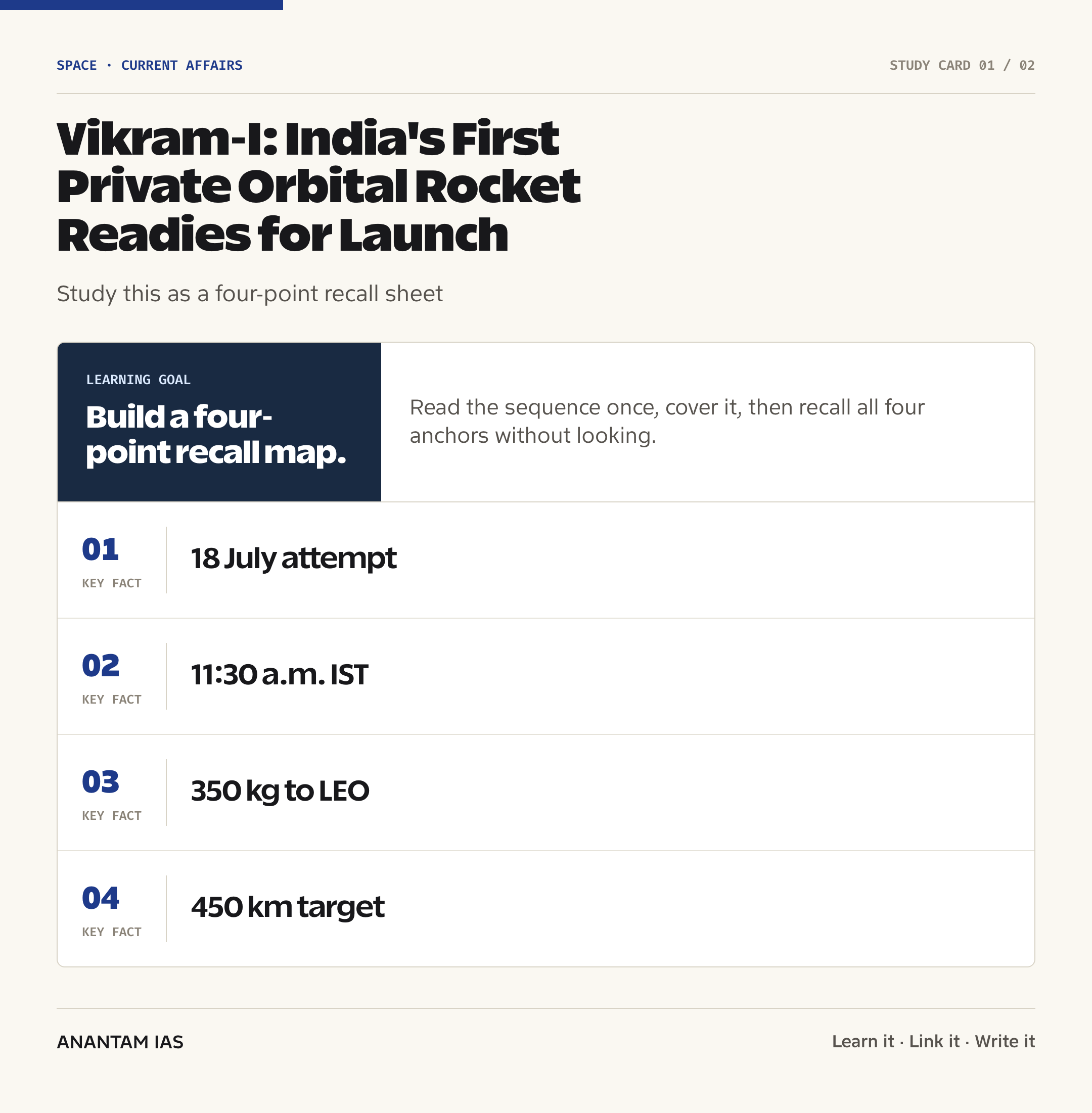
Skyroot Aerospace is scheduled to attempt the maiden flight of Vikram-I at 11:30 a.m. IST on 18 July 2026 from the Satish Dhawan Space Centre, Sriharikota. The Indian Express reported the company-announced plan on 17 July. At the time of this note, the mission is an upcoming test flight, not a completed launch.
Named Mission Aagaman, the flight would be India’s first attempt to place payloads in orbit using a launch vehicle developed entirely by a private Indian company. Skyroot describes the maiden mission as a developmental flight meant to generate data for improving the rocket and building a reliable launch cadence.
- The planned liftoff is at 11:30 a.m. IST on 18 July from Sriharikota
- Mission Aagaman is the maiden orbital test of the indigenously developed Vikram-I
- The flight targets an orbit of about 450 km at a 60-degree inclination
- Technology payloads include missions associated with Grahaa Space, Cosmoserve, DCubed and Skyroot’s own SCOPE
- Skyroot said the required airspace and maritime notices had been issued for the launch window
The development matters in the context of:
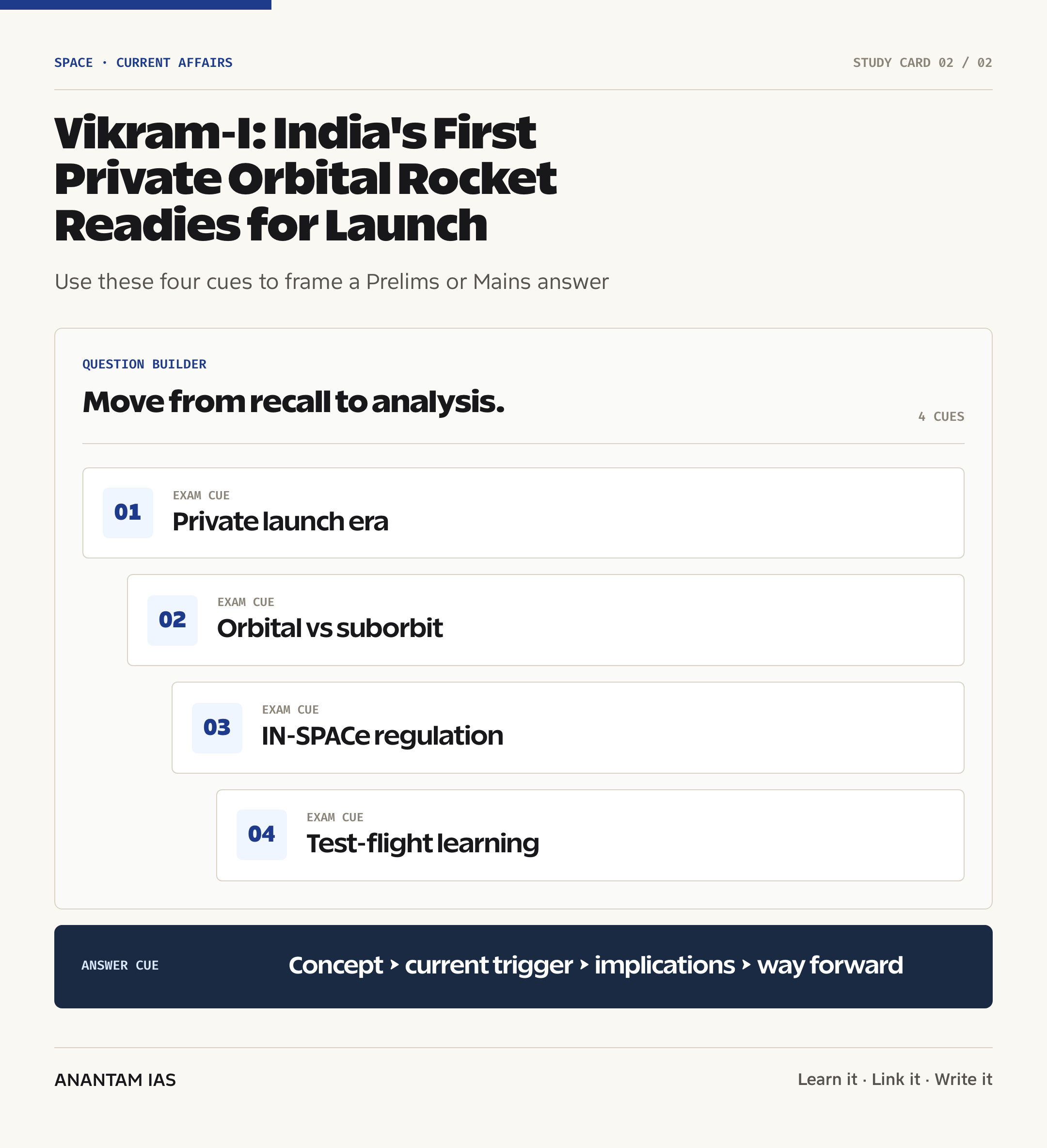
- The launch tests whether India’s post-2020 reforms can move private firms from suborbital demonstration to an independent orbital launch service
- A credible small-launch service could give Indian satellite builders more control over launch schedule, orbit and mission design
- Because this is a developmental flight, public evaluation should cover flight data, safety oversight and corrective learning
UPSC Relevance
Prelims Relevance
- Vikram-I: privately developed, orbital-class small-satellite launch vehicle built by Skyroot Aerospace
- Mission Aagaman: name of Vikram-I’s planned maiden orbital test flight
- Low Earth Orbit (LEO): generally the region up to about 2,000 km above Earth
- Sun-synchronous orbit (SSO): a near-polar orbit that crosses a location at roughly the same local solar time
- Orbital versus suborbital flight: an orbital vehicle must acquire enough horizontal velocity to keep falling around Earth
- Satish Dhawan Space Centre: India’s principal spaceport at Sriharikota, Andhra Pradesh
- IN-SPACe: autonomous, single-window nodal agency under the Department of Space for private space activity
- Indian Space Policy 2023: framework that allocates roles among ISRO, IN-SPACe, NSIL and non-government entities
- Vikram-S: Skyroot’s suborbital demonstration vehicle launched in November 2022 under Mission Prarambh
Mains Relevance
GS Paper 3
- Indigenisation of launch-vehicle technology and the emergence of a private Indian space industry
- Commercial potential and technical limits of dedicated small-satellite launch services
- Innovation policy, public research infrastructure and the scaling of deep-tech startups
GS Paper 2
- Regulatory design under the Indian Space Policy 2023 and the authorisation role of IN-SPACe
- Balancing commercial participation with public safety, security and international responsibility
Essay
- Public institutions as platforms for private innovation
- Why technological self-reliance needs both experimentation and accountability
Background and Context
Mission Aagaman and the planned flight
The first Vikram-I mission is a developmental test whose stated purpose is to learn in flight.
- Skyroot has scheduled the attempt for 18 July at 11:30 a.m. IST from the Satish Dhawan Space Centre; weather, range safety or technical conditions can still affect a launch window
- The Indian Express reported that the mission will target a roughly 450 km orbit with an inclination of 60 degrees
- The payload set includes technology demonstrations linked to Grahaa Space, space-debris company Cosmoserve, space-component maker DCubed and Skyroot’s SCOPE satellite
- Its exam-relevant purpose is validating launch-vehicle systems and payload deployment
- Skyroot has called it the rocket’s first real flight-environment test; telemetry will be used to understand stage performance, guidance, separation and orbital injection
- A launch attempt becomes an orbital success only when the vehicle completes the required sequence and deploys its payloads into the planned orbit; a liftoff alone doesn’t establish orbital capability
What Vikram-I is designed to do
Vikram-I targets the growing market for small satellites that need dedicated or rideshare access to orbit.
- Skyroot lists a payload capacity of up to 350 kg to Low Earth Orbit and up to 260 kg to Sun-synchronous orbit
- Low Earth Orbit supports earth observation, communications, scientific experiments and technology demonstrations because it offers lower latency and lower launch energy than high orbits
- Sun-synchronous orbit is useful for earth observation because repeated passes occur under similar sunlight conditions, making images easier to compare over time
- A dedicated launch gives one customer greater control over timing and destination; a rideshare launch spreads cost across several payloads but offers less mission flexibility
- Skyroot advertises custom orbital deployment, a useful feature for small-satellite operators that would otherwise wait for spare capacity on a larger rocket
- The vehicle is named for Vikram Sarabhai, whose institution-building shaped India’s civilian space programme
Launcher architecture and tested systems
The vehicle combines composite structures, solid propulsion and a liquid upper-stage engine.
- Skyroot describes Vikram-I as an all-carbon-composite launch vehicle with solid-fuel booster stages and a 3D-printed liquid engine
- ISRO recorded the first static firing of the Kalam-1200 first-stage motor at Sriharikota on 8 August 2025
- The ISRO test record describes Kalam-1200 as an 11 m-long, 1.7 m-diameter monolithic composite motor containing about 30 tonnes of propellant
- A static test fires a stage while it remains fixed to a test stand, allowing engineers to measure thrust, pressure, vibration and structural behaviour before flight
- ISRO also supported a 2023 test of the Raman-II liquid engine, intended for Vikram-I’s fourth stage and manufactured using additive techniques
- Flight must prove integrated performance across propulsion, guidance, separation and payload release
From Vikram-S to an orbital vehicle
Skyroot’s 2022 suborbital flight was a useful precursor, but orbital flight is a much harder engineering threshold.
- Under Mission Prarambh, Skyroot launched Vikram-S from Sriharikota on 18 November 2022
- The ISRO mission record says Vikram-S reached about 89.5 km in 155 seconds and carried three payloads
- Vikram-S followed a suborbital trajectory: it entered space but didn’t gain the sustained horizontal velocity needed to remain around Earth
- Vikram-I must accelerate, navigate and stage accurately enough to achieve orbital velocity and inject payloads at the intended altitude and inclination
- The change from a short demonstration to an orbital mission adds demanding requirements in propulsion duration, guidance precision, thermal loads, separation events and range safety
- Mission Aagaman should be assessed as the next step in an engineering sequence, not as a routine repetition of Mission Prarambh
India's private-space governance architecture
Private launch is enabled by a public framework that separates research, regulation and commercial functions.
- The 2020 space-sector reforms opened end-to-end space activity to non-government entities, including the building of satellites and launch vehicles
- The Indian Space Policy 2023 seeks a stable framework and wider private participation across the space-economy value chain
- IN-SPACe promotes, enables, authorises and supervises private space activity and mediates access to facilities controlled by the Department of Space and ISRO
- ISRO retains its central role in advanced research, technology development, national missions and the provision of technical facilities and expertise
- NewSpace India Limited (NSIL) is the Department of Space public-sector enterprise focused on commercialising mature space capabilities and undertaking demand-driven missions
- Skyroot remains responsible for its own vehicle and mission execution; using public test infrastructure doesn’t turn Vikram-I into an ISRO rocket
Why the small-launch segment matters
Smaller satellites have created demand for launches that are frequent, responsive and tailored to specific orbits.
- Miniaturised electronics let small satellites perform earth observation, Internet-of-Things connectivity, scientific research and in-orbit demonstrations at lower spacecraft cost
- Large rockets offer low unit cost on rideshare missions, but a small payload may have to accept the primary customer’s schedule and destination orbit
- A dedicated small launcher can reduce waiting time and deliver a payload closer to its required altitude, inclination and local crossing time
- Commercial viability still depends on launch cadence, meaning how often a provider can safely and reliably fly, not only on a successful first launch
- An Indian launcher can connect domestic upstream manufacturing with downstream space services
- Vikram-I will coexist with other routes, including SSLV technology, larger ISRO vehicles and global rideshare providers; these options serve different payload and schedule needs
Strategic and economic significance
A domestic private launcher matters because launch access is both a commercial service and strategic infrastructure.
- Successful orbital capability would widen India’s pool of organisations able to design and operate launch vehicles, reducing concentration in one public provider
- A private firm can test new production methods, supply arrangements and customer models while ISRO focuses more resources on frontier research and national missions
- Domestic launch services can help retain spending by Indian satellite startups and attract foreign small-satellite customers, supporting high-skill manufacturing and exports
- The programme deepens experience in composites, propulsion, avionics and systems engineering
- The recent CE20 flight-acceptance test shows the wider principle: repeatable launch capability depends on component qualification, test discipline and supply-chain quality
- Strategic value doesn’t remove commercial discipline; customers will still compare price, reliability, insurance, schedule certainty and orbital accuracy
How to judge a maiden orbital test
A first flight should be evaluated through evidence rather than a binary headline.
- Range safety comes first: the vehicle must remain within its approved corridor, and termination systems must protect people and property if it deviates
- Stage performance is judged through burn duration, thrust, attitude control and clean separation under real aerodynamic and vibration loads
- Orbital insertion requires the correct combination of altitude, velocity and inclination; merely crossing the conventional edge of space is insufficient
- Payload deployment tests whether satellites separate safely and begin operations without collision or damage
- Telemetry completeness can make even a partial flight useful by locating the cause of an anomaly and guiding a verified redesign
- Long-term credibility will come from transparent learning, corrective action and repeated safe flights, not from calling one launch a complete commercial ecosystem
Way Forward
Learn from flight data
- Publish a clear post-flight account of mission objectives, achieved milestones and anomalies without overstating a partial result
- Convert telemetry into stage-by-stage corrective action and independently verify critical redesigns before the next attempt
Build reliable launch cadence
- Standardise production and qualification so successive rockets have consistent materials, propulsion and avionics performance
- Develop supplier redundancy and quality-control systems for space-grade components that can support repeated missions
Strengthen public oversight
- Give IN-SPACe adequate technical capacity for timely authorisation, safety review and post-flight oversight as launch activity grows
- Clarify insurance, liability, debris mitigation and accident-investigation expectations so innovation operates inside predictable rules
Create a sustainable market
- Use transparent procurement and competitive missions to give capable Indian launch firms early demand without insulating them from performance standards
- Coordinate spectrum, tracking and space-situational-awareness services so more launches don’t create avoidable orbital risk
Conclusion
Vikram-I’s planned flight is important because it tests a new institutional claim: an Indian private company can progress from a suborbital demonstrator to an orbital launch system while public institutions provide regulation, facilities and technical support. The result must be described precisely after the flight, since a launch attempt, a partial test and successful orbital deployment are different outcomes.
For UPSC answers, connect Mission Aagaman to three layers: indigenous technology, Indian Space Policy 2023 and the economics of small-satellite launch services. A balanced evaluation should pair opportunity in jobs, exports and strategic capacity with the need for safety, reliability, liability rules and responsible use of orbit.
UPSC Practice Questions
Prelims MCQ 1
With reference to Skyroot Aerospace’s launch vehicles, consider the following statements:
- Vikram-S completed a suborbital demonstration flight in 2022.
- Vikram-I is designed to place small satellites in orbit.
- IN-SPACe manufactures the propulsion stages used by Vikram-I.
How many of the above statements are correct?
(a) Only one (b) Only two (c) All three (d) None
Answer: (b) Only two
Explanation:
Statements 1 and 2 are correct. Vikram-S made a suborbital flight under Mission Prarambh, while Vikram-I is an orbital-class small-satellite launcher. Statement 3 is wrong: IN-SPACe authorises and enables private space activity; Skyroot develops the vehicle.
Prelims MCQ 2
Which one of the following best distinguishes an orbital flight from a suborbital flight?
(a) An orbital flight must carry a human crew (b) An orbital flight gains enough horizontal velocity to keep falling around Earth (c) A suborbital flight cannot cross the conventional boundary of space (d) A suborbital flight must use only solid propellant
Answer: (b) An orbital flight gains enough horizontal velocity to keep falling around Earth
Explanation:
Reaching a high altitude doesn’t by itself create an orbit. A vehicle must acquire sufficient horizontal velocity so that its continuing fall follows Earth’s curvature. Suborbital vehicles can cross the boundary of space and may use different propulsion types.
UPSC Mains Questions
- Mission Aagaman is a test not only of a private rocket but also of India’s post-2020 space-sector reforms. Examine how Vikram-I could strengthen indigenous capacity, and identify the regulatory and commercial conditions needed for a reliable private launch industry. (250 words)
- Distinguish between suborbital and orbital launch capability. Using Vikram-S and Vikram-I as examples, discuss why propulsion integration, guidance, range safety and launch cadence are critical to commercial small-satellite services. (150 words)
Sources: Indian Express, citing Skyroot Aerospace and ISRO.
Frequently Asked Questions
What is Vikram-I?
Vikram-I is an orbital-class small-satellite launch vehicle developed by Hyderabad-based Skyroot Aerospace. The company lists capacity of up to 350 kg to Low Earth Orbit and up to 260 kg to Sun-synchronous orbit. It uses carbon-composite structures, solid propulsion stages and a liquid upper-stage engine.
When is Mission Aagaman scheduled?
Skyroot scheduled the maiden Vikram-I attempt for 11:30 a.m. IST on 18 July 2026 from the Satish Dhawan Space Centre at Sriharikota. The timing was still prospective when this note was prepared on 17 July, so the mission shouldn’t be described as completed before a verified post-flight result.
Why is the launch historically important?
If the mission reaches its planned orbit, it would be the first orbital launch by a privately developed Indian rocket. Vikram-S flew in 2022, but that was a suborbital demonstration.
What is the difference from Vikram-S?
Vikram-S was a suborbital technology demonstrator that reached about 89.5 km during Mission Prarambh in November 2022. Vikram-I is a multi-stage orbital vehicle designed to accelerate payloads to sustained orbital velocity and deploy them at a specified altitude and inclination.
What role does IN-SPACe play?
IN-SPACe is the autonomous single-window nodal agency under the Department of Space that promotes, enables, authorises and supervises private space activity. It also facilitates access to government space infrastructure. It doesn’t manufacture Vikram-I; Skyroot owns the vehicle’s development and mission execution.
What counts as success on a test flight?
The full objective is safe flight, correct stage and fairing separation, accurate orbital insertion and successful payload deployment. A partial flight can still produce valuable telemetry, but it should be reported as partial. Commercial credibility requires corrective learning followed by repeated, safe and reliable missions.
Tell Google you want more of this.
Add Anantam IAS as a preferred sourceOne tap, and this site shows up more often in your own Top Stories, AI Overviews and AI Mode. Remove it any time.