
Why in News?
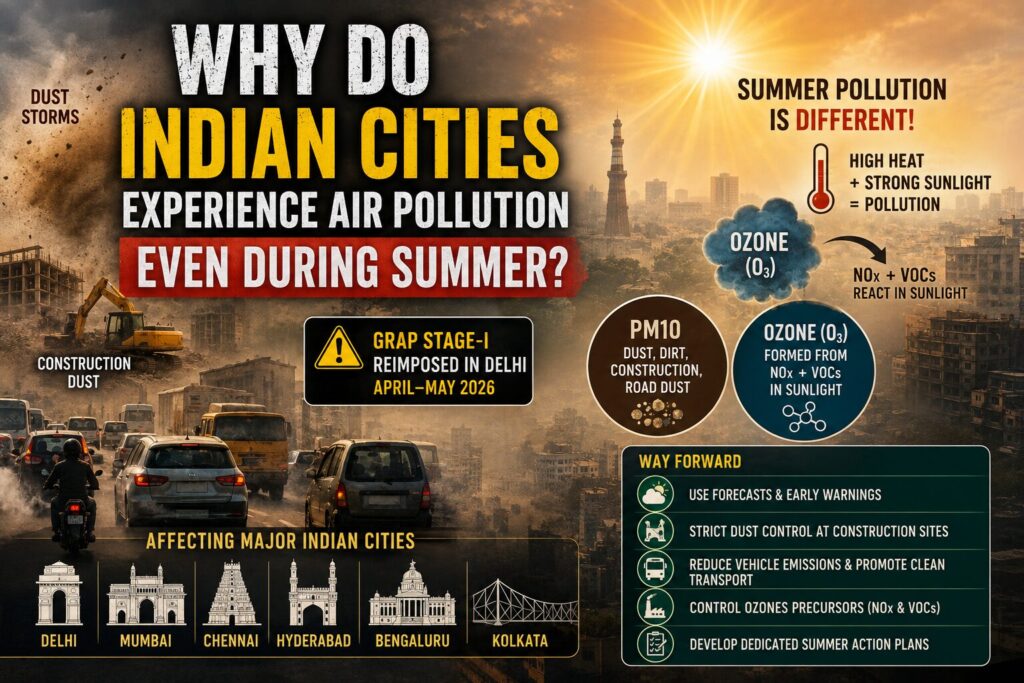
Despite the onset of summer conditions that usually help disperse pollutants, several Indian cities, including Delhi, Mumbai, Chennai, Hyderabad, Bengaluru, and Kolkata, witnessed significant air pollution episodes during April–May 2026. The Commission for Air Quality Management (CAQM) had to reimpose Stage-I restrictions under the Graded Response Action Plan (GRAP) in Delhi due to rising particulate matter and ozone levels.
UPSC Relevance
Prelims:
Air pollutants, PM2.5, PM10, ozone, dust storms, AQI, GRAP, AQEWS.
Mains:
GS III: Environmental Pollution and Degradation, Urban Environmental Challenges, Climate and Air Quality Management, Public Health.
Background
Air pollution in India is often associated with winter smog, particularly in the Indo-Gangetic Plain. During winter, low temperatures, weak winds, and temperature inversions trap pollutants close to the ground, leading to severe air quality deterioration.
However, recent pollution episodes demonstrate that summer is not necessarily a clean-air season. Although stronger winds, higher temperatures, and occasional thunderstorms improve atmospheric mixing, other factors such as dust storms, construction activity, vehicular emissions, and ozone formation continue to degrade air quality.
This highlights the need for year-round air pollution management rather than a seasonal focus limited to winter.
Understanding Summer Air Pollution
How is Summer Pollution Different from Winter Pollution?
The dominant pollutants vary across seasons.
Winter pollution is primarily driven by PM2.5, which consists of fine particulate matter capable of penetrating deep into the lungs and bloodstream. Crop residue burning, biomass burning for heating, vehicular emissions, and industrial pollution contribute significantly to winter smog.
Summer pollution, in contrast, is largely dominated by PM10 and ground-level ozone. Dust storms, road dust, construction activities, and atmospheric chemistry associated with high temperatures become more influential during this period.
Major Pollutants During Summer
PM10 (Coarse Particulate Matter)
PM10 consists of larger airborne particles with diameters less than 10 micrometres. These particles mainly originate from dust storms, construction sites, road dust, mining activities, and industrial operations.
While larger than PM2.5, they can still cause respiratory illnesses, irritation of airways, and aggravate asthma and other lung diseases.
Ground-Level Ozone
Ground-level ozone differs from the protective ozone layer found in the stratosphere.
It is a secondary pollutant formed when nitrogen oxides (NOx) and volatile organic compounds (VOCs) react in the presence of strong sunlight. High ozone levels can reduce lung function, worsen respiratory diseases, and damage vegetation.
Why Does Ozone Increase During Summer?
Role of Sunlight and Heat
Unlike particulate matter, ozone is not emitted directly from any source.
It forms through photochemical reactions involving:
- Nitrogen oxides (NOx) emitted primarily from vehicles and industries.
- Volatile Organic Compounds (VOCs) emitted from fuel combustion, industrial activities, paints, solvents, and petrochemical processes.
Strong sunlight and high temperatures accelerate these reactions, making summer conditions ideal for ozone formation.
Urban Heat and Traffic
Cities with dense traffic and industrial activity often experience elevated ozone concentrations during hot summer afternoons. Even when particulate matter levels decline, ozone pollution can remain severe and pose significant public health risks.
Why Does PM10 Rise During Summer?
Dust Storms and Regional Winds
During summer, intense heating of the Indian subcontinent creates low-pressure conditions over northern India.
The interaction between these low-pressure systems and surrounding high-pressure zones generates strong winds capable of transporting dust over long distances. Dust from:
- The Thar Desert,
- Arid regions of western India,
- West Asian deserts,
can travel across northern and central India, significantly increasing PM10 levels.
Loo and Andhi Events
The hot, dry winds known as loo frequently affect North India during summer. These winds often carry large quantities of dust, causing sustained deterioration in air quality.
Short-duration local dust storms known as andhi also occur, especially before thunderstorms. These storms rapidly lift dust from dry surfaces and can temporarily raise particulate concentrations to hazardous levels.
Human Contributions
Natural dust events are often intensified by human activities.
Construction and demolition work typically increase after winter restrictions are relaxed. Poor dust management at construction sites allows large quantities of particulate matter to enter the atmosphere.
Similarly, traffic moving over damaged or dusty roads continuously resuspends loose dust, contributing to elevated PM10 concentrations.
Air Pollution Across Indian Cities
Delhi and the Indo-Gangetic Plain
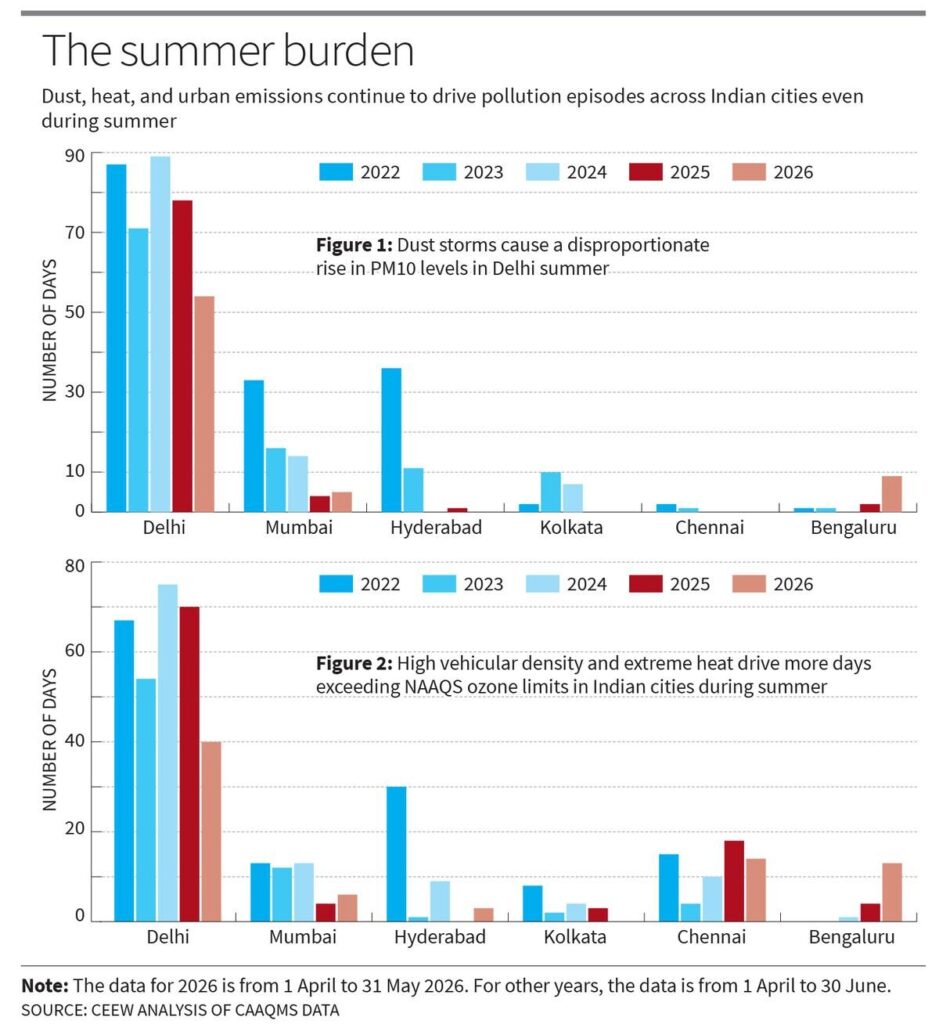
Delhi recorded multiple PM10 exceedances during April and May 2026. Ozone concentrations also crossed prescribed national standards at several monitoring stations.
Although winter smog remains a major concern, summer pollution episodes have become increasingly frequent.
Mumbai
Mumbai has witnessed recurring PM10 and ozone spikes over recent years. Rapid construction activity, vehicular congestion, and urban dust have emerged as major contributors.
Chennai
While PM10 exceedances are relatively less frequent, Chennai’s combination of high temperatures and dense traffic makes it particularly vulnerable to ozone pollution.
Hyderabad, Bengaluru, and Kolkata
These cities also experience periodic pollution spikes linked to local emission sources, construction activities, traffic density, and meteorological conditions.
Institutional Mechanisms for Air Quality Management
Graded Response Action Plan (GRAP)
GRAP is a framework for implementing emergency pollution-control measures in the National Capital Region based on air quality levels.
It prescribes escalating restrictions on activities such as construction, industrial operations, and vehicular movement depending on pollution severity.
Air Quality Early Warning System (AQEWS)
The AQEWS was developed following major dust storms and severe pollution episodes in North India.
It provides:
- Air quality forecasts,
- Dust storm warnings,
- Meteorological information,
- Multi-day AQI predictions.
The system has gradually expanded beyond Delhi to cities such as Jaipur and Mumbai.
Role of the IMD
The India Meteorological Department regularly issues weather forecasts and can support local authorities in issuing timely alerts regarding dust storms, heatwaves, and pollution episodes.
Challenges in Tackling Summer Pollution
Difficulty in Controlling Natural Dust
Large-scale dust transport from deserts and arid regions cannot be prevented. Authorities can only forecast and prepare for such events.
Weak Enforcement of Dust Control Measures
Construction activities often continue without adequate dust suppression mechanisms such as water spraying, enclosure systems, and debris management.
Rising Vehicular Emissions
Rapid urbanisation and increasing vehicle ownership continue to contribute significantly to NOx and VOC emissions that drive ozone formation.
Limited Focus on Ozone
Air quality management in India has traditionally concentrated on particulate matter. Ozone monitoring, forecasting, and mitigation strategies remain relatively underdeveloped.
Way Forward
Strengthen Forecast-Based Action
Authorities should fully utilise AQEWS and IMD forecasts to issue advance warnings regarding dust storms, ozone spikes, and deteriorating air quality.
Improve Construction Dust Management
Strict enforcement of dust-control measures at construction and demolition sites should continue throughout the year rather than only during winter.
Reduce Vehicular Emissions
Promotion of public transport, electric mobility, cleaner fuels, and anti-idling campaigns can significantly reduce NOx emissions.
Address Ozone Precursors
Targeted policies should focus on reducing VOC emissions from industries, fuel combustion, paints, solvents, and petrochemical activities.
Develop Summer Action Plans
Major Indian cities should formulate dedicated summer air quality action plans that address dust management, ozone control, public advisories, and emergency responses.
Conclusion
The perception that air pollution is primarily a winter phenomenon is increasingly outdated. While meteorological conditions during summer may help disperse some pollutants, high temperatures, intense sunlight, dust storms, and continued human emissions create a different but equally important pollution challenge. Effective air quality management in India requires a year-round approach that addresses both winter smog and summer pollution with equal urgency.
Practice Questions
Prelims Question 1 (Inference-Based)
Consider the following statements:
- Improvements in atmospheric mixing during summer automatically ensure good air quality in Indian cities.
- Different meteorological conditions can alter the dominant type of air pollutant in a season.
- Effective air pollution management requires interventions throughout the year.
Which of the above statements can be inferred from the passage?
(a) 2 and 3 only
(b) 1 and 2 only
(c) 1 and 3 only
(d) 1, 2 and 3
Answer: (a)
Explanation:
Statement 1 is incorrect. Despite better atmospheric mixing, many cities still experienced pollution episodes due to dust storms, ozone formation, and anthropogenic emissions.
Statement 2 is correct. Winter is dominated by PM2.5 pollution, whereas summer sees higher contributions from PM10 and ozone.
Statement 3 is correct. The article emphasises the need for year-round air quality management instead of focusing solely on winter pollution.
Prelims Question 2
Consider the following regarding ground-level ozone:
- It is a secondary pollutant.
- It is formed through reactions involving nitrogen oxides and volatile organic compounds.
- Its formation is enhanced by strong sunlight and high temperatures.
Which of the statements given above are correct?
(a) 1 and 2 only
(b) 2 and 3 only
(c) 1 and 3 only
(d) 1, 2 and 3
Answer: (d)
Explanation:
Statement 1 is correct. Ground-level ozone is not emitted directly and is therefore a secondary pollutant.
Statement 2 is correct. Ozone forms through photochemical reactions involving NOx and VOCs.
Statement 3 is correct. High temperatures and strong sunlight accelerate these reactions, making ozone pollution particularly severe during summer.
Mains Questions
- Why has summer air pollution emerged as a major environmental challenge in Indian cities? Examine the role of PM10 and ozone in shaping urban air quality.
- Discuss the meteorological and anthropogenic factors responsible for seasonal variations in air pollution in India. Suggest measures for year-round air quality management.
Tell Google you want more of this.
Add Anantam IAS as a preferred sourceOne tap, and this site shows up more often in your own Top Stories, AI Overviews and AI Mode. Remove it any time.