Why in News?
Ukraine has carried out another attack on the Kerch Bridge (also known as the Crimean Bridge), damaging a key road span and the parallel railway bridge. The attack highlights the bridge’s strategic importance to Russia’s military logistics, territorial control and presence in Crimea.
| UPSC Relevance: GS-2 International Relations: Locations in News Prelims: Location of Kerch Bridge |
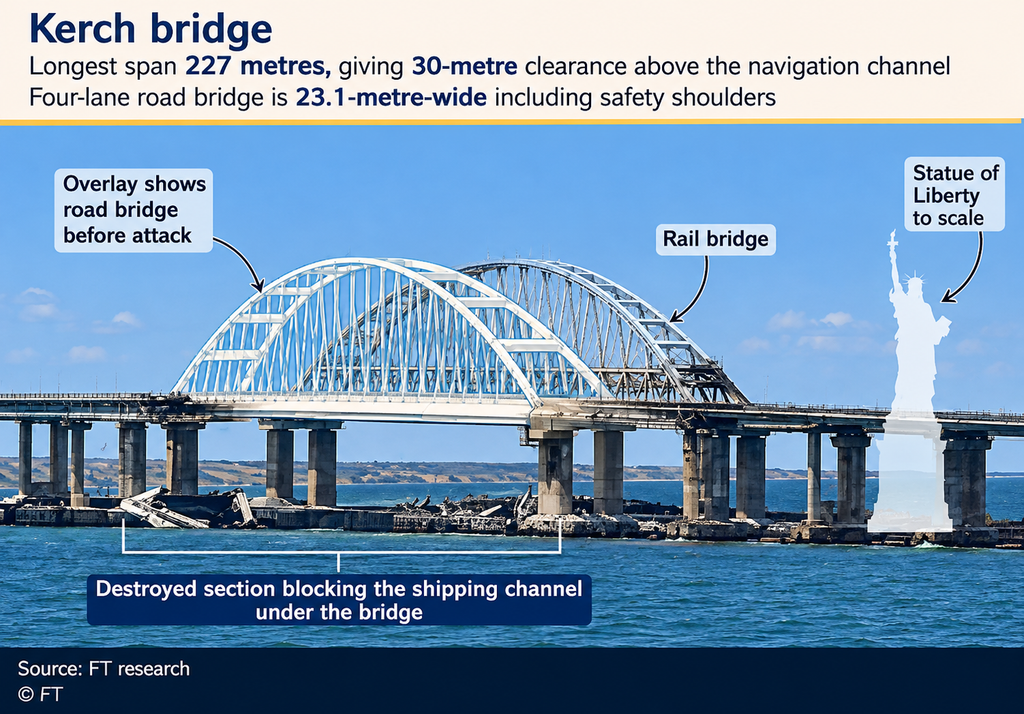
About the Kerch Bridge:
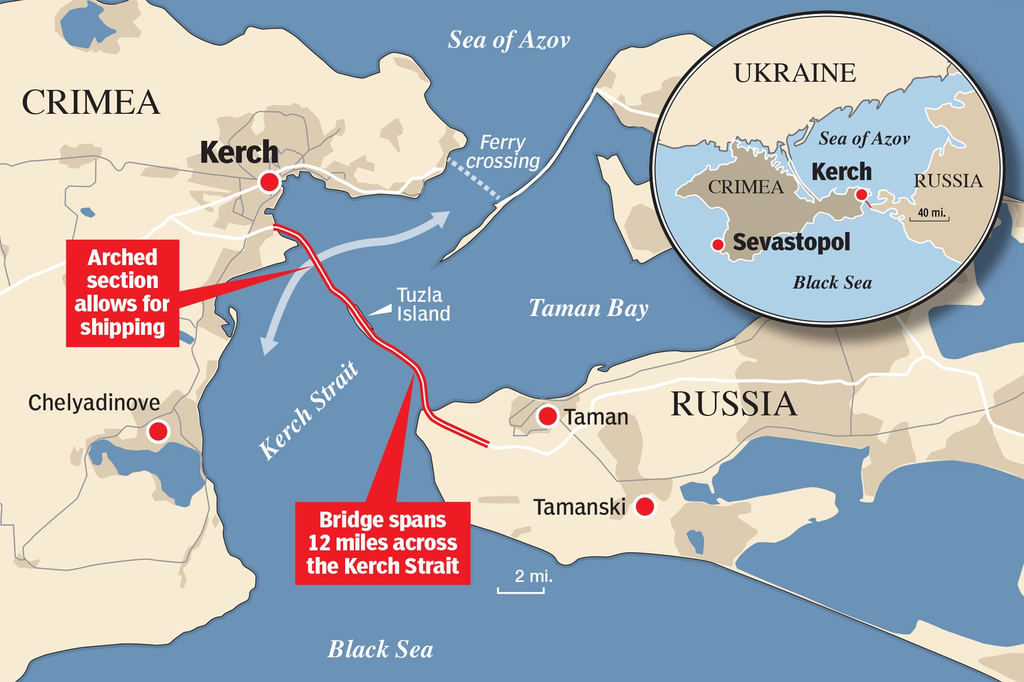
- Location: Spans the Kerch Strait, connecting Russia’s mainland with the Crimean Peninsula.
- Length: Approximately 19 km, making it the longest bridge in Europe.
- Connectivity: Comprises parallel road and railway bridges.
- Strategic location: The Kerch Strait connects the Black Sea with the Sea of Azov.
- Construction: Opened in 2018, following Russia’s annexation of Crimea in 2014.
Why does Ukraine keep targeting the Kerch Bridge?
The bridge has military, economic, logistical and symbolic significance for Russia.
- Disrupting military logistics: It serves as an important supply route for Russian forces operating in southern Ukraine and Crimea, facilitating the movement of military equipment, personnel and supplies.
- Weakening Russia’s control over Crimea: The bridge provides direct connectivity between mainland Russia and Crimea, strengthening Moscow’s administrative and military control over the peninsula.
- Economic disruption: Crimea depends significantly on mainland Russia for food, fuel and other essential supplies. Attacks can disrupt civilian movement and commercial transportation.
- Symbolic significance: The bridge represents Russia’s claim over Crimea and its integration with mainland Russia. Ukraine views it as a symbol of occupation.
- Demonstrating military capabilities: Repeated attacks demonstrate Ukraine’s ability to strike heavily protected Russian infrastructure using drones, naval drones and missiles.
Why is the impact of recent attacks relatively limited?
Unlike in 2022, Russia is no longer almost entirely dependent on the Kerch Bridge for connectivity with Crimea.
- Land corridor: Russia has established an alternative land route through occupied territories in southern Ukraine, connecting mainland Russia with Crimea.
- Alternative transportation: Ferry services across the Kerch Strait provide additional connectivity.
- Logistical redundancy: Multiple supply routes reduce the strategic impact of disruptions to the bridge.
Nevertheless, repeated attacks increase security costs, disrupt transportation and expose vulnerabilities in Russia’s critical infrastructure.
Wider Geopolitical and Strategic Implications:
- Infrastructure as a military target: The conflict demonstrates how bridges, ports, energy networks and transport corridors can become strategically significant in modern warfare.
- Changing nature of warfare: Long-range drones, precision missiles, electronic warfare and intelligence capabilities are increasingly shaping battlefield operations.
- Black Sea security: Disruptions around the Kerch Strait have implications for maritime movement and regional security.
- Escalation risks: Attacks on critical infrastructure can trigger retaliation and increase the intensity of the conflict.
The repeated targeting of the Kerch Bridge reflects its importance beyond physical connectivity. Although alternative land and maritime routes have reduced Russia’s dependence on the bridge, its vulnerability continues to have significant military and political implications.
Prelims Practice MCQ:
Q1. With reference to the Kerch Bridge, consider the following statements:
1. It connects the Crimean Peninsula with the Taman Peninsula in Russia.
2. It spans the Kerch Strait, bridging the gap between the Black Sea and the Sea of Azov.
3. It is exclusively a single-track railway bridge built solely for military logistics.
Which of the statements given above are correct?
(a) 1 and 2 only
(b) 2 and 3 only
(c) 1 and 3 only
(d) 1, 2 and 3
Answer: (a) The bridge features both a multi-lane highway and a double-track railway line for civilian and dual-use transport.
Q2. Which of the following countries share a coastline with the Black Sea?
1. Moldova
2. Georgia
3. Bulgaria
4. Armenia
5. Turkey
Select the correct answer using the code given below:
(a) 1, 2 and 3 only
(b) 2, 3 and 5 only
(c) 1, 4 and 5 only
(d) 2, 3, 4 and 5
Answer: (b) Georgia (east), Bulgaria (west/southwest), and Turkey (south) are all Black Sea littoral states. Moldova and Armenia are both landlocked nations in the region.
Tell Google you want more of this.
Add Anantam IAS as a preferred sourceOne tap, and this site shows up more often in your own Top Stories, AI Overviews and AI Mode. Remove it any time.