Why in News?
The Indian Prime Minister attended the Quad Leaders’ Summit, ASEAN-India Summit and East Asia Summit (EAS) in Manila, Philippines (November 2026).
The Quad leaders issued a joint statement opposing economic and maritime coercion in the Indo-Pacific and reaffirmed their commitment to regional peace, stability and a rules-based order.
| UPSC Relevance: GS-2 International Relations: Regional groupings Prelims: About Quad Mains: Quad: Key Achievements, Significance, Challenges |
What is Quad?
The Quadrilateral Security Dialogue (Quad) is a diplomatic partnership comprising India, Australia, Japan and the United States, committed to a free, open, inclusive, resilient and prosperous Indo-Pacific.
- It is not a military alliance and has no collective-defence clause or mutual defence obligation.
- It follows an issue-based approach to cooperation, focusing on maritime security, economic resilience, critical technologies and regional public goods.
Genesis and Evolution
- 2004 – Tsunami Cooperation: The four countries coordinated humanitarian assistance following the Indian Ocean tsunami, laying the foundation for subsequent cooperation.
- 2007 – Formation: The first Quad consultation was held alongside the ASEAN Regional Forum in Manila. Differences in strategic priorities subsequently led to a prolonged hiatus.
- 2017 – Revival: The four countries revived consultations amid growing strategic and maritime concerns in the Indo-Pacific.
- 2019 – Ministerial Level: Quad consultations were elevated to the Foreign Ministers’ level.
- 2021 – Leaders’ Level: The first virtual Quad Leaders’ Summit was held in March, followed by the first in-person summit in Washington in September.
- 2024 – Wilmington Summit: Expanded cooperation in maritime security, health, ports, semiconductors, digital public infrastructure, climate and clean energy, space and STEM education.
Recent Developments: Quad Leaders’ Summit, Manila (2026):
The November 2026 summit reflected the Quad’s growing focus on economic and maritime security.
Key outcomes:
- Free and Open Indo-Pacific: Reaffirmed commitment to a free, open, stable and prosperous Indo-Pacific; opposed unilateral attempts to change the status quo through force or coercion and expressed concern over economic coercion, including arbitrary export restrictions.
- Quad Business Leaders’ Forum: Announced the first Quad Business Forum in Mumbai in 2027 to strengthen business-to-business cooperation and investment among the four countries.
- Super Intelligence (SI) Accelerator: Reaffirmed the Super Intelligence Accelerator, announced earlier by Quad Foreign Ministers in Atlanta, to coordinate and fund trusted AI access, deployment and technical assistance across the Indo-Pacific.
- Indo-Pacific Maritime Surveillance Collaboration (IPMSC): Announced enhanced information-sharing and maritime domain awareness to improve maritime security.
- Joint Maritime Exercise (2027): P-8 and P-3C maritime patrol aircraft of the four countries are scheduled to participate in a maritime exercise for the first time in a Quad context.
- Cable Connectivity and Resilience: Expanded Australia’s contribution to the Quad Partnership for Cable Connectivity and Resilience, with a focus on electricity cables. Also welcomed upcoming undersea cable projects in the Indian Ocean.
- Cybersecurity Cooperation: Announced enhanced Quad Cybersecurity Cooperation to address increasing cyber incidents and promote an open and secure cyberspace.
- Counterterrorism Cooperation: Condemned terrorism and violent extremism in all forms, including cross-border terrorism, and committed to strengthening cooperation against these threats.
- ASEAN Centrality: Reaffirmed support for ASEAN centrality and unity in maintaining an inclusive and stable Indo-Pacific regional architecture.
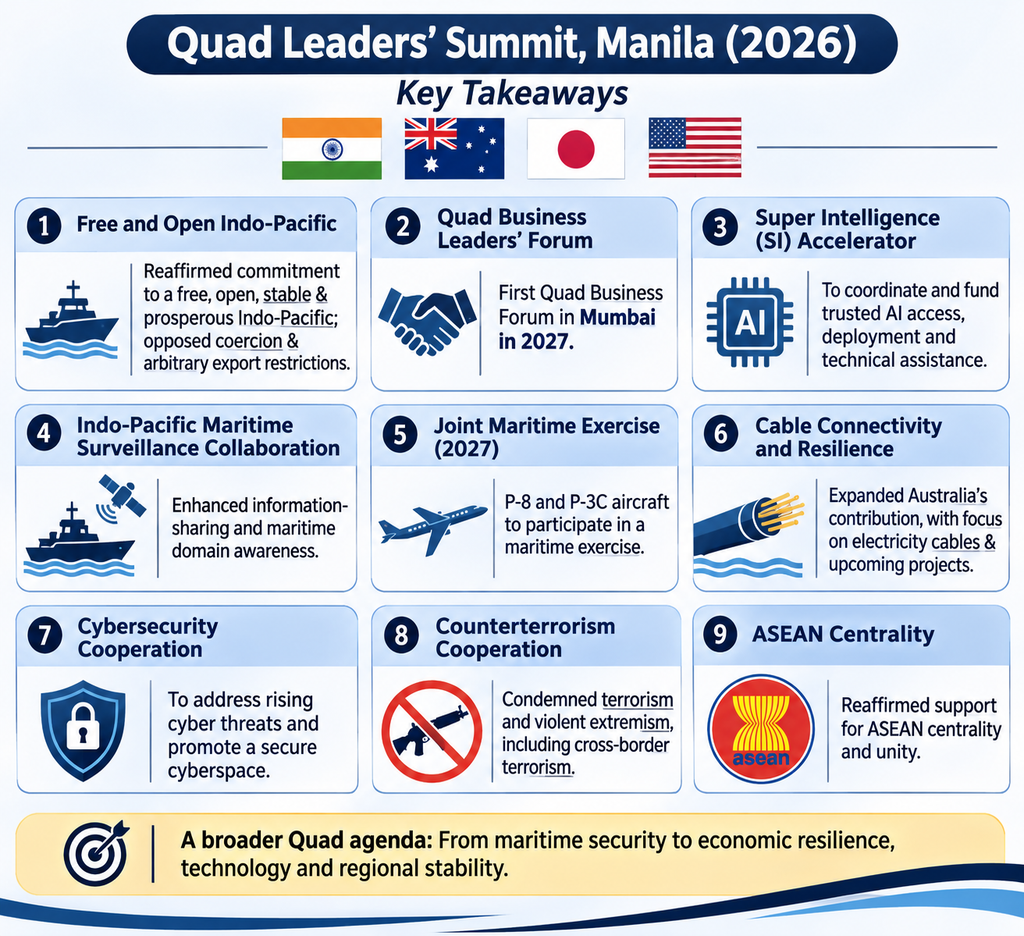
The summit indicates that the Quad’s agenda is expanding beyond traditional maritime security to encompass economic security, strategic supply chains and commercial cooperation.
Key Areas of Quad Cooperation
| Pillar | Major initiatives |
| Maritime security | Indo-Pacific Partnership for Maritime Domain Awareness (IPMDA), MAITRI, Quad-at-Sea Ship Observer Mission and Indo-Pacific Maritime Surveillance Collaboration |
| Economic security | Quad Critical Minerals Framework, energy security cooperation, Ports of the Future Partnership and semiconductor supply-chain resilience |
| Technology | Quad Investors Network, DPI principles, AI-ENGAGE, BioExplore and Quad STEM Fellowship |
| Health | Quad Cancer Moonshot, focusing on cervical cancer prevention, screening and treatment |
| Climate and disaster resilience | Quad HADR Partnership, Indo-Pacific Logistics Network (IPLN), Q-CHAMP and satellite-data sharing |
Strategic Significance for India:
- Balancing China’s Assertiveness: The Quad provides a platform to coordinate responses to China’s expanding maritime presence and unilateral actions in the South China Sea and wider Indo-Pacific, without formally creating an anti-China military alliance.
- Strategic Autonomy: The Quad enables India to deepen strategic cooperation with the US, Japan and Australia without entering a treaty-based military alliance, preserving its engagement with other platforms such as BRICS and SCO.
- Enhanced Maritime Domain Awareness: Initiatives such as IPMDA and the new Indo-Pacific Maritime Surveillance Collaboration strengthen maritime domain awareness, information-sharing and monitoring of illicit activities.
- Strengthening Indo-Pacific Architecture: Quad complements India’s Act East Policy, SAGAR, Indo-Pacific Oceans Initiative (IPOI) and the more recent MAHASAGAR vision.
- Economic Security: Cooperation in critical minerals, semiconductors, energy and resilient supply chains can reduce India’s dependence on concentrated global sources, particularly China.
- Technology Partnerships: Collaboration in AI, cybersecurity, biotechnology and digital infrastructure can strengthen India’s technological capabilities and innovation ecosystem.
Key Challenges and Constraints:
- Divergent Strategic Priorities: The four countries do not have identical threat perceptions or geographical priorities. India attaches particular importance to the Indian Ocean and continental security, while the US, Japan and Australia have stronger strategic concerns regarding the Western Pacific and East/South China Seas. Differences in members’ approaches towards China, Russia and ongoing conflicts can constrain strategic coordination.
- Implementation Gap: The absence of a permanent secretariat and common budget can make implementation dependent on the national capacities and political priorities of individual members.
- No Collective-Defence Commitment: The Quad cannot automatically provide military assistance in the event of an armed attack against a member or partner.
- Regional Sensitivities: ASEAN and Pacific Island countries generally prefer an inclusive regional architecture and may resist being drawn into great-power rivalry. This makes demand-driven and development-oriented Quad initiatives particularly important.
- Chinese Opposition: China views the Quad with suspicion and considers it an attempt to contain its regional influence, potentially increasing geopolitical tensions.
Way Forward:
- Strengthen Implementation Mechanisms: Use measurable deliverables, implementation dashboards and regular reviews to ensure that summit commitments translate into projects on the ground.
- Deepen Economic Cooperation: Move from broad frameworks towards practical cooperation in critical-mineral processing, recycling, semiconductors, clean energy and pharmaceuticals.
- Enhance Maritime Cooperation: Integrate maritime surveillance, information-sharing and capacity-building initiatives while respecting the sovereignty of regional partners.
- Expand Non-Traditional Security Cooperation: Deepen cooperation in cybersecurity, counterterrorism, HADR, climate resilience and transnational organised crime.
- Promote Regional Inclusivity: Strengthen engagement with ASEAN, IORA and Pacific Island countries and align initiatives with their developmental priorities.
- Maintain Strategic Flexibility: Avoid turning the Quad into a rigid military bloc and preserve its flexible, issue-based character.
The Quad is an important instrument of India’s multi-alignment strategy and its vision of a free, open and inclusive Indo-Pacific. Its effectiveness will depend not merely on strategic signalling but on its ability to deliver tangible regional public goods, strengthen economic resilience and uphold international law.
Mains Practice Question
Q. The Quad is evolving from a strategic consultation mechanism into a broader platform for economic and maritime security cooperation. Examine its significance for India’s Indo-Pacific strategy and the challenges to its effectiveness.
Tell Google you want more of this.
Add Anantam IAS as a preferred sourceOne tap, and this site shows up more often in your own Top Stories, AI Overviews and AI Mode. Remove it any time.