Why in News?
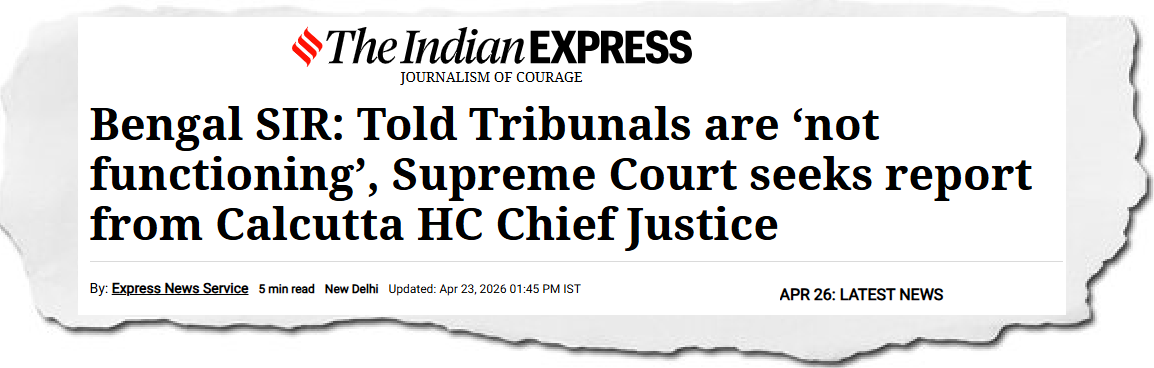
The Supreme Court has sought a report from the Chief Justice of the Calcutta High Court regarding the functioning of Appellate Tribunals handling disputes arising out of the Special Intensive Revision (SIR) of electoral rolls in West Bengal.
UPSC Relevance
GS-II: Elections, Electoral Reforms, Judiciary, Representation of People, Constitutional Principles, SIR
Background: Electoral Roll Revision and SIR
Electoral rolls form the backbone of democratic participation. Periodic revision is undertaken to:
- Include newly eligible voters
- Remove ineligible or duplicate entries
A Special Intensive Revision (SIR) is a more exhaustive exercise, often conducted before major elections, where the entire roll is re-verified.
However, given the scale of such exercises in a country like India, errors of inclusion and exclusion are almost inevitable, which makes grievance redressal mechanisms crucial.
Institutional Mechanism: Role of Appellate Tribunals
To address disputes arising from revision:
- Appellate Tribunals act as quasi-judicial bodies
- They hear appeals of individuals:
- Wrongfully excluded
- Objecting to wrongful inclusion
These bodies are essential because the right to vote, though statutory, is central to democratic participation, and denial without proper hearing undermines electoral legitimacy.
Role of the Supreme Court: Ensuring Electoral Fairness
The Supreme Court stepped in primarily to ensure that the process remains fair, accessible, and constitutionally compliant.
Use of Article 142
The Court invoked Article 142, which allows it to pass orders necessary for “complete justice”.
- It permitted individuals cleared by Tribunals to vote
- Their names could be added through supplementary electoral rolls
This reflects a pragmatic approach—balancing:
- Timely elections
- Inclusion of eligible voters
Clarification on Voting Rights
The Court clearly distinguished between:
- Pending appeals → No automatic right to vote
- Successful appeals → Eligible for inclusion
This ensures that the process is not misused while still protecting genuine voters.
What are the Key Issues and Concerns?
1. Effectiveness of Appellate Tribunals
The credibility of the entire revision process depends on how effectively Tribunals function.
If these bodies are:
- Inaccessible
- Procedurally restrictive
- Unable to dispose of cases in time
then the consequence is not merely administrative inefficiency, but denial of voting rights in a time-bound electoral process.
In elections, delay is not neutral — it effectively becomes disenfranchisement.
2. Scale of Errors: A Structural Concern
The fact that over 34 lakh appeals have been filed is significant.
This indicates:
- The issue is not limited to isolated mistakes
- There may be systemic gaps in enumeration, verification, or data handling
Such large-scale disputes can:
- Overburden adjudicatory mechanisms
- Reduce public confidence in electoral rolls
3. Balancing Inclusion and Electoral Integrity
Electoral systems must strike a delicate balance:
- Over-inclusion risks allowing ineligible voters
- Over-exclusion denies legitimate citizens their rights
Issues like bulk applications (e.g., through Form 6) highlight the challenge of maintaining:
- Accuracy
- Transparency
- Timely verification
4. Administrative Capacity vs Electoral Timelines
Elections operate on strict timelines, whereas:
- Verification processes
- Appeals and hearings
require time and institutional capacity.
When large-scale revisions are conducted close to elections, it creates pressure on institutions, increasing the risk of errors and incomplete adjudication.
Whar are the Broader Constitutional Principles Involved?
This issue goes beyond procedural lapses and touches core democratic values:
- Free and fair elections (basic structure doctrine)
- Rule of law (decisions based on due process)
- Natural justice (right to be heard)
- Judicial review (courts as guardians of fairness)
Way Forward:
Strengthening Tribunal Capacity
Appellate Tribunals must be adequately staffed and accessible, with both physical and digital modes of hearing. Time-bound disposal of cases is essential so that eligible voters are not excluded due to delays.
Improving Electoral Roll Management
Instead of relying heavily on last-minute revisions, there should be continuous updation of electoral rolls using technology, Aadhaar-based verification (with safeguards), and field-level checks. This reduces large-scale disputes during elections.
Ensuring Transparency in Inclusion/Deletion
Clear and publicly accessible procedures for:
- Inclusion (Form 6)
- Deletion
- Objections
will enhance trust and reduce litigation. Transparency is key to electoral legitimacy.
Better Synchronisation with Election Cycle
Major revision exercises like SIR should ideally be conducted well before election schedules, allowing sufficient time for appeals and corrections without affecting electoral timelines.
Role of Judiciary as a Corrective, Not Routine Mechanism
While judicial intervention is essential in exceptional cases, over-reliance on courts indicates administrative weakness. Strengthening institutions at the ground level is the long-term solution.
Conclusion
The episode highlights that accurate electoral rolls and effective grievance redressal are as important as the act of voting itself. In a large and complex democracy like India, ensuring both inclusiveness and integrity of electoral processes requires strong institutions, robust procedures, and timely intervention where necessary. Strengthening these mechanisms is crucial to uphold the constitutional mandate of free and fair elections.
Practice Questions
- Discuss the challenges associated with electoral roll revision in India. How can institutional mechanisms be strengthened to address them?
- Examine the role of quasi-judicial bodies in ensuring fairness in electoral processes.
- “Judicial intervention ensures fairness but cannot substitute administrative efficiency.” Analyse in the context of electoral governance.