Opens in a new tab
Join Anantam IAS Channel on Telegram

Daily Digest · Monday

11 May 2026 Current Affairs for UPSC

7 current affairs published on Monday, 11 May 2026

11 May 2026 Current Affairs for UPSC — every Why-in-News article AnantamIAS published on Monday, 11 May 2026, broken down with Why in News?, the exact GS paper it feeds, sub-topic mapping, MCQ-ready facts and a UPSC-style practice question. 7 articles in total, covering Polity, Economy, Environment, S&T, IR, Geography, History, Society and Internal Security — the same Why-in-News + GS-paper-mapping + practice-question format the Compass uses across every daily digest on the site.

Daily current affairs for UPSC is where new material enters your prep stream. Read this 11 May 2026 digest end-to-end in 25–35 minutes, attempt the practice question at the foot of each article (it's MCQ for some, 10/15-marker for others), then bookmark the entries that fall inside your active revision window. Everything stays cross-linked: tap any subject pill to jump to that subject's hub, or use the table of contents above to skip straight to a specific story.

Use this page three ways. Read sequentially for a one-sitting scan of everything that mattered on 11 May 2026. Download the 11 May 2026 PDF below for offline study or print revision. Or use the May 2026 Current Affairs compilation to see this day in the month's full context. For the previous day's reading, see 10 May 2026 Current Affairs; the next day's is 12 May 2026 Current Affairs.

Why we publish daily current affairs separately from the monthly compilation: daily is learning, monthly is revision. Use the daily page to add fresh material to your notes the day it breaks; come back to the May 2026 compilation 60 days before Prelims when the noise has settled and only the lasting takeaway is worth re-reading.

India & Trinidad Sign 8 MoUs during EAM Jaishankar’s Visit

Open article →Download PDF

Why in News?

India and Trinidad and Tobago signed eight Memoranda of Understanding (MoUs) during the visit of India’s External Affairs Minister to the Caribbean nation in May 2026.  

UPSC Relevance: GS-2 International Relations: Bilateral Relations 

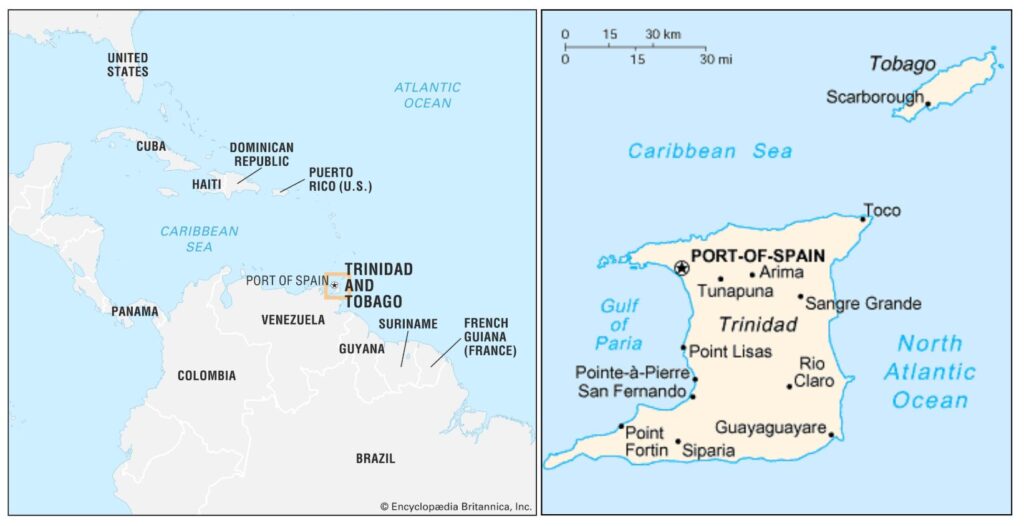
Prelims: Location of Trinidad and Tobago 
Mains: Expansion of India’s foreign policy: From SAARC to Global South via the Caribbean. 

Location of Trinidad and Tobago: 

  • Trinidad and Tobago is a high-income twin-island republic located in the Caribbean region and is a member of the Caribbean Community.
  • Geography: Comprises two main islands (Trinidad and Tobago) and 21 smaller islands, situated just 11 km off the Venezuelan coast.
  • Capital: Port of Spain.
  • Government: A parliamentary republic.
  • Economy: Hydrocarbon-based economy (driven by petroleum, natural gas) and tourism.
  • Demographics: A significant population of Indian-origin descendants alongside Afro-Trinidadians.

As a major CARICOM member, it is a key partner in India’s engagement with Caribbean states due to its large Indian diaspora and strategic location. 
India & Trinidad Sign 8 MoUs during EAM Jaishankar’s Visit

Historical Background of India- Trinidad & Tobago Relationship:  

The Girmitiya Bond: 

  • The relationship is deeply rooted in the migration of Indian indentured labourers (Girmitiyas) to the Caribbean during British colonial rule between the 19th and early 20th centuries. Around 143,000 Indians migrated (mostly from Bihar and eastern UP) to Trinidad between 1845 and 1917. Most migrants originated from Bihar and eastern Uttar Pradesh. 
  • Their descendants now constitute nearly 40-45% of T&T’s 1.36 million population (the single largest ethnic group). This living diaspora is India’s most potent soft-power asset in the Caribbean.

Key Outcomes of EAM Jaishankar’s Visit: 

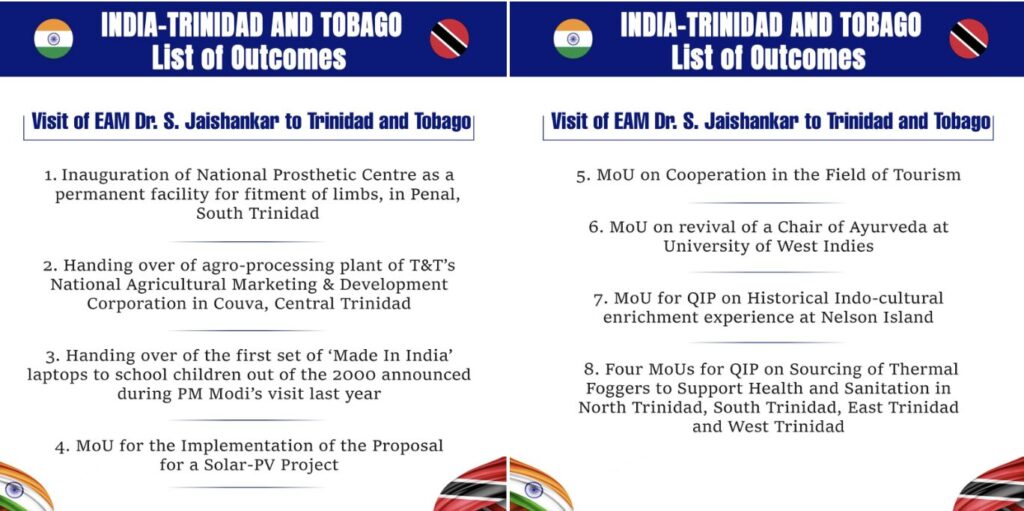
India and Trinidad and Tobago signed 8 Memoranda of Understanding (MoUs). Key areas covered: 

  • Tourism Cooperation: Framework for promoting two-way tourism, cultural exchanges, and hospitality sector linkages. 
  • Solarisation of Government Buildings: India will support the solarisation of Trinidad and Tobago’s Ministry of Foreign and CARICOM Affairs building. Importance: Renewable energy partnership, climate-friendly development cooperation and support for Small Island Developing States (SIDS). 
  • Vector Control: Collaborative programme on mosquito-borne disease control (dengue, Zika, etc.). 
  • Nelson Island Infrastructure Upgrade: India agreed to support infrastructure upgrades on Nelson Island, a historic site linked to the arrival of Indian indentured labourers. 
  • Ayurveda Chair at the University of the West Indies: India will establish an Indian Chair on Ayurveda at the University of the West Indies. This promotes AYUSH diplomacy, expands India’s soft power and encourages traditional medicine collaboration.
  • Archival Cooperation Agreement: An MoU between the National Archives of India and Trinidad and Tobago aims to help people trace ancestral roots. 

India handed over the first batch of 2000 laptops to schoolchildren in Trinidad and Tobago. 

Earlier in 2025, the Prime Minister of India made a landmark state visit to Trinidad & Tobago. It was the first Indian PM visit since 1999. 6 MoUs signed, and he was awarded the Order of the Republic of T&T. 
Strategic Importance for India: 

  • Expansion of India’s Caribbean Outreach: As T&T is a major CARICOM member, the visit strengthens India’s engagement with Caribbean nations as part of its broader Global South strategy. 
  • Strengthening South-South Cooperation: India is increasingly positioning itself as a development partner through: Capacity building, Digital public infrastructure, Renewable energy support and Healthcare assistance. This reflects India’s development-oriented diplomacy model.
  • Diaspora Diplomacy: The Indian-origin population acts as a cultural bridge between the two nations. The benefits include political goodwill, economic linkages, cultural continuity, tourism, and educational exchanges. 
  • Soft Power Projection: India’s use of Ayurveda, education support, cultural heritage and digital assistance enhances its soft power influence in the Caribbean region. 
What is CARICOM?
CARICOM (Caribbean Community) is an intergovernmental organisation established in 1973 via the Treaty of Chaguaramas. 
Aim: To promote economic integration (CARICOM Single Market), coordinate foreign policy, and ensure equitable sharing of benefits among its 15 member states and 5 associate members in the Caribbean and Americas. 
Members: 15 Member States (including Jamaica, Trinidad & Tobago, Barbados, Haiti, Guyana) and 5 Associate Members (including Bermuda, British Virgin Islands).
Headquartered in Guyana. 
CARICOM facilitates functional cooperation in areas like education, health, and security, and acts as a single market for many members.

2nd India-CARICOM Summit (Georgetown, Guyana 2024): first stand-alone meeting between Indian and CARICOM leaders in a member state. India has committed to providing a USD 150 million Line of Credit specifically for solar energy, renewable energy, and USD 14 million for community development projects. 

India’s Caribbean Outreach: The Three-Nation Tour

Jaishankar’s Caribbean tour (May 2026) covered Jamaica, Suriname, and Trinidad & Tobago. Suriname has an Indian diaspora of over 27%, while T&T’s is 40-45%. This is South-South cooperation backed by a civilisational bridge. 

Key Strategic Interests for India in the Caribbean: Why the Caribbean matters? 

  • Accessing Caribbean vote blocs in UN & multilateral forums: CARICOM nations have historically supported India’s positions, including its bid for permanent membership in a reformed UN Security Council.
  • Advancing Global South Solidarity: India positions itself as the voice of the Global South, bridging the developmental needs of Small Island Developing States (SIDS) with India’s technological and economic capacity. This includes supporting CARICOM on issues such as climate change, debt restructuring, and disaster resilience.
  • Expanding UPI, DigiStack, & India Stack: Trinidad and Tobago became the first Caribbean nation to adopt India’s UPI (Unified Payments Interface). India is actively expanding its digital footprint by implementing India Stack solutions, including DigiLocker, e-Sign, and Government e-Marketplace (GeM), across the region. 
  • Maritime and Energy Cooperation: The Caribbean is key to India’s energy diversification strategy. Trinidad and Tobago, a major LNG exporter, is a critical partner, with cooperation extending into maritime safety and security, including the supply of naval hardware (e.g., Dornier aircraft).
  • Countering Chinese Influence: As China expands its footprint in the Caribbean through infrastructure lending, India offers an alternative, transparent partnership model based on capacity building, sustainable development, and “responsible finance”.
  • Illustrate India’s soft power via diaspora, culture, Ayurveda, and Yoga. 

India’s foreign policy has progressively expanded its priority geography: from SAARC neighbours, to the Indo-Pacific, to now explicitly engaging the Global South via the Caribbean. 
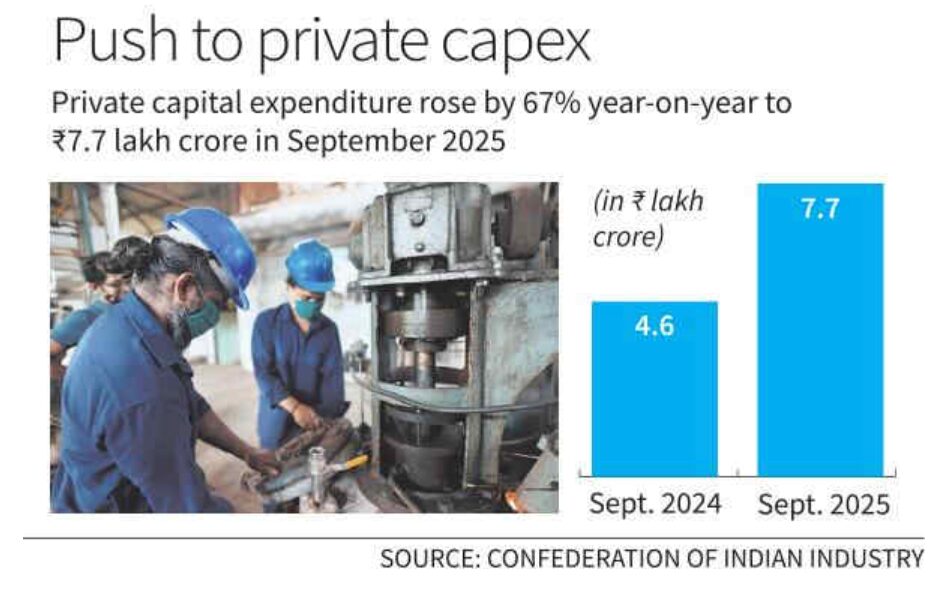
India’s Private Sector Capex surges 67% to Rs 7.70 lakh crore 

Open article →Download PDF

Why in News?

As per the industry body Confederation of Indian Industry (CII), India’s private sector capital expenditure surged 67% to ₹7.7 lakh crore ($81.48 billion) in September 2025 in comparison to September 2024.  

UPSC Relevance: GS-3 Economy: Growth and Development; Role of Private Sector in Economic Development

Prelims: Capital Expenditure; Private Capex (key trends, Significance & challenges). 

Key Trends & Highlights:

The 67% increase in 2025 follows a 66.3% rise over the four years between FY 2021-22 and FY 2024-25, signalling a sustained, broad-based revival. While 2025-26 projects a temporary 25.5% decline due to high costs, overall investment sentiment remains robust.  

  • Sector Focus: Investments are primarily concentrated in renewable energy, electronics, semiconductors, steel, chemicals, and data centres.
  • Funding Sources:
    • Internal accruals: Approximately 65% of 2025-26 Capex is expected to be funded through internal accruals (funds generated internally by the company, including net profits and depreciation)
    • Domestic debt: 23% of the funds from domestic debt (Money borrowed from financial institutions, banks, or bond markets within India).
  • Manufacturing Dominance: Manufacturing leads sectoral capex with a 43.8% share (₹3.8 lakh crore led by metals, automobiles and chemicals). It is followed by information & communication (15.6%) and transportation (14%). 

What is Capital Expenditure?

  • Definition: Capital expenditure (CapEx) refers to funds used by companies or governments to acquire, upgrade, or maintain physical and intangible assets to improve or expand productive capacity. 
  • Key Purposes of CapEx: 
    • Creation of physical assets such as land, buildings, or machinery.
    • Expansion of productive capacity, such as building a new factory.
    • Modernisation and technology upgrades to improve efficiency, or adopting new technologies.
    • Infrastructure development. E.g., Long-term investments in assets like roads, power grids, or data centres

What are the factors driving the Private Capex Revival?

  • Robust Corporate Health: After years of debt reduction, Indian companies have significantly healthier balance sheets, with interest coverage ratios more than doubling between 2021 and 2025. Strong corporate earnings have increased internal accruals, which are now the primary funding source (approx. 65%) for new projects. 
  • Crowding-In Effect: Massive public investment in infrastructure (highways, railways, and defence) and schemes (like National Infrastructure Pipeline and Gati Shakti Mission) has created steady demand for core industries like steel and cement, “crowding in” private players to expand. 
  • PLI Schemes: The Production Linked Incentive (PLI) schemes have incentivised major investments in electronics, semiconductors, and automobile manufacturing.
  • Monetary Easing: Recent rate cuts by the Reserve Bank of India (RBI) and lower inflation have reduced the cost of borrowing for new projects.
  • Emerging Industries: A significant portion of growth is concentrated in “new-age” sectors such as Green Hydrogen, Electric Vehicles (EVs), Data Centres, and Renewables.
  • Energy Transition: Commitments to net-zero goals are driving massive private investments in solar, wind, and battery manufacturing. 
  • Global Strategic Shifts: “China + 1” Strategy: Global supply chain diversification is encouraging Indian firms to expand domestic manufacturing to capture larger export market shares.

What is the Significance of Rising Private Capex?

Rising Capex is a vital indicator of economic health, representing a shift from consumption-led growth to investment-driven growth. 

  • Sustained Economic Growth: Higher Capex directly expands the capital stock, increasing the economy’s ability to produce goods and services. Private investment has a high multiplier effect, boosting national income and expanding secondary industries.
  • Employment Generation: Capex-intensive sectors like manufacturing, infrastructure, renewable energy, and electronics create both direct employment and ancillary jobs. Industrial expansion and new-age sectors generate employment for the growing labour force.
  • Boost to Manufacturing: Rising private investment boosts initiatives like the PLI Scheme, which has attracted over ₹2.16 lakh crore in investment and facilitated manufacturing capacity expansion. Private investments enhance the competitiveness of Indian goods globally. 
  • Technological Advancement: Investment is surging in new-age sectors like data centres, AI, and cloud computing, driven by 5G and structural demands. Adopting advanced technology boosts overall productivity and innovation capacity.
  • Aids Green Transition: Strong investment in renewable energy, green hydrogen, and electric vehicles (EVs) helps reduce dependency on imported fossil fuels and helps transition towards a more sustainable industrial model.
  • Strengthens Financial Sector: Increased corporate borrowing and investment deepens capital markets, enhances credit growth and improves banking sector profitability. 

Associated Challenges: 

  • Uneven Sectoral Distribution: Investment is currently concentrated in a few high-growth pockets (like Capital-intensive industries). MSMEs still face credit constraints, technology gaps and demand volatility. 
  • Global Economic Risks: External challenges include geopolitical tensions, supply-chain disruptions, commodity price volatility and slow global growth. 
  • Capacity Utilisation Concerns: Sustained investment requires a strong consumer demand, export growth and higher industrial utilisation rates. Without adequate demand, fresh investments may slow.
  • Demand Gap: Weak rural consumption and stagnant real wages remain a concern; without robust domestic demand, firms may pivot toward liquid financial assets rather than physical projects. 

Curbing SO2 Emissions from Coal Plants can Prevent 1.24 Lakh Deaths Annually: IIT Delhi Study 

Open article →Download PDF

Why in News?

A recent study by the Indian Institute of Technology Delhi has estimated that India could prevent nearly 1.24 lakh deaths annually by fully mitigating sulphur dioxide (SO2) emissions from coal-fired power plants (CFPPs). 

UPSC Relevance: GS-3 Environment and Biodiversity: Pollution 

Prelims: Sulphur dioxide Pollution, Flue-gas desulfurization 

Key Findings of the IIT Delhi Study: 

  • The study found that complete mitigation of SO2 emissions from CFPPs could:
    • Prevent nearly 1.24 lakh deaths annually.  
    • Reduce annual PM2.5 exposure by 0.3-12 microgrammes per cubic metre (µg/m³)
    • Reduce ambient SO₂ levels by 0.1-13.6 parts per billion across states (ppb).
  • The implementation of SO2 emission norms remains slow, localised and uneven in India. Fully enforcing current limits could cut coal power plant-linked SO₂ and PM2.5 emissions by over 80% by 2030. 

What is SO2, and why is it harmful?

  • Sulphur Dioxide (SO2) is a colourless, pungent, and toxic air pollutant mainly emitted from:
    • Coal-fired thermal power plants (~73% of SO2 emissions) 
    • Burning sulfur-containing fossil fuels 
    • Extraction of metal from ore, petroleum processing, and manufacturing.
    • Natural Sources: Volcanic activity
  • Chemical Transformation: SO2 reacts in the atmosphere to form: Sulphates, Nitrates, Ammonium aerosols. These pollutants add to PM2.5, the fine particulate matter linked to cardiovascular and respiratory diseases. 

Key Health & Environmental Hazards of SO2: 

  • Respiratory Damage: SO2 is a potent irritant. Inhalation causes narrowing of the airways, leading to chest tightness, coughing, and shortness of breath. Can aggravate asthma and chronic bronchitis. 
  • Air Pollution & Particulates: SO2 reacts with other atmospheric compounds to form sulfur oxides and secondary sulfate particles. These contribute to fine particulate matter PM 2.5, which can penetrate deep into the lungs.
  • Acid Rain Formulation: SO2 is a major precursor to acid rain. It reacts with water vapour to form sulfuric acid, which damages forests, acidifies lakes, and erodes buildings and statues. 

Flue Gas Desulfurization: 

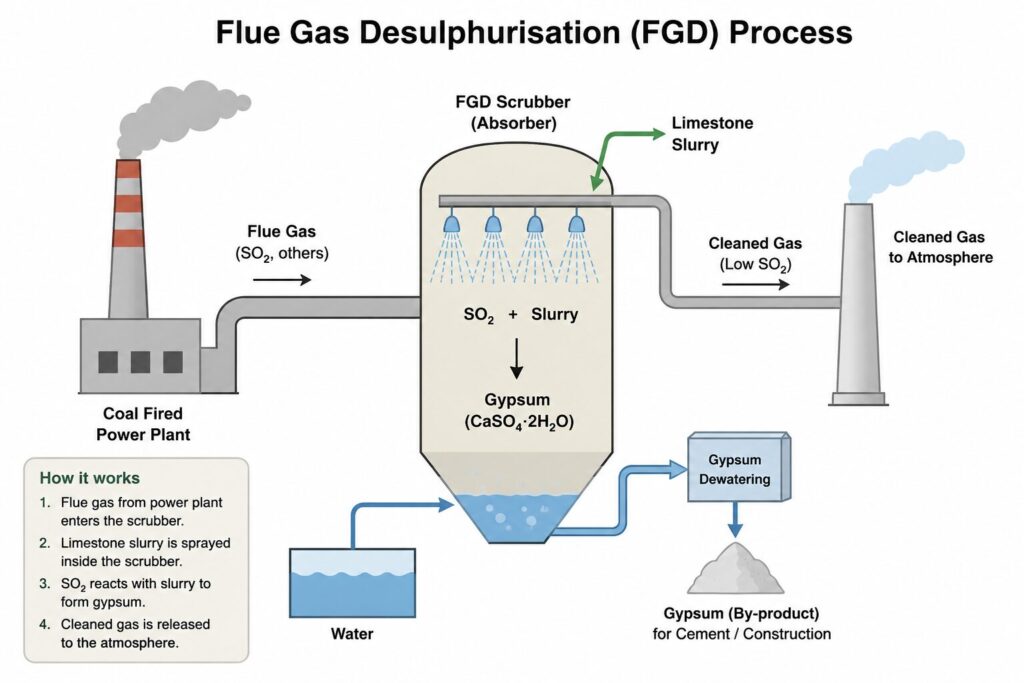
  • Flue-gas desulfurization (FGD) is a set of technologies that removes sulfur dioxide (SO2) from the exhaust gases of fossil-fuel power plants, refineries, and industrial boilers to curb acid rain and air pollution.  

How FGD Works?

  • Flue Gas Collection: Exhaust gas (Flue gas) containing SO2, particulate matter, and other pollutants is collected from a boiler, furnace, or incinerator.
  • SO2 Removal: The collected flue gas is then passed through an FGD system. There are two primary methods:
    • Wet Scrubbing: The gas is sprayed with a limestone (CaCO3) or lime slurry. The SO2 reacts with the limestone to form calcium sulfite, which is then oxidised into gypsum.
    • Dry Scrubbing: A dry or semi-dry sorbent (like lime or activated carbon) is injected into the gas. The sorbent absorbs the SO2 and is collected as a dry waste product in a downstream filter.
  • Cleaned Flue Gas with reduced SO2 levels is discharged into the atmosphere. By-products are collected for disposal or reuse. High-quality gypsum from wet systems is often sold for use in manufacturing wallboard or cement. 

SO2 emissions and Thermal power plants: 

The study comes amid continuing debate over the installation of flue gas desulphurisation (FGD) systems in Coal-fired power plants (CFPPs).  

  • A key argument against FGD installation has been that Indian coal has relatively low sulphur content, making the technology expensive.
    • 2015: The Union Ministry of Environment, Forest and Climate Change had introduced mandatory emission norms for CFPPs, targeting significantly lower levels of SO₂, nitrogen oxides, mercury and particulate matter. 
    • 2025: The Centre relaxed the 2015 emission norms for CFPPs, exempting roughly 79% of coal-fired units from installing FGD systems to curb SO₂ emissions.
  • The study, however, argues that health-related monetary gains from reduced emissions are likely to outweigh the cost of installing emission-control technologies. 

Stronger implementation of SO₂ emission norms, wider adoption of FGDs and related control technologies, and prioritisation of hotspot regions are essential to curb SO2 pollution.  

UPSC PYQ 2013 

Q. Acid rain is caused by the pollution of the environment by: 

(a)     carbon dioxide and nitrogen

(b)     carbon monoxide and carbon dioxide

(c)     ozone and carbon dioxide

(d)    nitrous oxide and sulphur dioxide

Answer: (d) 

UPSC PYQ 2020

Q. Which of the following are the reasons/factors for exposure to benzene pollution?

1.  Automobile exhaust

2. Tobacco smoke

3. Wood burning

4. Using varnished wooden furniture

5. Using products made of polyurethane

Select the correct answer using the code given below:

(a) 1, 2 and 3 only

(b) 2 and 4 only

(c) 1, 3 and 4 only

(d) 1, 2, 3, 4 and 5

Answer: (d) 

Advancing India-South Korea Defence Innovation Ties 

Open article →Download PDF

Why in News?

Korea-India Defence Accelerator (KIND-X) is a bilateral innovation platform launched during the state visit of the South Korean President to New Delhi in April 2026.  

UPSC Relevance: GS-2 International Relations: Bilateral ties; GS-3: Science & Technology: Defence Technology

Prelims: Korea-India Defence Accelerator (KIND-X) 

Evolution of India-South Korea Defence Relations: 

  • Early Defence Cooperation: India and South Korea established diplomatic relations in 1973 and have maintained defence ties since then. 
  • 2005 MoU on Defence Industry and Logistics: The first formal agreement promoted cooperation in production, research and development, and procurement. It enabled exchanges of expertise, training, visits and joint exercises. 
  • 2010 Defence R&D agreement: focused on emerging technologies such as marine, electronics, and intelligent systems through links between India’s Defence Research and Development Organisation (DRDO) and the South Korean defence industry. 
  • 2015 Special Strategic Partnership: The elevation of bilateral ties to a Special Strategic Partnership reflected shared Indo-Pacific interests, defence industrial cooperation, maritime security convergence and economic and technology collaboration. 
  • 2020 Roadmap for Defence Industries Cooperation expanded engagements into key areas, such as land, naval, aero, and guided weapon systems, along with investments and technology transfer in India’s defence industrial corridors. A notable outcome of this partnership is the K9 Vajra-T self-propelled artillery system manufactured in India by Larsen & Toubro (L&T) and Hanwha Aerospace of South Korea under the ‘Make in India’ initiative. 
  • Joint Strategic Vision (2026-2030) aims to elevate the India-ROK partnership through deeper industrial and technological alignment.  

At the India-South Korea Summit, a new defence innovation platform called the Korea-India Defence Accelerator (KIND-X) was announced.

Korea-India Defence Accelerator (KIND-X): 

Korea-India Defence Accelerator (KIND-X) is a bilateral innovation platform launched during the state visit of the South Korean President to New Delhi in April 2026. 

Key Features of KIND-X: 

  • Operational Leadership: Led by India’s Defence Innovation Organisation (DIO) and South Korea’s Defence Acquisition Program Administration (DAPA).
  • Strategic Model: It is modelled after India’s existing “innovation bridges,” such as INDUS-X (with the United States) and FRIND-X (with France). 
  • Core Objectives:
    • Linking startups, incubators, and universities from both countries to foster co-development and co-design of advanced military systems.
    • Reinvigorating the 2020 Roadmap for Defence Industry Cooperation.
    • Connecting South Korean innovation clusters (E.g., Changwon, Gumi) with India’s Defence Industrial Corridors. 
  • Potential Areas of Cooperation: KIND-X focuses on high-tech and emerging domains, including:
    • AI for military applications, autonomous weapon systems and robotics. 
    • Joint development of satellites for space-based intelligence, surveillance, and reconnaissance (ISR), Space Situational Awareness (SSA). 
    • Next-generation hardware, such as anti-aircraft gun-missile systems and counter-drone technologies.
    • Critical supply chains, including defence semiconductor fabs and critical minerals. 

KIND-X aligns with India’s Defence Forces Vision 2047 and South Korea’s Defence Innovation 4.0 strategy, and represents a major evolution in India-South Korea defence ties-  shifting from traditional buyer-seller relations toward a collaborative innovation-driven partnership. 

Understanding inequality in India’s growth story 

Open article →Download PDF

Why in News?

Recent policy changes, including the implementation of the Labour Codes and the replacement of Mahatma Gandhi National Rural Employment Guarantee Act (MGNREGA) with the Viksit Bharat-Guarantee for Rozgar and Ajeevika Mission (Gramin) Bill, 2025, have revived debate on inequality, informal labour distress, and rural welfare in India. Simultaneously, new findings from the Household Consumer Expenditure Survey (HCES) 2023-24 have triggered discussion on whether inequality in India is actually declining or merely being underestimated.

UPSC Relevance:

GS II : Welfare schemes, vulnerable sections, labour reforms, social justice.
GS III : Inclusive growth, employment, informal sector, poverty, regional imbalance, human development, economic reforms and inequality.

Understanding Inequality

Inequality refers to the unequal distribution of income, wealth, consumption, opportunities, and social advantages among individuals or groups in society.

It can be measured through:

  • Income inequality
  • Wealth inequality
  • Consumption expenditure inequality
  • Regional inequality
  • Social inequality based on caste, class, gender, religion, and occupation

The article primarily examines consumption expenditure inequality using HCES 2023-24 data.

Measuring Inequality

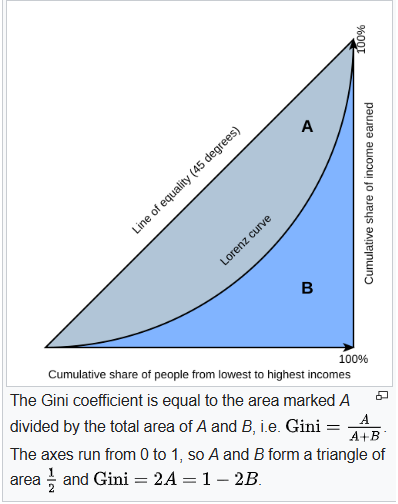
Gini Coefficient

The most widely used measure of inequality is the Gini Index or Gini Coefficient.

                                0≤G≤1

  • A value closer to 0 indicates perfect equality.
  • A value closer to 1 indicates extreme inequality.

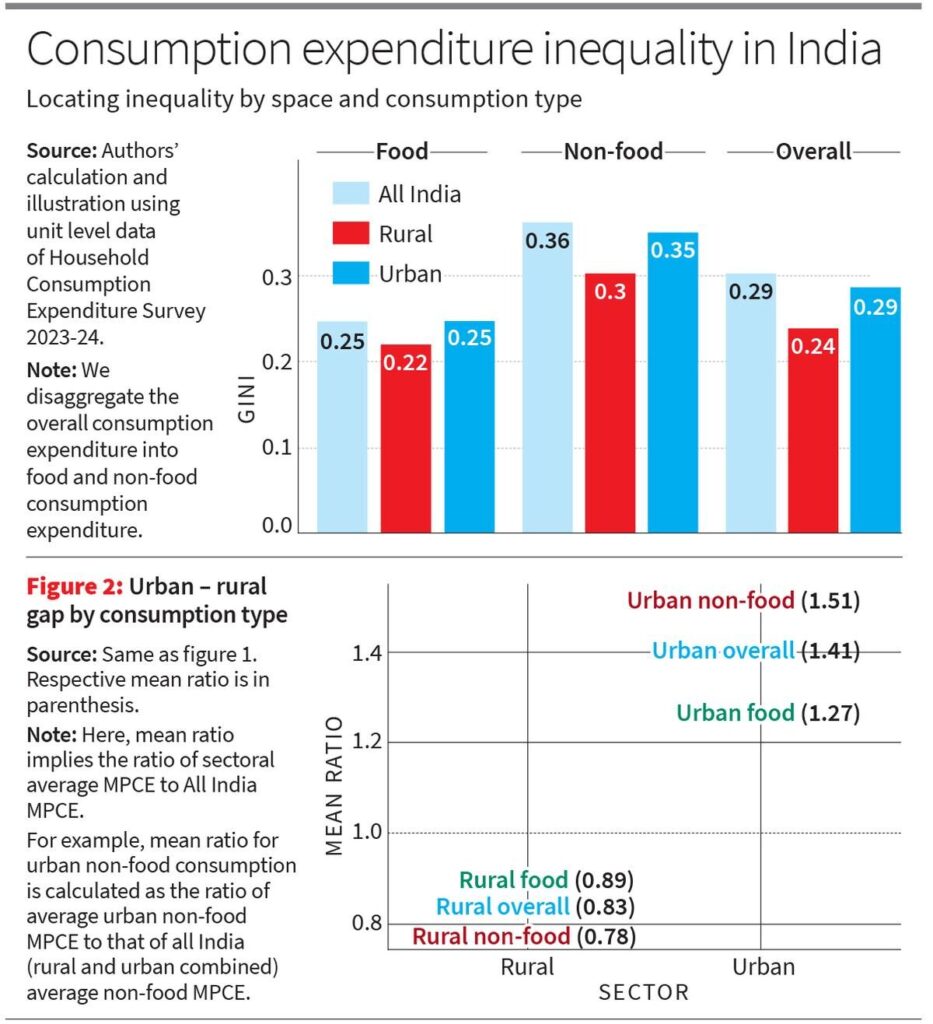
The study estimates India’s consumption inequality at:

  • 0.29 based on HCES 2023-24
  • Compared to the World Bank estimate of 0.25

This suggests inequality may be higher than officially projected.

Major Findings from HCES 2023-24

Urban India is More Unequal than Rural India

The data shows that urban consumption inequality is significantly higher than rural inequality.

Urban growth has disproportionately benefited:

  • Owners of capital
  • Professionals
  • High-skilled service workers
  • Urban elites

Meanwhile:

  • Informal workers
  • Agricultural labourers
  • Small farmers
    continue to lag behind.

Non-Food Expenditure Drives Inequality

India’s consumption boom is largely driven by non-food expenditure such as:

  • Education
  • Healthcare
  • Housing
  • Transport
  • Consumer durables
  • Leisure

Inequality in non-food expenditure is much higher than food expenditure.

This indicates widening disparities in:

  • Quality of life
  • Access to services
  • Human capital formation

Urban-Rural Divide

The average urban non-food Monthly Per Capita Expenditure (MPCE) is approximately 1.5 times the all-India average, while rural expenditure remains far below the national benchmark.

The disparity highlights:

  • Uneven economic growth
  • Persistent agricultural distress
  • Urban-centric development policies

Decile-Based Inequality

Concentration of Consumption

In urban India:

  • The top 10% accounts for 27% of total non-food expenditure.

The mean MPCE:

  • Of the richest urban decile is six times that of the poorest urban decile.
  • Of the richest urban decile is nine times that of the poorest rural decile.

This demonstrates sharp consumption concentration among upper-income groups.

Between-Group vs Within-Group Inequality

The study decomposes inequality into:

  1. Within-group inequality
  2. Between-group inequality

The findings show that:

  • Between-group inequality contributes nearly 90% of non-food expenditure inequality.

This indicates structural disparities between social and economic groups rather than merely individual differences.

Inequality Along Social Axes

Class Inequality

Research by Vamsi Vakulabharanam shows that since the 1980s:

  • Urban owners, managers, and professionals have gained disproportionately.
  • Informal workers and agricultural labourers have experienced stagnation.

This reflects:

  • Rising class inequality
  • Unequal gains from liberalisation and economic growth

Caste and Rural Distress

Inequality in India also overlaps with:

  • Caste hierarchy
  • Land ownership patterns
  • Occupational segmentation

Marginalised caste groups remain overrepresented in:

  • Informal labour
  • Agricultural distress
  • Low-income occupations

What are the Problems in Measuring Inequality in India?

Underestimation of the Super-Rich

National Sample Surveys often fail to adequately capture:

  • Billionaires
  • High-net-worth individuals
  • Corporate wealth concentration

Thus, actual inequality may be significantly higher.

Data Comparability Issues

Methodological differences across surveys create challenges in:

  • Comparing inequality over time
  • Estimating long-term trends accurately

Debt-Led Consumption

A large section of the population sustains consumption through:

  • Loans
  • Informal credit
  • Household indebtedness

This can mask underlying economic distress.

Structural Causes of Rising Inequality

Jobless Growth

Economic growth has not generated adequate:

  • Formal employment
  • Manufacturing jobs
  • Secure livelihoods

This has increased precarity in the labour market.

Informalisation of Labour

Over 90% of India’s workforce remains informal with:

  • Low wages
  • Lack of social security
  • Weak bargaining power

Agrarian Distress

Persistent rural challenges include:

  • Small landholdings
  • Rising input costs
  • Climate vulnerability
  • Low farm incomes

Unequal Access to Education and Healthcare

Human development opportunities remain highly unequal across:

  • Regions
  • Social groups
  • Income categories

What are the Implications of High Inequality?

Economic Consequences

High inequality can:

  • Reduce aggregate demand
  • Increase dependence on debt-led consumption
  • Slow sustainable growth

Social Consequences

It can lead to:

  • Social alienation
  • Reduced social mobility
  • Increased crime and unrest

Democratic Concerns

Extreme concentration of wealth may:

  • Distort political influence
  • Increase corporate capture
  • Deepen exclusion in policymaking

Government Initiatives

Major welfare initiatives include:

  • Pradhan Mantri Garib Kalyan Yojana
  • PM-KISAN
  • Ayushman Bharat
  • National Food Security Act
  • Skill India Mission
  • Direct Benefit Transfer (DBT)

However, welfare support alone has not reversed structural inequality.

Way Forward

Employment-Centric Growth

India needs:

  • Labour-intensive manufacturing
  • MSME expansion
  • Rural industrialisation

Strengthening Social Security

Universal and portable social protection is needed for:

  • Informal workers
  • Gig workers
  • Migrant labourers

Revitalising Rural Economy

Focus areas include:

  • Agricultural diversification
  • Rural infrastructure
  • Irrigation
  • Farmer producer organisations

Progressive Taxation

A more progressive fiscal framework can improve redistribution through:

  • Better wealth taxation
  • Rationalised subsidies
  • Increased public investment

Investment in Human Capital

Improved public spending on:

  • Education
  • Healthcare
  • Nutrition
  • Skill development

is essential to reduce long-term inequality.

Conclusion

India’s growth story has produced significant economic expansion, but its benefits remain unevenly distributed. Rising urban prosperity, expanding non-food consumption, and the concentration of economic gains among elite groups reveal deep structural inequalities. Consumption-based estimates alone may understate the true scale of disparity. Sustainable and inclusive development requires not only growth, but equitable access to opportunities, livelihoods, and social mobility.

Practice Questions

1. With reference to the Gini Coefficient, consider the following statements:

  1. It is used to measure inequality in income or consumption distribution.
  2. A Gini value of 1 indicates perfect equality.
  3. The closer the Gini value is to zero, the lower the inequality.

Which of the statements given above are correct?

(a) 1 and 2 only
(b) 1 and 3 only
(c) 2 and 3 only
(d) 1, 2 and 3

Answer: (b)

2. Which of the following factors are commonly associated with rising economic inequality in India?

  1. Informalisation of labour
  2. Urban-centric growth
  3. Agrarian distress
  4. Universal access to quality healthcare

Select the correct answer using the code below:

(a) 1, 2 and 3 only
(b) 2 and 4 only
(c) 1 and 4 only
(d) 1, 2, 3 and 4

Answer: (a)

Mains Practice Questions

  1. Critically analyse the limitations of consumption expenditure surveys in capturing inequality in India.
  2. “Economic growth without equitable distribution can deepen structural inequalities.” Discuss in the context of India’s recent growth trajectory.
  3. Examine the relationship between urbanisation, labour informalisation, and rising inequality in India.

Fixing structural deficits in India’s health system 

Open article →Download PDF

Why in News?

The Union Ministry of Health informed Parliament in March 2026 that 43 new medical colleges and nearly 20,000 MBBS and postgraduate medical seats had been approved for the 2025–26 academic year. Despite this expansion in medical education infrastructure, India continues to face severe shortages of doctors and specialists in rural and underserved regions, raising concerns about structural weaknesses in the public health system.

UPSC Relevance

GS II:  Issues relating to health, human resource challenges in healthcare, welfare schemes, social sector development.
GS III : Human capital, inclusive growth, regional disparities, public expenditure and governance challenges.

India’s Public Health Challenge

India has significantly expanded:

  • Medical colleges
  • MBBS seats
  • Postgraduate seats
  • Healthcare infrastructure

However, improvements in:

  • Rural healthcare delivery
  • Specialist availability
  • Quality public healthcare access

remain limited.

The core issue is not merely the production of doctors, but their uneven distribution and weak integration into the public health system.

Current Status of Medical Education Expansion

According to the government:

  • 43 new medical colleges were approved.
  • 11,682 MBBS seats were added.
  • 8,967 postgraduate seats were sanctioned for 2025–26.

However:

  • 27 of the new colleges belong to the private sector.
  • Only eight are under State governments.

Private institutions largely function outside direct public-service obligations.

Shortage of Specialists in Rural India

Community Health Centres (CHCs)

A Community Health Centre is the first referral unit in rural healthcare.

A CHC is expected to serve:

  • 1.6–2 lakh population
  • With 30 beds
  • And five specialists:
    • Physician
    • Surgeon
    • Obstetrician
    • Paediatrician
    • Anaesthetist

Yet, according to the Health Dynamics of India Report 2022–23:

  • India has 5,491 rural CHCs.
  • Required specialists: 21,964
  • Available specialists: 4,413

This reflects a vacancy rate of nearly 80%.

Structural Problems in the Health System

Infrastructure Without Human Resources

The government’s health strategy has heavily focused on:

  • Building hospitals
  • Expanding colleges
  • Capital expenditure

But insufficient attention has been given to:

  • Staffing
  • Diagnostics
  • Drug availability
  • Emergency care
  • Operational funding

As a result, many health facilities remain underutilised.

Regional Imbalance

Doctors and specialists are concentrated in:

  • Urban centres
  • Private hospitals
  • Metropolitan regions

Remote regions such as:

  • Tribal belts
  • Hilly regions
  • Aspirational districts

continue to face chronic shortages.

Weak Incentive Structure

Specialists often avoid rural postings due to:

  • Poor infrastructure
  • Lack of staff quarters
  • Weak schooling facilities
  • Professional isolation
  • Heavy workload
  • Limited career opportunities

Thus, merely increasing postgraduate seats does not ensure better rural healthcare delivery.

Problems with Existing CHC Expansion

States continue constructing new CHCs largely to utilise central funds.

However:

  • Many CHCs function like Primary Health Centres (PHCs).
  • Specialists are spread too thinly.
  • Most CHCs lack full specialist teams.

The article argues that instead of creating more centres, India should operationalise fewer CHCs effectively.

Faculty Shortage in Medical Institutions

Even premier institutions face staffing shortages.

Eleven of eighteen All India Institutes of Medical Sciences reportedly have nearly 40% vacancies in teaching and research posts.

This affects:

  • Specialist training quality
  • Medical research
  • Clinical mentorship
  • Public health innovation

Health Inequality and Public Dependence

India’s poor and marginalised populations depend overwhelmingly on public healthcare facilities.

Weak rural healthcare results in:

  • Long-distance travel for treatment
  • High out-of-pocket expenditure
  • Delayed treatment
  • Preventable mortality

Thus, specialist shortages directly deepen health inequality.

Existing Government Initiatives

Major initiatives include:

  • Ayushman Bharat
  • Health and Wellness Centres
  • National Health Mission (NHM)
  • PM Ayushman Bharat Health Infrastructure Mission
  • Expansion of AIIMS
  • District medical college expansion

However, implementation gaps remain substantial.

Suggested Reforms

Rationalisation of CHCs

Instead of increasing the number of facilities indiscriminately:

  • Functional CHCs should be prioritised.
  • Two or three fully equipped CHCs per district may be more effective.

Area-Based Classification

Health centres should be classified into:

  • Normal areas
  • Difficult areas
  • Most difficult areas

based on:

  • Vacancy levels
  • Accessibility
  • Terrain
  • Infrastructure deficits

This model was earlier attempted in Chhattisgarh under the Rural Medical Corps Scheme.

Incentive-Based Rural Service

Specialists serving in remote regions should receive:

  • Financial incentives
  • Staff housing
  • Schooling support
  • Career advancement
  • Priority in postgraduate admissions

Linking PG Seats with Public Service

Government-sponsored postgraduate medical seats should be tied to:

  • Mandatory rural specialist service
  • CHC vacancy requirements

This would create direct linkage between:

  • Medical education expansion
  • Public healthcare needs

Team-Based Posting

The article recommends an “all-or-none” model:

  • Either all five specialists are posted in a CHC
  • Or the CHC should not be operationalised as a referral centre

This prevents fragmented healthcare delivery.

Strengthening Operational Capacity

Public health investments must also prioritise:

  • Diagnostics
  • Drug supply
  • ICU facilities
  • Labour rooms
  • Ambulance services
  • Human resources

rather than focusing only on buildings.

Broader Significance

Human Capital Development

A strong healthcare system:

  • Improves productivity
  • Enhances labour participation
  • Reduces poverty traps

Social Justice

Accessible healthcare is central to:

  • Equity
  • Inclusive development
  • Constitutional welfare goals

Economic Importance

Poor health infrastructure increases:

  • Household indebtedness
  • Catastrophic health expenditure
  • Economic vulnerability

Conclusion

India’s healthcare challenge is no longer limited to inadequate infrastructure or low medical education capacity. The deeper structural problem lies in the inability to ensure equitable distribution of trained specialists and operational healthcare services across regions. Without systemic reforms in staffing, incentives, public health financing, and rural service delivery, the expansion of medical colleges alone cannot bridge India’s healthcare deficit. Strengthening the public health system requires shifting focus from infrastructure creation to functional healthcare outcomes.

Practice Questions

1. With reference to Community Health Centres (CHCs) in India, consider the following statements:

  1. CHCs function as first referral units in rural healthcare.
  2. A CHC is expected to have five specialist doctors.
  3. CHCs are established under the Ministry of Rural Development.

Which of the statements given above are correct?

(a) 1 and 2 only
(b) 2 and 3 only
(c) 1 only
(d) 1, 2 and 3

Answer: (a)

2. Which of the following are major reasons for specialist shortages in rural healthcare facilities?

  1. Lack of infrastructure and staff quarters
  2. Professional isolation
  3. Weak schooling facilities in remote areas
  4. Excessive concentration of specialists in rural India

Select the correct answer using the code below:

(a) 1, 2 and 3 only
(b) 1 and 4 only
(c) 2 and 4 only
(d) 1, 2, 3 and 4

Answer: (a)

Mains Practice Questions

  1. “Infrastructure without operational capacity cannot improve healthcare outcomes.” Analyse in the context of India’s public health system.
  2. India’s healthcare challenge is increasingly becoming a problem of distribution rather than production of medical professionals. Discuss.
  3. Critically examine the structural deficits in India’s rural public healthcare system despite expansion in medical education infrastructure.

How does Kerala plan to tackle oil spill hazards? 

Open article →Download PDF

Why in News?

Two major maritime accidents off the coast of Kerala — the sinking of the cargo vessels MSC Elsa 3 in May 2025 and MV Wan Hai 503 in June 2025 — triggered concerns about marine pollution, oil spills, and coastal ecological damage. Following these incidents, the Kerala State Pollution Control Board prepared a draft Oil Spill Contingency Plan (OSCP), which was submitted before the National Green Tribunal in April 2026.

The issue has highlighted the vulnerability of India’s western coastline to marine disasters and the need for coordinated environmental response mechanisms.

UPSC Relevance

GS II: Environmental governance, Disaster management institutions, Centre-State coordination

GS III: Marine pollution, Coastal ecosystem conservation, Disaster preparedness, Blue Economy, Climate and environmental security

Oil Spill Hazards: Meaning and Nature

An oil spill refers to the accidental release of petroleum products into marine or coastal ecosystems due to ship collisions, tanker accidents, offshore drilling failures, pipeline leaks, or port-related mishaps.

Oil spills are among the most damaging forms of marine pollution because crude oil spreads rapidly over water surfaces, obstructing oxygen exchange, poisoning aquatic organisms, and damaging coastal ecosystems.

India’s long coastline, dense shipping traffic, offshore energy infrastructure, and dependence on maritime trade increase the risk of such disasters.

Kerala’s Vulnerability to Oil Spills

Geographical Factors

Kerala possesses a coastline of nearly 590 km along the Arabian Sea. A major international shipping lane carrying crude oil from West Asia passes close to the Kerala coast, making the State highly vulnerable to maritime accidents.

Nine out of Kerala’s 14 districts are categorised as oil spill-prone.

Ecological Sensitivity

The coast contains ecologically fragile systems such as:

  • Mangroves
  • Estuaries
  • Backwaters
  • Coral ecosystems
  • Fish breeding grounds
  • Coastal wetlands

An oil spill in such areas can permanently damage biodiversity and fisheries.

Economic Dependence on Coastal Resources

A large population in Kerala depends on:

  • Marine fisheries
  • Tourism
  • Coastal agriculture
  • Port activities

Oil contamination directly affects livelihoods and food security.

Recent Maritime Incidents

MSC Elsa 3 Incident

The vessel sank carrying:

  • 640 containers
  • Hazardous materials
  • Calcium carbide cargo
  • Plastic nurdles (industrial pellets)

Nurdles washed ashore across Kerala’s southern coast, raising concerns over microplastic pollution and long-term ecological harm.

Why Nurdles Are Dangerous

Nurdles are small plastic pellets used in plastic manufacturing. They:

  • Persist for decades in marine ecosystems
  • Are consumed by marine animals
  • Enter the food chain
  • Absorb toxic chemicals from seawater

The incident highlighted that marine disasters today involve not only oil spills but also hazardous chemical and plastic pollution.

Oil Spill Contingency Plan (OSCP)

Meaning

An Oil Spill Contingency Plan is a coordinated emergency response framework designed to:

  • Prevent oil spill disasters
  • Detect and monitor spills
  • Minimise environmental damage
  • Coordinate rescue and clean-up operations
  • Restore affected ecosystems

The draft plan in Kerala has been prepared in accordance with the National Oil Spill Disaster Contingency Plan (NOS-DCP).

Major Features of Kerala’s OSCP

1. Environmental Sensitivity Mapping

The plan proposes Environmental Sensitive Index (ESI) mapping of Kerala’s coastline.

This identifies:

  • Ecologically vulnerable areas
  • Fishing zones
  • Tourism zones
  • Mangrove belts
  • Turtle nesting areas
  • Sensitive estuaries and wetlands

Such mapping helps authorities prioritise protection efforts during emergencies.

2. Hydrodynamic and Oil Spill Modelling

Scientific modelling will be used to predict:

  • Spread of spilled oil
  • Direction of movement
  • Impact zones
  • Shoreline vulnerability

This improves preparedness and evacuation planning.

3. Clear Command Structure

The OSCP proposes a structured chain of command specifying:

  • Duties of departments
  • Crisis coordination mechanisms
  • Emergency communication channels
  • Inter-agency coordination

This reduces confusion during disasters.

4. Shoreline Response Strategy

The plan includes:

  • Clean-up protocols
  • Equipment deployment methods
  • Shoreline restoration measures
  • Waste disposal procedures

Priority-based response mechanisms will protect ecologically sensitive zones first.

5. Wildlife Protection Measures

The framework proposes dedicated wildlife response plans for:

  • Marine mammals
  • Birds
  • Fish populations
  • Coastal biodiversity

Oil spills can severely affect feathers, fur, respiration, and reproductive systems of marine organisms.

6. Equipment and Infrastructure Database

The plan aims to maintain updated information regarding:

  • Booms
  • Skimmers
  • Dispersants
  • Emergency vessels
  • Trained personnel
  • Port facilities

This allows rapid mobilisation during emergencies.

National Oil Spill Disaster Contingency Plan (NOS-DCP)

India’s national framework for oil spill management is coordinated by the Indian Coast Guard.

Key Features

  • Established under the Merchant Shipping Act
  • Provides tiered response systems
  • Coordinates Centre-State actions
  • Covers offshore and coastal pollution incidents
  • Includes surveillance and containment mechanisms

The Coast Guard acts as the central coordinating authority.

Environmental Impact of Oil Spills

Marine Biodiversity Loss

Oil coats fish gills, bird feathers, coral reefs, and marine vegetation, leading to:

  • Suffocation
  • Toxicity
  • Reproductive failure
  • Habitat destruction

Fisheries Impact

Oil contamination reduces fish populations and affects:

  • Coastal fishermen
  • Export industries
  • Food chains

Tourism Damage

Kerala’s beaches and backwaters are major tourism assets. Oil spills damage:

  • Beaches
  • Water quality
  • Recreational activities
  • Coastal aesthetics

Long-Term Ecological Effects

Oil residues may remain in sediments for years, causing:

  • Bioaccumulation
  • Food chain contamination
  • Persistent ecosystem degradation

Legal and Institutional Framework in India

Constitutional Provisions

Article 48A

Directs the State to protect and improve the environment.

Article 51A(g)

Makes environmental protection a Fundamental Duty of citizens.

Major Laws

LawPurpose
Environment Protection Act, 1986Umbrella environmental legislation
Merchant Shipping Act, 1958Marine pollution control
Water Act, 1974Prevention of water pollution
Disaster Management Act, 2005Disaster coordination mechanisms

International Frameworks

India is party to several international marine pollution agreements under the International Maritime Organization.

MARPOL Convention

The International Convention for the Prevention of Pollution from Ships regulates marine pollution from ships.

UNCLOS

The United Nations Convention on the Law of the Sea obligates countries to protect marine environments.

Challenges in Oil Spill Management

Limited Coastal Preparedness

Many coastal States lack:

  • Modern clean-up equipment
  • Trained manpower
  • Real-time monitoring systems

Inter-Agency Coordination Problems

Coordination gaps among:

  • Coast Guard
  • Pollution control boards
  • Fisheries departments
  • Port authorities
  • Disaster management agencies

often delay responses.

High Cost of Restoration

Marine ecosystem restoration after spills is expensive and time-consuming.

Emerging Pollution Risks

Modern shipping accidents involve:

  • Chemicals
  • Plastics
  • Hazardous cargo
  • LNG and industrial substances

Traditional oil spill frameworks may not fully address these new threats.

Way Forward

Strengthening Coastal Surveillance

India should expand:

  • Satellite monitoring
  • Drone surveillance
  • Early warning systems
  • Vessel tracking mechanisms

Building Dedicated Marine Disaster Units

Specialised marine pollution response forces should be developed in all coastal States.

Enhancing Port Safety Standards

Strict compliance with:

  • International shipping norms
  • Hazardous cargo handling
  • Emergency preparedness protocols

is essential.

Community-Based Coastal Protection

Local fishermen and coastal communities should be integrated into:

  • Monitoring systems
  • First-response mechanisms
  • Awareness programmes

Blue Economy and Sustainability

Oil spill management must become a core component of India’s Blue Economy strategy to ensure sustainable maritime development.

Conclusion

The recent maritime disasters off Kerala’s coast exposed the growing vulnerability of India’s marine ecosystems to shipping-related environmental hazards. Kerala’s proposed Oil Spill Contingency Plan represents an important shift from reactive disaster response to scientific preparedness and coordinated ecological protection.

As maritime trade expands and coastal infrastructure grows, India must strengthen institutional capacity, technological preparedness, and environmental governance to safeguard its marine resources and coastal livelihoods.

Prelims Practice Questions

1. With reference to the National Oil Spill Disaster Contingency Plan (NOS-DCP), consider the following statements:

  1. It is coordinated by the Indian Coast Guard.
  2. It deals only with offshore oil drilling accidents.
  3. It provides a framework for marine pollution response.

Which of the statements given above are correct?

(a) 1 and 2 only
(b) 1 and 3 only
(c) 2 and 3 only
(d) 1, 2 and 3

Answer:

(b) 1 and 3 only

2. Nurdles, recently seen in news, are:

(a) Deep-sea drilling chemicals
(b) Microplastic industrial pellets
(c) Oil spill absorbent materials
(d) Coral reef microorganisms

Answer:

(b) Microplastic industrial pellets

Mains Practice Questions

  1. “Marine environmental security is becoming central to India’s Blue Economy strategy.” Analyse in the context of increasing oil spill and maritime pollution risks.
  2. Discuss the ecological and economic impacts of oil spills on India’s coastal regions. Examine the institutional preparedness required for effective marine disaster management.