Why in News?
A recent study by the Indian Institute of Technology Delhi has estimated that India could prevent nearly 1.24 lakh deaths annually by fully mitigating sulphur dioxide (SO2) emissions from coal-fired power plants (CFPPs).
| UPSC Relevance: GS-3 Environment and Biodiversity: Pollution Prelims: Sulphur dioxide Pollution, Flue-gas desulfurization |
Key Findings of the IIT Delhi Study:
- The study found that complete mitigation of SO2 emissions from CFPPs could:
- Prevent nearly 1.24 lakh deaths annually.
- Reduce annual PM2.5 exposure by 0.3-12 microgrammes per cubic metre (µg/m³)
- Reduce ambient SO₂ levels by 0.1-13.6 parts per billion across states (ppb).
- The implementation of SO2 emission norms remains slow, localised and uneven in India. Fully enforcing current limits could cut coal power plant-linked SO₂ and PM2.5 emissions by over 80% by 2030.
What is SO2, and why is it harmful?
- Sulphur Dioxide (SO2) is a colourless, pungent, and toxic air pollutant mainly emitted from:
- Coal-fired thermal power plants (~73% of SO2 emissions)
- Burning sulfur-containing fossil fuels
- Extraction of metal from ore, petroleum processing, and manufacturing.
- Natural Sources: Volcanic activity
- Chemical Transformation: SO2 reacts in the atmosphere to form: Sulphates, Nitrates, Ammonium aerosols. These pollutants add to PM2.5, the fine particulate matter linked to cardiovascular and respiratory diseases.
Key Health & Environmental Hazards of SO2:
- Respiratory Damage: SO2 is a potent irritant. Inhalation causes narrowing of the airways, leading to chest tightness, coughing, and shortness of breath. Can aggravate asthma and chronic bronchitis.
- Air Pollution & Particulates: SO2 reacts with other atmospheric compounds to form sulfur oxides and secondary sulfate particles. These contribute to fine particulate matter PM 2.5, which can penetrate deep into the lungs.
- Acid Rain Formulation: SO2 is a major precursor to acid rain. It reacts with water vapour to form sulfuric acid, which damages forests, acidifies lakes, and erodes buildings and statues.
Flue Gas Desulfurization:
- Flue-gas desulfurization (FGD) is a set of technologies that removes sulfur dioxide (SO2) from the exhaust gases of fossil-fuel power plants, refineries, and industrial boilers to curb acid rain and air pollution.
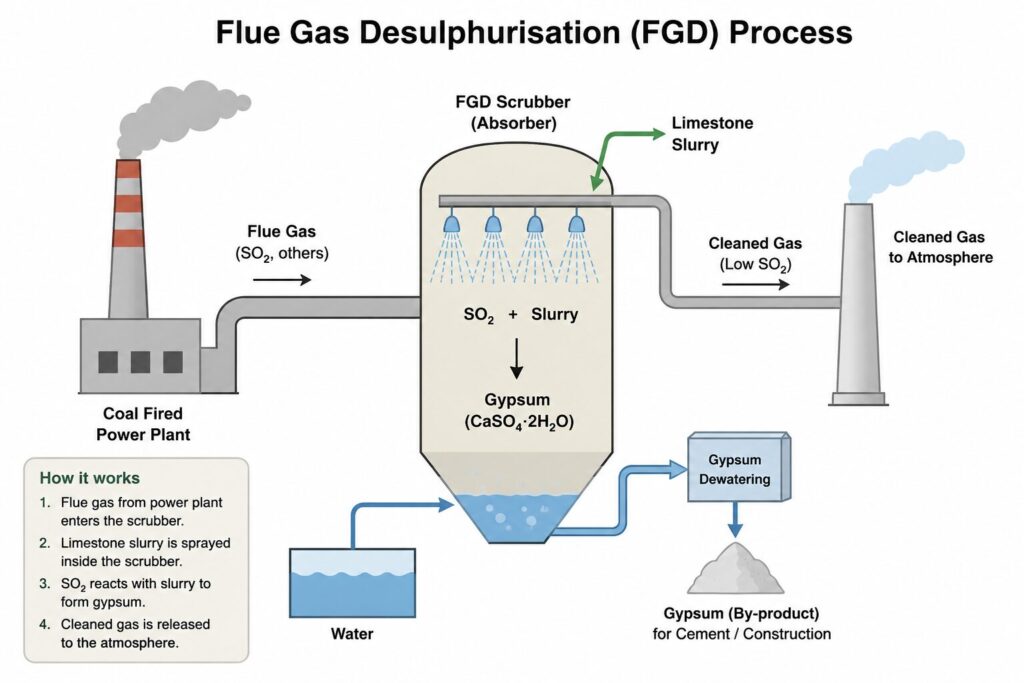
How FGD Works?
- Flue Gas Collection: Exhaust gas (Flue gas) containing SO2, particulate matter, and other pollutants is collected from a boiler, furnace, or incinerator.
- SO2 Removal: The collected flue gas is then passed through an FGD system. There are two primary methods:
- Wet Scrubbing: The gas is sprayed with a limestone (CaCO3) or lime slurry. The SO2 reacts with the limestone to form calcium sulfite, which is then oxidised into gypsum.
- Dry Scrubbing: A dry or semi-dry sorbent (like lime or activated carbon) is injected into the gas. The sorbent absorbs the SO2 and is collected as a dry waste product in a downstream filter.
- Cleaned Flue Gas with reduced SO2 levels is discharged into the atmosphere. By-products are collected for disposal or reuse. High-quality gypsum from wet systems is often sold for use in manufacturing wallboard or cement.
SO2 emissions and Thermal power plants:
The study comes amid continuing debate over the installation of flue gas desulphurisation (FGD) systems in Coal-fired power plants (CFPPs).
- A key argument against FGD installation has been that Indian coal has relatively low sulphur content, making the technology expensive.
- 2015: The Union Ministry of Environment, Forest and Climate Change had introduced mandatory emission norms for CFPPs, targeting significantly lower levels of SO₂, nitrogen oxides, mercury and particulate matter.
- 2025: The Centre relaxed the 2015 emission norms for CFPPs, exempting roughly 79% of coal-fired units from installing FGD systems to curb SO₂ emissions.
- The study, however, argues that health-related monetary gains from reduced emissions are likely to outweigh the cost of installing emission-control technologies.
Stronger implementation of SO₂ emission norms, wider adoption of FGDs and related control technologies, and prioritisation of hotspot regions are essential to curb SO2 pollution.
UPSC PYQ 2013
Q. Acid rain is caused by the pollution of the environment by:
(a) carbon dioxide and nitrogen
(b) carbon monoxide and carbon dioxide
(c) ozone and carbon dioxide
(d) nitrous oxide and sulphur dioxide
Answer: (d)
UPSC PYQ 2020
Q. Which of the following are the reasons/factors for exposure to benzene pollution?
1. Automobile exhaust
2. Tobacco smoke
3. Wood burning
4. Using varnished wooden furniture
5. Using products made of polyurethane
Select the correct answer using the code given below:
(a) 1, 2 and 3 only
(b) 2 and 4 only
(c) 1, 3 and 4 only
(d) 1, 2, 3, 4 and 5
Answer: (d)
Tell Google you want more of this.
Add Anantam IAS as a preferred sourceOne tap, and this site shows up more often in your own Top Stories, AI Overviews and AI Mode. Remove it any time.