Why in News?
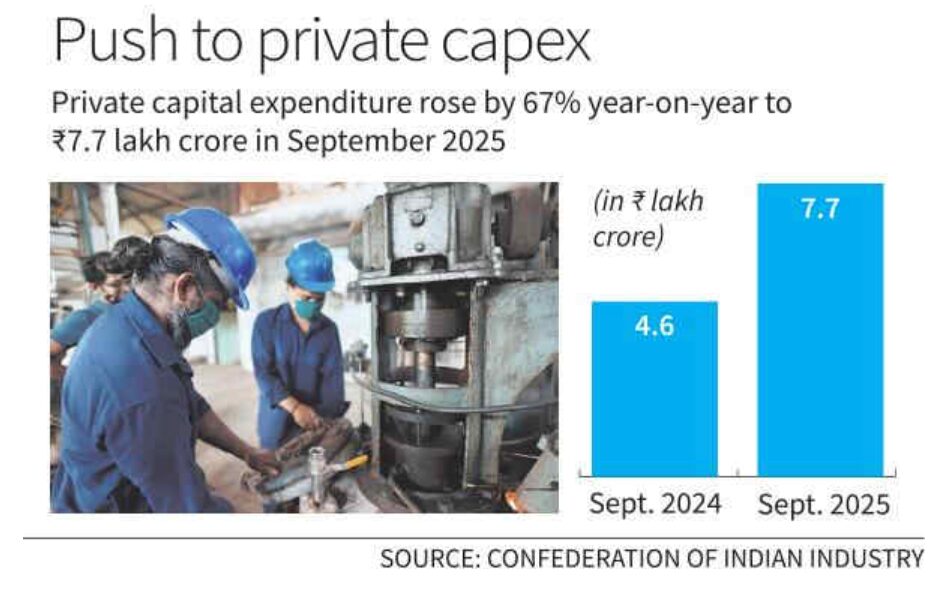
As per the industry body Confederation of Indian Industry (CII), India’s private sector capital expenditure surged 67% to ₹7.7 lakh crore ($81.48 billion) in September 2025 in comparison to September 2024.
| UPSC Relevance: GS-3 Economy: Growth and Development; Role of Private Sector in Economic Development Prelims: Capital Expenditure; Private Capex (key trends, Significance & challenges). |
Key Trends & Highlights:
The 67% increase in 2025 follows a 66.3% rise over the four years between FY 2021-22 and FY 2024-25, signalling a sustained, broad-based revival. While 2025-26 projects a temporary 25.5% decline due to high costs, overall investment sentiment remains robust.
- Sector Focus: Investments are primarily concentrated in renewable energy, electronics, semiconductors, steel, chemicals, and data centres.
- Funding Sources:
- Internal accruals: Approximately 65% of 2025-26 Capex is expected to be funded through internal accruals (funds generated internally by the company, including net profits and depreciation)
- Domestic debt: 23% of the funds from domestic debt (Money borrowed from financial institutions, banks, or bond markets within India).
- Manufacturing Dominance: Manufacturing leads sectoral capex with a 43.8% share (₹3.8 lakh crore led by metals, automobiles and chemicals). It is followed by information & communication (15.6%) and transportation (14%).
What is Capital Expenditure?
- Definition: Capital expenditure (CapEx) refers to funds used by companies or governments to acquire, upgrade, or maintain physical and intangible assets to improve or expand productive capacity.
- Key Purposes of CapEx:
- Creation of physical assets such as land, buildings, or machinery.
- Expansion of productive capacity, such as building a new factory.
- Modernisation and technology upgrades to improve efficiency, or adopting new technologies.
- Infrastructure development. E.g., Long-term investments in assets like roads, power grids, or data centres
What are the factors driving the Private Capex Revival?
- Robust Corporate Health: After years of debt reduction, Indian companies have significantly healthier balance sheets, with interest coverage ratios more than doubling between 2021 and 2025. Strong corporate earnings have increased internal accruals, which are now the primary funding source (approx. 65%) for new projects.
- Crowding-In Effect: Massive public investment in infrastructure (highways, railways, and defence) and schemes (like National Infrastructure Pipeline and Gati Shakti Mission) has created steady demand for core industries like steel and cement, “crowding in” private players to expand.
- PLI Schemes: The Production Linked Incentive (PLI) schemes have incentivised major investments in electronics, semiconductors, and automobile manufacturing.
- Monetary Easing: Recent rate cuts by the Reserve Bank of India (RBI) and lower inflation have reduced the cost of borrowing for new projects.
- Emerging Industries: A significant portion of growth is concentrated in “new-age” sectors such as Green Hydrogen, Electric Vehicles (EVs), Data Centres, and Renewables.
- Energy Transition: Commitments to net-zero goals are driving massive private investments in solar, wind, and battery manufacturing.
- Global Strategic Shifts: “China + 1” Strategy: Global supply chain diversification is encouraging Indian firms to expand domestic manufacturing to capture larger export market shares.
What is the Significance of Rising Private Capex?
Rising Capex is a vital indicator of economic health, representing a shift from consumption-led growth to investment-driven growth.
- Sustained Economic Growth: Higher Capex directly expands the capital stock, increasing the economy’s ability to produce goods and services. Private investment has a high multiplier effect, boosting national income and expanding secondary industries.
- Employment Generation: Capex-intensive sectors like manufacturing, infrastructure, renewable energy, and electronics create both direct employment and ancillary jobs. Industrial expansion and new-age sectors generate employment for the growing labour force.
- Boost to Manufacturing: Rising private investment boosts initiatives like the PLI Scheme, which has attracted over ₹2.16 lakh crore in investment and facilitated manufacturing capacity expansion. Private investments enhance the competitiveness of Indian goods globally.
- Technological Advancement: Investment is surging in new-age sectors like data centres, AI, and cloud computing, driven by 5G and structural demands. Adopting advanced technology boosts overall productivity and innovation capacity.
- Aids Green Transition: Strong investment in renewable energy, green hydrogen, and electric vehicles (EVs) helps reduce dependency on imported fossil fuels and helps transition towards a more sustainable industrial model.
- Strengthens Financial Sector: Increased corporate borrowing and investment deepens capital markets, enhances credit growth and improves banking sector profitability.
Associated Challenges:
- Uneven Sectoral Distribution: Investment is currently concentrated in a few high-growth pockets (like Capital-intensive industries). MSMEs still face credit constraints, technology gaps and demand volatility.
- Global Economic Risks: External challenges include geopolitical tensions, supply-chain disruptions, commodity price volatility and slow global growth.
- Capacity Utilisation Concerns: Sustained investment requires a strong consumer demand, export growth and higher industrial utilisation rates. Without adequate demand, fresh investments may slow.
- Demand Gap: Weak rural consumption and stagnant real wages remain a concern; without robust domestic demand, firms may pivot toward liquid financial assets rather than physical projects.
Tell Google you want more of this.
Add Anantam IAS as a preferred sourceOne tap, and this site shows up more often in your own Top Stories, AI Overviews and AI Mode. Remove it any time.