Why in News?
On 16 October, the Department of Science and Technology reported a Birbal Sahni Institute of Palaeosciences study reconstructing 4,600 years of monsoon, environmental and human history from Karela Lake sediments.
- Karela Lake is an oxbow lake near the Hulas Khera archaeological site, close to Lucknow in the Central Ganga Plain.
- Researchers combined radiocarbon chronology, carbon and nitrogen isotopes, grain-size analysis, end-member modelling and palynology.
- The reconstruction identifies four major environmental phases and examines links between hydrology, vegetation and early farming adaptation.
- The study appeared in the Journal of Asian Earth Sciences; the official release reports its findings, rather than announcing a new forecasting service.
- The Central Ganga Plain allows environmental records to be studied alongside evidence of agricultural and cultural development.
- A long record helps distinguish historical variability from assumptions based only on recent observations.
UPSC Relevance
Prelims Relevance
- Oxbow lakes and river meanders
- Accelerator mass spectrometry and radiocarbon chronology
- Palynology and fossil pollen
- Stable carbon and nitrogen isotopes
- Indian Summer Monsoon and westerly moisture
Mains Relevance
GS Paper 1
- Monsoon variability and human adaptation in the Ganga Plain.
- Combining geographical and archaeological evidence without climatic determinism.
GS Paper 3
- Wetlands as environmental archives and sources of adaptation evidence.
Essay
- Environmental constraints influence societies, but do not mechanically determine their choices.
Background and Context
Why Karela Connects Climate With Farming
The study joins a natural archive with a nearby archaeological setting, allowing climate and human activity to be examined together.
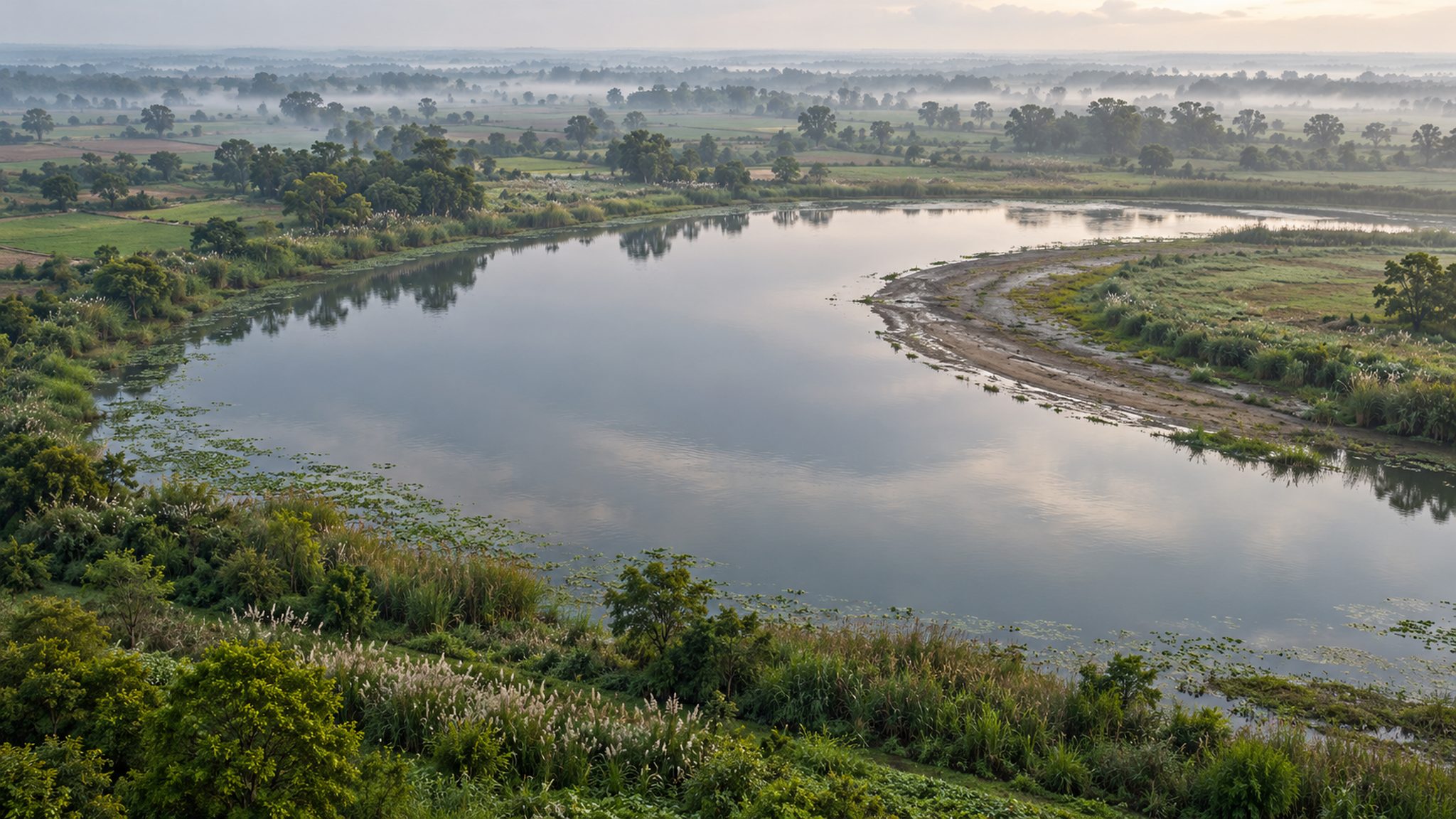
- Oxbow lakes form when a river meander becomes separated from the main channel. Their sediment accumulation can retain environmental information that would otherwise disappear from the active floodplain as channels shift.
- Karela Lake preserves Late Holocene sediments near Hulas Khera. This proximity offers a way to compare environmental change with evidence of agricultural communities, rather than treating a lake record as an isolated rainfall history.
- Monsoon fluctuations influence lake water conditions and the movement of sediment into the basin. Changing transport and deposition affect what becomes preserved, linking regional climate with the local archive that researchers eventually examine.
- Vegetation and organic matter add another layer of information: changes in surrounding plants, material reaching the lake and microbial activity can accompany hydrological change, rather than leaving only a simple wet-or-dry signal.
- Farming adaptation is the human dimension of the reconstruction. The reported record includes manure-based agricultural practices and herbivore evidence, helping researchers explore how land use interacted with changing conditions around the lake.
Dating the Record and Reading Its Signals
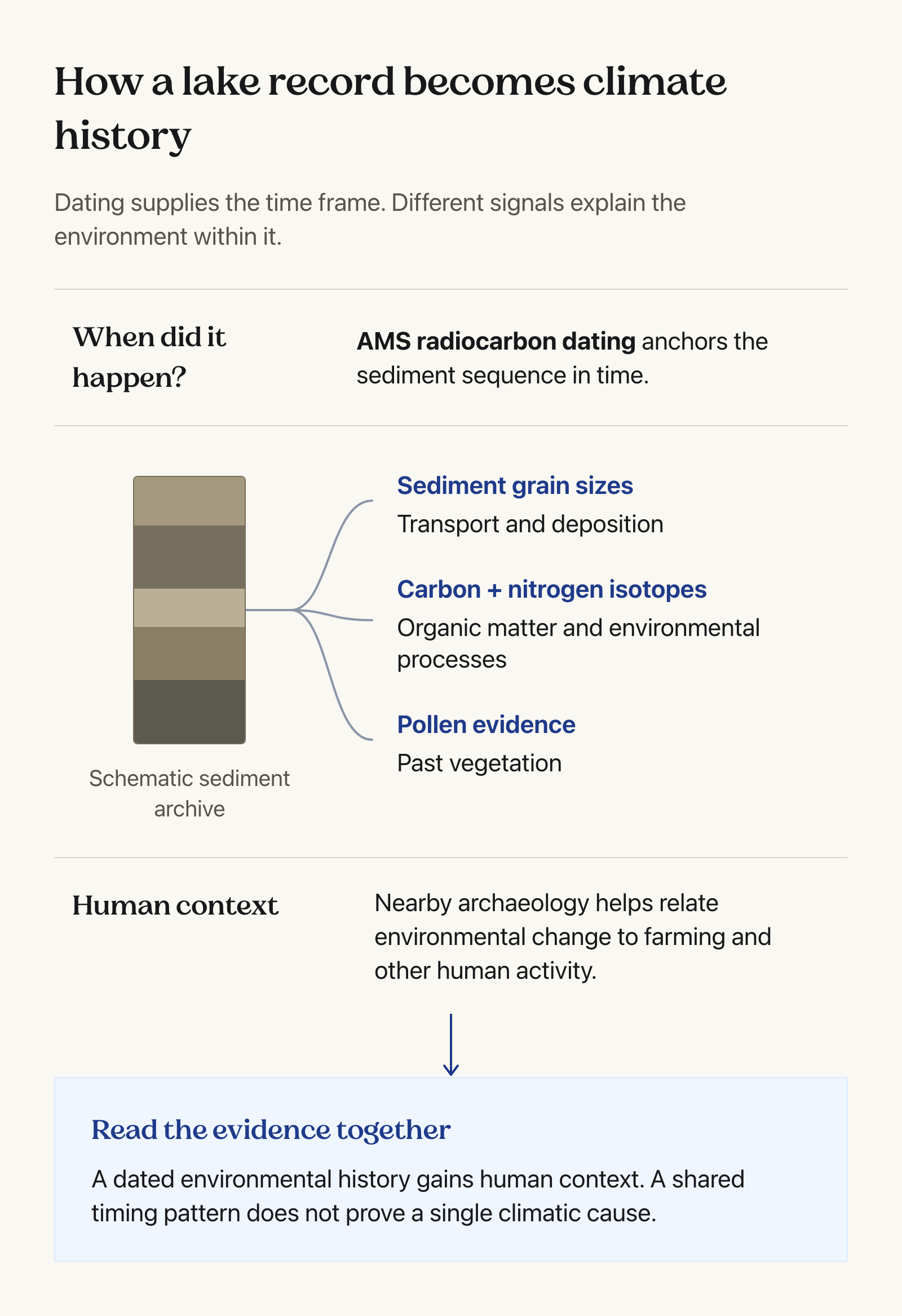
A chronology answers when change occurred; environmental proxies help explain what changed, while archaeology supplies the human context.
- AMS radiocarbon dating anchors the sediment chronology through measurements of radiocarbon. Its role is to constrain timing; it does not directly measure ancient monsoon rainfall or independently identify the cause of agricultural change.
- Stable carbon and nitrogen isotopes contribute evidence about sedimentary organic matter and environmental processes. Their interpretation belongs within the combined reconstruction, rather than equating a single isotope measurement with a precise rainfall amount.
- Grain-size analysis describes sediment particles, while end-member modelling helps distinguish components within their distributions. Together, these approaches support interpretation of sediment transport and deposition, which must be considered alongside changes in lake conditions.
- Palynology examines pollen and related biological remains to investigate vegetation history. The integrated study also reconstructs shifts between C₃ and C₄ vegetation, connecting plant responses with the wider environmental record preserved in sediments.
- Converging evidence strengthens an interpretation when different indicators support a consistent account within the dated sequence. Archaeological context then helps relate environmental conditions to human activity without substituting climate evidence for direct social evidence.
What the Reconstruction Can and Cannot Establish
The findings support long-term environmental understanding, but the interpretation must retain uncertainty about timing, mechanisms and human choices.
- Named climatic episodes discussed in the study include the 4.2 ka arid event, Roman Warm Period and Little Ice Age. The release does not supply exact boundaries for all four reconstructed phases.
- Westerly moisture also matters: the reported Little Ice Age record links moisture delivered by westerly winds with flooding during its colder phase. Not every wet signal should automatically be attributed to a stronger summer monsoon.
- Correlation is not a single cause: parallel environmental and archaeological changes can suggest relationships. They do not establish that one monsoon fluctuation alone caused migration, altered farming or determined the fate of an entire civilisation.
- Local sensitivity makes small oxbow lakes valuable archives, but a reconstruction from one basin is not automatically a complete regional history. Comparing records helps separate broader climatic influences from conditions specific to that lake.
- Reconstruction differs from prediction: this study investigates past conditions and provides baseline evidence. Its findings may inform adaptation and modelling, but do not constitute a forecast of the timing or intensity of future monsoons.
Way Forward
Use the Archive Without Overstating It
- Protect wetland sediment archives alongside their present ecological functions; disturbance can erase evidence needed to understand environmental change.
- Compare independently dated records across the region before generalising a local hydrological pattern.
- Use historical variability as one input to water and agricultural planning, alongside current observations and locally tested adaptation options.
Conclusion
- Karela Lake shows the value of combining chronology, environmental proxies and archaeological context: each contributes a different part of the explanation of changing monsoon conditions and human adaptation.
- For analysis, keep evidence and inference separate. A dated environmental record can illuminate the pressures facing farming communities without reducing their history to climate alone or promising a forecast of future rainfall.
UPSC Practice Questions
Prelims MCQ 1
With reference to palaeoenvironmental reconstruction, consider the following statements:
- AMS radiocarbon dating helps establish a chronology.
- Palynology can provide evidence of past vegetation.
- An isotope measurement by itself necessarily establishes an exact historical rainfall amount.
How many of the above statements are correct?
(a) Only one (b) Only two (c) All three (d) None
Answer: (b) Only two
Explanation:
The first two statements are correct. Isotope evidence requires contextual interpretation and does not by itself establish an exact rainfall amount.
Prelims MCQ 2
Which inference is most consistent with the Karela Lake reconstruction?
(a) Every flood signal proves a stronger summer monsoon. (b) A local lake record establishes a precise forecast for future monsoons. (c) Climate and archaeological evidence can be compared without assuming a single climatic cause for social change. (d) Radiocarbon dating directly measures historical rainfall.
Answer: (c) Climate and archaeological evidence can be compared without assuming a single climatic cause for social change.
Explanation:
The study integrates different evidence streams. Its past-environment reconstruction neither supplies a rainfall forecast nor proves that climate alone determined social outcomes.
UPSC Mains Questions
- How can lake sediments and archaeological evidence be combined to understand human adaptation to monsoon variability? Discuss the limits of such inference.
- Explain the relevance of long-term palaeoenvironmental records for wetland conservation and agricultural adaptation in the Ganga Plain.
Source: PIB, Ministry of Science & Technology.
Frequently Asked Questions
Where is Karela Lake?
Karela is an oxbow lake near Hulas Khera, close to Lucknow in the Central Ganga Plain. Its proximity to an archaeological site helps connect environmental reconstruction with evidence of past communities.
Why combine several environmental proxies?
Different proxies illuminate different processes, including sediment transport, vegetation and organic matter. Comparing them within a dated sequence strengthens interpretation and reduces dependence on an ambiguous signal from a single indicator.
Is radiocarbon dating a monsoon proxy?
Radiocarbon dating primarily provides chronological constraints. It helps researchers place environmental changes in time; other evidence, including sediment characteristics and biological or geochemical indicators, supports interpretation of the conditions associated with those changes.
Does the study predict future monsoons?
No. It reconstructs past environmental conditions and supplies a long-term baseline that may support further modelling and adaptation research. It does not forecast when a future monsoon will occur or how strong it will be.