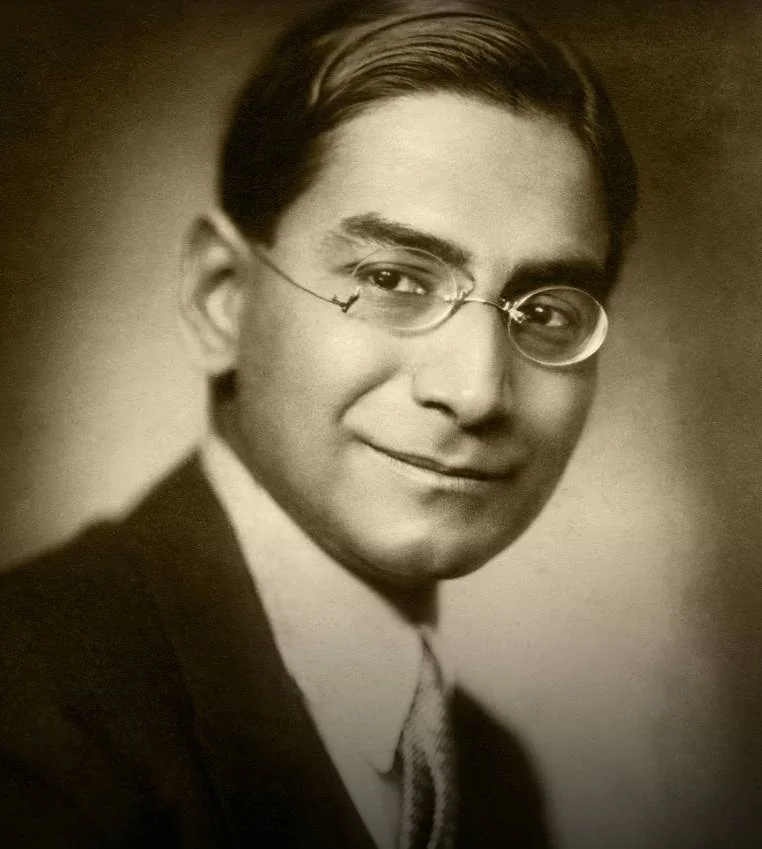
PC Mahalanobis (Prasanta Chandra Mahalanobis, 1893-1972) was the Indian scientist who built the country’s modern statistical system. He founded the Indian Statistical Institute in Kolkata in 1931, devised the measure now called the Mahalanobis distance, set up the National Sample Survey in 1950 and designed the economic model behind the Second Five-Year Plan. India marks his birthday, 29 June, as Statistics Day.
Most readers know him only as “the man behind the Second Plan”, and that’s the smaller half of his work. He was a physicist turned statistician who spent his life on a more basic problem: how a poor country can know itself accurately and cheaply, through samples rather than full counts. The planning model came late and is the most disputed part of his record. This note puts the statistics first and the plan in its place.
Who Was PC Mahalanobis?
He was a Cambridge-trained physicist who taught at Presidency College, Calcutta, and turned to statistics in the 1920s because he found real problems that needed it. Everything else in his career, from the institute to the plan, grew out of that turn.
| Fact | Detail |
|---|---|
| Born | 29 June 1893, Calcutta |
| Died | 28 June 1972, Calcutta, a day before his 79th birthday |
| Education | B.Sc. (Physics honours), Presidency College, 1912; Mathematics and Physics Triposes, King’s College, Cambridge, 1914-15 |
| Founded | Indian Statistical Institute (meeting of 17 December 1931; registered 28 April 1932) |
| Journal | Sankhya, the Indian Journal of Statistics, from 1933 |
| Known for | Mahalanobis distance; large-scale sample surveys; National Sample Survey (1950); Second Plan model |
| Government roles | Honorary Statistical Adviser to the Cabinet from 1949; chairman, National Income Committee, 1949; member, Planning Commission |
| Honours | Fellow of the Royal Society (1945); Padma Vibhushan (1968) |
| Commemoration | Statistics Day, 29 June, observed since 2007 |
How Did His Life Unfold?
His life falls into four phases, and each one added a piece to the system he left behind.
Calcutta and Cambridge, 1893 to 1915
Mahalanobis was born into a Brahmo family in Calcutta and studied physics at Presidency College, graduating in 1912. At Cambridge he took Part I of the Mathematics Tripos in 1914 and Part II of the Physics Tripos in 1915. There he chanced on bound volumes of Biometrika, Karl Pearson’s statistics journal, in the King’s College library. He bought a full set and carried it home. That purchase changed his career.
Physicist turned statistician, 1915 to 1931
Back in Calcutta he joined the Indian Educational Service in 1915 and taught physics at Presidency College, later becoming its principal. But his real work moved toward data. In 1920 Nelson Annandale of the Zoological Survey of India asked him to analyse body measurements of Anglo-Indians in Calcutta, which led to his first scientific paper in 1922. He also worked as a meteorologist in Calcutta from 1922 to 1926.
The flood studies of this period show his method best. After a disastrous flood in North Bengal in 1922, engineers proposed basins to hold back floodwater. His analysis of about 50 years of rainfall and flood records showed the basins wouldn’t help and that faster drainage was the real need. After a severe flood on the Brahmani in Orissa in 1926, engineers said the riverbed had risen and wanted higher embankments. His study of about 60 years of data showed the bed hadn’t changed, and recommended dams upstream instead. His calculations for a multipurpose scheme on the Mahanadi system formed the basis of the Hirakud project, inaugurated in 1957. Data beat assumption, twice.
The institute builder, 1931 to 1949
An informal Statistical Laboratory had grown in his room at Presidency College. On 17 December 1931 a public meeting founded the Indian Statistical Institute (ISI), registered on 28 April 1932 as a learned society. In 1933 he launched the journal Sankhya. In 1937 the ISI estimated jute acreage in Bengal by random sampling, and over 1937-44 it ran surveys on everything from consumer spending to crop disease. He was elected a Fellow of the Royal Society in 1945.
The nation’s statistician, 1949 to 1972
After independence the government turned to him to build an official statistical system. In 1949 he became Honorary Statistical Adviser to the Cabinet and chaired the National Income Committee, which set out how India should measure its national income. The National Sample Survey followed in 1950 and the Central Statistical Organisation in 1951. In 1954 Prime Minister Jawaharlal Nehru and the Planning Commission asked him to start planning studies at the ISI, which led to his models for the Second Plan. In 1959 Parliament declared the ISI an institution of national importance. He died on 28 June 1972, still directing the institute and still advising the government.
What Is the Mahalanobis Distance?
The Mahalanobis distance is a way of measuring how far apart two groups, or a point and a group, are when you look at many measurements at once. He developed it from his anthropometric work and set it out in “On the generalised distance in statistics” in the Proceedings of the National Institute of Sciences of India in 1936. Statisticians often write it as D-squared.
Here’s the problem it solves. Suppose you compare two communities on height, head length and nose width. Plain distance would just add up the differences. But these measurements move together: taller people tend to have longer heads. Adding the raw gaps counts the same underlying difference twice, and a measurement on a big scale swamps one on a small scale.
The Mahalanobis distance corrects for both. It scales each measurement by how much it normally varies and discounts the overlap between measurements that are correlated. Picture a crowd photographed from above, spread out as a long oval rather than a circle. A person standing at the end of the oval isn’t unusual; a person the same number of steps away but off to the side is. Ordinary distance treats them the same; the Mahalanobis distance sees the oval. The picture works for two measurements, but the real power is that the same logic holds for ten or fifty at once, where no picture helps.
Today the measure is used in cluster analysis, classification, outlier detection, quality control and machine learning. Mahalanobis himself pushed past the tool to a harder question: whether the conclusions depended on which measurements a researcher happened to choose.
How Did He Change Survey Methods?
He made the large-scale sample survey reliable enough for governments to trust. Before him, official data in India was mostly a by-product of administration. He argued that a properly designed sample could give useful data quickly, cheaply and with known accuracy. His basic results appeared in 1944 in the Philosophical Transactions of the Royal Society.
His three contributions to survey method:
- Pilot surveys. A small trial run before the main survey, to estimate costs, test questionnaires and build a sampling frame.
- Optimum survey design. Choosing sample size and structure by weighing statistical accuracy against field costs.
- Interpenetrating sub-samples. Splitting the sample into independent parts handled by different teams, so that errors by any one investigator show up when the parts are compared.
The last idea is the most clever, and it’s simple once you see it. If two teams independently survey matched halves of the same area and get very different answers, something is wrong with the fieldwork. The survey checks itself.
The National Sample Survey, set up in 1950, put these ideas to work across the country, and it’s still the backbone of India’s data on consumption, employment and living conditions. His crop-cutting method, which used small circular plots to estimate yield, did spark a long argument with agricultural statisticians who preferred larger plots and the existing administrative system; the ISI’s own record holds that the small cuts were cheaper and free from bias when properly standardised.
What Was the Mahalanobis Model?
The Mahalanobis model was the growth strategy behind the Second Five-Year Plan (1956-61): invest heavily in basic and capital goods industries so that the economy can grow faster in the long run. He first built a two-sector model and then a four-sector model.
The logic runs like this. An economy produces two kinds of things: consumer goods, which people use up, and capital goods, such as steel and machines, which make other goods. If a bigger share of investment goes into making capital goods, the economy’s capacity to produce grows faster each year, even though consumption grows slowly at first. Picture a farmer who keeps more seed for next season rather than eating it all; the harvest after next is larger. The analogy holds for the idea of sacrifice now for growth later, but it breaks at the scale: a country can’t keep its seed in a sack, and building steel plants takes foreign exchange, skills and years.
The four-sector version split consumer goods further:
- Capital goods, to be built up through large public-sector industry.
- Factory consumer goods.
- Household and small-industry consumer goods, to absorb labour and meet demand without much capital.
- Services, including health and education.
He set two goals for it: doubling national income and reducing unemployment substantially over about twenty years. The plan’s heavy-industry push, steel plants and machine-building among them, reflected this model, and it shaped Indian industrial policy from 1950 to 1991. The note on five-year plans of India sets the Second Plan in that longer story.
What Do Historians and Economists Dispute?
The statistics side of his record is widely admired; the planning side is argued over. A fair answer keeps the two apart.
- Agriculture and wage goods. Critics argued that the model gave too little weight to agriculture and to the food and basic goods workers buy with their wages. Economists C. N. Vakil and P. R. Brahmananda proposed a wage-goods model as an alternative.
- Foreign exchange. The heavy investment needed imported machinery, and the Second Plan ran into a foreign exchange crunch in its early years.
- Originality. Similar two-sector logic appears in the work of the Soviet economist G. A. Feldman in the 1920s, which is why textbooks sometimes speak of the Feldman-Mahalanobis model. Mahalanobis is generally credited with working out his version independently.
- Long-run effect. Defenders point to the industrial and scientific base India built in the 1950s and 1960s; critics point to slow growth and shortages that lasted into the 1980s. Both sides are judging the strategy, not the statistician.
Even the crop-survey debate fits this pattern. It was a quarrel about method between capable statisticians, not a question about his integrity or his science.
PC Mahalanobis Today
His institutions are his legacy. The NSS and the Central Statistical Organisation merged in 2019 into the National Statistical Office, and the ISI remains an institution of national importance.
Statistics Day keeps his name in view. The Ministry of Statistics and Programme Implementation held the 20th Statistics Day on 29 June 2026, his 133rd birth anniversary, on the theme “Unlocking the Potential of Administrative Data”. The 2025 theme was “75 Years of National Sample Survey”, marking the survey he founded.
The ISI itself is in the middle of a legal change. The Indian Statistical Institute Bill, 2026 was introduced in the Lok Sabha on 3 August 2026 to repeal and replace the ISI Act, 1959 and make the institute a statutory body corporate with a Board of Governors. It was referred to a parliamentary standing committee on 1 September 2026. The site’s note on the ISI Bill covers the governance debate.
How to Study PC Mahalanobis for Exams
He appears in General Studies Paper III (planning, growth strategy and industrial policy), in Paper I (post-independence consolidation and personalities) and in Prelims as a matching or statement question on institutions, dates and the Second Plan.
Revision facts to keep:
- Born 29 June 1893, Calcutta; died 28 June 1972.
- Founded the Indian Statistical Institute in 1931; Sankhya from 1933.
- Mahalanobis distance (D-squared), set out in 1936.
- Honorary Statistical Adviser to the Cabinet and chairman of the National Income Committee, 1949.
- National Sample Survey, 1950; ISI an institution of national importance under the ISI Act, 1959.
- Architect of the Second Five-Year Plan (1956-61) and its heavy-industry strategy.
- Statistics Day on 29 June since 2007; Padma Vibhushan 1968.
Keep these apart. The Mahalanobis model drove the Second Plan, not the First, which leaned on the Harrod-Domar framework and agriculture. The ISI dates to 1931, but its national-importance status dates to 1959. And the NSS (1950) is his; the CSO (1951) grew from the Central Statistical Unit he headed.
| Plan | Period | Main model or focus |
|---|---|---|
| First Five-Year Plan | 1951-56 | Agriculture and irrigation; Harrod-Domar growth framework |
| Second Five-Year Plan | 1956-61 | Mahalanobis model; heavy and basic industry |
| Third Five-Year Plan | 1961-66 | Self-reliant growth; disrupted by war and drought |
See the note on planning in India for the wider arc, and the one on Jawaharlal Nehru for the political side of the partnership.
How is the theme tested? Mains asks about the planning system and its successor rather than about his biography. Mains 2018 GS Paper III asked: “How are the principles followed by the NITI Aayog different from those followed by the erstwhile Planning Commission in India?” The Mahalanobis model is the clearest example of the old Commission’s top-down, investment-led approach. In the Prelims bank, Indian Economy accounts for 256 of the 1,403 questions from 2013 to 2026, and planning history is a steady part of that share.
The judgment for your preparation: lead with the statistician. Anyone can write “architect of the Second Plan”. An answer that explains why a sample survey with interpenetrating sub-samples was a breakthrough for a poor country, and then weighs the planning model’s costs fairly, shows you understand why 29 June is Statistics Day and not Planning Day.
Frequently Asked Questions
Who was PC Mahalanobis?
Prasanta Chandra Mahalanobis (1893-1972) was an Indian physicist and statistician who founded the Indian Statistical Institute in 1931, set up the National Sample Survey in 1950 and designed the model behind the Second Five-Year Plan. He’s often called the father of Indian statistics.
Why is 29 June celebrated as Statistics Day in India?
29 June is the birth anniversary of PC Mahalanobis, and the Government of India designated it Statistics Day to honour his contributions to statistics and economic planning. It has been observed with a theme every year since 2007; the 2026 theme was ‘Unlocking the Potential of Administrative Data’.
What is the Mahalanobis distance?
It’s a measure of how far a point or group lies from another group when many measurements are considered together. It adjusts for how much each measurement varies and for correlation between them. Mahalanobis set it out in 1936, and it’s now used in classification, outlier detection and machine learning.
What is the Mahalanobis model?
It’s the growth model behind the Second Five-Year Plan (1956-61). It argued that putting a larger share of investment into capital goods and basic industries would raise long-run growth. He first built a two-sector version and then a four-sector one.
When was the Indian Statistical Institute founded?
The ISI was founded at a meeting on 17 December 1931 in Calcutta and registered as a society on 28 April 1932. Parliament declared it an institution of national importance through the ISI Act of 1959.
What was the role of PC Mahalanobis in the National Sample Survey?
He established the National Sample Survey in 1950 to collect socio-economic data through sample surveys across India, partly to fill gaps in national income estimates. It drew on survey methods he had developed at the ISI between 1937 and 1944.
What awards did PC Mahalanobis receive?
He was elected a Fellow of the Royal Society of London in 1945 and received the Padma Vibhushan in 1968. He was also President of the Indian Science Congress in 1950 and a founder fellow of the Indian National Science Academy.
Practice Questions
Prelims
1. Consider the following statements about PC Mahalanobis: 1. He founded the Indian Statistical Institute in 1931. 2. He was the principal architect of the First Five-Year Plan. Which of the statements given above is/are correct?
- (a) 1 only
- (b) 2 only
- (c) Both 1 and 2
- (d) Neither 1 nor 2
Answer: (a) He founded the ISI in 1931; his model shaped the Second Plan, not the First.
2. Consider the following statements: 1. The Indian Statistical Institute was declared an institution of national importance by an Act of Parliament in 1959. 2. The National Sample Survey was established in 1950. Which of the statements given above is/are correct?
- (a) 1 only
- (b) 2 only
- (c) Both 1 and 2
- (d) Neither 1 nor 2
Answer: (c) Both dates are correct.
3. Statistics Day in India is observed on:
- (a) 20 October
- (b) 29 June
- (c) 1 July
- (d) 28 February
Answer: (b) 29 June, the birth anniversary of PC Mahalanobis.
4. The Mahalanobis distance is best described as:
- (a) A measure of income inequality between two regions
- (b) A multivariate measure of distance that accounts for correlation among variables
- (c) The straight-line distance between two places on a map
- (d) A measure of the gap between planned and actual investment
Answer: (b) It measures distance across many correlated measurements at once.
5. The ‘interpenetrating sub-samples’ technique introduced by Mahalanobis is used mainly to:
- (a) Increase the response rate of households
- (b) Detect and control errors made by field investigators
- (c) Reduce the number of variables in a survey
- (d) Replace a population census
Answer: (b) Independent sub-samples handled by different teams reveal fieldwork errors when compared.
Mains
- How are the principles followed by the NITI Aayog different from those followed by the erstwhile Planning Commission in India? (15 marks, 250 words) Previous year: Mains 2018, GS Paper III.
- Explain the Mahalanobis model and evaluate its impact on India’s industrial development during the Second Five-Year Plan. (15 marks, 250 words)
- PC Mahalanobis is remembered more for statistics than for planning. Discuss his contribution to building India’s official statistical system. (10 marks, 150 words)
- Why are large-scale sample surveys important for policy-making in a developing country? Illustrate with reference to the National Sample Survey. (10 marks, 150 words)
- Critically examine the criticism that the Second Five-Year Plan neglected agriculture and wage goods. (15 marks, 250 words)
Tell Google you want more of this.
Add Anantam IAS as a preferred sourceOne tap, and this site shows up more often in your own Top Stories, AI Overviews and AI Mode. Remove it any time.