
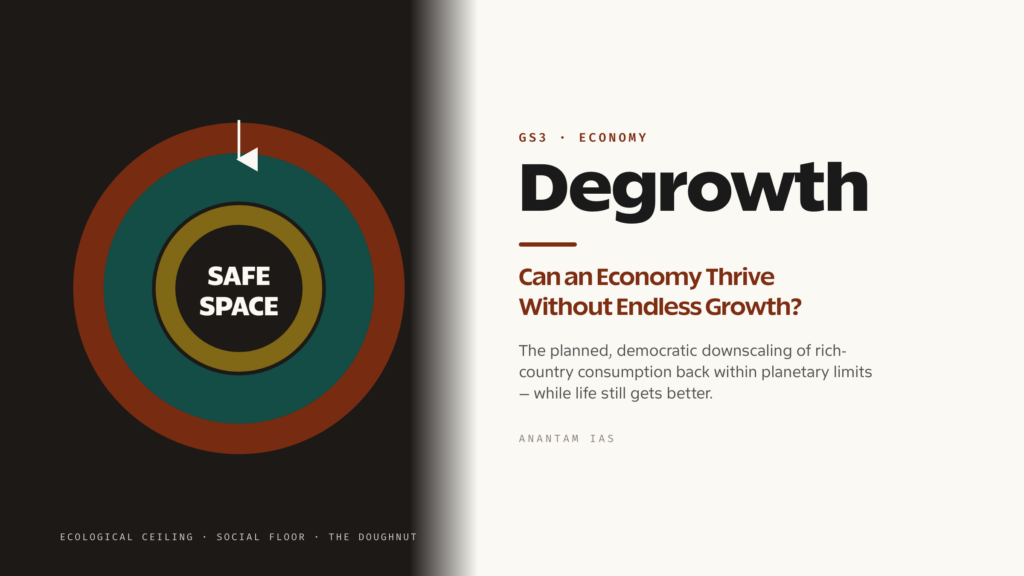
For two centuries, almost every government on earth has agreed on one thing: the economy must grow. A rising gross domestic product is the headline number that decides whether a finance minister is praised or blamed, whether a country feels successful or stuck. Degrowth is the heretical idea that this consensus is the problem. It argues that the richest economies have grown so large that their hunger for materials and energy is now breaking the living systems they depend on, and that the honest response is not to grow a little greener but to deliberately, democratically shrink — to use less stuff and less energy while making life better, not worse, for the people inside those economies.
That sounds like economic suicide, and the first job of any serious aspirant is to see why it isn’t quite what it appears. Degrowth is not a wish for recession, and it is not a programme for India or any poor country. It is a targeted argument aimed at high-income nations, built on a single uncomfortable observation: the green dream of growing the economy while emissions fall on their own has not happened fast enough or far enough to keep the planet safe. For UPSC, the topic sits exactly where GS Paper 3 wants you to be sharp — the meeting point of the economy, the environment and sustainable development — and it rewards a candidate who can hold a radical idea up to scrutiny without either swallowing it whole or dismissing it.
What Degrowth Actually Argues
Start with the claim, because most arguments about degrowth go wrong by misstating it. Degrowth, as set out by economists like Jason Hickel and the late Serge Latouche, is the planned, democratic reduction of production and consumption in rich economies, aimed at bringing their resource and energy use back within ecological limits while improving human wellbeing. Every word in that sentence is load-bearing. Planned and democratic means a chosen, managed transition, not a crash. Rich economies means it is addressed to the wealthy world, not the poor. Resource and energy use — what scholars call throughput — is the real target, not GDP for its own sake. And improving wellbeing is the goal that separates it from austerity.
The intellectual root is an idea older than the word itself. The Romanian economist Nicholas Georgescu-Roegen argued in the 1970s that an economy is a physical system that takes in low-entropy energy and materials and spits out waste and heat, so it cannot expand forever on a finite planet. Herman Daly built on this with steady-state economics — an economy held at a stable size, neither growing nor shrinking. Serge Latouche gave the movement its rallying cry, the “decolonisation of the imaginary,” meaning we must unlearn the deep cultural assumption that more is always better. And Tim Jackson’s 2009 book Prosperity Without Growth, written for a UK government commission, put the case in plain language: prosperity is the capacity to flourish, and a society can deliver that without forever expanding its GDP. Kate Raworth’s doughnut economics sits alongside this family, picturing a safe zone between a social floor of human needs and an ecological ceiling.
So the core argument runs like this. Wellbeing in rich countries long ago stopped tracking GDP — beyond a point, more income buys little extra happiness, health or life expectancy, which is the same gap that fuels the wider search for measures of progress beyond GDP. Yet the economy keeps growing, which keeps pushing resource and energy use upward, which keeps stressing the climate, biodiversity and the other planetary boundaries that mark the safe operating space for humanity. Degrowth proposes to cut the cord. If growth is no longer making rich societies meaningfully better off but is making the planet measurably worse off, the rational move is to stop chasing it and to organise the economy around enough rather than more.
The Decoupling Debate: Green Growth Versus Degrowth
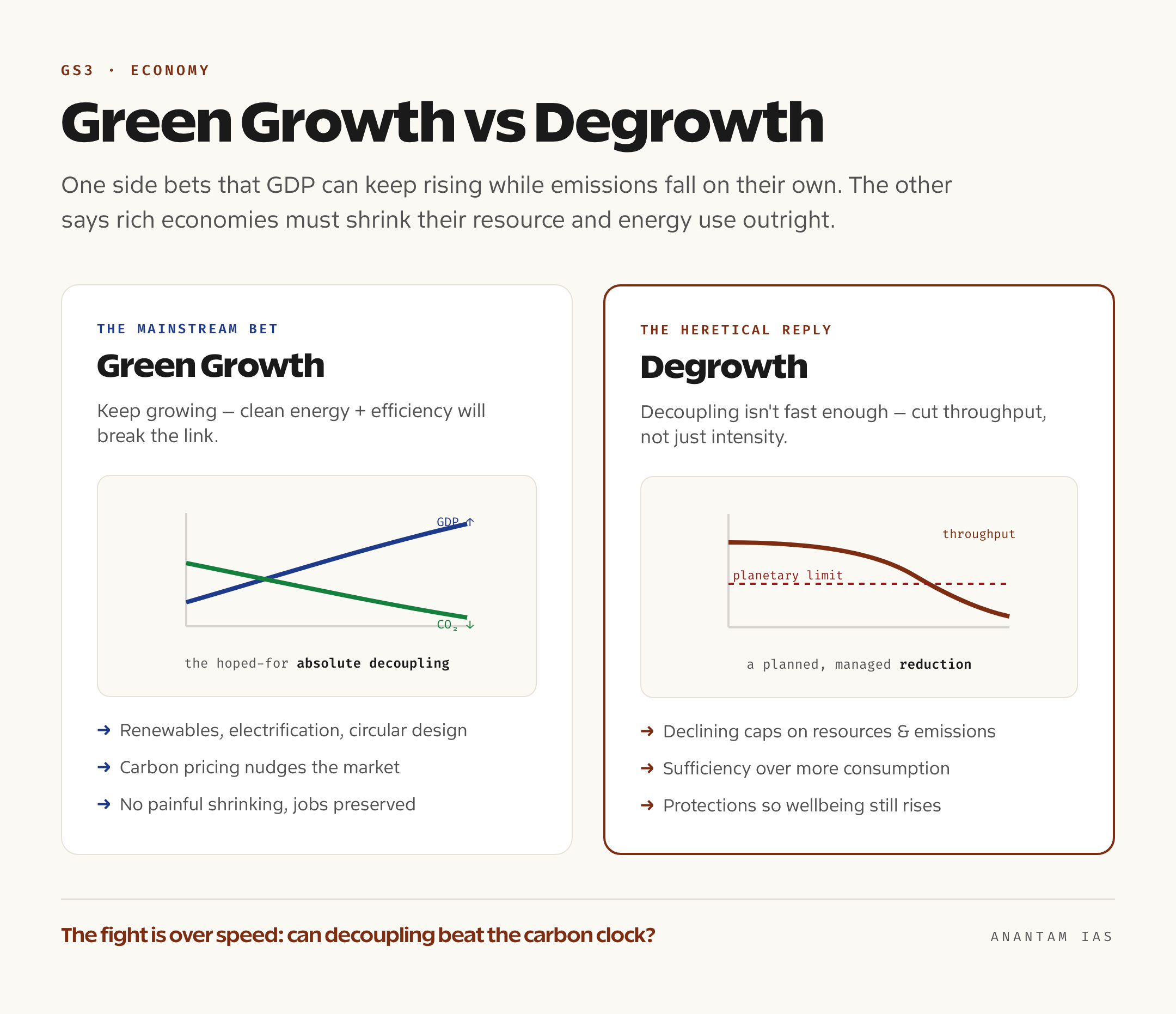
The whole quarrel turns on one technical word — decoupling — so it pays to get it exactly right. Decoupling means breaking the link between economic growth and environmental harm, so that GDP can rise while emissions or resource use fall. Relative decoupling is when the economy grows faster than its environmental impact, so the impact per dollar drops but the total can still climb. Absolute decoupling is the real prize: GDP rises while total emissions or resource use actually fall in absolute terms. Green growth — the mainstream position behind most climate policy, from the European Green Deal to India’s renewable push — bets that absolute decoupling can be achieved fast enough, mainly by swapping fossil fuels for clean energy and squeezing more output from every tonne of material.
Degrowth’s central empirical claim is that this bet is losing against the clock. Some rich countries have managed absolute decoupling of GDP from territorial emissions, which proves green growth is not impossible. But a 2025 review in The Lancet Planetary Health, co-authored by Hickel, Jackson and Giorgos Kallis, argued the rates are nowhere near fast enough: to keep warming under 1.5°C or 2°C while the economy keeps growing at normal rates, emissions would have to fall faster than any decoupling on record, because more growth means more energy demand pulling in the opposite direction. The honest reading of the modelling, degrowth scholars say, is that the only pathways that cut emissions quickly enough involve reducing resource and energy use outright — not just hoping efficiency outruns growth. Material-resource use, in particular, has shown no sign of absolute decoupling at the global level at all.
The green-growth camp answers, with real force, that degrowth’s medicine may be worse than the disease. Deliberately shrinking a modern economy could throw millions out of work, blow holes in pension and welfare systems built on growth, and collapse the public support any climate policy needs. Critics also point out that clean technology — solar, wind, batteries, electrification — has fallen in cost faster than almost anyone predicted, which strengthens the case that we can build our way out rather than shrink our way out. So the debate is genuinely open. Degrowth says the maths of decoupling doesn’t add up in time; green growth says the politics and economics of shrinking don’t add up at all. A good answer presents both blades of that scissor rather than picking a side too cheaply.
What Degrowth Does and Doesn’t Mean
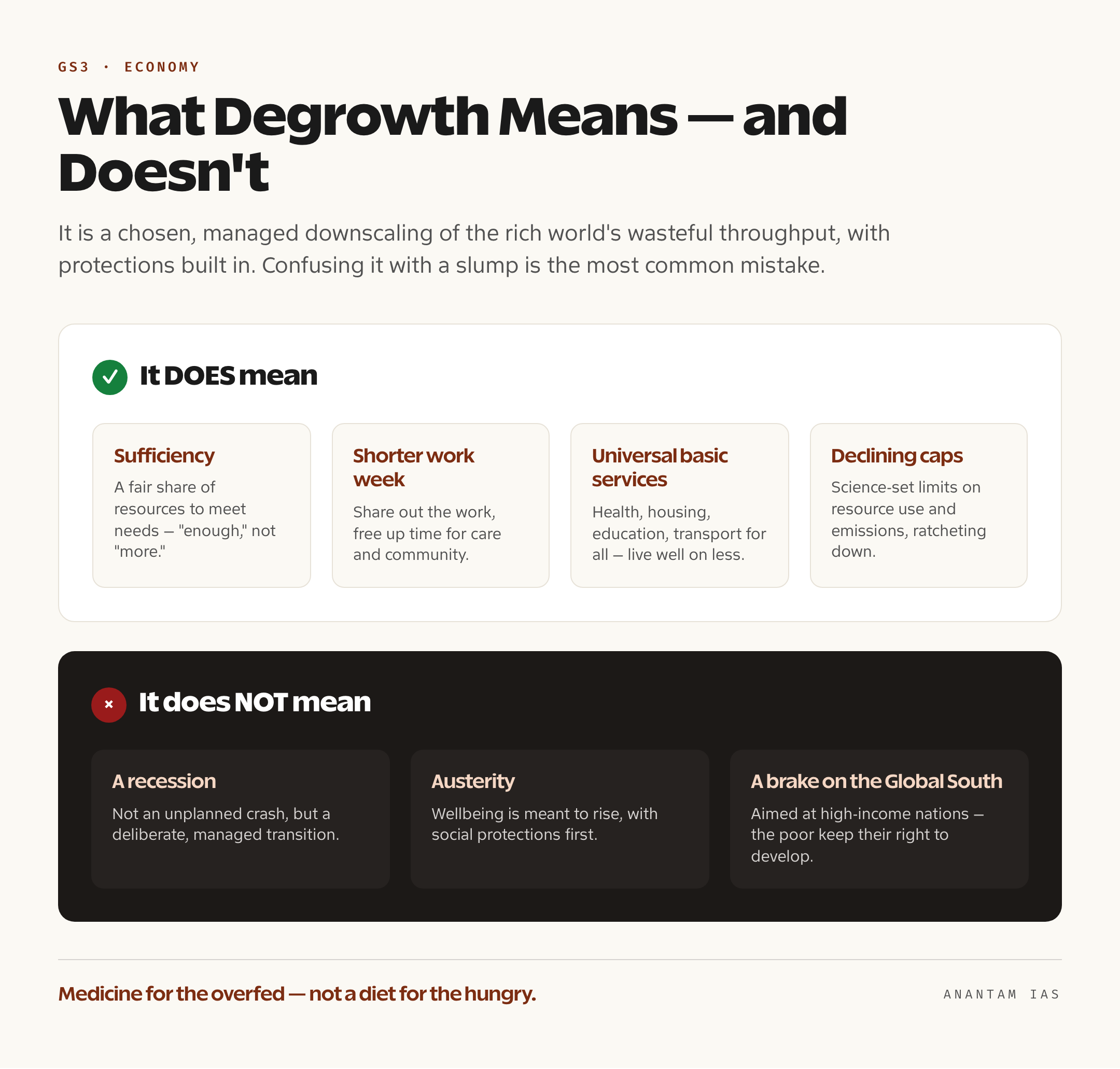
Half the resistance to degrowth comes from a misreading, so clearing the fog is worth a paragraph or two. Degrowth is not recession. A recession is an unplanned, chaotic contraction in a growth-dependent economy that throws people out of work and destabilises society — degrowth scholars are at pains to say their proposal is the opposite, a deliberate and managed shrinking of the most wasteful parts of the economy with social protections built in from the start. It is not a demand that everyone become poorer; it is a demand that rich societies stop measuring success by a number that no longer serves them. And it is not anti-technology or a romantic call to return to the past.
What degrowth does mean is a concrete menu of policies, and naming a few of them makes the idea real on the page. The first is sufficiency — the principle that there is a level of “enough,” and that everyone should have a fair share of resources to meet their needs while total resource use is capped. The second is work-time reduction: a shorter working week so that a smaller economy can still keep people employed and share out the work, with more time for care, community and rest. The third is universal basic services — guaranteeing healthcare, housing, education and transport to all, so that people can live well on lower private incomes and don’t need to earn and consume ever more to feel secure. Latouche packaged the spirit of this in his “eight Rs,” a chain that begins with re-evaluate and re-conceptualise our values and ends with the familiar reduce, reuse, recycle.
Two more levers complete the toolkit. Degrowth proposes hard, declining caps on resource extraction and carbon emissions — limits set by science, not by markets, that ratchet downward over time. And it leans toward redistribution: maximum-income caps, wealth taxes and stronger floors, on the logic that a smaller pie can still deliver a good life for everyone if it is shared far more equally. So the picture is not deprivation. It is a society that works fewer hours, leans on shared public services rather than private consumption, throttles back the most ecologically destructive industries, and calls that progress. Whether voters would ever choose it is a separate, harder question — and it is where the critique bites hardest.
The Critique and the Feasibility Problem
No UPSC-grade treatment of degrowth is complete without taking the objections seriously, because they are strong. The first is political feasibility. Few electorates anywhere will vote for a programme that can be painted as planned poverty, and opponents of climate action are only too happy to caricature any talk of “consuming less” as a demand for sacrifice. The risk is that degrowth, by attacking growth head-on, hands ammunition to those who want to do nothing at all. Surveys testing public appetite for degrowth-style policies find more support than you might expect for specific measures like a four-day week or basic services, but far less for the word “degrowth” itself or for the headline idea of shrinking the economy.
The second objection is technical and institutional. Modern economies are wired for growth in ways that are hard to unpick: pensions, public debt, banking and employment all assume an expanding base, and a shrinking economy can set off vicious spirals of debt and unemployment. Degrowth scholars have answers — stock-flow-consistent models from Tim Jackson and Peter Victor, for instance, try to show how a non-growing economy could stay stable — but these remain largely theoretical, never tested at the scale of a real high-income country. Critics, including many sympathetic environmentalists, argue that betting the climate on an untried and politically toxic transition is reckless when proven tools like carbon pricing, clean-energy deployment and efficiency are available now.
The third, and for the developing world the sharpest, objection is one degrowth itself accepts: a strategy that depends on rich countries voluntarily restraining themselves is ethically attractive but practically fragile. As analysts of the Global South have warned, a poor country cannot build its development plan on the hope that wealthy societies will choose to consume less. This is exactly why honest degrowth thinkers insist the idea applies only to high-income nations — and it is the hinge on which the whole India question turns. Because if degrowth is medicine for the overfed, the obvious next question is what it has to say to a country that is still, by any measure, hungry.
Where India Fits: Growth, Sufficiency and “LiFE”
Here the answer must be careful and confident at once, and the rule is simple: degrowth is not a prescription for India. India remains a developing country where hundreds of millions still need more energy, more infrastructure, more income and more of the basic goods that growth delivers. Its per-capita emissions are a fraction of those in the rich world, and its per-capita consumption of almost every resource is low. To ask India to “degrow” would be to freeze inequality in place and deny its people the development that the West already enjoyed. Degrowth’s own logic concedes this: the historical responsibility for breaching planetary boundaries sits overwhelmingly with high-income nations, and the right to develop sits with the Global South. India’s task is to grow — but to grow differently.
That is where India’s own framing becomes the bridge. The country’s official language is “sustainable development,” not degrowth: growth that meets present needs without robbing future generations. And India has added a distinctive cultural note through the LiFE initiative — Lifestyle for Environment — launched by Prime Minister Narendra Modi and taken to global forums, which urges mindful and deliberate use of resources over mindless, wasteful consumption. LiFE explicitly invokes the Gandhian line that “the world has enough for everyone’s need, but not for everyone’s greed.” Read closely, this is sufficiency — a cousin of the degrowth idea — but aimed at consumer behaviour and the rich rather than at the size of a poor country’s economy. It lets India press the moral core of the argument (the wealthy must rein in their excess) while protecting its own non-negotiable right to develop.
So the Indian position is best stated as a clean distinction. Degrowth is a demand made of the rich; development is the right of the poor; and sufficiency is the shared ethic that can apply to both at different scales. India can champion frugality, circularity, renewable energy and LiFE-style mindful consumption at home, and it can use the degrowth critique as a sharp diplomatic tool abroad — to argue that the burden of cutting back falls first on those who grew the most. That is the framing examiners reward: not a starry-eyed endorsement of shrinking the economy, and not a flat rejection of the underlying ecological warning, but a position that turns the argument’s strongest insight into a case for climate justice and a smarter kind of growth.
For Your Mains Answer
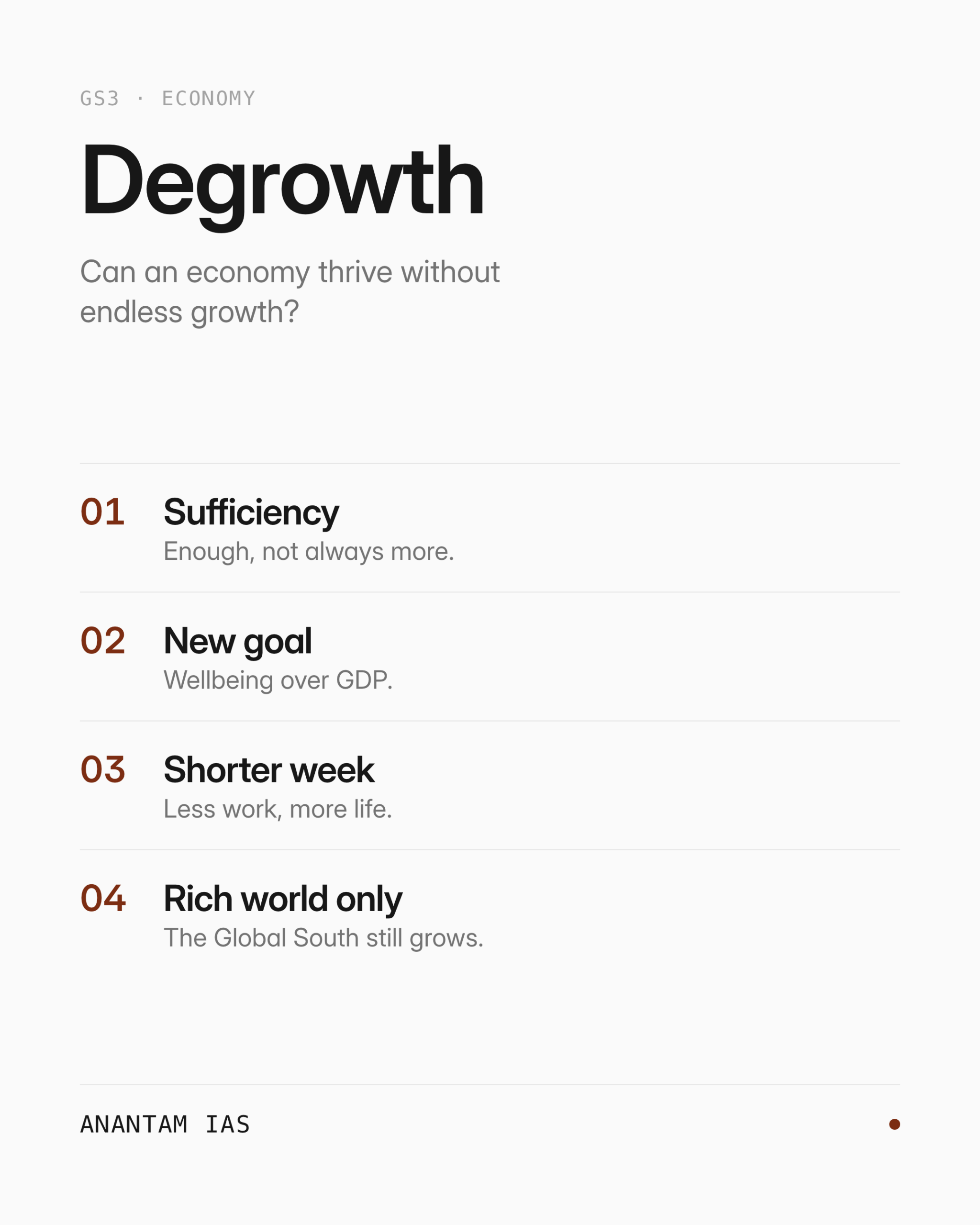
This is a high-value, cross-cutting topic for GS Paper 3, which covers the Indian economy, growth and development, environment, and sustainable development. It can also enrich an Essay on themes of progress, limits, sustainability or “development versus environment.” The examiner’s reward goes to the candidate who can define a radical idea precisely, weigh it fairly, and then land the India angle without confusion. The single most important move is to keep three things apart: degrowth (for the rich), development (for the poor), and sufficiency (the shared ethic).
How to Build the Answer
Open by defining degrowth in one tight sentence — the planned, democratic downscaling of rich-country throughput within planetary limits while improving wellbeing — and immediately say what it is not (not recession, not for poor countries). Then move in a chain: the core argument (growth no longer raises wellbeing in rich nations but keeps breaching planetary boundaries) → the decoupling debate (green growth bets on absolute decoupling; degrowth says it isn’t fast enough) → what degrowth means in practice (sufficiency, shorter work week, universal basic services, caps, redistribution) → the critique (political feasibility, growth-dependent institutions, fragility of relying on rich-world restraint) → the India angle (sustainable development plus LiFE, growth as a right). Close with a balanced verdict.
Common Mistakes to Avoid
Don’t equate degrowth with recession or austerity — it is planned and protective, and that distinction is itself examinable. Don’t suggest degrowth is a path for India; it is explicitly aimed at high-income nations. Don’t claim decoupling is impossible — relative and even some absolute decoupling exist; the degrowth claim is about speed and scale, not impossibility. And don’t ignore the critique: an answer that only praises degrowth reads as one-sided.
A Compact Answer Spine
Degrowth = planned, democratic downscaling of rich-country resource and energy use within planetary boundaries while raising wellbeing (Hickel, Latouche, Jackson, Daly’s steady state) → premise: beyond a point GDP stops lifting wellbeing but keeps stressing the planet → green growth bets on absolute decoupling; degrowth says it’s too slow to hold 1.5-2°C → tools: sufficiency, work-time reduction, universal basic services, declining caps on throughput, redistribution → critiques: political feasibility, growth-dependent institutions, fragile reliance on rich-world restraint → India: degrowth is for the rich; India’s right to develop stands; its frame is “sustainable development” + LiFE (mindful consumption, “need not greed”) → verdict: reject as a target for India, use as a case for climate justice and smarter growth.
Diagram or Flowchart Idea
Draw two concentric rings — an inner social floor (basic needs met) and an outer ecological ceiling (planetary boundaries), the doughnut’s “safe and just space” between them — with an arrow showing rich economies overshooting the outer ring and degrowth pulling them back in, while a second arrow shows poor economies rising from below the inner ring through development. One image captures the whole asymmetry: shrink the overshoot, lift the shortfall.
A Balanced-Conclusion Line
A line that lands the marks: “Degrowth is less a blueprint for India than a mirror held up to the rich world — a reminder that the planet’s limits are real, that endless growth in already-wealthy societies has costs, and that India’s task is not to stop growing but to grow within those limits, turning sufficiency into a strength rather than a sacrifice.”
How to Use Data Without Cramming
You need only a handful of anchors, not a literature review: the contrast between relative and absolute decoupling; the Lancet Planetary Health 2025 finding that decoupling isn’t fast enough to hold 1.5-2°C under continued growth; the four signature policies (sufficiency, shorter work week, universal basic services, declining caps); and India’s LiFE line, “enough for everyone’s need, not everyone’s greed.” Attribute plainly — “as a 2025 review in The Lancet Planetary Health argued” — rather than scattering claims without a source.
Frequently Asked Questions
Is degrowth the same as a recession?
No, and this is the distinction that earns marks. A recession is an unplanned, chaotic contraction in a growth-dependent economy that throws people out of work and destabilises society. Degrowth is the opposite: a deliberate, democratic and managed reduction of the most wasteful production and consumption in rich economies, with social protections like shorter working weeks and universal basic services built in so that wellbeing rises even as the economy’s physical size falls.
Does degrowth apply to India?
No. Degrowth is aimed squarely at high-income nations whose throughput already overshoots planetary limits. India is still a developing country with low per-capita emissions and consumption, and hundreds of millions who need the energy, infrastructure and income that growth delivers. India’s right to develop stands. What India does share with the degrowth argument is the ethic of sufficiency, expressed through “sustainable development” and the LiFE initiative’s call for mindful rather than wasteful consumption.
What is the green-growth versus degrowth debate?
Green growth holds that economies can keep growing while emissions and resource use fall, through clean energy and efficiency — so-called absolute decoupling. Degrowth argues that decoupling, while real in places, is not happening fast or fully enough to keep warming within 1.5-2°C if rich economies keep growing, so those economies must cut their resource and energy use outright. Green growth replies that deliberately shrinking an economy is politically and economically dangerous. Both sides have a point, which is why the debate stays live.
Who are the main thinkers behind degrowth?
The lineage runs from Nicholas Georgescu-Roegen, who framed the economy as a physical system bound by entropy, to Herman Daly’s steady-state economics. Serge Latouche gave the movement its philosophy — the “decolonisation of the imaginary” and the “eight Rs” — while Tim Jackson’s Prosperity Without Growth (2009) and Jason Hickel’s later work made the economic case. Kate Raworth’s doughnut economics is an adjacent framework that pictures a safe space between a social floor and an ecological ceiling.
Practice Questions
Prelims MCQs
- With reference to “degrowth,” which of the following best describes it?
(a) An unplanned contraction of a growth-dependent economy
(b) The planned, democratic reduction of production and consumption in rich economies within ecological limits while improving wellbeing
(c) A policy requiring all countries to halt economic growth immediately
(d) A strategy for developing countries to leapfrog industrialisation
Answer: (b) Degrowth is a deliberate, managed downscaling aimed at high-income nations, not a recession and not a prescription for poor countries. - The term “absolute decoupling” in the green-growth debate refers to which of the following?
(a) GDP rising while total emissions or resource use fall in absolute terms
(b) The economy growing faster than its environmental impact, though impact still rises
(c) Separating monetary policy from fiscal policy
(d) Delinking the rupee from the US dollar
Answer: (a) Absolute decoupling means total impact falls even as GDP grows; relative decoupling only means impact per unit of GDP falls while the total can still rise. - Which thinker is most associated with the concept of the “steady-state economy”?
(a) Serge Latouche
(b) Kate Raworth
(c) Herman Daly
(d) Jason Hickel
Answer: (c) Herman Daly developed steady-state economics — an economy held at a stable physical size; Daly built on Nicholas Georgescu-Roegen’s entropy-based view of the economy. - The “LiFE” initiative associated with India promotes which of the following?
(a) Mandatory degrowth targets for Indian states
(b) Mindful and deliberate use of resources over wasteful consumption
(c) A four-day working week across the economy
(d) Caps on India’s GDP growth rate
Answer: (b) LiFE — Lifestyle for Environment — urges sustainable, mindful consumption, invoking the line that the world has enough for everyone’s need but not everyone’s greed; it is a sufficiency ethic, not a degrowth target. - Which of the following are commonly cited degrowth policy proposals? (1) Work-time reduction (2) Universal basic services (3) Declining caps on resource use and emissions (4) Mandatory annual GDP growth targets. Select the correct answer.
(a) 1, 2 and 3 only
(b) 1, 2 and 4 only
(c) 2, 3 and 4 only
(d) 1, 2, 3 and 4
Answer: (a) Work-time reduction, universal basic services and declining caps are core degrowth proposals; mandatory GDP growth targets are the opposite of degrowth.
Mains Practice Questions
- “Degrowth is not a recession but a planned transition.” Examine the core argument of degrowth economics and explain why its proponents insist it applies only to high-income nations. (15 marks, 250 words)
- Critically analyse the debate between green growth and degrowth, with particular reference to the evidence on decoupling economic growth from environmental impact. (15 marks, 250 words)
- Discuss the main policy instruments proposed by degrowth thinkers and evaluate the political and institutional obstacles to implementing them in a modern economy. (15 marks, 250 words)
- “For India, degrowth is a mirror, not a blueprint.” Discuss India’s position on growth, sustainable development and the sufficiency ethic embodied in the LiFE initiative. (10 marks, 150 words)
- Endless economic growth on a finite planet is widely questioned, yet growth remains central to development. Evaluate how India can reconcile its right to develop with the ecological concerns raised by the degrowth and post-growth debate. (15 marks, 250 words)
Tell Google you want more of this.
Add Anantam IAS as a preferred sourceOne tap, and this site shows up more often in your own Top Stories, AI Overviews and AI Mode. Remove it any time.