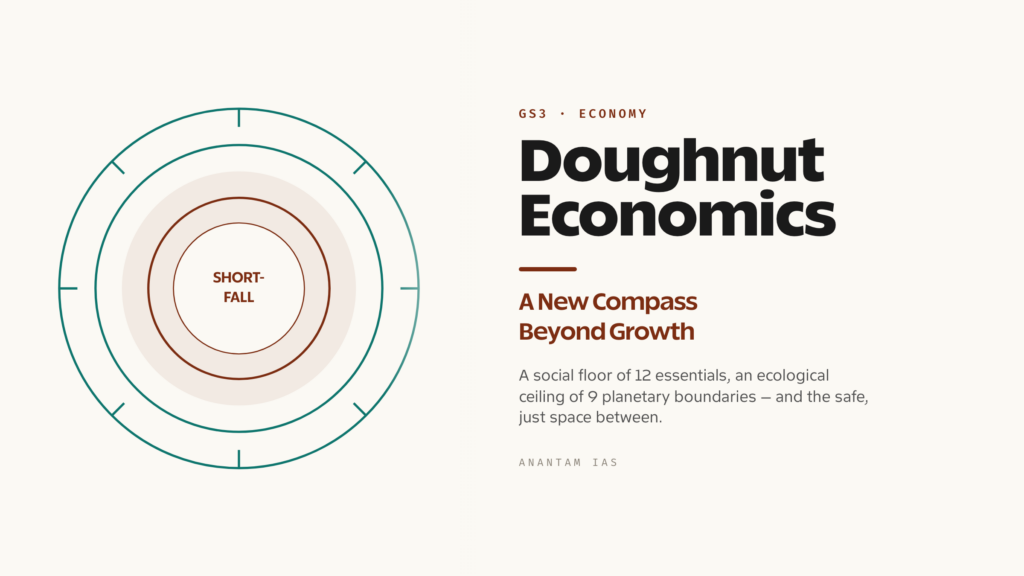
For nearly a century, one number has run the world. Gross Domestic Product — the money value of everything an economy produces in a year — became the scoreboard by which finance ministers, voters and headline writers judged whether a country was winning or losing. Grow it, and you were a success; let it stall, and you had a crisis. But a quiet rebellion against that scoreboard has been building, and its most memorable image is a doughnut. In 2017 the Oxford economist Kate Raworth published Doughnut Economics: Seven Ways to Think Like a 21st-Century Economist, and the picture at its heart — two rings with a sweet spot in between — has since travelled from a research diagram to the policy framework of whole cities. It asks a deceptively simple question: what if the goal of an economy were not to grow forever, but to meet everyone’s needs without wrecking the planet?
That question matters far beyond academic seminars, and it matters acutely for India. A country still lifting hundreds of millions out of deprivation cannot simply switch off growth, yet it is also among the most exposed to climate stress, water scarcity and polluted air. The doughnut hands an aspirant a single, vivid frame for the central dilemma of GS Paper 3 — development versus sustainability — and a vocabulary that ties together the Sustainable Development Goals, the planetary-boundaries science and the long argument over what GDP does and does not measure. So it is worth understanding the model properly, not as a slogan but as a tool you can sketch and defend in an answer.
What the Doughnut Actually Is
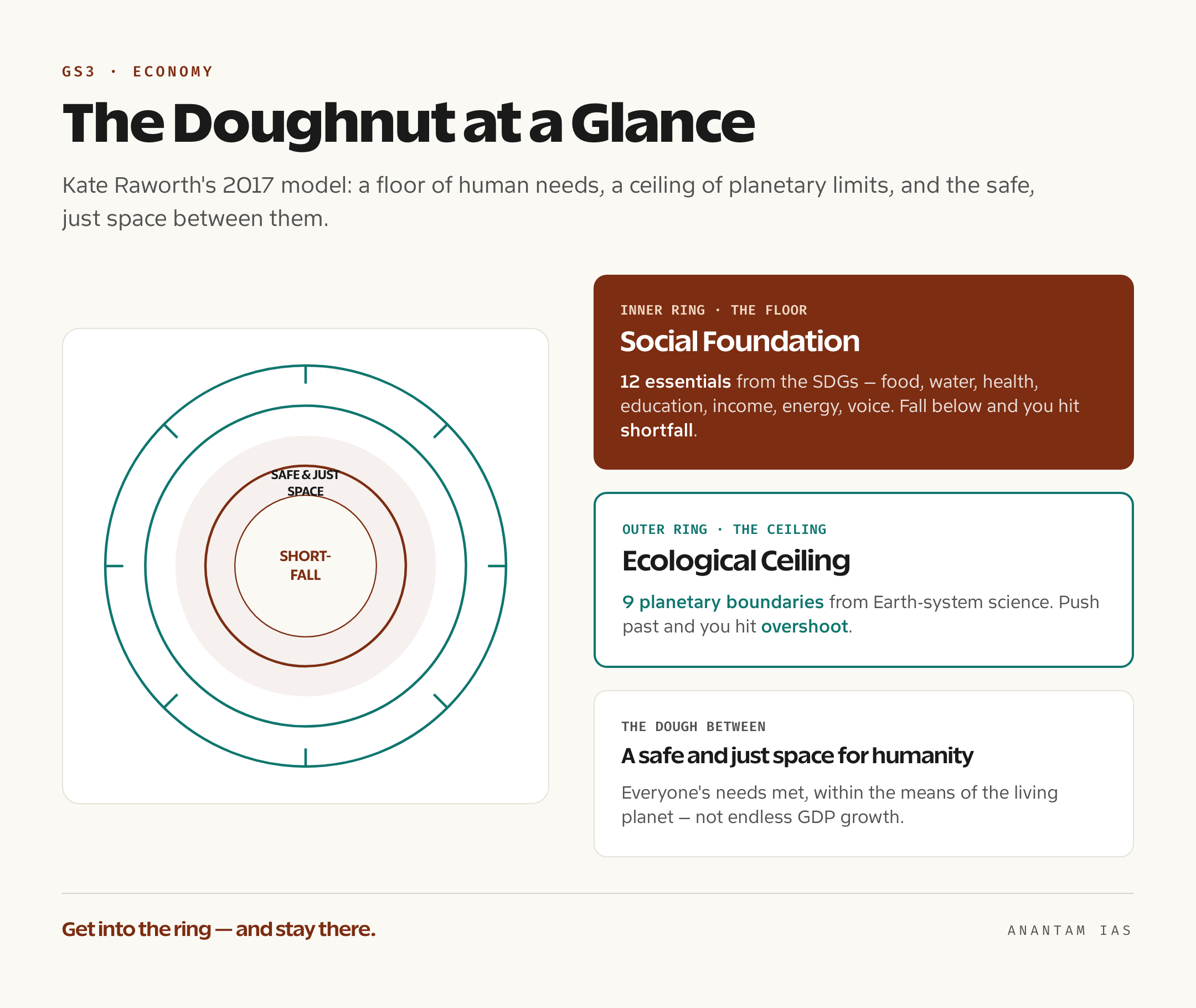
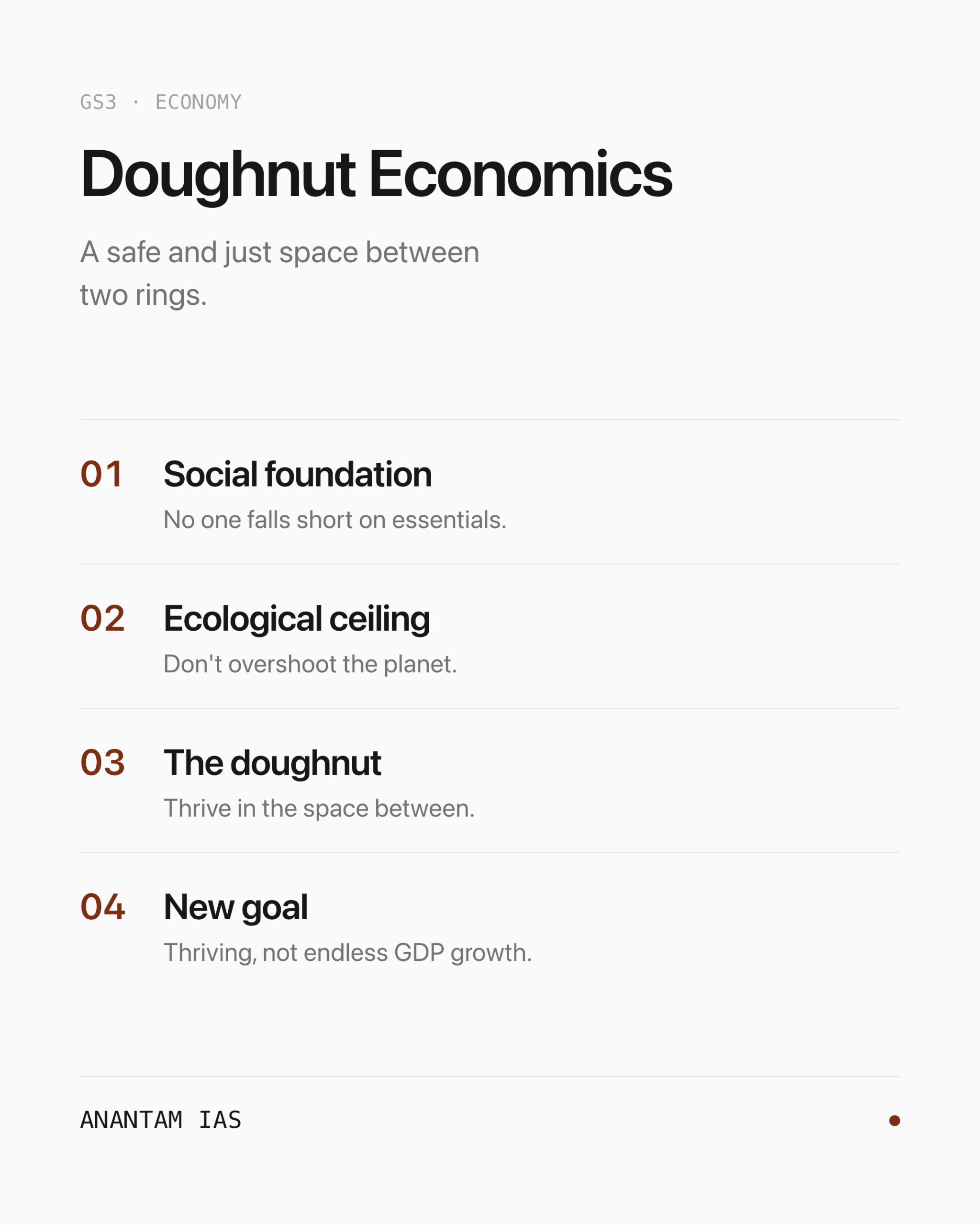
Picture a ring doughnut seen from above — two concentric circles with the dough in between. That shape is the whole idea. Raworth first drew it in a 2012 Oxfam paper titled A Safe and Just Space for Humanity, then built the 2017 book around it. The inner ring is the social foundation: the minimum every person needs for a life of dignity. Fall through the hole in the middle and you land in shortfall — hunger, illiteracy, no clean water, no political voice. The outer ring is the ecological ceiling: the limits of what the living planet can take. Push past it and you tip into overshoot — a destabilised climate, collapsing biodiversity, poisoned soils and seas. The dough itself, the ring between the two rings, is what Raworth calls the safe and just space for humanity — an economy that is, in her words, both “ecologically safe and socially just,” where no one is left falling short and the planet’s life-support systems are not breached. The aim of economic life, in this view, is to get everyone into that ring and keep them there.
What makes the doughnut more than a pretty diagram is that both rings are filled with real, measurable dimensions rather than vague aspirations. The inner ring is built from twelve essentials of the social foundation, drawn directly from the priorities the world’s governments agreed in the Sustainable Development Goals in 2015. They are: food, water, health, education, income and work, peace and justice, political voice, social equity, gender equality, housing, networks (access to information and community) and energy. The outer ring is built from the nine planetary boundaries identified by Earth-system scientists at the Stockholm Resilience Centre — the safe operating limits for the natural systems that keep the planet stable. Between a floor of human needs and a ceiling of planetary limits sits the doughnut, and the genius of the design is that it lets you see deprivation and ecological damage on the same page, as two failures of the same system rather than two separate problems.
The Two Rings: Social Foundation and Ecological Ceiling
Start with the floor. The social foundation says there is a minimum below which no human should fall, and it converts the lofty language of the SDGs into a checklist you can audit. A society does badly on the doughnut if large numbers of its people lack any of those twelve essentials — if children are out of school, if women are shut out of work and voice, if households cook on dirty fuel or have no secure roof. This is the “just” half of the safe and just space, and it is the half that resonates most in a developing country, because for hundreds of millions the urgent problem is not overshoot but shortfall. The doughnut does not treat poverty as a footnote to growth; it puts meeting everyone’s basic needs at the dead centre of what an economy is for.
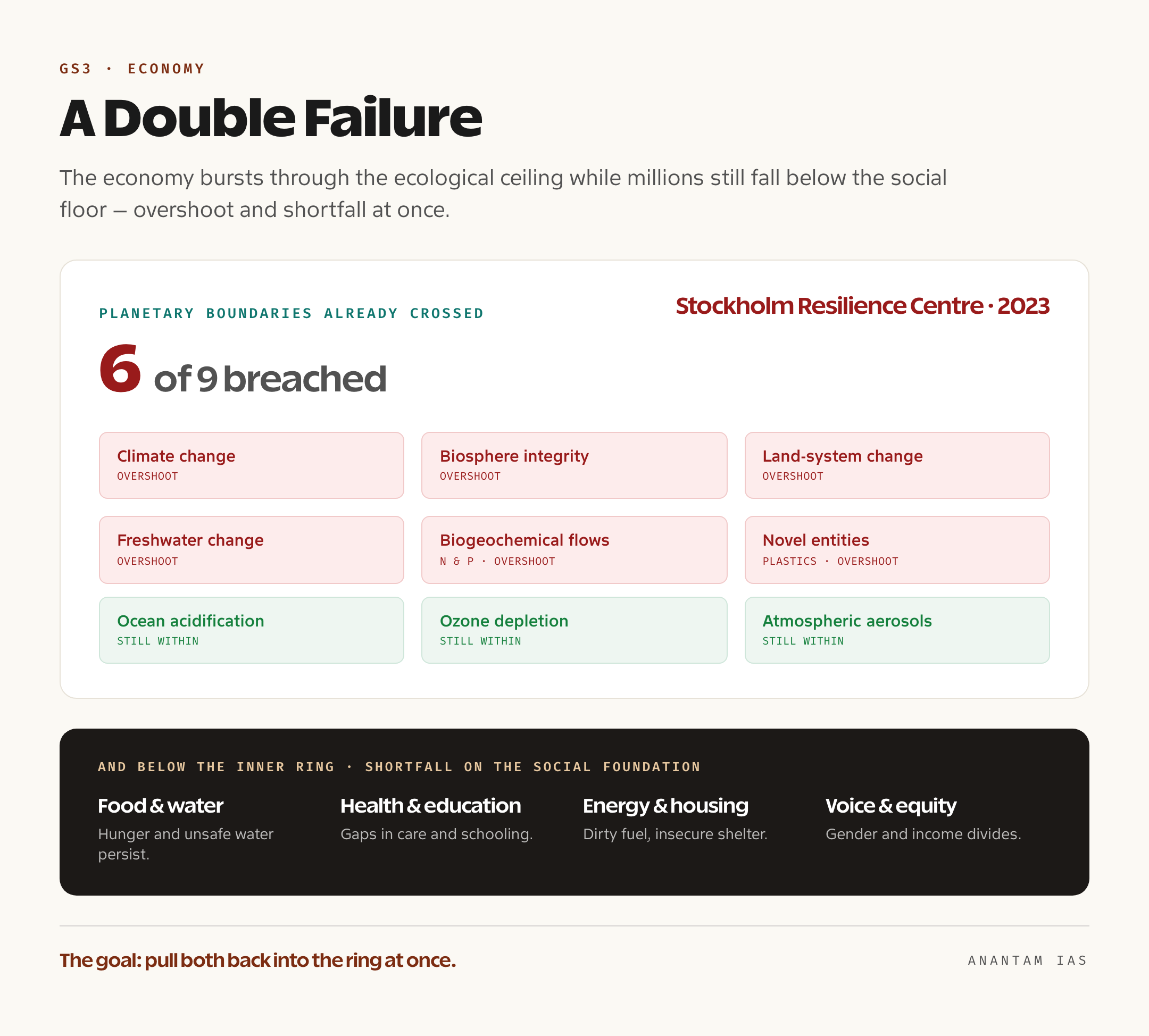
Now the ceiling. The ecological ceiling is the outer boundary, and it rests on the planetary-boundaries framework — the set of nine Earth-system processes, from climate to freshwater, that scientists say humanity must stay within to avoid dangerous, possibly irreversible, change. The nine are climate change, biodiversity loss (biosphere integrity), land-system change, freshwater change, the nitrogen and phosphorus cycles (biogeochemical flows), ocean acidification, ozone depletion, atmospheric aerosol loading and novel entities such as plastics and synthetic chemicals. They are not abstract: a 2023 update from the Stockholm Resilience Centre concluded that humanity has already crossed six of the nine — climate change, biosphere integrity, land-system change, freshwater change, biogeochemical flows and novel entities — meaning we are living in overshoot on most of them. If you want the full architecture of that ceiling, the detail of each boundary and where Earth stands, our explainer on the nine planetary boundaries lays it out. The point for the doughnut is stark: the human economy has already burst through the outer ring on multiple fronts even while millions remain stuck below the inner one. We are overshooting the ceiling and undershooting the floor at the same time — which is exactly the double failure the model is built to expose.
Seven Ways to Think Like a 21st-Century Economist
The doughnut is the goal; the rest of the book is about how to get there. Raworth argues that mainstream economics is still taught with twentieth-century diagrams and assumptions — a self-correcting market, “rational economic man,” growth as an unquestioned good — that quietly steer the world toward overshoot and inequality. So she offers seven shifts in thinking to replace them. First, change the goal: stop treating GDP growth as the target and aim instead for the doughnut — thriving within the social and ecological boundaries. Second, see the big picture: redraw the economy not as a closed circular flow of money but as embedded inside society and the living planet, dependent on the Sun’s energy and the Earth’s materials. Third, nurture human nature: drop the cartoon of the calculating, self-interested individual and recognise people as social, reciprocating, often cooperative beings. Fourth, get savvy with systems: replace the neat supply-and-demand cross with the messy feedback loops and tipping points of complex systems. Fifth, design to distribute: build economies that share value widely by design — in how enterprises are owned, how money is created, how land and knowledge are held — rather than relying on growth to trickle down later. Sixth, create to regenerate: move from a take-make-use-throw line to a circular economy that works with nature’s cycles, regenerating rather than depleting. And seventh, be agnostic about growth: design economies that can thrive whether or not GDP keeps rising, instead of ones that collapse without it.
The thread running through all seven is a single contrast Raworth keeps returning to. Today’s economy, she argues, is “divisive and degenerative by default” — it concentrates wealth and runs down nature unless something stops it. Tomorrow’s must be “distributive and regenerative by design” — built from the start to spread value and restore the living world. That phrase is the whole programme in eight words, and it is worth memorising, because it converts a sprawling argument into a single testable claim: are our institutions designed to distribute and regenerate, or are they merely hoping growth will fix distribution and technology will fix the environment later?
The Quarrel with GDP and Endless Growth
At the centre of the model sits a direct challenge to the idea that has organised economic policy since the mid-twentieth century: that more growth is always the answer. Raworth’s most quoted image is that GDP growth has become “the cuckoo in the nest” of economics — the chick that hatches in someone else’s nest and pushes the other eggs out, so that a single goal crowds out every other aim a society might have. We have, she argues, become “structurally addicted” to growth: our pensions, our banks, our politics and our sense of progress are all wired to assume the number keeps rising, which makes any pause feel like catastrophe rather than maturity. The problem is not that growth is always bad — for a low-income country it can be exactly what lifts people across the social foundation — but that endless, undifferentiated growth on a finite planet eventually drives the economy through the ecological ceiling.
Her quarrel is also with what GDP fails to count. As a single money-value of output, GDP rises when forests are felled and sold, when traffic jams burn more fuel, when illness fills hospital beds — and it ignores unpaid care work, the health of ecosystems and how income is shared. A country can post handsome GDP figures while its rivers die and its poorest go hungry; the doughnut is designed to catch precisely what the headline number misses. Raworth does not call for a crude halt to growth, and she is careful to separate herself from any simple “anti-growth” slogan. Her stance is agnosticism: an economy should be built to meet human needs within planetary limits whether it grows, holds steady or shrinks, rather than being chained to perpetual expansion. That is the part critics push back on hardest — sceptics argue the model is strong on diagnosis but thin on the hard mechanics of how a modern economy actually runs without growth, especially one still trying to industrialise. It is a fair challenge, and a balanced answer should name it rather than dodge it.
From Diagram to Policy: Adoption and India’s Stake
What lifts the doughnut above the usual run of big-think economics is that real governments have started using it. In April 2020, in the depths of the first COVID-19 lockdown, the city of Amsterdam became the first place in the world to adopt the doughnut as the official framework for its recovery — working with Raworth’s Doughnut Economics Action Lab (DEAL), the organisation she co-founded to turn the idea into practice, to build a “city doughnut” measuring how well Amsterdam meets its residents’ needs without overshooting its fair share of planetary limits. The city paired it with a circular-economy strategy targeting a halving of new raw-material use by 2030 and a fully circular city by 2050, and a grassroots “doughnut coalition” of hundreds of local groups grew up around it. Amsterdam’s move was contagious: Copenhagen, Brussels, and cities as far apart as Dunedin in New Zealand and Nanaimo in Canada took up versions of the same tool, and DEAL now supports a worldwide community downscaling the global doughnut to neighbourhoods, businesses and regions. It remains a framework for measuring and steering rather than a finished policy machine, but it has moved decisively out of the seminar room.
For India the doughnut is less a ready-made plan than a clarifying mirror, and that is exactly its value. India sits in the hardest part of the diagram — deep shortfall on several social-foundation dimensions for tens of millions, alongside mounting overshoot on climate, freshwater and air. A rich country can talk about staying inside the doughnut mainly by pulling its overshoot back down; India has to climb up to the social floor and stay below the ecological ceiling at the same time, with far less room and far less historical responsibility for the damage already done. That tension is the live debate in every Indian development choice — coal versus solar, highways versus wetlands, GDP targets versus clean air — and it maps directly onto India’s own policy vocabulary: the SDGs that NITI Aayog tracks, the LiFE (Lifestyle for Environment) idea of sufficiency that India took to the global stage, and the push for a circular economy. The doughnut does not tell India to stop growing; growth is how the country reaches the social floor. It insists that the purpose of that growth be measured against both rings — needs met and limits respected — rather than against the single number of GDP. Used that way, it is one of the sharpest frames an aspirant can carry into a sustainable-development answer.
For Your Mains Answer
This is a high-value, cross-cutting topic for GS Paper 3 — environment, conservation, and sustainable development — and it travels easily into questions on the limits of GDP, inclusive growth and the green-economy debate. It is equally useful for the Essay paper on themes of growth versus sustainability, progress, and what development is really for, and it gives GS Paper 1 a crisp lens on the social effects of unbalanced growth. Examiners reward candidates who can connect a global concept to India’s specific position, and the doughnut is tailor-made for that move: name the model, draw it, then land it on India’s dual challenge.
How to Build the Answer
Open by naming the goal you are replacing — the GDP-growth scoreboard — then introduce the doughnut as the alternative. Define the two rings in one line each (social foundation = floor of needs; ecological ceiling = planetary limits) and the safe and just space between them. Anchor each ring in evidence: twelve social essentials from the SDGs, nine planetary boundaries with six already crossed. Then pivot to the “so what” — the seven ways to think differently, compressed to “change the goal” and “distributive and regenerative by design.” Close on India: shortfall and overshoot at once, and the doughnut as a frame, not a ban on growth. That arc — replace the goal, define the rings, show the evidence, name the shift, apply to India — fits almost any version of the question.
Common Mistakes to Avoid
Don’t present the doughnut as an “anti-growth” or “de-growth” demand — Raworth’s actual position is growth-agnostic, and saying so shows you read the model rather than a headline. Don’t confuse the two rings: the inner is social (needs), the outer is ecological (limits). Don’t leave the planetary boundaries vague — naming that six of nine are already breached is the single most examinable fact here. And don’t forget the critique: a top answer concedes that the model is stronger on goals than on the operational mechanics of a non-growing economy.
A Compact Answer Spine
GDP-growth-as-goal is being challenged → Kate Raworth’s doughnut (2017) reframes the aim → inner ring = social foundation, 12 SDG-based essentials (no one falls short) → outer ring = ecological ceiling, 9 planetary boundaries (don’t overshoot), 6 already crossed → between them = the safe and just space for humanity → seven shifts, chiefly “change the goal” and “distributive and regenerative by design” → growth-agnostic, not anti-growth → adopted by Amsterdam (2020) via DEAL, then other cities → India: shortfall + overshoot together, so the doughnut is a compass for development-with-sustainability, aligned with SDGs, LiFE and the circular economy.
Diagram or Flowchart Idea
Draw the doughnut itself — it is the rare concept whose entire argument is a single sketch. Two concentric circles: label the inner ring “social foundation (12 essentials)” with an arrow pointing inward to “shortfall,” and the outer ring “ecological ceiling (9 planetary boundaries)” with an arrow pointing outward to “overshoot.” Shade the ring between them and write “safe and just space.” One clean figure communicates floor, ceiling and goal at a glance and is quick to reproduce under time pressure.
A Balanced-Conclusion Line
A line that lands the marks: “Doughnut economics does not ask India to choose between its poor and its planet — it insists the two be served together, replacing the single question ‘is GDP growing?’ with the better one, ‘are we meeting everyone’s needs within the means of the living planet?'”
How to Use Data Without Cramming
You need only a handful of anchors: 12 social-foundation dimensions, 9 planetary boundaries, 6 of them already crossed (2023), the 2017 book and 2012 paper, and Amsterdam 2020 as the first city to adopt it. Attribute them plainly — “Raworth’s 2017 book,” “the Stockholm Resilience Centre’s 2023 assessment” — rather than scattering figures without a source.
Frequently Asked Questions
What is doughnut economics in simple terms?
It is a model by economist Kate Raworth that pictures the goal of an economy as a doughnut. The inner ring is a social foundation — twelve essentials like food, health, education and energy, drawn from the Sustainable Development Goals — that no one should fall below. The outer ring is an ecological ceiling — the nine planetary boundaries — that humanity should not push past. The space between is the “safe and just space for humanity,” where everyone’s needs are met without overshooting the planet’s limits. The aim is to get into that ring and stay there, rather than to chase endless GDP growth.
How is doughnut economics different from the usual focus on GDP growth?
Conventional economics treats rising GDP as the main measure of success. Raworth argues GDP has become “the cuckoo in the nest” — a single goal that crowds out everything else and ignores unpaid care, the health of ecosystems and how income is shared. The doughnut replaces “is GDP growing?” with “are we meeting everyone’s needs within planetary limits?” She is not anti-growth but growth-agnostic: economies should be designed to thrive whether or not GDP keeps rising.
Has any government actually used the doughnut model?
Yes. In April 2020 Amsterdam became the first city to adopt the doughnut as the framework for its post-COVID recovery, working with Raworth’s Doughnut Economics Action Lab (DEAL) and pairing it with a target to halve new raw-material use by 2030. Copenhagen, Brussels and other cities followed with their own versions, and DEAL now supports communities worldwide in scaling the idea down to local level. It is used mainly as a tool to measure and steer policy rather than as a complete economic blueprint.
Why does doughnut economics matter for India?
Because India faces both problems the doughnut tracks at once: millions still fall below the social foundation (in income, sanitation, clean cooking fuel and more), while the country’s growth pushes against ecological limits on climate, freshwater and air quality. The doughnut offers a single frame for the development-versus-sustainability debate at the heart of GS3, and it aligns with India’s own SDG tracking, the LiFE (Lifestyle for Environment) idea of sufficiency, and the circular-economy push — without demanding that a developing country stop growing.
Practice Questions
Prelims MCQs
- With reference to the “doughnut” in Kate Raworth’s doughnut economics, the inner ring and outer ring respectively represent:
(a) The ecological ceiling and the social foundation
(b) The social foundation and the ecological ceiling
(c) GDP growth and inflation
(d) Imports and exports
Answer: (b) The inner ring is the social foundation (a floor of human needs) and the outer ring is the ecological ceiling (the planetary limits); the safe and just space lies between them. - The twelve dimensions of the social foundation in the doughnut model are primarily derived from which of the following?
(a) The nine planetary boundaries
(b) The United Nations Sustainable Development Goals
(c) The Human Development Index components
(d) The Paris Agreement targets
Answer: (b) The twelve social-foundation essentials are drawn from the priorities the world’s governments agreed in the Sustainable Development Goals in 2015. - The “ecological ceiling” of the doughnut is built on which scientific framework?
(a) The planetary boundaries identified by the Stockholm Resilience Centre
(b) The Kyoto Protocol’s emission targets
(c) The IPCC’s representative concentration pathways
(d) The Living Planet Index
Answer: (a) The ecological ceiling rests on the nine planetary boundaries; a 2023 assessment found six of the nine already crossed. - Which statement best describes Kate Raworth’s position on economic growth?
(a) Growth must be maximised at all costs
(b) Growth must be immediately and permanently stopped
(c) Economies should be designed to thrive whether or not GDP grows — a growth-agnostic stance
(d) Only developed countries should grow
Answer: (c) Raworth is growth-agnostic, not anti-growth: she wants economies built to meet needs within planetary limits regardless of whether GDP rises. - Which city was the first in the world to officially adopt the doughnut model as a framework for policy?
(a) Copenhagen
(b) Brussels
(c) Amsterdam
(d) Dunedin
Answer: (c) Amsterdam adopted the doughnut in April 2020 as a guide for its recovery from the COVID-19 pandemic, working with the Doughnut Economics Action Lab.
Mains Practice Questions
- Explain the doughnut model of economics. How does it reframe the goal of economic activity compared with the conventional focus on GDP growth? (15 marks, 250 words)
- “Today’s economy is divisive and degenerative by default; tomorrow’s must be distributive and regenerative by design.” Critically examine this proposition in the context of doughnut economics. (15 marks, 250 words)
- Discuss how the social foundation and the ecological ceiling together define a “safe and just space for humanity.” What does the current breach of six of the nine planetary boundaries imply for development policy? (15 marks, 250 words)
- GDP has been called “the cuckoo in the nest” of economics. Examine the limitations of GDP as a measure of progress and assess whether alternatives such as the doughnut can supplement it. (10 marks, 150 words)
- India must climb above its social foundation while staying below its ecological ceiling. Evaluate the relevance of doughnut economics to India’s development-versus-sustainability challenge. (15 marks, 250 words)
Tell Google you want more of this.
Add Anantam IAS as a preferred sourceOne tap, and this site shows up more often in your own Top Stories, AI Overviews and AI Mode. Remove it any time.