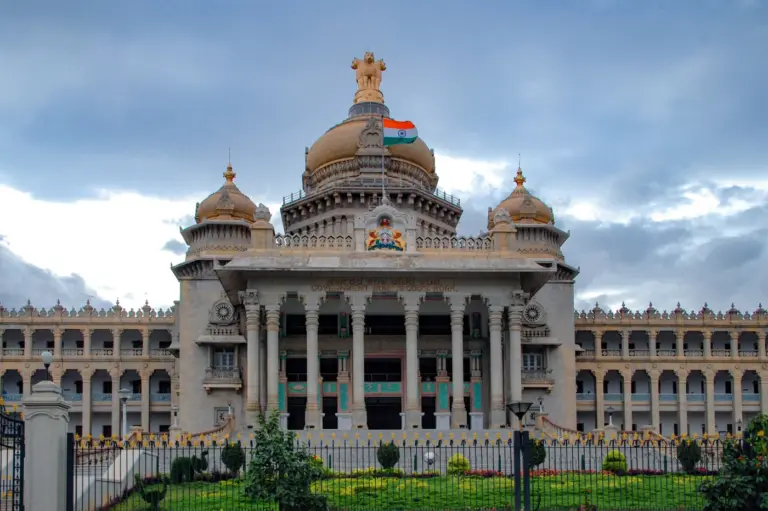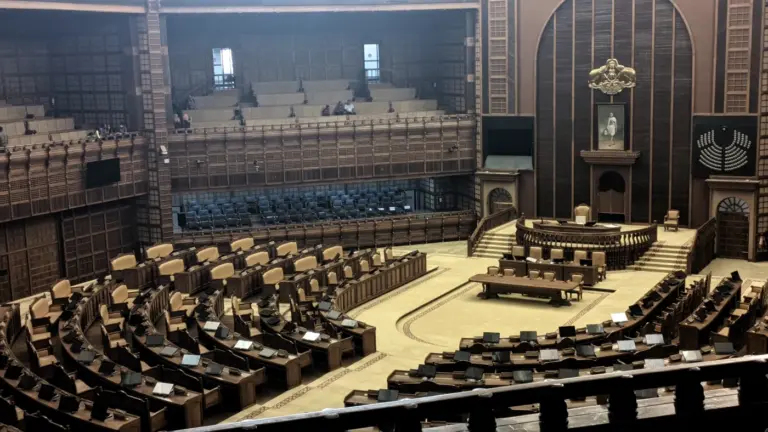
Ask most people what democracy is and they will describe an election — a queue at a polling booth, an inked finger, a vote dropped into a box. That picture is true, but it is also thin. It captures only the moment a citizen hands power to a representative and then, for the next five years, mostly falls silent. A growing body of thinkers and a wave of real experiments around the world argue that this is the floor of democracy, not its ceiling. Their answer is deliberative democracy — the idea that self-rule should rest not only on counting votes but on reasoned public discussion, where ordinary citizens learn, argue, weigh evidence and reach considered judgements together.
This is not a seminar-room abstraction any more. Over the past decade Ireland rewrote its constitution on abortion and same-sex marriage after randomly chosen citizens deliberated on those questions; France convened 150 citizens picked by lot to draft climate policy; cities from Madrid to Melbourne have handed budgets to citizen panels. The Organisation for Economic Co-operation and Development has named this surge a “deliberative wave.” For an Indian aspirant, the topic sits squarely in the political-theory and governance parts of the syllabus, and it carries a sharp domestic twist — because India built a constitutional machinery for citizen deliberation, the gram sabha, decades before the West rediscovered the idea. Understanding deliberative democracy means understanding both a frontier of democratic innovation and a mirror held up to India’s own promise of participatory rule.
Beyond the Ballot: What Deliberative Democracy Means
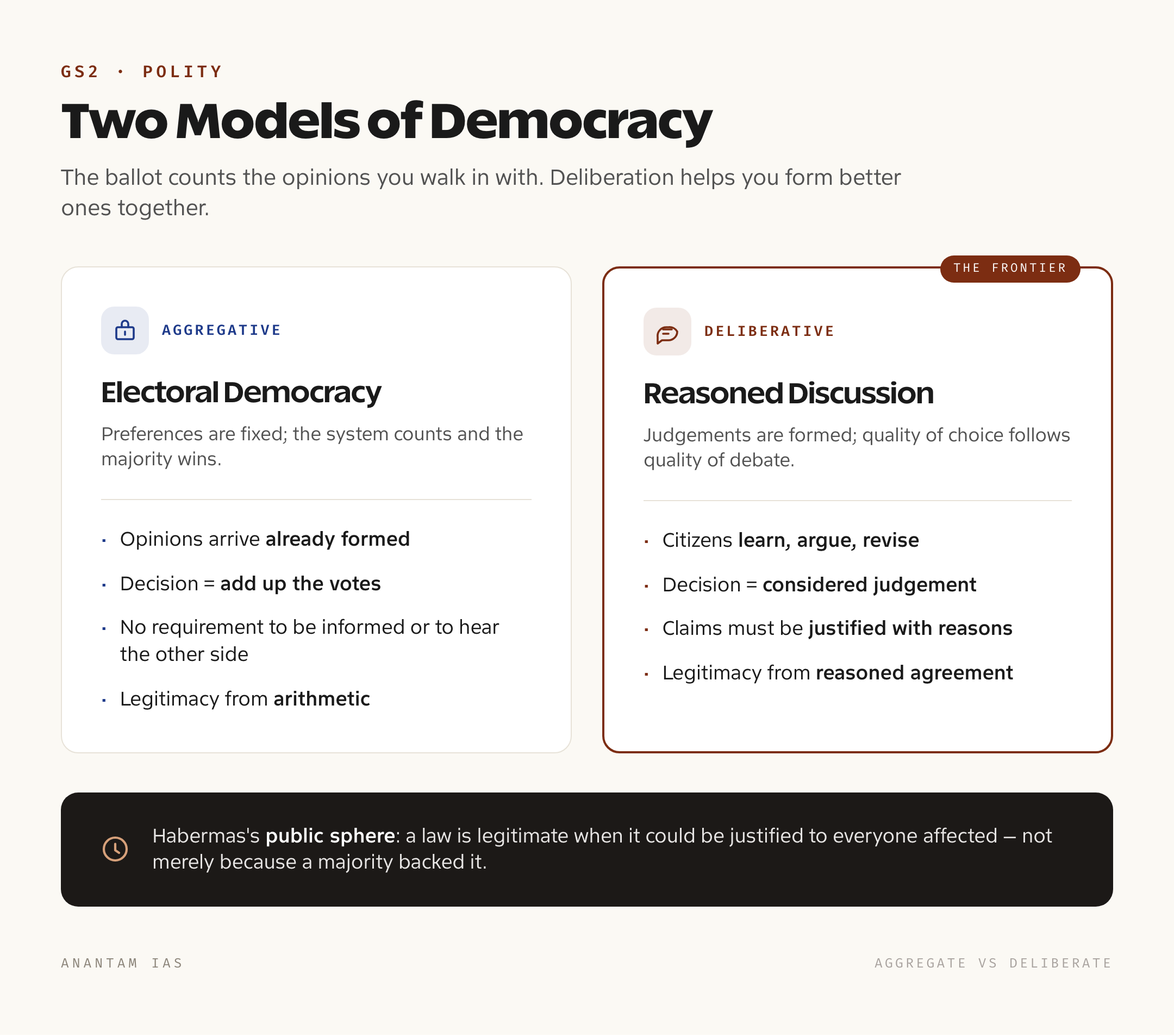
Begin with the contrast that makes the idea click. Conventional electoral democracy is, at heart, aggregative — it treats citizens’ preferences as fixed and given, then adds them up. You arrive at the booth with your opinion already formed; the system’s job is simply to count opinions and let the majority win. It asks nothing of how those opinions were reached, whether they were informed, or whether you ever heard the other side. Voting aggregates preferences; it does not improve them.
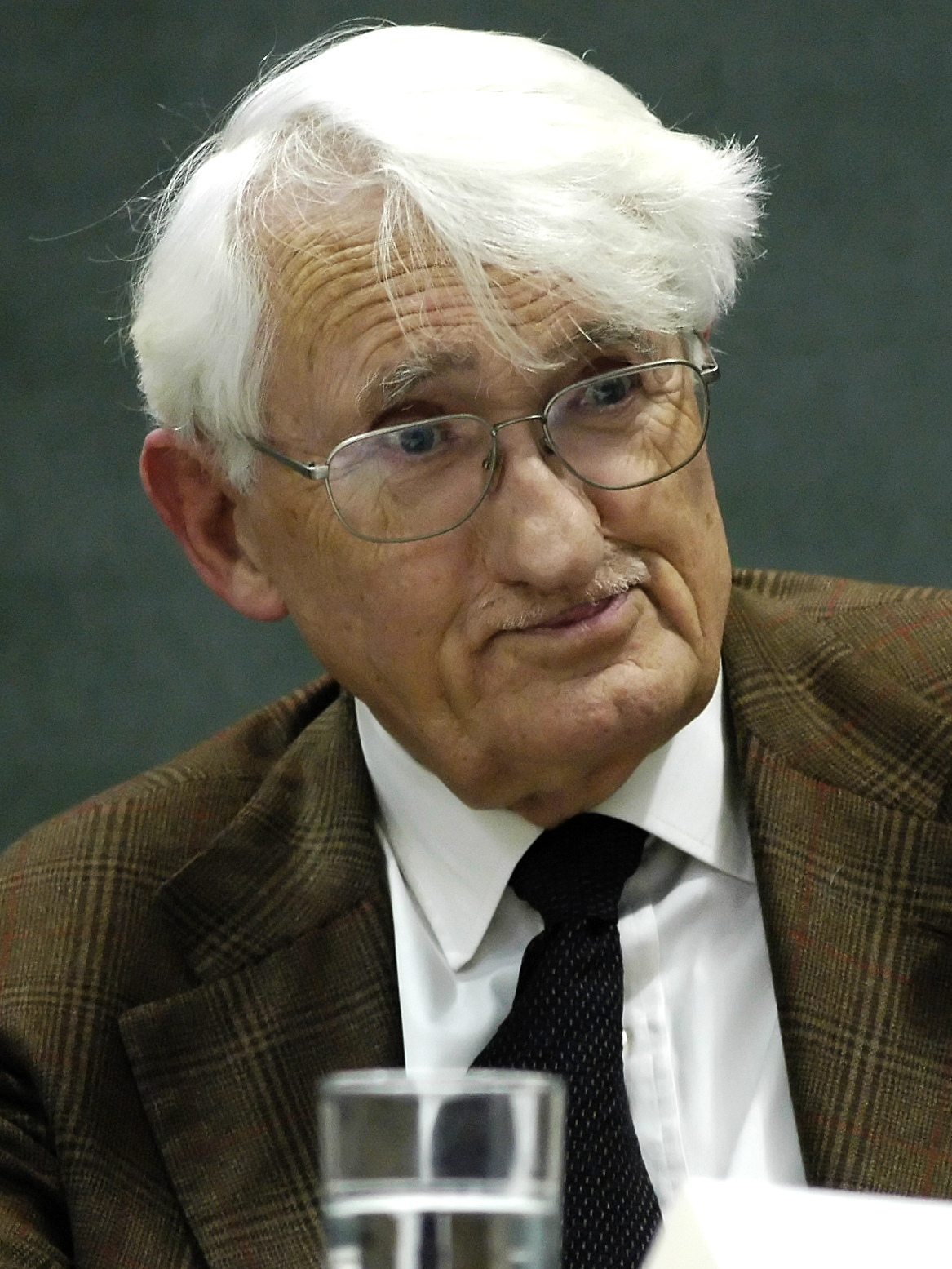
Deliberative democracy starts from a different premise: that the quality of a decision depends on the quality of the discussion that produced it. On this view, legitimate collective choices should emerge from reasoned public deliberation — citizens exchanging arguments, justifying their positions with reasons others can accept, listening, and revising their views in light of better evidence. The German philosopher Jürgen Habermas gave this its deepest grounding with his idea of the public sphere: a space, sitting between the private household and the state, where private people come together as a public to debate matters of common concern through rational discourse rather than through money, status or force. For Habermas and the deliberative tradition he inspired, a law or policy is legitimate not merely because a majority backed it, but because it could be justified to everyone affected by it in free and equal discussion. Legitimacy, in short, comes from reasoned agreement, not just from arithmetic.
The distinction matters because it changes what a democracy is for. An aggregative system is content to register what people happen to want. A deliberative system wants citizens to form considered judgements — what they would want after hearing the arguments and the facts. Deliberative democracy does not reject voting; in the end most assemblies still take a vote. What it rejects is the idea that voting alone, without deliberation, is enough to make a decision genuinely the people’s own. It treats democracy as a conversation a society has with itself, of which the vote is only the final sentence.
Citizens’ Assemblies, Sortition and the Deliberative Wave
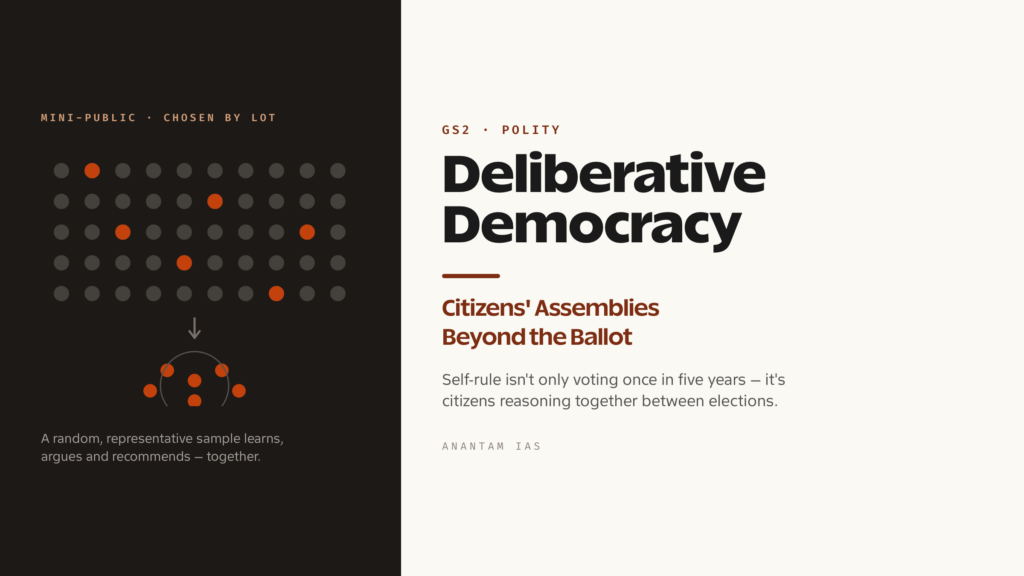
The concept would stay academic without a practical engine, and that engine is the citizens’ assembly, the flagship of a family of bodies that scholars call deliberative mini-publics. A mini-public is a small group of citizens — anywhere from a few dozen to a few hundred — convened to stand in for the whole population, learn deeply about one issue, deliberate, and produce recommendations. Its two defining features are deliberation and representativeness, and the second is achieved through an old, almost forgotten method: sortition, or selection by lot.
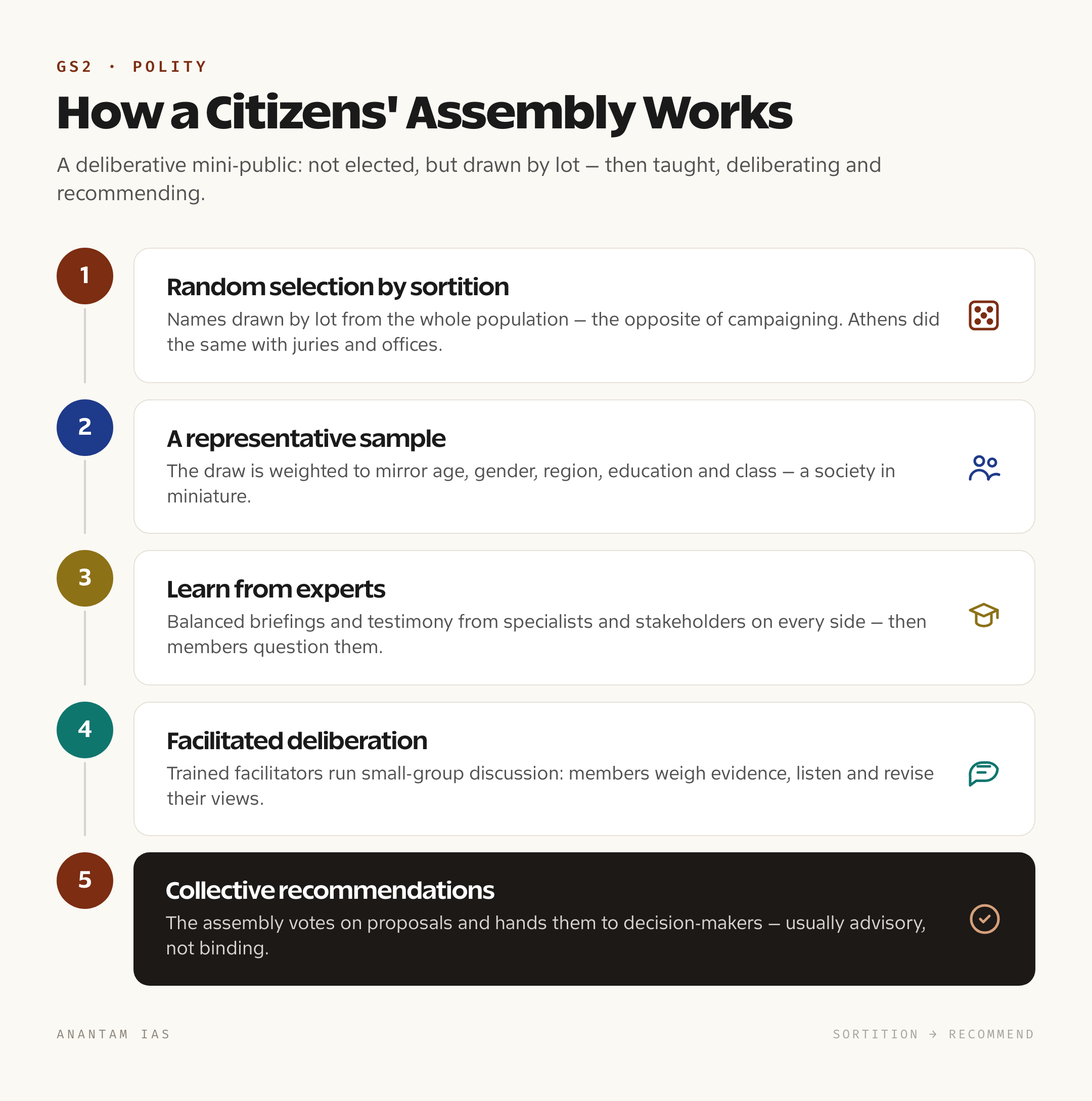
Sortition is the deliberate opposite of election. Instead of letting people put themselves forward and compete, organisers draw names more or less at random from the population, then weight the draw so the final group mirrors society’s mix of age, gender, region, education and class. The roots run deep — ancient Athens used the lot to fill most public offices and juries, on the conviction that ordinary citizens, not just the ambitious or the wealthy, should govern. A modern citizens’ assembly revives that logic. The randomly chosen members spend weekends or months in a structured process: they receive balanced briefing materials, hear from experts and stakeholders on every side, question them, then deliberate among themselves with trained facilitators before voting on recommendations. The promise is a body that is descriptively representative, free of the careerism and party discipline of elected politicians, and informed in a way ordinary voters rarely get the chance to be.
From Ireland to the Climate: The Idea in Action
The case that turned sceptics was Ireland. Faced with two of the most divisive questions a Catholic-majority society could ask — same-sex marriage and abortion — Ireland chose not to leave them to politicians alone. A Convention on the Constitution, mixing 66 randomly selected citizens with 33 politicians, recommended marriage equality, and in a 2015 referendum 62 per cent of voters agreed, making Ireland the first country in the world to legalise same-sex marriage by popular vote. The success emboldened a bolder step. A Citizens’ Assembly of 99 members chosen at random to mirror the country deliberated on abortion across five weekends between late 2016 and 2017, hearing medical, legal and ethical experts and personal testimony from every side. The assembly recommended allowing terminations without restriction up to a gestational limit — a more liberal position than the politicians had expected — and in the 2018 referendum 66.4 per cent voted to repeal the constitutional ban. Ordinary citizens, given time and good information, had charted a path the political class had been too nervous to take.
From Ireland the idea spread to the hardest collective problem of all, climate change. In 2019-20 France convened the Citizens’ Convention for Climate, 150 people selected by lot, who met over several weekends and produced 149 proposals for cutting emissions, much of which fed into a 2021 climate law. The United Kingdom ran a parallel Climate Assembly of 108 citizens in 2020 to advise Parliament on reaching net-zero. The appeal in the climate context is obvious: emissions cuts demand sacrifices that elected politicians, fearful of the next election, struggle to ask for, but a representative panel of citizens can grant a kind of permission that politicians cannot manufacture for themselves. Across Europe alone, more than 200 climate assemblies have since been held, most at the city level.
This is the “deliberative wave” the OECD documented when it gathered close to 300 representative deliberative processes used by governments to inform public decisions — a movement building since the 1980s and accelerating since roughly 2010. The OECD’s point was that mini-publics had moved from academic experiment to a standard tool in the policymaker’s kit, used on everything from infrastructure and health to constitutional reform.
The Promise and the Limits
It is worth being clear-eyed about why reformers are excited, and equally clear about what deliberative democracy cannot do. The promised benefits are real. Because members are chosen by lot rather than by party, an assembly can cut through polarisation — people who would never agree as partisans often find common ground as neighbours working through a problem. That same quality is a counter to populism and misinformation: deliberation forces claims to be defended with evidence, which is precisely the discipline that demagoguery and viral falsehood avoid. Assemblies blend expert knowledge with citizen values, marrying technical input from specialists with the lived priorities of ordinary people, so policy is both informed and grounded. And the experience tends to rebuild trust — participants leave with a higher sense of political efficacy, and a public that sees fellow citizens deliberate in good faith may regain some faith in democracy itself.
But the limits are just as real, and a strong answer names them honestly. The first is scale: a few hundred people can deliberate well, but a nation of hundreds of millions cannot all sit in one room, so an assembly is always a sample, never the whole. The second is binding power: almost all assemblies are advisory, and governments are free to ignore them. France’s experience is the cautionary tale — many of the climate convention’s proposals were watered down or dropped, and the promised referendum never happened, leaving members feeling used. The third is capture and design risk: who frames the question, who picks the experts, who facilitates — all of this shapes the outcome, and a poorly designed assembly can become a fig-leaf that launders decisions already taken. The fourth is representativeness in practice: sortition mirrors demographics, but those who decline to take part, or fall silent in the room, skew the result, and a few hundred can never capture every minority experience. Deliberative democracy, then, is best understood not as a replacement for elections, courts and parties but as a supplement — a way to deepen representative democracy at the points where it is weakest, not a substitute for it.
The India Angle: Gram Sabha and the Promise of Participatory Rule
For an Indian student the most striking fact is that India did not have to import this idea. The Constitution, through the 73rd and 74th Amendments of 1992-93, gave constitutional status to panchayats and urban local bodies and, with the panchayats, created the gram sabha — the assembly of every registered voter in a village, a forum of direct, face-to-face democracy older in spirit than any Western citizens’ assembly. The gram sabha is meant to be exactly what deliberative theory prescribes: a space where ordinary citizens collectively discuss development plans, approve budgets, choose beneficiaries and hold their elected panchayat to account. India built, on paper, a deliberative institution at the base of its democracy for some of its population — not a sample chosen by lot, but the whole village in the room.
In places, the promise has been redeemed. The most celebrated example is Kerala’s People’s Plan Campaign, launched in 1996, which devolved a large share of the state plan budget to local bodies and used gram sabhas to let villagers themselves identify needs and decide how money should be spent — a vast exercise in participatory budgeting before the term was fashionable elsewhere. Across the country, the gram sabha’s power of social audit has become a real check on corruption, most visibly under the rural job-guarantee law, MGNREGA, where villagers publicly read out muster rolls and expenditure records to expose ghost workers and inflated bills. These are deliberative democracy in action, Indian-style — citizens not merely voting but scrutinising, deliberating and deciding.
Yet the deficits are as instructive as the successes. In much of India the gram sabha exists more in the statute book than in practice: meetings are poorly attended, dominated by the powerful, captured by caste and patriarchy, reduced to a formality where decisions taken elsewhere are merely ratified. Devolution of the funds, functions and functionaries the amendments envisaged remains incomplete, leaving local bodies dependent and weak. So India holds both halves of the lesson at once. Its experience with the Panchayati Raj system shows that a deliberative institution can be written into a constitution and still wither without genuine devolution, social equality and an active citizenry — and that deepening democracy, whether through revitalised gram sabhas at home or citizens’ assemblies abroad, demands more than good design on paper. The frontier of democratic reform, including the electoral reforms India keeps debating, increasingly asks not just how citizens vote, but how, between elections, they reason and decide together.
For Your Mains Answer
This is a high-value topic for GS Paper 2, which covers the Indian polity, the functioning of democratic institutions, devolution of powers to local levels, and governance. It also gives the Essay paper a rich, current vocabulary for themes of democracy, citizenship and participation, and it connects naturally to political-science optional papers on democratic theory. The skill examiners reward here is the ability to define a concept crisply, illustrate it with two or three precise global examples, and then anchor it firmly in the Indian institutional reality — moving from theory to the gram sabha and back.
How to Build the Answer
Open by distinguishing aggregative from deliberative democracy in one clean sentence — counting fixed preferences versus forming considered judgements through reasoned discussion. Introduce the mechanism: citizens’ assemblies as mini-publics chosen by sortition, learning, deliberating and recommending. Give one or two examples with dates and numbers — Ireland’s abortion assembly and the French climate convention work best. Then pivot decisively to India: the gram sabha as a constitutional deliberative body under the 73rd and 74th Amendments, Kerala’s People’s Plan and MGNREGA social audits as successes, low attendance and elite capture as the deficits. Close by judging the idea as a supplement to, not a substitute for, representative democracy.
Common Mistakes to Avoid
Don’t conflate deliberative democracy with direct democracy or with referendums — the heart of it is reasoned discussion, not just more voting. Don’t treat citizens’ assemblies as binding lawmakers; almost all are advisory, and that limit is examinable. Don’t present the gram sabha as an unqualified success or an unqualified failure — the marks lie in holding both the constitutional promise and the on-ground deficit together. And don’t forget the theory anchor: a single line on Habermas and the public sphere signals depth.
A Compact Answer Spine
Aggregative democracy counts fixed preferences; deliberative democracy forms considered judgements through reasoned public discussion (Habermas, public sphere → legitimacy from reasoned agreement) → mechanism: citizens’ assemblies / mini-publics chosen by sortition, who learn, deliberate and recommend → global cases: Ireland (99-member abortion assembly, 2018 repeal vote 66.4%), France (150-member climate convention, 149 proposals), OECD “deliberative wave,” ~300 processes → benefits: cuts polarisation, counters populism, expert-plus-citizen input, builds trust → limits: scale, non-binding, capture, representativeness → India: gram sabha under 73rd/74th Amendments (1992-93), Kerala People’s Plan (1996), MGNREGA social audits = successes; low turnout, elite capture, weak devolution = deficits → verdict: a supplement that deepens, not replaces, representative democracy.
Diagram or Flowchart Idea
Draw a simple two-column contrast — “Aggregative: count preferences → vote” beside “Deliberative: learn → deliberate → considered judgement” — and below it a five-box flow of a citizens’ assembly: sortition → representative sample → expert learning → facilitated deliberation → recommendations. A clean visual like this communicates the whole concept at a glance and is fast to sketch.
A Balanced-Conclusion Line
A line that lands the marks: “Deliberative democracy reminds us that the health of a republic is measured not only by how often its citizens vote, but by how well they reason together between elections — and for India, reviving the gram sabha may matter as much as any electoral reform.”
How to Use Data Without Cramming
You need only a handful of anchors: Ireland’s 99-member assembly and the 66.4 per cent repeal vote of 2018, France’s 150 citizens and 149 proposals, the OECD’s roughly 300 deliberative processes, and India’s 73rd-74th Amendments of 1992-93 with Kerala’s 1996 People’s Plan. Drop those into the right sentences and attribute them plainly — “as the OECD documented in its survey of deliberative processes” — rather than scattering numbers without a source.
Frequently Asked Questions
What is deliberative democracy in simple terms?
Deliberative democracy is the idea that legitimate political decisions should come from reasoned public discussion, not just from counting votes. Instead of treating citizens’ opinions as fixed and simply adding them up, it asks citizens to learn about an issue, hear the arguments on every side, deliberate together and reach a considered judgement. Voting still happens, but it follows genuine discussion rather than replacing it. The philosopher Jürgen Habermas grounded the idea in his notion of a public sphere where citizens reason as equals.
What is a citizens’ assembly and how is it different from an election?
A citizens’ assembly is a group of ordinary people — usually a few dozen to a few hundred — brought together to study one issue deeply, deliberate and make recommendations. The crucial difference from an election is how members are chosen: by sortition, or random selection, weighted to mirror society’s mix of age, gender, region and class, rather than by campaigning and competition. The aim is a body free of party discipline and careerism that is broadly representative of the whole population, like a jury for public policy.
Where have citizens’ assemblies actually worked?
The best-known cases are in Ireland, where randomly chosen citizens deliberated on same-sex marriage and abortion and helped pave the way for the 2015 and 2018 referendums that changed the constitution. France convened 150 citizens to draft climate proposals in 2019-20, and the United Kingdom ran a 108-member climate assembly in 2020. The OECD has documented close to 300 such deliberative processes worldwide, a surge it calls the “deliberative wave.”
Does India have anything like deliberative democracy?
Yes — the gram sabha, the assembly of all adult voters in a village, given constitutional status by the 73rd and 74th Amendments of 1992-93. It is meant to let villagers deliberate on development plans, approve budgets and audit spending, which is deliberative democracy at the grassroots. Kerala’s People’s Plan Campaign from 1996 and MGNREGA social audits show how powerful it can be, though in much of India the gram sabha suffers from poor attendance, elite capture and incomplete devolution of powers.
Practice Questions
Prelims MCQs
- Which of the following best describes “deliberative democracy”?
(a) A system where all decisions are taken by direct referendum
(b) The idea that legitimate decisions arise from reasoned public discussion, not merely from aggregating votes
(c) Rule by a committee of technical experts
(d) A democracy in which only elected representatives may debate policy
Answer: (b) Deliberative democracy holds that the legitimacy of collective decisions depends on the quality of reasoned deliberation that produced them, going beyond the mere counting of preferences. - The method of selecting members of a citizens’ assembly by random lot, weighted to mirror the population, is known as:
(a) Proportional representation
(b) Plurality voting
(c) Sortition
(d) Co-option
Answer: (c) Sortition is selection by lot; it was used in ancient Athens to fill offices and juries and is revived in modern deliberative mini-publics. - The concept of the “public sphere,” central to deliberative-democracy theory, is most closely associated with which thinker?
(a) John Rawls
(b) Jürgen Habermas
(c) Robert Dahl
(d) Joseph Schumpeter
Answer: (b) Jürgen Habermas developed the idea of the public sphere as a space where private citizens come together to debate common concerns through rational discourse. - In India, the gram sabha — a body for grassroots deliberation — was given constitutional status by which amendments?
(a) The 42nd and 44th Amendments
(b) The 61st and 69th Amendments
(c) The 73rd and 74th Amendments
(d) The 86th and 97th Amendments
Answer: (c) The 73rd and 74th Constitutional Amendments of 1992-93 gave constitutional status to panchayats and urban local bodies, with the gram sabha as the village assembly of all registered voters. - With reference to citizens’ assemblies worldwide, which statement is correct?
(a) Their recommendations are legally binding on governments in most countries
(b) They are typically advisory bodies whose recommendations governments may accept or reject
(c) Members are elected through competitive campaigns
(d) They replace elected legislatures entirely
Answer: (b) Almost all citizens’ assemblies are advisory; they inform decisions but do not bind governments, which is one of their key limitations.
Mains Practice Questions
- Distinguish between aggregative and deliberative conceptions of democracy. Why is deliberative democracy increasingly seen as a way to deepen democratic legitimacy? (15 marks, 250 words)
- “Citizens’ assemblies are juries for public policy.” Examine the role of sortition and deliberative mini-publics in contemporary democratic innovation, with examples. (15 marks, 250 words)
- The gram sabha embodies the promise of deliberative democracy in India, yet that promise remains partly unfulfilled. Critically analyse, with reference to the 73rd and 74th Amendments. (15 marks, 250 words)
- Discuss the benefits and limitations of citizens’ assemblies as instruments of democratic decision-making. Should they supplement or replace representative institutions? (15 marks, 250 words)
- “Participatory budgeting and social audits have made Indian local democracy more deliberative.” Evaluate this claim with reference to Kerala’s People’s Plan and MGNREGA. (10 marks, 150 words)
Tell Google you want more of this.
Add Anantam IAS as a preferred sourceOne tap, and this site shows up more often in your own Top Stories, AI Overviews and AI Mode. Remove it any time.