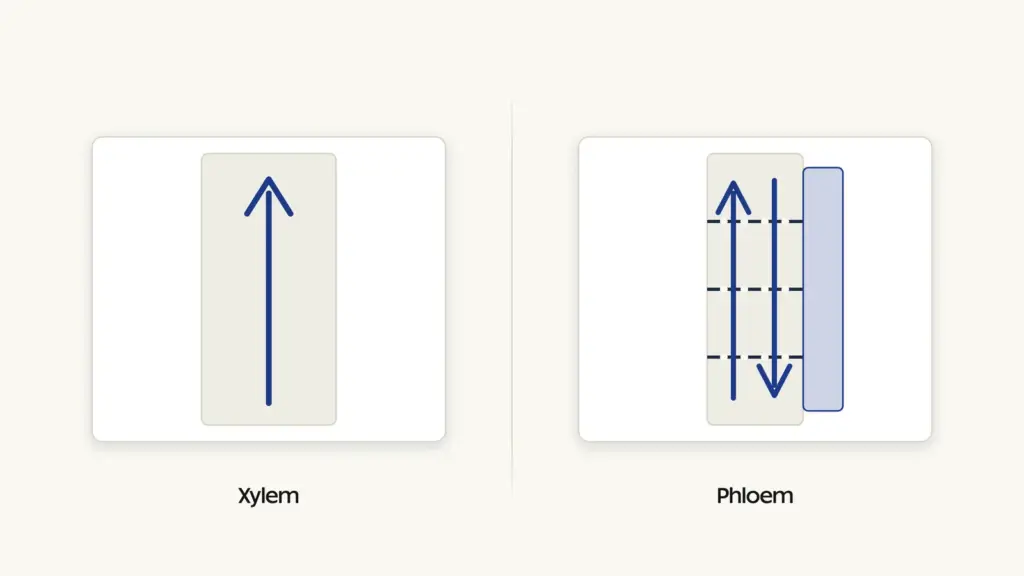
The difference between xylem and phloem is the difference between a pipe and a pump. Xylem carries water and dissolved minerals from the roots upward to the rest of the plant, through cells that are dead and hollow at maturity, driven almost entirely by the evaporation of water from leaves. Phloem carries the sugars made in photosynthesis from wherever they are produced to wherever they are needed, through living cells, using energy the plant itself spends.
Both are complex permanent tissues — meaning each is made of more than one cell type — and together they form the vascular tissue that distinguishes higher plants from mosses and algae. A plant without xylem could not grow tall, because water could not be lifted. A plant without phloem could not feed its roots, because sugar made in the leaves would never reach them.
What xylem is made of
Xylem contains four kinds of elements, and the crucial ones are dead.
Tracheids are long, tapering cells with thick, lignified walls. At maturity the living contents die and disappear, leaving an empty tube. Tracheids do not have open ends; water moves between adjacent tracheids through pits, thin regions in the wall where the lignified secondary layer is absent. Tracheids are the only water-conducting element in ferns and most gymnosperms, and they are present in flowering plants too.
Vessels, also called tracheae, are found mainly in angiosperms and are the more efficient design. Individual vessel elements are shorter and wider than tracheids, and their end walls are perforated or dissolved away entirely, so a stack of them forms a continuous open pipe running many centimetres or more. Wider bore and open ends mean far less resistance to flow.
Xylem parenchyma cells are living. They store starch and fats and help move water sideways through the tissue.
Xylem fibres are dead sclerenchyma cells with heavily thickened walls that provide mechanical strength.
The lignified secondary wall is what makes xylem structurally decisive. Lignin is rigid and waterproof, and its deposition is what allows a hollow tube to resist collapsing under the enormous negative pressure inside it — a property of plant cell walls explained further in this guide to the cell wall.
What phloem is made of
Phloem also has four kinds of elements, and here the conducting cells are alive.
Sieve tube elements are living cells stacked end to end. Their end walls are not dissolved but perforated into sieve plates — sieves, literally, with pores through which cytoplasm is continuous from one cell to the next. At maturity the sieve tube element loses its nucleus and most of its organelles, keeping only its plasma membrane, some smooth endoplasmic reticulum, and modified plastids. It is alive but cannot govern itself.
Companion cells solve that problem. Each sieve tube element is paired with one or more companion cells, dense with cytoplasm and possessing a prominent nucleus, connected to the sieve tube through numerous plasmodesmata. The companion cell effectively runs the sieve tube’s metabolism and drives the loading of sugars into it. Sieve tube and companion cell arise from the same mother cell and function as a single unit. Gymnosperms lack this arrangement, using sieve cells and albuminous cells instead.
Phloem parenchyma stores food and resinous materials.
Phloem fibres, also called bast fibres, are the only dead component of phloem. They are the commercial fibre in jute, flax, and hemp.
Xylem vs phloem: comparison table
| Basis | Xylem | Phloem |
|---|---|---|
| Substance transported | Water and dissolved mineral salts | Soluble organic food, chiefly sucrose, plus amino acids and hormones |
| Direction of transport | Unidirectional — upward, from roots to the rest of the plant | Bidirectional — from any source to any sink, up or down |
| Conducting cells | Tracheids and vessels, dead and hollow at maturity | Sieve tubes, living but without a nucleus at maturity |
| Supporting elements | Xylem fibres (dead) and xylem parenchyma (living) | Phloem fibres (dead) and phloem parenchyma (living) |
| Cell walls | Thick and heavily lignified | Thin and made of cellulose, not lignified |
| End walls of conducting cells | Perforated or absent in vessels; pits in tracheids | Perforated sieve plates with cytoplasmic continuity |
| Nucleus in conducting cells | Absent — the cells are dead | Absent in sieve tubes, but the attached companion cell has one |
| Driving mechanism | Transpiration pull, assisted by root pressure | Pressure flow, following active loading at the source |
| Energy requirement | Passive; the plant spends no metabolic energy on the flow itself | Active; loading and unloading require ATP |
| Pressure inside | Negative pressure — the water column is under tension | Positive hydrostatic pressure |
| Position in a dicot stem bundle | Inner side, towards the centre of the stem | Outer side, towards the periphery |
| Mechanical role | Provides substantial mechanical support; secondary xylem forms wood | Little mechanical support; secondary phloem forms part of the bark |
| Speed of movement | Rapid, often several metres per hour | Slower, typically well under a metre per hour |
| Economic product | Timber and wood pulp | Bast fibres such as jute, flax, and hemp |
How water rises: transpiration pull
Water enters root hairs by osmosis, crosses the root cortex, and reaches the xylem. From there it has to travel, in a tall tree, tens of metres against gravity. No pump exists. The energy comes from outside the plant.
Water evaporates from the moist walls of mesophyll cells into the air spaces of the leaf and then diffuses out through the stomata. This is transpiration. As water leaves the cell wall surfaces, the remaining water is drawn into the microscopic spaces between cellulose fibres, creating a strongly negative pressure — a tension. Because water molecules cling to each other by hydrogen bonding (cohesion) and cling to the walls of the narrow xylem tubes (adhesion), the water in the xylem behaves as an unbroken thread. Pull the top and the whole column moves.
This is the cohesion-tension theory, and it explains why the conducting cells must be dead and lignified. A living cell full of cytoplasm would obstruct the flow, and a thin wall would be crushed inward by the negative pressure. Evolution’s answer was to kill the cell, empty it, and reinforce the wall with lignin.
Root pressure is a second, smaller mechanism. Roots actively pump mineral ions into the xylem, water follows osmotically, and a modest positive pressure builds up. It matters mainly at night and in short plants, when transpiration is low, and it is what produces guttation — drops of water at the leaf margins of grasses on humid mornings. It cannot account for water reaching the top of a tall tree.
The trade-off in this system is unavoidable. Stomata must open to let carbon dioxide in for photosynthesis, and whenever they are open, water escapes. Plants in nutrient-poor habitats have gone to remarkable lengths to work around what water alone cannot supply — the insectivorous plants trap animals precisely because their soil cannot furnish enough nitrogen.
How food moves: the pressure flow mechanism
Phloem transport is called translocation, and the accepted explanation is the pressure flow or mass flow hypothesis, proposed by Ernst Münch in 1930.
At a source — usually a photosynthesising leaf — sucrose is actively loaded into the sieve tube, mostly through the companion cell, against a concentration gradient. The sieve tube’s solute concentration rises, so water moves in from the neighbouring xylem by osmosis, and hydrostatic pressure inside the tube rises sharply.
At a sink — a growing root tip, a developing fruit, a storage tuber — sucrose is unloaded and consumed or stored. Solute concentration falls, water leaves the sieve tube, and pressure drops.
The result is a pressure gradient from source to sink along the sieve tube, and the entire contents flow down that gradient as a mass. Nothing pushes the sugar directly; it is carried along by water moving from high pressure to low.
Two consequences follow. First, translocation is bidirectional in the plant as a whole, because a source and a sink can be anywhere. In spring, a tuber is a source and the new shoot a sink, so flow is upward; in summer the leaf is the source and the tuber the sink, so flow is downward. Second, phloem transport is energy-dependent. Loading requires ATP, and a poison that blocks respiration in the phloem stops translocation without affecting the xylem stream at all.
The classical demonstration is the girdling or ringing experiment. Remove a complete ring of bark — which takes the phloem with it but leaves the xylem intact — and the tissue just above the ring swells with accumulated sugars, while the parts below eventually starve and the plant dies. Water transport continues normally throughout, which is exactly the point.
Where the two tissues sit
In a typical dicot stem, xylem and phloem occur together in vascular bundles, with xylem on the inner side and phloem on the outer, and a layer of vascular cambium between them. Such a bundle is conjoint, collateral, and open. In monocot stems the cambium is missing, so the bundle is closed and the stem cannot thicken by secondary growth.
In roots the arrangement is different: xylem and phloem lie on separate radii, alternating around the central stele, in what is called a radial arrangement. Root xylem is exarch — the first-formed elements lie towards the periphery — while stem xylem is endarch.
When secondary growth begins, the vascular cambium cuts off new cells on both faces: secondary xylem to the inside and secondary phloem to the outside. Because it produces far more xylem than phloem, the accumulated secondary xylem becomes the wood of a tree trunk, while older secondary phloem is pushed outward and crushed, ending up as part of the bark. The annual rings visible in a cut trunk are successive layers of secondary xylem, wide in a favourable growing season and narrow in a poor one.
The tissues themselves are built from cells that follow the general plant pattern — a rigid wall, a large vacuole, plastids — which is worth comparing against the plant cell and animal cell distinction, since neither xylem nor phloem has any animal counterpart.
Common confusions
“Xylem is dead and phloem is living.” Too blunt in both directions. Xylem parenchyma is living tissue within xylem. Phloem fibres are dead tissue within phloem. What is accurate is that the *conducting* cells of xylem are dead and those of phloem are living.
“Phloem transport is downward.” Only some of the time. Phloem moves material from source to sink, and a sink can be above the source — a developing flower or fruit at the top of a plant is fed by leaves below it. Xylem is the tissue with a genuinely one-way flow.
“Sieve tubes have no nucleus, so they are dead.” A cell without a nucleus is not necessarily dead. Sieve tube elements retain a functioning plasma membrane and cytoplasm and depend on their companion cell for nuclear control. Mature mammalian red blood cells make the same point.
“Root pressure pushes water to the top of trees.” Root pressure produces only a modest positive pressure and is easily measured in short plants at night. Transpiration pull does the overwhelming majority of the lifting, and it works by tension from above rather than pressure from below.
“Wood and bark are separate tissues unrelated to xylem and phloem.” Wood *is* accumulated secondary xylem. Bark includes secondary phloem along with cork and cork cambium. The everyday words describe the same tissues at a later stage of life.
Frequently Asked Questions
Why are xylem conducting cells dead while phloem conducting cells are alive?
Xylem is a passive conduit. Water flows through it under a physical pressure gradient generated by evaporation, so living contents would only obstruct the flow, and a rigid lignified wall is needed to resist collapse under tension. Phloem transport requires sugars to be actively loaded and unloaded, which only a living cell with a functioning membrane can do.
Is transport in phloem upward or downward?
Both. It runs from source to sink, and either can be higher than the other. Sugar flows down from leaves to roots in the growing season and up from storage organs to new shoots in spring.
What is the difference between tracheids and vessels?
Tracheids are long and tapering with closed, pitted end walls, so water passes sideways through pits. Vessels are shorter and wider with perforated or absent end walls, forming a continuous open pipe. Vessels are more efficient and are characteristic of angiosperms; gymnosperms rely mainly on tracheids.
What is the role of companion cells?
They provide the nucleus and metabolic machinery that the mature sieve tube element lacks, and they carry out the active loading of sucrose into the sieve tube at the source. Damage the companion cell and the sieve tube stops working.
What does the girdling experiment prove?
That organic food is transported through the phloem. Removing a ring of bark removes the phloem while leaving the xylem intact; sugars accumulate above the cut, tissues below starve, but water transport is unaffected.
Which tissue forms wood?
Xylem. Specifically, secondary xylem produced by the vascular cambium accumulates year after year to form the wood of a tree trunk, with annual rings marking successive growing seasons.
Are xylem and phloem present in all plants?
No. They define the vascular plants — ferns, gymnosperms, and angiosperms. Mosses and liverworts lack true vascular tissue, which is one reason they remain small and stay close to moist ground.
Practice Questions
1. Which of the following components of xylem is living at maturity?
a) Tracheids
b) Vessels
c) Xylem parenchyma
d) Xylem fibres
Answer: c) Xylem parenchyma
2. The upward movement of water in tall trees is explained chiefly by:
a) Root pressure generated by active ion uptake
b) Transpiration pull acting through cohesion and adhesion of water
c) Active pumping by xylem parenchyma cells
d) Capillary action within the sieve plates
Answer: b) Transpiration pull acting through cohesion and adhesion of water
3. Sieve tube elements are unusual because they:
a) Are dead and hollow at maturity
b) Are living but lack a nucleus at maturity
c) Possess heavily lignified secondary walls
d) Are found only in gymnosperms
Answer: b) Are living but lack a nucleus at maturity
4. The girdling or ringing experiment demonstrates that:
a) Water is transported through the phloem
b) Minerals are transported through the sieve tubes
c) Organic food is transported through the phloem
d) Transpiration occurs mainly through the stem
Answer: c) Organic food is transported through the phloem
5. In a typical dicot stem vascular bundle, the arrangement is:
a) Xylem outer, phloem inner, with no cambium
b) Xylem inner, phloem outer, with cambium between them
c) Xylem and phloem on alternate radii
d) Phloem surrounded on all sides by xylem
Answer: b) Xylem inner, phloem outer, with cambium between them
- Distinguish between xylem and phloem with respect to structure, direction of transport, and energy requirement.
- Explain the cohesion-tension theory of water movement in plants, and account for the fact that xylem conducting elements are dead at maturity.
- Describe the pressure flow hypothesis of translocation and explain why phloem transport is described as bidirectional.
- “The companion cell and the sieve tube element function as a single physiological unit.” Examine this statement.
- Discuss the role of the vascular cambium in secondary growth, and explain why a tree accumulates wood but not a comparable mass of secondary phloem.
Tell Google you want more of this.
Add Anantam IAS as a preferred sourceOne tap, and this site shows up more often in your own Top Stories, AI Overviews and AI Mode. Remove it any time.