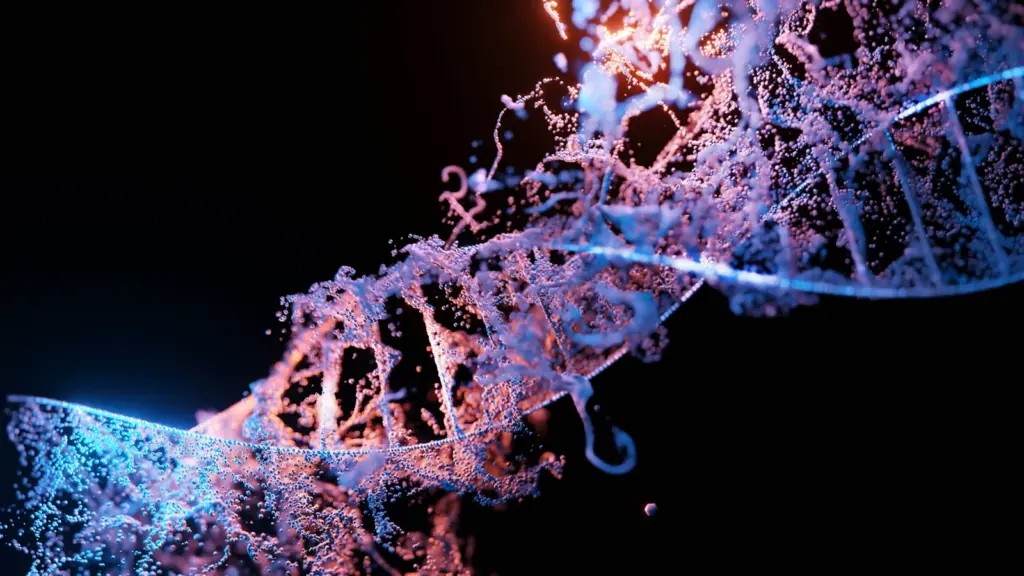
Every cell in your body carries about 3.1 billion base pairs of DNA, and roughly 2 percent of it makes protein. For decades the other 98 percent was called junk. It is not, and understanding why is what separates memorising the central dogma from actually understanding molecular biology.
The Packaging: Chromosomes
A chromosome is a thread-like structure in the cell nucleus, made of DNA tightly coiled around proteins called histones. The coiling serves two purposes: it packages roughly two metres of DNA into a microscopic nucleus, and it ensures correct distribution during cell division.
| Human chromosome set | Detail |
|---|---|
| Total per body cell | 46, in 23 pairs |
| Autosomes | 22 pairs, carrying most genetic traits |
| Sex chromosomes | 1 pair; XX in females, XY in males |
The Genome
The genome is the complete set of genetic information: all the genes and the regions between them.
| Genome measure | Value |
|---|---|
| Haploid set size | ~3.1 to 3.2 billion base pairs |
| Protein-coding share | ~1 to 2 percent |
| Protein-coding genes | ~20,000 to 21,000 |
| Non-coding share | ~98 to 99 percent |
The non-coding portion regulates gene expression, maintains chromosome structure, produces functional RNA and controls when and where genes switch on. Calling it junk was a statement about the limits of 1970s understanding, not about the DNA.
DNA: Structure and Chemistry
DNA, deoxyribonucleic acid, carries genetic information using four chemical bases: adenine, cytosine, guanine and thymine.
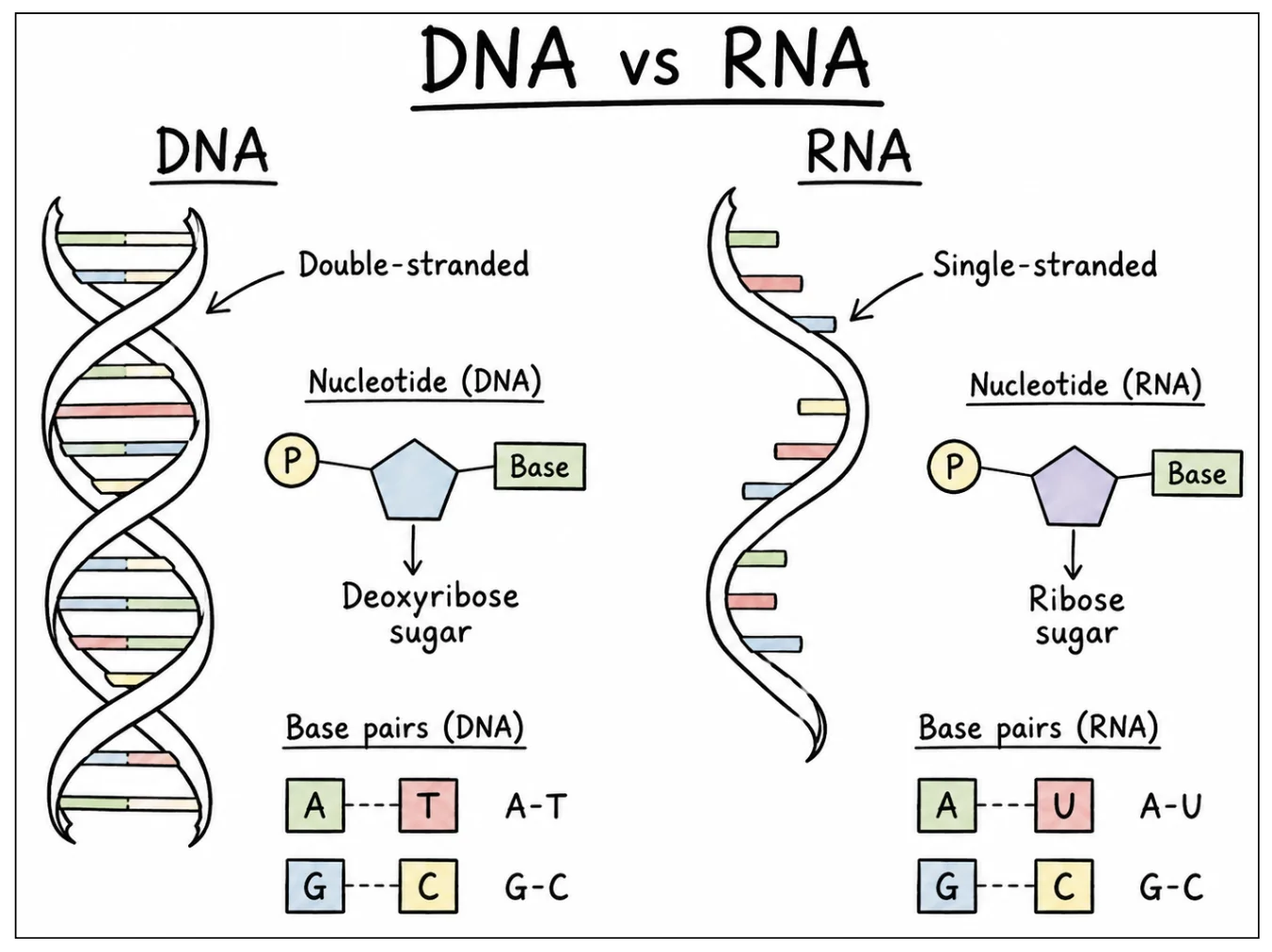
The nucleotide has three parts.
| Part | Function |
|---|---|
| Deoxyribose | Five-carbon sugar providing structural support |
| Phosphate group | Links nucleotides into the backbone; gives DNA its negative charge |
| Nitrogenous base | Adenine, guanine, cytosine or thymine |
The base pairing rule. Adenine pairs with thymine; guanine pairs with cytosine. These pairings form the rungs of the double helix, and they carry a consequence worth stating explicitly: knowing one strand tells you the other. That redundancy is what makes replication accurate and sequencing possible.
DNA replicates semi-conservatively before every cell division, so each new cell receives an identical copy, and it passes from parents to offspring through gametes, one chromosome set from each parent. Mutation and recombination during this process introduce the variation that evolution acts on.
All living organisms use the same four-letter code. Scientists have built synthetic eight-letter DNA in the laboratory, called hachimoji DNA, which shows that four bases is an evolutionary accident rather than a chemical requirement.
RNA
RNA is single-stranded, uses ribose instead of deoxyribose, and substitutes uracil for thymine.
| Type | Role |
|---|---|
| mRNA | Copies a gene’s instructions from DNA, using RNA polymerase, and carries them to the ribosome |
| tRNA | Reads the mRNA one codon at a time and brings the matching amino acid |
| rRNA | Structural and functional component of the ribosome itself |
The Central Dogma
The flow of genetic information runs DNA to RNA to protein, in two stages.
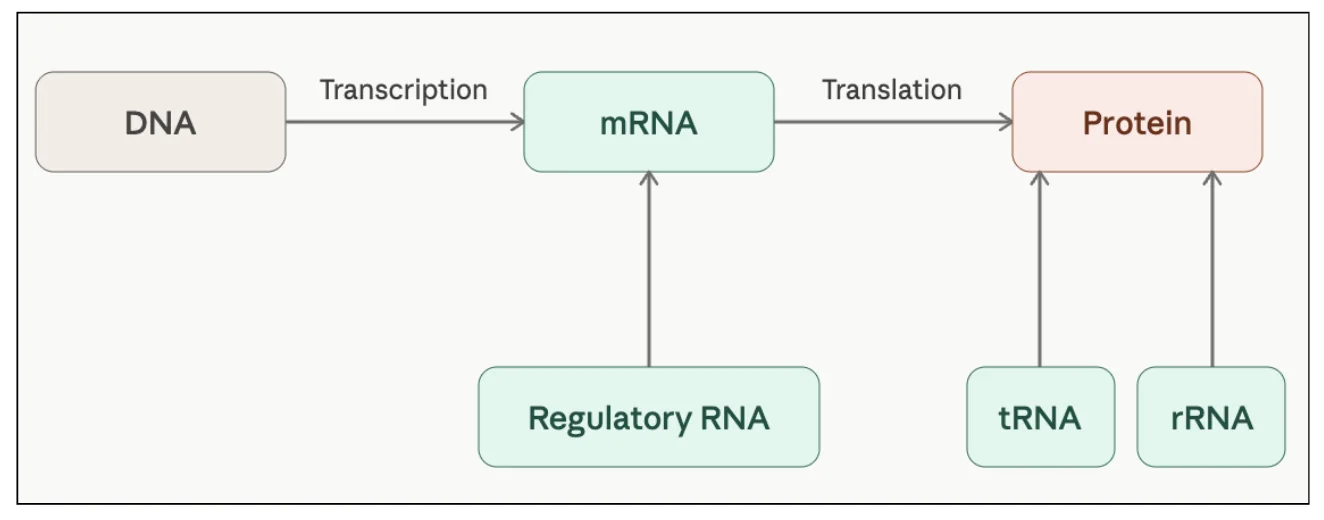
Transcription. In eukaryotic cells this happens in the nucleus. An enzyme copies a specific gene’s DNA sequence into a complementary messenger RNA strand, which travels to the cytoplasm.
Translation. In the cytoplasm, ribosomes read the mRNA in sets of three, called codons, and assemble the corresponding chain of amino acids into a protein.
Why This Matters Beyond the Textbook
The central dogma is not merely descriptive. Every major biotechnology of the last decade is an intervention at a specific point in this chain.
- Gene editing cuts and repairs at the DNA stage.
- mRNA vaccines skip DNA entirely, delivering the messenger directly so the cell manufactures the protein itself. That is why they could be designed within days of a viral sequence being published.
- RNA interference therapies block translation, silencing a gene without altering the genome.
- Genome sequencing reads the DNA stage, which is possible only because of the base pairing rule.
Learning the dogma as a sequence of three arrows is what most students do. Learning it as a set of four intervention points is what makes the applications comprehensible.
The Way Forward for Study
- Anchor every biotechnology question to the stage of the dogma it acts on.
- Remember the numbers: 46 chromosomes, 23 pairs, ~3.2 billion base pairs, ~20,000 genes, 1 to 2 percent coding.
- Keep the DNA-RNA differences precise: strandedness, sugar and the uracil substitution.
- Treat non-coding DNA as regulatory rather than redundant, since most current research is there.
Frequently Asked Questions
What is a chromosome?
A thread-like structure in the cell nucleus made of DNA tightly coiled around proteins called histones. Chromosomes package DNA efficiently and ensure its correct distribution during cell division. Human body cells contain 46 chromosomes in 23 pairs: 22 pairs of autosomes and one pair of sex chromosomes, XX in females and XY in males.
What is a genome?
The complete set of genetic information in an organism, comprising all genes and the regions between them across the 23 pairs of chromosomes. One haploid human set contains about 3.1 to 3.2 billion base pairs.
How much of the human genome codes for proteins?
Only about 1 to 2 percent, through roughly 20,000 to 21,000 protein-coding genes. The remaining 98 to 99 percent is non-coding, but not useless: much of it regulates gene expression, maintains chromosome structure and produces functional RNA.
What are the components of a nucleotide?
Three parts: a deoxyribose sugar providing structural support, a phosphate group that links nucleotides into the sugar-phosphate backbone and gives DNA its negative charge, and one of four nitrogenous bases, adenine, guanine, cytosine or thymine.
What is the base pairing rule?
Adenine pairs with thymine and guanine pairs with cytosine, forming the rungs of the double helix. The consequence is that knowing one strand’s sequence tells you the other strand’s sequence, which is what makes replication and sequencing possible.
How does RNA differ from DNA?
RNA is single-stranded, uses ribose rather than deoxyribose sugar, and substitutes uracil for thymine among its bases. Its three major types are messenger RNA which carries gene instructions to the ribosome, transfer RNA which reads codons and brings matching amino acids, and ribosomal RNA which forms part of the ribosome itself.
What is the central dogma of molecular biology?
The flow of genetic information from DNA to RNA to protein, in two stages. Transcription, in the nucleus of eukaryotic cells, copies a gene’s DNA sequence into complementary messenger RNA which travels to the cytoplasm. Translation, in the cytoplasm, has ribosomes read the mRNA in codons of three letters and assemble the corresponding chain of amino acids into a protein.
What is hachimoji DNA?
A synthetic DNA built in the laboratory using eight letters instead of the four found in all living organisms. It demonstrates that the four-base genetic alphabet is a product of evolutionary history rather than a chemical necessity.
Practice Questions
Prelims MCQs
- The human genome, in one haploid set, contains approximately
(a) 3.1 to 3.2 million base pairs
(b) 3.1 to 3.2 billion base pairs
(c) 23 million base pairs
(d) 46 billion base pairs
Answer: (b) About 3.1 to 3.2 billion base pairs across 23 chromosomes in a haploid set. - The proportion of the human genome that codes for proteins is approximately
(a) 1 to 2 percent
(b) 12 percent
(c) 45 percent
(d) 98 percent
Answer: (a) Roughly 20,000 to 21,000 protein-coding genes occupy only 1 to 2 percent; the rest is non-coding but largely regulatory. - In RNA, which base replaces thymine?
(a) Adenine
(b) Cytosine
(c) Guanine
(d) Uracil
Answer: (d) RNA uses uracil in place of thymine and ribose in place of deoxyribose. - Transcription in eukaryotic cells occurs in the
(a) Cytoplasm
(b) Nucleus
(c) Ribosome
(d) Mitochondrion only
Answer: (b) Transcription occurs in the nucleus; the mRNA then travels to the cytoplasm for translation. - Transfer RNA reads the messenger RNA in units of
(a) One base
(b) Two bases (a doublet)
(c) Three bases (a codon)
(d) Four bases
Answer: (c) tRNA reads codons of three bases and brings the corresponding amino acid to the ribosome.
Mains Questions
- Explain the central dogma of molecular biology and its significance for modern biotechnology. (150 words)
- Most of the human genome does not code for protein. Discuss the significance of non-coding DNA. (250 words)
- The structure of DNA explains both heredity and variation. Examine. (250 words)
- Discuss how understanding of the central dogma has enabled mRNA vaccine technology. (150 words)
- Synthetic genetic alphabets such as hachimoji DNA raise scientific and regulatory questions. Comment. (150 words)
Tell Google you want more of this.
Add Anantam IAS as a preferred sourceOne tap, and this site shows up more often in your own Top Stories, AI Overviews and AI Mode. Remove it any time.