Disclosure: this guide contains Amazon affiliate links. As an Amazon Associate, Anantam IAS earns from qualifying purchases — at no extra cost to you.
The last decade of UPSC English Compulsory papers reveals clear patterns. Precis length targets have standardised, essay topics have tilted toward governance and technology, comprehension passages have grown in philosophical density, and the grammar section rotates through a predictable set of eight question types. This PYQ breakdown covers 2015–2024.
Year-by-Year Essay Topics
| Year | Representative topic |
|---|---|
| 2015 | Tourism — can it be the next big thing for India? |
| 2016 | Innovation is the key determinant of economic growth and social welfare |
| 2017 | Water disputes between states in federal India |
| 2018 | Has the Non-Aligned Movement lost its relevance? |
| 2019 | Credit-based higher education system — status, opportunities and challenges |
| 2020 | Technology as the silent factor in international relations |
| 2021 | Life is long journey between human being and being humane |
| 2022 | The time to repair the roof is when the sun is shining |
| 2023 | Girls are weighed down by restrictions, boys with demands — two equally harmful disciplines |
| 2024 | Forests are the best case studies for economic excellence |
Theme Distribution 2015–2024
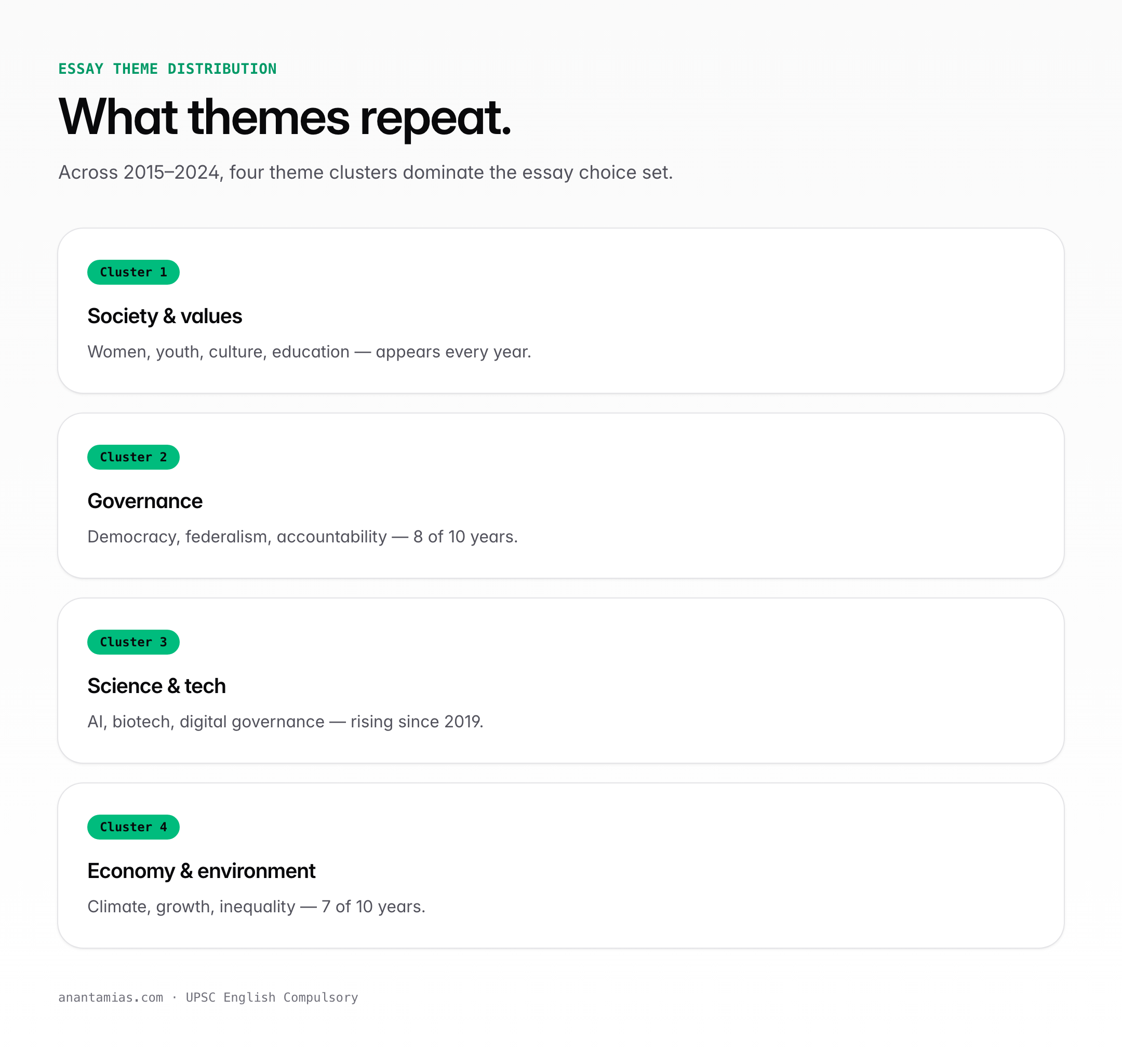
- Governance and federalism: 3 topics (2017, 2018, 2021)
- Technology and society: 2 topics (2016, 2020)
- Education: 2 topics (2019, 2023)
- Economy and environment: 2 topics (2015, 2024)
- Philosophical/abstract: 1 topic (2022)
Precis Length Patterns
| Year | Original length | Target length |
|---|---|---|
| 2016 | 600 | 200 |
| 2017 | 650 | 210 |
| 2018 | 600 | 200 |
| 2019 | 700 | 230 |
| 2020 | 600 | 200 |
| 2021 | 540 | 180 |
| 2022 | 580 | 190 |
| 2023 | 620 | 205 |
| 2024 | 600 | 200 |
Observation: target length is reliably one-third, rounded to the nearest 10. Preparing at 600→200 is a safe default.
Comprehension Passage Sources (Traced)
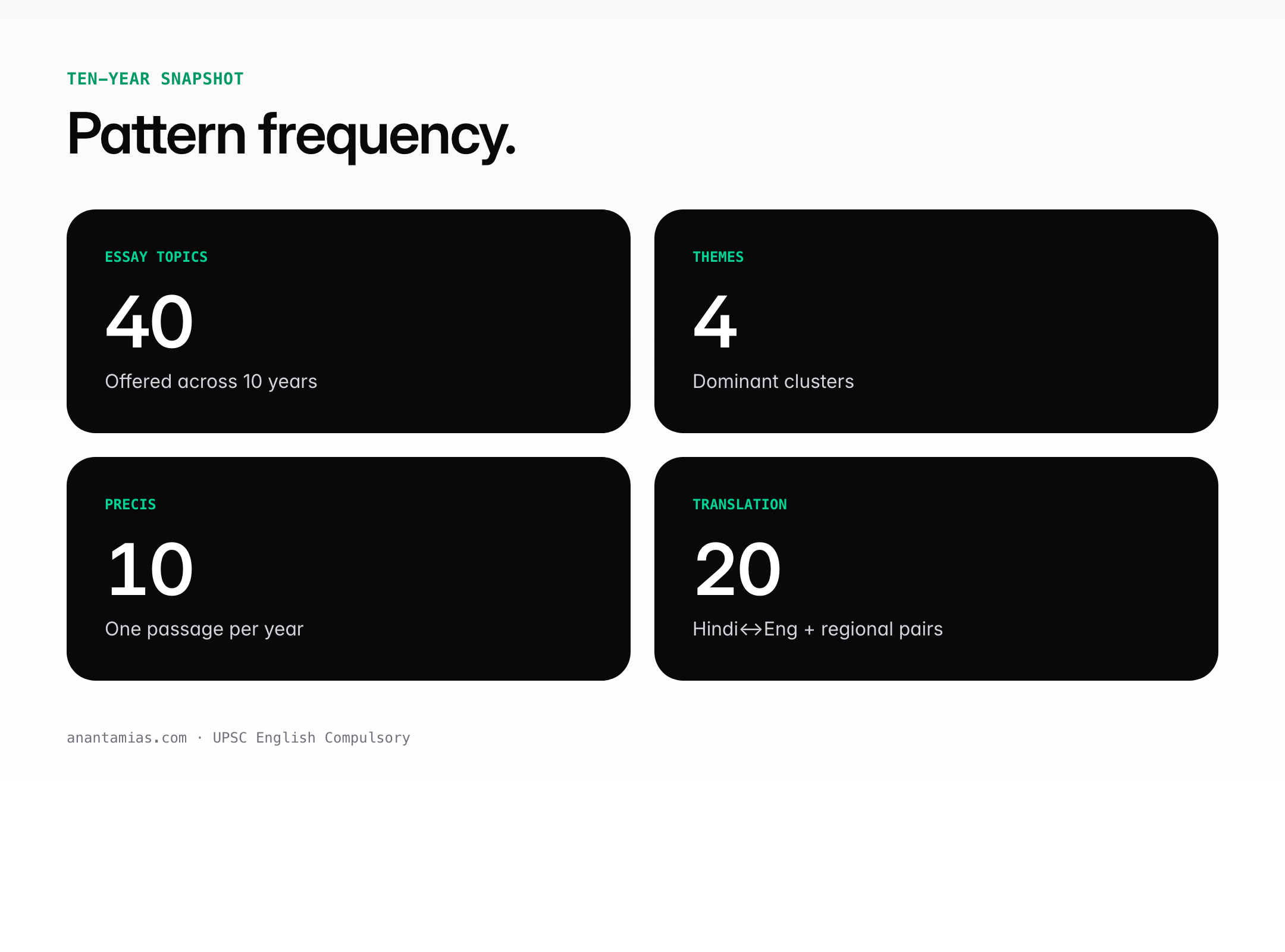
- 2016 — abridged from E.M. Forster, Two Cheers for Democracy
- 2017 — adapted from a World Bank development report
- 2018 — Amartya Sen on inequality (speech, 2015)
- 2019 — Bertrand Russell on boredom and reflection
- 2020 — adapted from Ramachandra Guha on Indian democracy
- 2021 — a Shashi Tharoor essay on language and identity
- 2022 — excerpt from a Yuval Noah Harari interview
- 2023 — essay on climate change adaptation
- 2024 — abridged from a UN Human Development Report
Grammar Section Question-Type Rotation
| Type | Appeared in (years) | Approximate weight |
|---|---|---|
| Error correction | 2015–2024 (every year) | 8–10 marks |
| Voice conversion | 2015–2024 (every year) | 5–8 marks |
| Direct/indirect speech | 2015, 16, 18, 19, 21, 22, 24 | 5–8 marks |
| Fill-in-the-blank (prepositions) | 2016, 18, 20, 22, 24 | 5 marks |
| Idioms | 2017, 19, 20, 21, 23 | 5 marks |
| Sentence transformation | 2015, 17, 19, 23 | 5 marks |
| Articles | 2016, 20, 22 | 5 marks |
Translation Difficulty Trend
Translation passages have grown progressively more idiomatic. Earlier papers (2015–2017) featured news-style prose with straightforward vocabulary. From 2018 onwards, passages include abstract nouns (justice, dignity, plurality) and metaphors, demanding context-aware translation rather than dictionary substitution.
What the PYQs Collectively Teach
- Essay topics are abstract enough to accept almost any example — depth beats specialisation.
- Precis targets have not deviated from one-third; any coaching that trains you to 40% is wasting your time.
- RC passage selection is biased toward 20th-century British and Indian essayists — read Russell, Forster, Tharoor, Guha.
- Grammar is the most predictable section — four question types appear every year without fail.
- Translation rewards idiomatic transfer; literal translators consistently lose 10+ marks out of 40.
High-Yield PYQ Practice List

Objective General English — S.P. Bakshi (Arihant, 2026 edition)
- 836 pages of objective practice across grammar, vocabulary and comprehension
- Rules stated briefly, then hundreds of questions per topic
- Built for CDS, SSC and banking; the grammar section is what UPSC candidates use
- Write full answers to 2019, 2021, and 2023 essay topics — all three test abstract topics
- Attempt the 2018 precis (Amartya Sen) — widely regarded as difficult
- Attempt 2020 and 2022 RC papers — both Indian-democracy themed
- Drill the 2017 grammar section — heaviest on sentence transformation
- Practise the 2024 translation — highest idiomatic density in the decade
Score Distribution (Publicly Reported)
| Year | Average (estimated) | Top 10th percentile |
|---|---|---|
| 2019 | 110–120 | 155+ |
| 2020 | 105–115 | 150+ |
| 2021 | 115–125 | 160+ |
| 2022 | 110–118 | 155+ |
| 2023 | 108–116 | 150+ |
All candidates who qualified Mains scored above 75; most topper copies score between 120 and 155. Scores above 180 are rare and usually indicate English Honours graduates.
Frequently Asked Questions
Are UPSC English Compulsory PYQs repeated?
Exact questions are not repeated, but themes rotate. Governance, technology, education, and federalism appear every few years.
Where can I find past papers?
Official papers from 2013 onwards are available on the UPSC website under ‘Previous Question Papers’. Many coaching portals host compiled PDFs.
Is the precis length always one-third?
Yes, consistently rounded to the nearest 10. Preparing at 600→200 words is a reliable default.
Which grammar questions appear every year?
Error correction and voice conversion — both tested in every paper from 2015 to 2024.
What score qualifies Mains?
75 out of 300. Topper scores range from 120 to 155. Above 180 is rare.
How many PYQs should I attempt?
Last 5 years under timed conditions, and spot-drill the other 5 years for grammar and translation. Full attempts of all 10 years are excessive.
Tell Google you want more of this.
Add Anantam IAS as a preferred sourceOne tap, and this site shows up more often in your own Top Stories, AI Overviews and AI Mode. Remove it any time.