Disclosure: this guide contains Amazon affiliate links. As an Amazon Associate, Anantam IAS earns from qualifying purchases — at no extra cost to you.
Vocabulary drives four of the five UPSC English Compulsory sections — comprehension answers, precis paraphrase, translation word-choice, and essay range. A 3,000-word active vocabulary is more than enough; most graduates already possess 2,000 and need to push the remaining 1,000 over two to three months.
Active vs Passive Vocabulary
Passive vocabulary is what you recognise when you read. Active vocabulary is what you produce when you write. UPSC rewards active vocabulary — a word you have used in two sentences is yours; a word you have only seen is not.
High-Yield Word Categories
| Category | Examples | Use case |
|---|---|---|
| Civic/political | polity, electorate, dissent, consensus, constituency | Essay, RC |
| Economic | fiscal, monetary, subsidy, inflation, equity | Essay |
| Evaluative adjectives | prudent, pragmatic, nebulous, sanguine, disquieting | Essay tone |
| Transitional adverbs | consequently, nevertheless, moreover, conversely, thereby | Every section |
| Precis verbs | contends, argues, illustrates, concedes, refutes | Precis + RC |
30 Words Every UPSC Aspirant Should Know
- Ameliorate — improve
- Austere — plain, severe
- Belie — contradict
- Candid — frank
- Concede — acknowledge reluctantly
- Cursory — hasty, superficial
- Desultory — random, unfocused
- Disparage — belittle
- Ephemeral — short-lived
- Equivocal — ambiguous
- Fastidious — hard to please
- Garrulous — talkative
- Impervious — not affected by
- Laconic — using few words
- Lucid — clear
- Meticulous — careful about details
- Nebulous — vague
- Obdurate — stubborn
- Obsequious — excessively eager to please
- Ostensible — apparent but not real
- Parsimonious — thrifty to the point of stinginess
- Pragmatic — practical
- Precarious — unstable
- Prudent — cautious and sensible
- Quixotic — idealistic and impractical
- Reticent — reserved in speech
- Sanguine — optimistic
- Sycophant — flatterer
- Tenuous — weak, thin
- Ubiquitous — found everywhere
The Two-Sentence Method
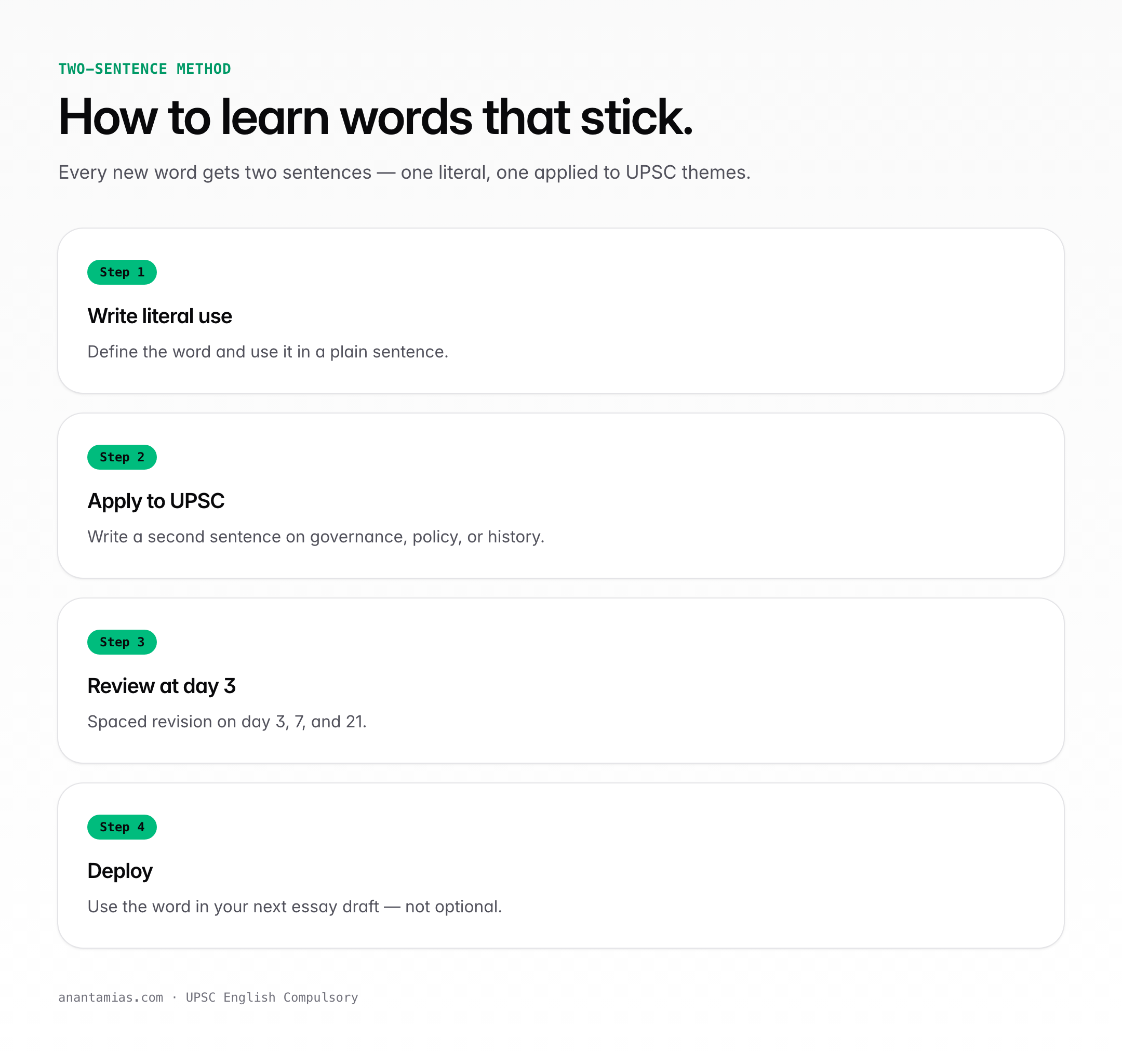
For every new word, write two sentences — one that copies the context of your reading, and one that invents a new context. The second sentence is the test of ownership.
Example: sanguine — “The finance minister remained sanguine about growth despite the slowdown.” | “Despite repeated interview rejections, she was sanguine that the next one would be different.”
Prefixes, Suffixes, and Roots
Learning 50 Latin and Greek roots unlocks 2,000+ words. High-yield roots for UPSC:
| Root | Meaning | Examples |
|---|---|---|
| bene | good | benevolent, benefactor, benign |
| mal | bad | malevolent, malady, malign |
| dict | say, speak | contradict, dictum, diction |
| cred | believe | credible, credit, creed |
| anim | life, spirit | animate, magnanimous, equanimity |
| loqu/locu | speak | eloquent, loquacious, interlocutor |
Reading That Builds Vocabulary

Word Power Made Easy — Norman Lewis (Goyal)
- The authorised Goyal edition of the 1979 classic
- Roots, prefixes and suffixes taught in daily sessions, not word lists
- A self-test after every session so the words stay
- The Economist editorial each Saturday
- The Hindu lead editorial daily
- One Orwell essay per week (Politics and the English Language, Shooting an Elephant)
- Ramachandra Guha’s monthly columns
- One chapter of Norman Lewis’s Word Power Made Easy weekly
Forty Idioms for UPSC
- A blessing in disguise, at loggerheads, beat around the bush, bite the bullet, burn the midnight oil, by and large, call a spade a spade, cut corners, down to earth, every cloud has a silver lining
- Face the music, fall on deaf ears, get cold feet, give the benefit of the doubt, hit the nail on the head, in the same boat, jump on the bandwagon, keep an eye on, let the cat out of the bag, miss the boat
- Nip in the bud, on thin ice, once in a blue moon, out of the blue, pass the buck, piece of cake, play devil’s advocate, pull the plug, read between the lines, rock the boat
- See eye to eye, speak of the devil, spill the beans, steal someone’s thunder, take with a pinch of salt, throw in the towel, turn a blind eye, under the weather, walk on eggshells, wild goose chase
What Not to Do
- Do not memorise 200-word SAT lists without context
- Do not use rare words to impress — they mark you as trying too hard
- Do not substitute utilise for use or commence for start — register matters
- Do not hoard new words; revise old ones weekly
A Simple Daily Routine
- Read one editorial (15 minutes)
- Circle 10 unknown words
- Write two sentences for each (20 minutes)
- Revise Monday’s words every Friday
Frequently Asked Questions
How many words do I need for UPSC English Compulsory?
About 3,000 active words. Most graduates already have 2,000 — the gap is 1,000 words of political, economic, and evaluative vocabulary.
Should I memorise Word Power Made Easy cover-to-cover?
Skim the chapters for roots and high-frequency words. Pure memorisation without writing practice rarely sticks.
How do I learn a word permanently?
Write two sentences with it — one matching the context you saw, one inventing a new context. Use the word again within seven days.
Are idioms really asked in UPSC?
Yes, both in grammar questions and embedded in RC passages. Learn 100 high-frequency idioms with example sentences.
Should I use rare words in the essay?
Only if they fit naturally. A misused rare word damages more than it helps. Prefer plain, precise words.
How long does it take to add 1,000 active words?
Roughly 90 days at 10–12 words a day with daily revision. Shorter timelines are possible but retention suffers.
Tell Google you want more of this.
Add Anantam IAS as a preferred sourceOne tap, and this site shows up more often in your own Top Stories, AI Overviews and AI Mode. Remove it any time.