Disclosure: this guide contains Amazon affiliate links. As an Amazon Associate, Anantam IAS earns from qualifying purchases — at no extra cost to you.
“Nature is the symbol of the spirit” appeared as Topic 5 of Section B in the UPSC Civil Services Mains Essay paper held on 21 August 2026. Seven words, a full stop, and a sentence most aspirants had never met before the hall. It is Ralph Waldo Emerson’s, from his 1836 essay Nature, and it is one of those prompts that looks like a gift and turns into a trap — easy to praise, hard to examine. This guide breaks the topic down the way it should be tackled under the clock: the meaning, the angles, the time map, the paragraph-by-paragraph plan, and a complete 1,100-word model essay you can study, dissect and adapt.
When this was asked and what UPSC is really testing
The topic was set in UPSC CSE Mains 2026, Essay paper, Section B. Three hours, two essays, one from each section, roughly 1,000 to 1,200 words each, 125 marks per essay. “Nature is the symbol of the spirit” is a philosophical-abstract prompt with an environmental door built into it — which is exactly why it is dangerous. Half the hall will walk through that door and write a GS III answer on climate change. The other half will stay outside and write a sermon on the divinity of trees. Neither scores.
UPSC is checking four things at once. One, can you read a transcendentalist metaphor, work out what “symbol” and “spirit” mean, and turn that into a thesis with a spine. Two, can you hold philosophy, ecology, law and lived experience in one argument without letting any of them take over. Three, can you bring India’s own long reading of nature — Vedic, Upanishadic, Buddhist, Jain, Gandhian — as substance rather than ornament. Four, can you face the obvious objection that nature is also cruel and indifferent, and come out of it with a stronger thesis than you went in with. The aspirant who does all four writes an essay examiners remember at the end of a 300-script day.
Five angles that unlock “Nature is the symbol of the spirit”
The trap with a quote like this is to pick the obvious reading — nature is sacred, so protect it — and ride it for 1,100 words. The mark-pulling answer identifies several lenses, names them, and weaves them. Here are the five most defensible readings of nature is the symbol of the spirit. Three, treated well, is the sweet spot. Know all five so your choice is conscious.
- The philosophical reading — Emerson’s own. In the “Language” chapter of Nature he builds three steps: words are signs of natural facts; particular natural facts are symbols of particular spiritual facts; therefore nature as a whole is the symbol of spirit. A river is not merely water; it is how the human mind understands time, purification, continuity. This angle gives the essay its definition and keeps it honest about what the sentence actually claims.
- The civilisational reading — India got here first. The Ishopanishad’s opening verse, the Prithvi Sukta of the Atharvaveda, the Gita’s vibhuti yoga, the Buddha under a peepal, the Jain care for one-sensed life, and beyond India, St Francis, Shinto, Wordsworth. The convergence of so many unrelated traditions on the same intuition is itself an argument.
- The ecological-scientific reading — interdependence without theology. Ecology as the study of relationships, the Gaia hypothesis, E. O. Wilson’s biophilia, hospital studies on recovery and green views. Science arriving, by a different road, at the correspondence Emerson asserted. This angle stops the essay floating.
- The legal-constitutional reading — Articles 48A and 51A(g), the public trust doctrine, rivers declared legal persons in Uttarakhand and New Zealand, the M.C. Mehta line of cases. Law is society trying to write the symbol into statute, and the limits of that attempt are as instructive as its successes.
- The mirror reading — the sharpest one. If nature symbolises spirit, then what a people does to nature reveals what its spirit is. A poisoned river is a portrait. This is also where the counter-argument lives — nature is indifferent, spirit is projection — and where it gets resolved: symbol does not mean benevolent, it means mirror.
A strong essay takes angles 1, 2 and 5 as its backbone (definition, civilisational depth, mirror), uses 3 as confirmation from an unexpected quarter, and 4 as concrete machinery so the argument touches the ground. That gives the essay movement — claim, inheritance, complication, resolution — instead of a single straight line from “nature is holy” to “save the planet.”
A time map for the 1,500-second window
One essay deserves about 75 to 90 minutes inside the three-hour paper. Spending more on Essay 1 starves Essay 2. The single biggest source of below-100 essay scores is poor time discipline — beautiful introductions, panicked conclusions. Use a rough breakdown like this:
| Minutes | Activity | What it earns you |
|---|---|---|
| 0 — 10 | Decode “symbol” and “spirit.” Write the thesis in one line. List 4 to 5 angles. Pick 3. | Direction. Decides whether this becomes an essay or a GS III answer. |
| 10 — 18 | Brainstorm examples: one scripture, one martyrdom, one scientist, one statute, one poet, one disaster. | The substance the body paragraphs will run on. |
| 18 — 22 | Draft a paragraph-level outline — 12 to 15 bullets, in sequence, with the counter-argument placed. | Prevents the mid-essay drift that kills 60% of attempts. |
| 22 — 80 | Write the essay — opening scene, body, conclusion — without re-planning. | The actual marks come from this window. Protect it. |
| 80 — 85 | Read the conclusion. Check every date and name. Tighten the last two sentences. | Conclusions are over-weighted by examiners. A clean ending saves 5 marks. |
Notice what is not on the list: rewriting the introduction halfway, hunting for the perfect Sanskrit verse, drawing a tree in the margin, decorative underlining. None of that earns marks. Discipline does.
What to add — and what to avoid at all costs
The essay paper rewards what most aspirants under-do and punishes what most aspirants over-do. Memorise this list before you walk into the hall.
Add liberally
- One precise thesis, stated by the end of paragraph two and not abandoned. “Nature is the symbol of the spirit not because it is kind but because it is a mirror; how a people reads and treats the natural world is the most honest record of what that people is.”
- Concrete examples across three or four domains — one historical (Amrita Devi at Khejarli in 1730, Chipko in 1973), one Indian-constitutional (Article 48A, 51A(g), the 2017 Uttarakhand ruling on the Ganga), one scientific (Ulrich’s 1984 hospital-window study, Lovelock’s Gaia, Wilson’s biophilia) and one literary or personal (Wordsworth at Tintern Abbey, Thoreau reading the Gita at Walden, Tagore’s open-air classes).
- Two or three short, named quotes — Emerson’s own “Nature always wears the colours of the spirit,” the Atharvaveda’s “the Earth is my mother, I am her son,” the line on need and greed attributed to Gandhi. One per major section is enough.
- One Indian philosophical anchor used substantively. The Ishopanishad’s Isha vasyam idam sarvam — the whole moving world is to be seen as enveloped by the divine — is not a decoration; it is an instruction on how to look. Explain what it does, not just that it exists.
- The counter-argument, taken seriously. The 2004 tsunami, pathogens, Tennyson’s “nature, red in tooth and claw.” Name it fully, then resolve it: a symbol need not be benevolent to be a symbol. This single move lifts the essay out of the sermon category.
- A clean conclusion that returns to the opening image — not a fresh argument, not a policy wish-list, not a new example.
Avoid — even when tempted
- The pantheist sermon. Eleven paragraphs proving that trees are divine and rivers are mothers, with no argument, no tension and no counter. Examiners read twenty of these per topic. They blur.
- The policy listicle. Paris Agreement, NDCs, Mission LiFE, National Action Plan, all bulleted. That is a GS III answer wearing an essay’s clothes. Use one or two legal anchors as evidence for a philosophical claim, never as the claim itself.
- Unsourced statistics. “Seventy per cent of India’s rivers are polluted” — if you cannot name the source, do not write the number. Examiners cross-mark this.
- Misquoting the anchor. The Gita names the ashvattha — the peepal — among trees, not the banyan; Emerson wrote Nature in 1836, not after Walden. Small errors in the one paragraph that was meant to impress cost more than they should.
- Hot-button political examples. Naming current ministers, parties or contested projects introduces avoidable risk with a human examiner. Use the institution, the statute or the historical episode instead.
- Moralising. “We must all love nature and plant trees” reads like a school assembly. The essay paper rewards examination, not exhortation.
A paragraph-by-paragraph blueprint
Twelve paragraphs at roughly 90 words each gets you to 1,080. Fifteen at 75 each gets you to 1,125. Either works. What follows is a 13-paragraph plan that maps cleanly onto the model essay below. Each line is what that paragraph is doing, not what it is saying.
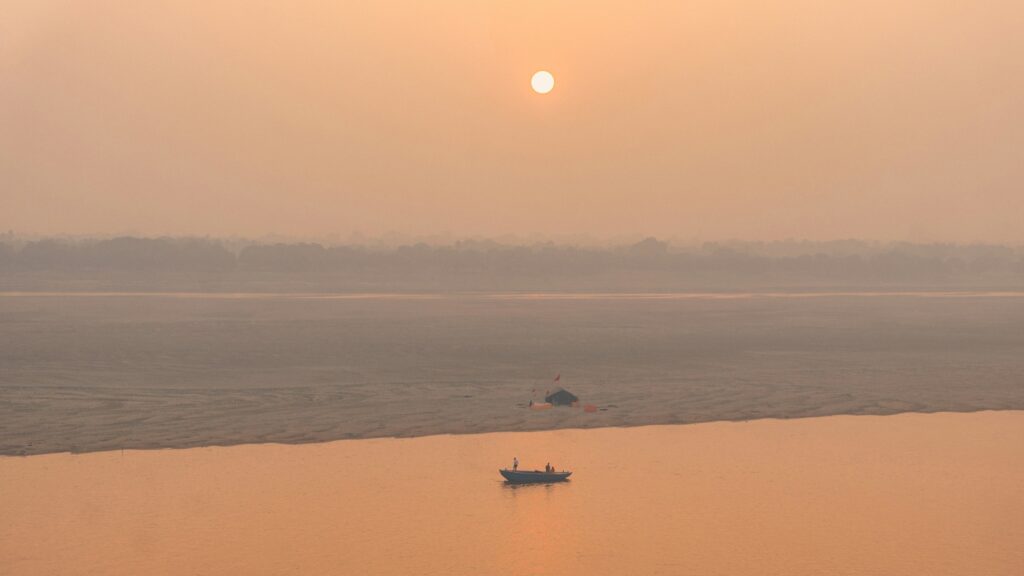
- Opening image — a ghat at dusk during Chhath, women standing in the river facing the setting sun. Nobody there is worshipping a ball of hydrogen. No mention of the topic yet.
- The pivot to thesis — name Emerson and the topic, then state the thesis in one sentence: symbol means mirror, not benefactor.
- Define the terms — Emerson’s three steps; what “symbol” and “spirit” mean here; why the claim is about correspondence, not decoration.
- Indian anchor — the Ishopanishad’s first verse, the Prithvi Sukta, the Gita’s vibhuti yoga. India read nature as a sign of spirit two and a half millennia before Concord.
- The convergence — the Buddha under the peepal, the Jain one-sensed beings, St Francis, Shinto, Wordsworth. Unrelated traditions arriving at the same reading.
- History — when the symbol became action — Khejarli 1730, Chipko 1973, sacred groves. A symbol strong enough to die for.
- Science confirms the correspondence — ecology as interdependence, Gaia, biophilia, the hospital-window study. Kinship without theology.
- Law tries to write it down — Article 48A, 51A(g), public trust doctrine, the Ganga and the Whanganui as legal persons. What law can and cannot do.
- The mirror turns dark — Kedarnath 2013, Joshimath 2023, a choked river. The environmental crisis read as a spiritual record, not merely a technical failure.
- Counter-argument handled — nature is indifferent and cruel; spirit is what humans project. Resolution: a symbol need not be benevolent; a mirror does not flatter.
- Way forward — individual — attention as a discipline: Thoreau at Walden, Tagore’s classroom under the trees.
- Way forward — collective — need versus greed; the word “enough”; governance that treats rivers as relatives before resources.
- Closing image — return to the ghat, the river now a mirror in the last light, close with one resonant line.
How to make an examiner stop and read
An essay examiner reads several hundred scripts in a sitting. On this topic most of them will open with “Nature has always been important to humans.” The first paragraph decides whether they read the second with attention or with autopilot. Four small habits separate the essays that get attention from the ones that get skimmed.
- Open with a scene, not a statement. A ghat at dusk, a woman touching the earth before the first furrow, a hospital window facing a stand of trees. Concrete images cost no marks and earn attention.
- Use the topic phrase itself two or three times across the essay. Once in the thesis, once at the turn where the mirror goes dark, once at the close. It signals discipline and prevents drift.
- Vary sentence length. A short sentence after three long ones lands. Examiners feel rhythm before they parse meaning.
- End paragraphs with the takeaway, not with examples. Place Khejarli or Gaia mid-paragraph. Let the last sentence be the thought, so the reader carries it into the next paragraph.
The complete essay — “Nature is the symbol of the spirit”
What follows is a 1,100-word model essay built on the blueprint above. Read it twice — once for the argument, once for the moves. The moves are what you can carry into your own essay; the argument is one of many you could make.
On the evening of Chhath, along the ghats of the Ganga in Bihar, women stand waist-deep in the river with baskets of fruit held before them, facing west, waiting for the sun to set. Nobody in that cold water believes she is addressing a sphere of burning hydrogen. She is addressing what the sun has always stood for — constancy, return, the debt every living thing owes to light. The physics is not denied. It is simply not the point.
Ralph Waldo Emerson, writing in Concord in 1836, gave that intuition its most compact form: “Nature is the symbol of the spirit.” The sentence is usually read as a compliment to nature. It is better read as a statement about us. Nature is the symbol of the spirit not because it is kind, but because it is a mirror: how a people reads the natural world, and what it is willing to do to it, is the most honest record of what that people’s spirit is.
Emerson built the claim in three steps in the chapter he called “Language.” Words are signs of natural facts: “spirit” once meant wind. Particular natural facts are symbols of particular spiritual facts: a river is how the mind grasps time, a seed how it grasps hope. Therefore nature as a whole is the symbol of spirit — the visible alphabet in which invisible things are written. Nature is not a pretty picture of the soul; it is the language the soul thinks in.
India had been reading that alphabet for millennia before Concord. The Ishopanishad opens with Isha vasyam idam sarvam — whatever moves in this moving world is to be seen as clothed in the divine — an instruction on how to look, not a description. The Prithvi Sukta of the Atharvaveda says plainly, “the Earth is my mother, I am her son.” In the Gita’s vibhuti yoga, the divine points to itself in the peepal among trees, the Ganga among rivers, the Himalaya among things that stand still. The discipline was to see it here.
That reading was not India’s alone, and the convergence is itself an argument. The Buddha woke under a peepal and kept his monks indoors through the monsoon so that new shoots and insects would not be trampled. Jain thought extended ahimsa to one-sensed beings — plants, water, air. Shinto placed kami in cedar and waterfall. Wordsworth felt “a motion and a spirit” that “rolls through all things.” Either all of them were mistaken in the same way, or all were looking at something real.
The symbol did not stay on the page; people died for it. In 1730, at Khejarli, Amrita Devi and 362 Bishnoi villagers wrapped their arms around khejri trees and were cut down with them rather than let them be felled for a palace. In 1973 the women of Chamoli did the same and gave the world the word Chipko. A symbol people will hold with their bodies is not a figure of speech. It is a fact about the human spirit.
Science has arrived at the same correspondence by another road. Ecology’s first lesson is that nothing in a forest exists alone. James Lovelock’s Gaia hypothesis proposed that the living Earth regulates itself like a single organism. E. O. Wilson named biophilia, the inborn human pull toward other living things. In 1984 Roger Ulrich showed in Science that surgical patients whose window faced trees recovered faster than those facing a brick wall. All of it says the human mind is built to read nature as kin.
Law has tried to write the symbol down. The 42nd Amendment gave the Constitution Article 48A, the State’s duty to the environment, and Article 51A(g), every citizen’s duty to protect rivers and forests and to have compassion for living creatures. The public trust doctrine, adopted in M.C. Mehta v. Kamal Nath, holds that rivers are held by the State for the people, not owned by it. In 2017 the Uttarakhand High Court declared the Ganga and Yamuna legal persons, as New Zealand did for the Whanganui; the Indian order was stayed. Law can name the relationship. It cannot make anyone feel it.
Here the mirror turns dark. If nature is the symbol of the spirit, then the state of our rivers is a portrait of us. Kedarnath, in June 2013, was swept away in a valley carved up for hotels and roads; Joshimath, in January 2023, began to sink under what had been built on it. These are engineering failures, but they are also readings. A civilisation that looks at a river and sees a drain has told us what its spirit has become. The climate crisis is a technical problem wrapped around a spiritual one.
It might be objected that all of this is sentiment; that nature is simply indifferent. The tsunami of December 2004 killed more than two lakh people without malice or meaning. Tennyson saw “nature, red in tooth and claw.” Whatever spirit we find in a forest, we carried there ourselves. The objection is right about nature and wrong about the sentence. Emerson never said nature was benevolent; he said it was a symbol, and a symbol need not be kind to be true. Elsewhere he wrote that “nature always wears the colours of the spirit.” Its indifference is what makes it an honest mirror: it shows us whatever we bring.
For an individual, this asks for a discipline of attention rather than a creed. Thoreau carried the Gita to Walden Pond and read it in the mornings; the pond taught him what the book described. Tagore built Shantiniketan so that children would learn under trees, convinced that the forest ashram had taught India its oldest lesson — that the mind grows best among things it did not make. Attention is not mysticism. It is looking at a tree long enough to stop seeing timber.
For a society, it asks for a harder word: enough. The line attributed to Gandhi — that the world has enough for everyone’s need but not for everyone’s greed — is not an economic forecast but a spiritual diagnosis. A State that reads its rivers as relatives before it reads them as resources will still build dams; it will build them as someone who expects to be looked at in return. Law can put that expectation into governance; it will work to the degree that the spirit behind it is real.
Return to the ghat. The sun is gone now, the women are wading back, and the river that a moment ago held the light holds instead the faces of the people standing in it. That is the quiet truth inside Emerson’s sentence. Nature is the symbol of the spirit because, long after the worship ends, it goes on showing us who we are. We do not get to choose whether the mirror is there. We only get to choose what it sees.
Word count: approximately 1,200.
How to use this model essay
Do not memorise it. Memorised essays read like memorised essays, and examiners spot them in two paragraphs. Use the model the way a chess student uses a master game: study the opening scene, the one-sentence thesis, the way the Indian anchor is explained rather than dropped, the placement of the counter-argument and the turn where the mirror goes dark. Then take a neighbouring topic and write your own essay on the same blueprint. Forests precede civilizations and deserts follow them tests the same mirror reading from the side of history; Brave human laws cannot resist natural laws pushes on the legal angle; and Muddy water is best cleared by leaving it alone works the Emersonian theme of attention and restraint. Repeat the exercise eight to ten times and the structure becomes muscle memory. On the day, the only thing you should have to think about is the topic itself.
Books quoted in this essay
The Bhagavad Gita, Eknath Easwaran’s translation. The plain-English edition most essay readers start with.
Tell Google you want more of this.
Add Anantam IAS as a preferred sourceOne tap, and this site shows up more often in your own Top Stories, AI Overviews and AI Mode. Remove it any time.