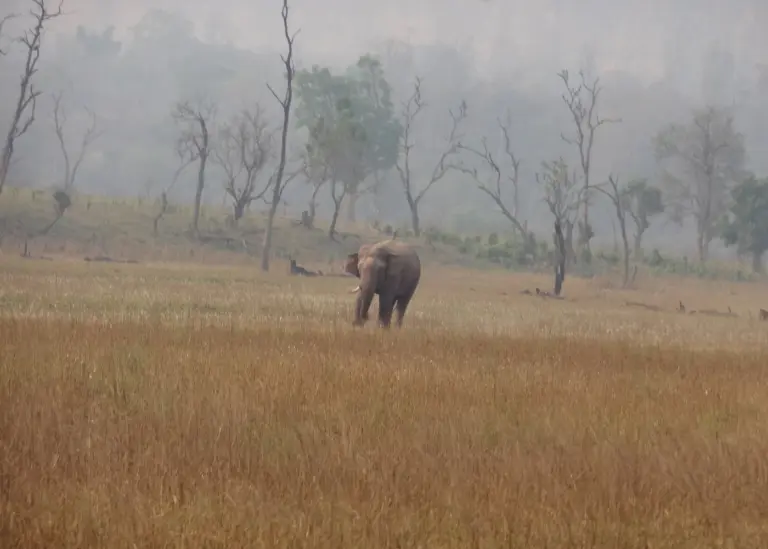

“Forests are the best case studies for economic excellence” appeared as Topic 1 of Section A in the UPSC Civil Services Mains Essay paper held on 16 September 2022. Six metaphor-loaded words and a verdict already buried inside them. One hundred and twenty-five marks if you can convert the metaphor into a thesis; a long hour of decorative writing if you cannot. This guide breaks the topic down the way it should be tackled in the hall — first the meaning, then the angles, then the time map, then the paragraph-by-paragraph plan, and finally a complete 1,200-word model essay you can study, dissect and adapt.
When this was asked and what UPSC is really testing
The topic was set in UPSC CSE Mains 2022, Essay paper, Section A. Three hours, two essays, one from each section, roughly 1,000 to 1,200 words each, 125 marks per essay. “Forests are the best case studies for economic excellence” is a metaphor-economic prompt — the kind UPSC favours when it wants to test whether you can move between ecology, economics and ethics in a single argument.
UPSC is checking four things at once. One, can you read a metaphor that yokes two distant domains — forest and firm — and convert it into a clear thesis. Two, can you organise material from ecology, economics, Indian history and tribal law around that thesis without it becoming a GS III answer. Three, can you move comfortably across nutrient cycles, Joint Forest Management, ecological economics and the Chipko movement without sounding like a textbook. Four, can you write 1,150 disciplined words that examine the metaphor rather than 1,500 loose words that celebrate trees. The aspirant who handles all four scores in the 130s. The aspirant who handles only the fourth — lyrical prose with no economic spine — scores in the 90s.
Five angles that unlock “Forests are the best case studies for economic excellence”
The trap with this topic is to read it as a plea to save forests and write a 1,100-word environmental sermon. The mark-pulling answer instead treats the forest as an economic object — a self-organising system that already does what human economies struggle to do. Here are the five most defensible readings of forests are the best case studies for economic excellence. Three, treated well, is the sweet spot.
- Forest as a self-organising economy — the literal reading. Nutrient cycles, mycelial networks (Suzanne Simard’s “wood-wide web”), canopy layering, zero waste. Every output is another organism’s input. No central planner, yet productive equilibrium.
- Forest as a model of long horizons — an oak takes a century to mature. Forests teach what quarterly capitalism has forgotten: that the most productive assets are the ones we plant for a generation we will not meet.
- Forest as a balance sheet of true costs — ecological economics from Herman Daly to Pavan Sukhdev’s TEEB. Forests price what GDP ignores — pollination, carbon, water, soil — and force the question of natural-capital accounting.
- Forest as a commons — sacred groves, Joint Forest Management, the Forest Rights Act, tribal cooperatives in tendu and mahua. Elinor Ostrom’s work on commons begins to fit here. The forest is excellent precisely because it is not privatised.
- Forest as a counter-example — the honest essay must admit that forests are not Pareto-perfect. Predator-prey crashes, monoculture vulnerability, the FRA implementation gap, tribal livelihood pressures. The metaphor illuminates; it does not exonerate.
A strong essay picks angles 1, 3 and 4 as its backbone (system, accounting, commons), uses 2 as the moral pivot (long horizons) and 5 as a counter-current (limits of the metaphor). That gives the essay rhythm — definition, complication, resolution — instead of a single straight line.
A time map for the 1,500-second window
One essay deserves about 75 to 90 minutes inside the three-hour paper. Spending more on Essay 1 starves Essay 2. The single biggest source of below-100 essay scores is poor time discipline — beautiful introductions, panicked conclusions. Use a rough breakdown like this:
| Minutes | Activity | What it earns you |
|---|---|---|
| 0 — 10 | Decode the topic. Write the thesis in one line. List 4 to 5 angles. Pick 3. | Direction. The single most important investment of the 90 minutes. |
| 10 — 18 | Brainstorm examples — Simard, Daly, Chipko, sacred groves, JFM, CAMPA, TEEB. | The substance the body paragraphs will run on. |
| 18 — 22 | Draft a paragraph-level outline — 12 to 15 bullets, in sequence. | Prevents the mid-essay drift that kills 60% of attempts. |
| 22 — 80 | Write the essay — opening, body, conclusion — without re-planning. | The actual marks come from this window. Protect it. |
| 80 — 85 | Read the conclusion. Tighten the last two sentences. Fix factual errors. | Conclusions are over-weighted by examiners. A clean ending saves 5 marks. |
Notice what is not on the list: rewriting the introduction halfway, hunting for the perfect quote, fancy diagrams, decorative underlining. None of that earns marks. Discipline does.
What to add — and what to avoid at all costs
The essay paper rewards what most aspirants under-do and punishes what most aspirants over-do. Memorise this list before you walk into the hall.
Add liberally
- One precise thesis, stated by the end of paragraph two and not abandoned. “Forests are economically excellent because they price every externality, plan in centuries, distribute risk through diversity, and treat waste as a resource — four habits modern economies are only beginning to learn.”
- Concrete examples across three or four domains — one ecological (Suzanne Simard’s mycorrhizal networks), one Indian historical (the 1730 Khejarli sacrifice, Chipko 1973, Appiko 1983), one economic (Pavan Sukhdev’s TEEB, Herman Daly’s steady-state economics), one institutional (Joint Forest Management, CAMPA, the Forest Rights Act 2006).
- Two or three short, named references — Tagore on the forest as university, Vandana Shiva on biodiversity, the Mundaka Upanishad on vana. One per major section is enough.
- One Indian philosophical anchor. Aranyaka — the forest books of the Vedic tradition — or Tagore’s aranya samskriti, the civilisation of the forest. Examiners read 300 essays a day; an Indian anchor lifts an essay full of ecology textbook above the pack.
- Counter-arguments handled briefly. “It might be objected that ecological systems crash too…” — then resolved in two lines. Acknowledging the other side earns more marks than ignoring it.
- A clean conclusion that returns to the opening image — not a fresh argument, not a new example.
Avoid — even when tempted
- Restating the topic in the first sentence. “Forests are indeed the best case studies for economic excellence…” — this signals that you have nothing to add. Open with a scene under a canopy.
- Drifting into pure ecology. A 1,100-word essay only on photosynthesis and species counts looks like a Class XI biology answer. The topic word is economic; honour it.
- Unsourced statistics. “Forests contribute $125 trillion a year to the global economy” — if you cannot name the source, do not write the number. Examiners cross-mark this.
- Hot-button political examples. The Essay paper is graded across the ideological spectrum. Naming current parties, ministers or pending bills introduces avoidable risk. Use the institution, not the personality.
- Decorative scholar-dropping. Citing Daly, Costanza, Ostrom, Sukhdev and Simard in one paragraph to look serious. Examiners spot performance citations instantly. One scholar, used well, beats four named in passing.
- Moralising. “We must all plant a tree” reads like a school speech. The essay paper rewards examination, not exhortation.
A paragraph-by-paragraph blueprint
Twelve paragraphs at roughly 95 words each gets you to 1,140. Thirteen at 90 each gets you to 1,170. Either works. What follows is a 13-paragraph plan that maps cleanly onto the model essay below. Each line is what that paragraph is doing, not what it is saying.
- Opening image — a scene under the canopy of a Western Ghats sholai or a Sundarbans mangrove that physically embodies a productive, self-managing economy. No mention of the topic yet.
- The pivot to thesis — name the topic, then state the four-part thesis in one sentence.
- Define the terms — what does “economic excellence” mean here (productive efficiency, allocative fairness, long-term resilience), and why a forest qualifies on each count.
- Angle 1 — Self-organising system — nutrient cycles, mycorrhizal networks, canopy layering, zero waste. The hidden division of labour.
- Indian anchor — aranya samskriti, the forest as university; vanaprastha as a stage that prized retreat into the forest as productive, not extractive.
- Angle 2 — True-cost accounting — TEEB, Costanza’s ecosystem-service valuations, India’s Green GDP attempts, the carbon market. The forest invoices what GDP forgets.
- Angle 3 — Commons and cooperation — Khejarli (1730), Chipko (1973), Appiko (1983), Joint Forest Management, Forest Rights Act 2006, tendu and mahua cooperatives.
- The long horizon — an oak takes a century, a Banyan grows for three. Why patient capital and the forest think alike, and why quarterly capitalism does not.
- Contemporary tension — Deforestation — monoculture plantations, the Aravalli losses, mining-led forest diversion. The metaphor under stress.
- Counter-argument handled — forests are not Pareto-efficient; predator-prey crashes, romanticisation of tribal lives. The metaphor illuminates, not exonerates.
- Way forward — accounting — natural-capital accounting (NCAVES), Green GDP, mandatory ecosystem-service disclosure for listed firms.
- Way forward — institutions — agroforestry, Aravalli Green Wall, CAMPA reform, full Forest Rights Act implementation, tribal cooperative enterprises.
- Closing image — return to the opening canopy, close with one resonant line on what the forest invoices civilisation.
How to make an examiner stop and read
An essay examiner reads several hundred scripts in a sitting. The first paragraph decides whether they read the second with attention or with autopilot. Four small habits separate the essays that get attention from the ones that get skimmed.
- Open with a scene, not a statement. A shaft of light through a Western Ghats canopy, a Khejri tree on the Rajasthan dune, a Banyan with two centuries of root. Concrete images cost no marks and earn attention.
- Use the topic phrase itself two or three times across the essay. Once in the thesis, once at the turn, once at the close. It signals discipline and prevents drift.
- Vary sentence length. A short sentence after three long ones lands. Examiners feel rhythm before they parse meaning.
- End paragraphs with the takeaway, not with examples. Place the example mid-paragraph. Let the last sentence be the thought, so the reader carries it into the next paragraph.
The complete essay — “Forests are the best case studies for economic excellence”
What follows is a 1,200-word model essay built on the blueprint above. Read it twice — once for the argument, once for the moves. The moves are what you can carry into your own essay; the argument is one of many you could make.
Stand at dawn under the canopy of a Western Ghats sholai. Light enters in slats, broken by four layers of leaf above you — emergents, canopy, understorey, shrubs. Beneath your boots, an entire commerce moves that the eye cannot see: fungi exchanging phosphorus for sugar, ants composting last week’s leaf into next week’s soil, a sapling drawing on the carbon savings of a parent tree forty metres away. Nothing here is wasted; nothing is centrally planned; nothing is optimised for this quarter. And yet by every meaningful measure — productivity per hectare, resilience to shock, distribution of returns across species — this is a working economy, older than every market on Earth.
“Forests are the best case studies for economic excellence” begins from that observation. The claim is not that a forest is a pretty alternative to a stock exchange. It is sharper than that. Forests are economically excellent because they do four things that human economies still struggle to do: they price every externality, they plan in centuries rather than quarters, they distribute risk through diversity, and they treat one organism’s waste as another organism’s resource. The task of this essay is to take those four habits one by one and ask what they teach a country that is simultaneously industrialising and losing forest cover.
Some careful definitions help. “Economic excellence” is wider than maximum output. It includes productive efficiency, allocative fairness across generations, and resilience to unforeseen shock. A factory that produces ten thousand widgets a day and collapses in the first power cut is not excellent. A village mill that produces less but never stops is closer to excellent. A forest, judged on this fuller standard, is the oldest excellent firm we know — it has stayed in business, on the same site, for four hundred million years.
The first habit is self-organisation. Suzanne Simard’s research on Douglas-fir stands revealed what foresters had long suspected: trees of different species share carbon, water and warnings through underground mycorrhizal networks — a “wood-wide web”. Older “mother trees” subsidise the seedlings of competitors. Canopy layering ensures that no two species fight for the same shaft of light. Leaf litter pre-pays next year’s soil. The result is a productive system with no central planner and no annual budget meeting, achieving what a hundred ministries of cooperation cannot.
India read this signal long before modern ecology named it. The Aranyakas — literally “forest books” — were composed in groves on the assumption that the forest was a place of teaching, not raw material. Tagore’s school at Santiniketan rebuilt that intuition into pedagogy, and his phrase aranya samskriti insisted that an entire civilisation could be organised on forest principles rather than against them. The vanaprastha stage of life was not retirement; it was productive withdrawal into the forest’s slower economy.
The second habit is honest accounting. Conventional GDP records the felling of a thousand-year sal tree as income and the cyclone that follows as expenditure, never noticing that the two are connected. Ecological economists from Herman Daly to Robert Costanza, and Pavan Sukhdev’s TEEB study, have spent four decades trying to put pollination, watershed regulation, carbon storage and biodiversity into the same ledger as steel and software. India’s NCAVES experiment in natural-capital accounting and successive Green GDP attempts are the domestic versions of that project. The forest already keeps these books. It is the auditor reminding the economy that the cheapest production is often the costliest one.
The third habit is cooperation in the commons. From the Bishnoi who died defending the Khejri trees at Khejarli in 1730 to the women who hugged the chir pines at Reni in 1973 and the villagers of Salkani who began Appiko in 1983, the Indian forest has been governed by ordinary people far more often than by foresters. Joint Forest Management, the Forest Rights Act of 2006, MSP for minor forest produce, and tribal cooperatives in tendu, mahua and lac add a modern legal scaffolding to a much older practice. Elinor Ostrom’s work on the commons demonstrated globally what these communities knew locally — that a well-governed commons can outperform both state and market on the same forest.
The fourth habit is the long horizon. A Quercus leucotrichophora oak in the Kumaon takes a century to mature. A Banyan grows for three. The forest plants for a tenant it will never meet. Modern finance, driven by quarterly earnings and CEO tenures of four years, has effectively shortened the longest planning horizon in the human economy to the next reporting cycle. Patient capital — long-dated bonds, generational endowments, sovereign green funds — borrows back from the forest a virtue that capitalism had as long as it was bound to land and lost as soon as it became liquid.
The metaphor begins to creak when we look at what has been done to actual forests. The Aravallis have lost a third of their cover in a generation. Monoculture eucalyptus and acacia plantations have replaced sal and teak diversity with a single-crop fragility. Mining-led forest diversion under CAMPA records compensatory afforestation on paper that often grows nothing on the ground. Each of these is a reminder that the forest’s excellence is descriptive of a wild system, not prescriptive of a managed one — that an economy like a forest is not the same as an economy against the forest.
It might be objected that forests are not Pareto-efficient either. Predator-prey populations crash, invasive species spread, fires reset entire stands. Romanticising the forest, the objection runs, glosses over the hard tribal livelihoods that depend on it and the implementation gaps in the Forest Rights Act. The objection is partly right and entirely useful. The forest is not a utopia; it is a case study. The point of a case study is not to copy it whole, but to read what it teaches — and what it teaches about externalities, diversity, cooperation and time still stands after every honest caveat.
For an Indian economy that is industrialising and warming at once, the practical agenda writes itself. Move natural-capital accounting from pilot to default in the Annual Survey. Make ecosystem-service disclosure mandatory for listed firms. Recognise community forest rights at the village scale that the 2006 Act envisaged. Treat agroforestry, the Aravalli Green Wall and mangrove restoration as infrastructure, not as charity. Build tribal cooperative enterprises that capture the value of minor forest produce instead of exporting the raw material to middlemen. None of these are new ideas. All of them, in the end, are habits the forest has been demonstrating for free.
Return for a moment to that shaft of dawn light in the sholai. The forest will not present an invoice for the rain it stores, the carbon it locks, the seeds it disperses, the cyclone it breaks. It will simply keep working, on a schedule older than civilisation. Forests remain the best case studies for economic excellence not because they have answered the questions an economy must ask, but because they have been quietly living the answers. Civilisations rise to the degree that they learn to read those answers. They fall to the degree that they mistake the forest for empty land.
Word count: approximately 1,200.
How to use this model essay
Do not memorise it. Memorised essays read like memorised essays, and examiners spot them in two paragraphs. Use the model the way a chess student uses a master game: study the opening move, the pivot, the way each paragraph hands the reader to the next, the placement of the Indian anchor, the way the counter-argument is brought up and then closed. Then take a different metaphor-economic topic — try “A ship in harbour is safe, but that is not what ships are built for” or “Wisdom finds truth” — and write your own essay using the same blueprint. Repeat that exercise eight to ten times and the structure becomes muscle memory. On the day of the exam, the only thing you should have to think about is the topic itself.
Tell Google you want more of this.
Add Anantam IAS as a preferred sourceOne tap, and this site shows up more often in your own Top Stories, AI Overviews and AI Mode. Remove it any time.