The link between attitude and behaviour is real but imperfect. Sometimes a person's stated attitudes predict her actions; often they do not. UPSC GS-IV asks the candidate to know why the link is sometimes strong and sometimes weak, and what an officer can do to keep her own attitudes and behaviours aligned. This guide consolidates the compass extracts on Factors Influencing Relation Between Attitude and Behaviour (Chapter 28) and Steps to Increase Correlation Between Attitude and Behaviour (Chapter 29) into one Mains-quality reference.
Editorial note — merge. This article merges the compass chapters Factors Influencing Relation Between Attitude & Behaviour (134 words) and Steps to Increase Correlation Between Attitude and Behaviour (49 words). The two are the diagnosis and the prescription for the same phenomenon — the attitude-behaviour gap — and they belong together.
The Background — Why the Gap Exists
A person can hold an attitude — corruption is wrong, citizens deserve respect, gender equality matters — and still act inconsistently. Richard LaPiere's 1934 experiment showed it empirically. Leon Festinger's 1957 cognitive-dissonance theory explained the psychological mechanism. Icek Ajzen's Theory of Planned Behaviour systematised the predictors.
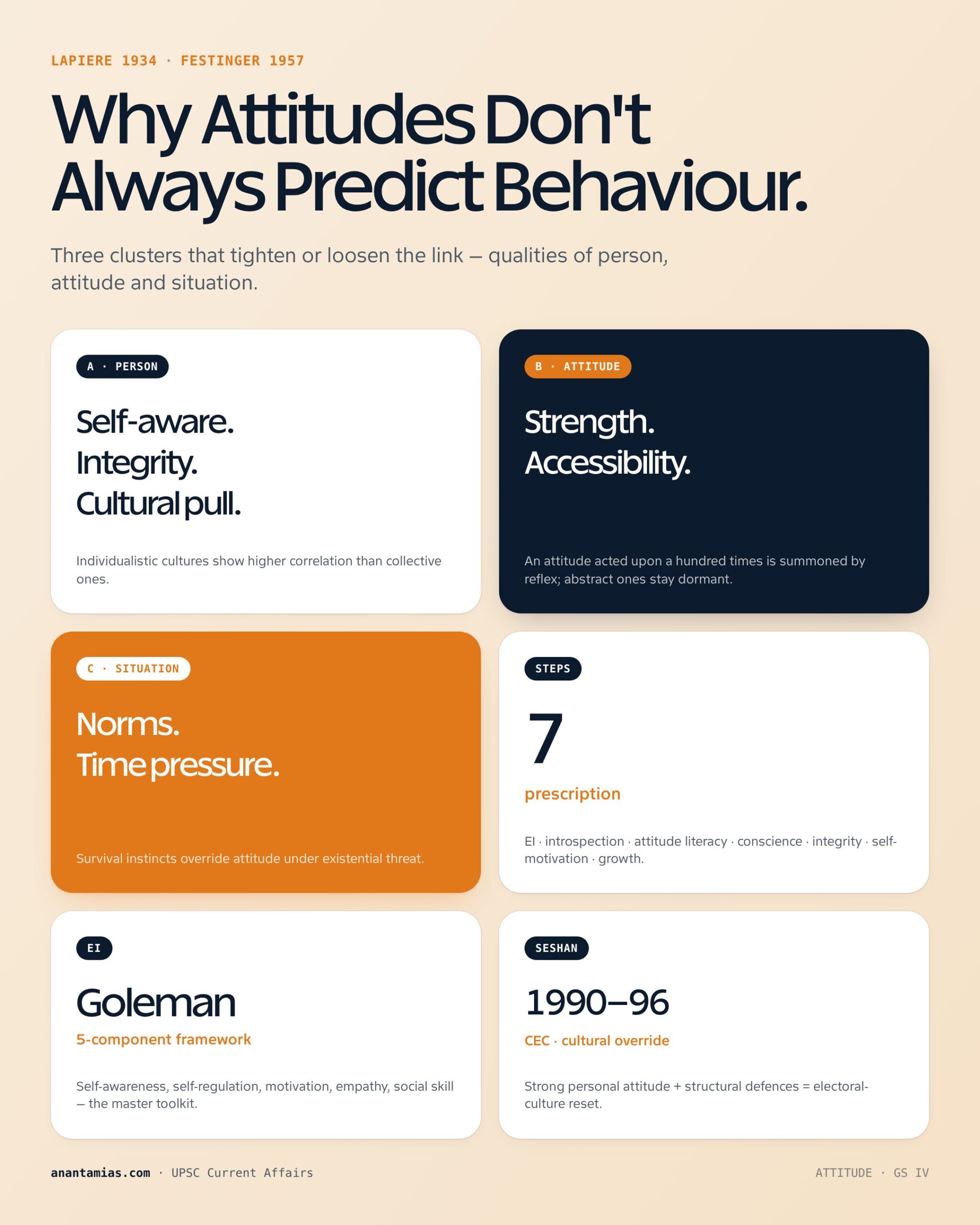
The compass extract identifies three clusters of factors that influence how tightly attitude and behaviour cohere:
- Qualities of the person.
- Qualities of the attitude itself.
- The situation.
Each cluster contains specific variables an aspirant should be able to name and apply.
Cluster A — Qualities of the Person
1. Self-Awareness
People who are aware of their feelings display more attitude-behaviour consistency than those who rely on situational questions to decide how to behave.
The self-aware person knows what she believes and feels and acts accordingly. The situationally driven person reads each context fresh and matches behaviour to perceived expectation, regardless of inner attitude. Self-awareness is therefore an upstream determinant of integrity.
The construct is closely linked to Daniel Goleman's emotional intelligence framework, where self-awareness is the foundational competence on which the other four (self-regulation, motivation, empathy, social skill) rest.
2. Integrity
People with a high level of integrity show a high correlation between attitude and behaviour.
Integrity literally means wholeness (Latin integer). The person of integrity has aligned what she thinks, what she feels, and what she does. The compass insight is empirical: integrity is attitude-behaviour consistency.
This is why integrity is the first of the 2nd ARC's foundational values for civil servants — without it, the other values (impartiality, objectivity, accountability) cannot be reliably enacted.
3. Cultural Orientation — Individualistic vs Collective
People in individualistic societies have more correlation compared to people in collective societies.
In individualistic cultures (US, Western Europe), personal attitude is the primary driver of behaviour. In collective cultures (India, East Asia, much of Africa), social norms and family expectations often outweigh personal attitude. An individual may hold an attitude and yet behave according to log kya kahenge.
For Indian civil servants, the implication is sharp: the cultural environment is biased toward norm-following over attitude-following, which makes it harder to be the dissenting honest officer. Constitutional ethics has to consciously override the cultural pull.
"It is no measure of health to be well adjusted to a profoundly sick society." — J. Krishnamurti
Cluster B — Qualities of the Attitude
4. Strength
Strong and weak attitudes show a high and low correlation between attitude and behaviour, respectively.
A strong attitude — held with conviction, formed through direct experience, frequently expressed — predicts behaviour better than a weak attitude held in passing. A vague disapproval of corruption rarely produces refusal of bribes; a strong, articulated, lived rejection of corruption almost always does.
The implication for training: strengthening attitudes (through reasoning, reflection, public commitment, modelling) is the upstream lever for changing behaviour.
5. Accessibility
Attitudes which are acted upon on a regular basis are more accessible from memory. Such attitudes show a higher correlation with behaviour.
The mere-exposure effect plus practice makes some attitudes easily activated. An attitude you have acted upon a hundred times is summoned by reflex; an attitude you hold abstractly is summoned only when prompted.
This is why routine ethical practice — refusing the small bribe, listening fully to the small citizen complaint — strengthens the attitude-behaviour link far more than occasional grand ethical gestures.
Cluster C — The Situation
6. Norms — What Others Expect
Norms or beliefs about how one should or is expected to behave in each situation can exert a powerful influence on behaviour.
Every situation comes with expected behaviour. A funeral, a courtroom, a public hearing, a private dinner — each has scripts that the agent reads and follows almost unconsciously. Norms can either support the attitude (an honesty-rewarding workplace) or override it (a corruption-tolerating workplace). The situational pull is often invisible to the agent inside it.
7. Time Pressure and Survival Instincts
Time pressure results in behaviour as per attitude. Survival instincts dominate attitude.
This is a sharp compass observation with two parts.
- Under time pressure, people fall back on default attitudes — there is no time to deliberate. This makes attitudes that have been deeply internalised dominant; weakly held attitudes lose. Hence, under stress, the officer of high integrity acts ethically automatically.
- Under existential threat, survival instincts override attitude. A person who deeply opposes violence may still defend herself when attacked. The civil-service implication: officers operating under genuine threat — communal violence, encounter operations, disaster response — need structural protection so that ethical attitudes are not displaced by survival instincts.
Seven Steps to Strengthen the Attitude-Behaviour Link
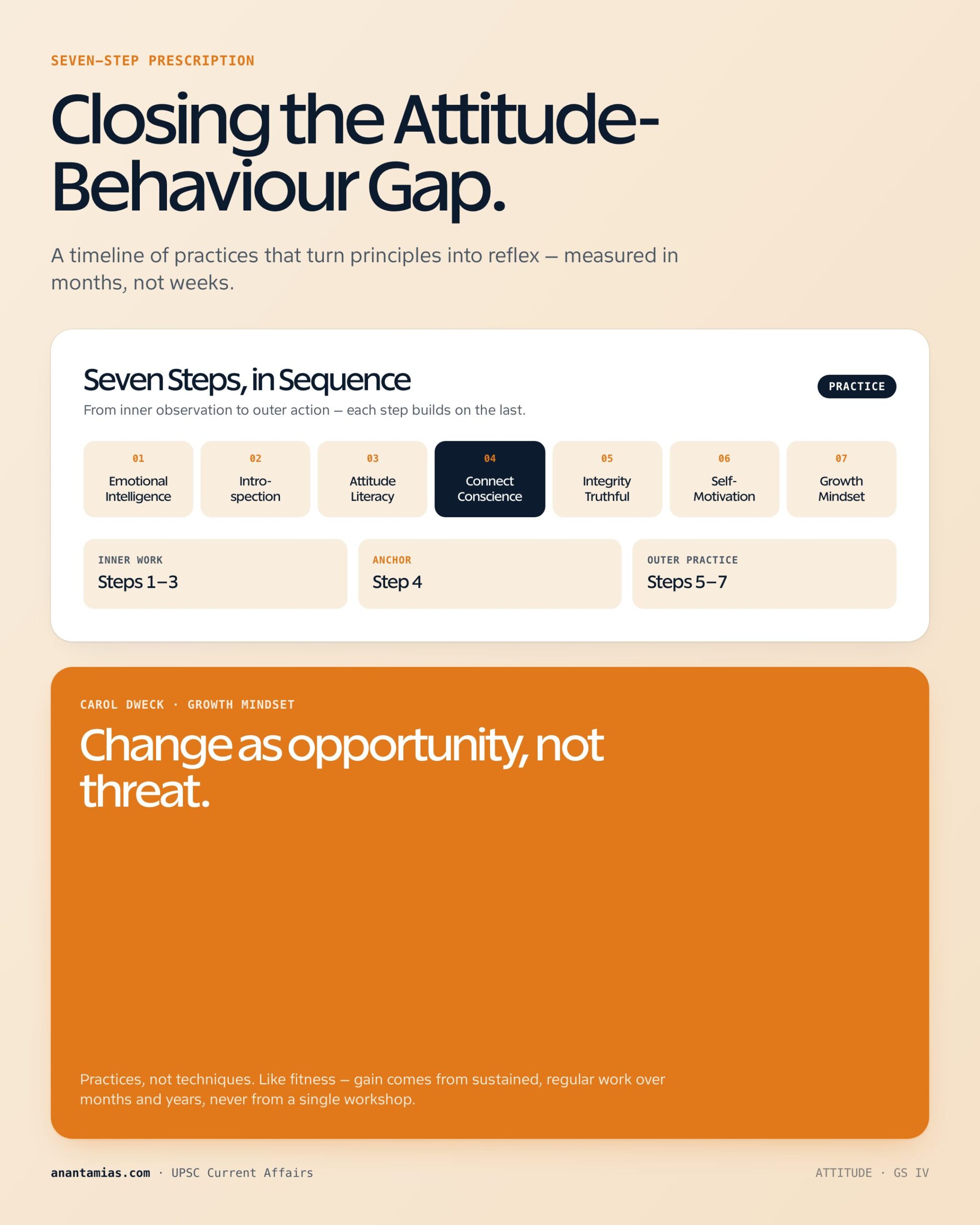
The compass Steps to Increase Correlation chapter offers seven practical interventions. They map directly onto the factors above and constitute the prescription to the diagnosis.
Step 1 — Develop Emotional Intelligence
Goleman's framework — self-awareness, self-regulation, motivation, empathy, social skill — is the master toolkit. EI training increases the agent's capacity to notice her attitudes, regulate her impulses, and align action with conviction under pressure.
LBSNAA, SVPNPA, and most civil-service training academies now include EI modules.
Step 2 — Introspection
Sustained, structured self-reflection is the simplest, oldest tool.
- Journaling at the end of each working day — what did I do, why did I do it, did my action match my values?
- Mindfulness meditation — the daily practice of observing one's mental states without judgment.
- Peer dialogue — talking through a difficult decision with a trusted colleague.
"An unexamined life is not worth living." — Socrates
Step 3 — Attitude Literacy
Learning what attitudes are, distinguishing them from beliefs, values and behaviour, and identifying the specific attitudes one holds. The compass calls this Identifying your good and bad attitudes. The civil-service candidate's GS-IV preparation is itself an exercise in attitude literacy.
Step 4 — Connect with Conscience
Examine why you hold an attitude. Is it inherited, examined, or chosen? An attitude held through conscious endorsement after examination has far higher predictive power for behaviour than one absorbed without question.
The compass phrase connecting with a conscience echoes the 2nd ARC's call for constitutional conscience in public servants.
Step 5 — Cultivate Integrity and Truthfulness
The compass identifies integrity and truthfulness as the values that most directly close the attitude-behaviour gap. Integrity is the disposition to align thought, feeling and action; truthfulness is the discipline of refusing the small lies that fragment that alignment.
"Integrity is doing the right thing, even when no one is watching." — C.S. Lewis
Step 6 — Discover Self-Motivation
The internally motivated agent does not need external rewards or threats to align her behaviour with her attitudes. The externally motivated agent's behaviour shifts whenever the reward structure shifts. Intrinsic motivation — pride in craft, love of public service, devotion to a cause — is the most reliable cement of the attitude-behaviour link.
Step 7 — See Change as an Opportunity to Grow
Attitudes do not stay static; situations do not stay static; the gap between them therefore changes shape over time. The agent who treats every change as threat narrows her attitudes defensively. The agent who treats change as growth opportunity updates her attitudes in light of new evidence and keeps the link alive.
This is the disposition the compass calls seeing change as an opportunity to grow and what psychologist Carol Dweck calls a growth mindset.
Two Indian Case Studies
Case 1 — The Stress-Test of T.N. Seshan
As Chief Election Commissioner from 1990 to 1996, T.N. Seshan held strong personal attitudes about electoral integrity. The situational norms of Indian electoral malpractice would, in most officers, have produced the LaPiere-type gap — strong attitudes, weak behaviour. Seshan closed the gap by combining: self-awareness (Step 1), public articulation of his attitudes (Step 3 — attitude literacy), integrity rewards (Step 5), and structural defences (use of paramilitary forces, observers, model code of conduct enforcement). The result was a structural reset of Indian electoral culture.
Case 2 — The Junior Officer and the Cultural Gap
A young IAS officer, posted in 2023 to her home state, finds that her strong personal attitudes against caste discrimination are eroded daily by the collective-cultural norms of the senior cadre. She journals (Step 2), participates in a peer-mentoring group with three other officers committed to the same standard (Step 4 — conscience), declines lunches that segregate by caste (Step 5 — integrity through small acts), and seeks training in conflict resolution (Step 1 — EI). After eighteen months, her attitude-behaviour alignment is strong enough to influence two junior officers in the same office. The case shows the diagnostic factors (cultural collectivism, weak situational support) and the prescriptive steps working together.
UPSC Syllabus Relevance
GS-IV explicitly names attitude — its influence and relation with thought and behaviour. The factors-and-steps frame is one of the highest-yield Mains topics in the syllabus.
Past-Year Prompts
- "What does each of the following quotations mean to you in the present context: (b) 'A man is but the product of his thoughts; what he thinks, he becomes.' — Mahatma Gandhi" — 2014.
- "What is meant by 'a populist measure'? Discuss its role in attitude formation in society." — 2018 variant.
- "How does emotional intelligence help in handling the attitude-behaviour gap in public servants?" — 2020.
- "What factors strengthen the link between an officer's attitude and her behaviour in a difficult posting?" — 2022 paraphrased.
Mains Answer-Writing Tips
- Open with the three clusters — qualities of person, attitude, situation.
- For each cluster, cite one factor with one example.
- Move to the seven steps — present at least four with operational detail.
- Cite Seshan or a similar Indian case — the examiner rewards Indian specificity.
- Close with the growth-mindset frame — change as opportunity, not threat.
Prelims Pointers
- LaPiere (1934) — empirical attitude-behaviour discrepancy.
- Fishbein & Ajzen — Theory of Reasoned Action.
- Ajzen — Theory of Planned Behaviour.
- Festinger (1957) — cognitive dissonance.
- Goleman (1995) — Emotional Intelligence; five components.
- Carol Dweck — Mindset; growth vs fixed.
- Hofstede — individualism-collectivism dimension.
FAQ
Are some people just born with strong attitude-behaviour consistency?
Personality traits matter, but the literature is clear: consistency is largely cultivated, not inherited. The seven steps work for most agents who practise them sustainably.
Why do collective cultures produce lower correlation?
Because norms outweigh personal attitude in collective decision-making. The agent's behaviour is calibrated to what the group expects, not to what she individually thinks. Constitutional ethics asks the public servant to lift personal-attitude weight above collective-norm weight where they conflict.
Is high attitude-behaviour correlation always good?
Mostly yes — but only if the underlying attitudes are themselves ethical. A person with strong unethical attitudes who acts consistently on them is a coherent villain, not a virtuous integrated agent. The first task is right attitudes; the second is consistency.
How long does it take to strengthen the link?
Months to years. The seven steps are practices, not techniques. Like fitness, the gain comes from sustained, regular work, not from a single workshop.
What if structural conditions (corrupt office, hostile cadre) make consistency dangerous?
This is the moral courage question. The seven steps include integrity and truthfulness, which often have personal cost. The literature on whistleblowing (Bhandari, Khemka, et al.) suggests peer support, formal protections (Whistle Blowers Protection Act, 2014), and patient documentation as the survival kit.
The factors that weaken the attitude-behaviour link and the steps that strengthen it are two sides of the same coin. A civil servant who keeps both lists in mind — diagnosing the pressures on her own consistency and applying the seven practices to counter them — is doing the most fundamental ethical maintenance her career will ever ask of her.
The factors that weaken the attitude-behaviour link and the steps that strengthen it are two sides of the same coin. A civil servant who keeps both lists in mind — diagnosing the pressures on her own consistency and applying the seven practices to counter them — is doing the most fundamental ethical maintenance her career will ever ask of her.
Tell Google you want more of this.
Add Anantam IAS as a preferred sourceOne tap, and this site shows up more often in your own Top Stories, AI Overviews and AI Mode. Remove it any time.