The first Viceroy of India was Lord Charles John Canning, who held office from 1 November 1858 to 21 March 1862. He had earlier served as the last Governor-General under the East India Company (1856-1858), and was elevated to the new designation of Viceroy after the Government of India Act, 1858 transferred Indian administration from the East India Company to the British Crown. His tenure spanned the most transformative years of nineteenth-century India, including the suppression of the Revolt of 1857, the reorganisation of the army and civil administration, and the passage of the Indian Councils Act, 1861.
| Quick fact | Detail |
|---|---|
| First Viceroy of India | Lord Charles John Canning |
| Tenure as Viceroy | 1 November 1858 – 21 March 1862 |
| Created by | Government of India Act, 1858 |
| Also | Last Governor-General under the East India Company (1856–58) |
| Key measures | Queen’s Proclamation (1858), Indian Councils Act 1861, Indian Penal Code (enforced 1862) |
Governor-General vs Viceroy
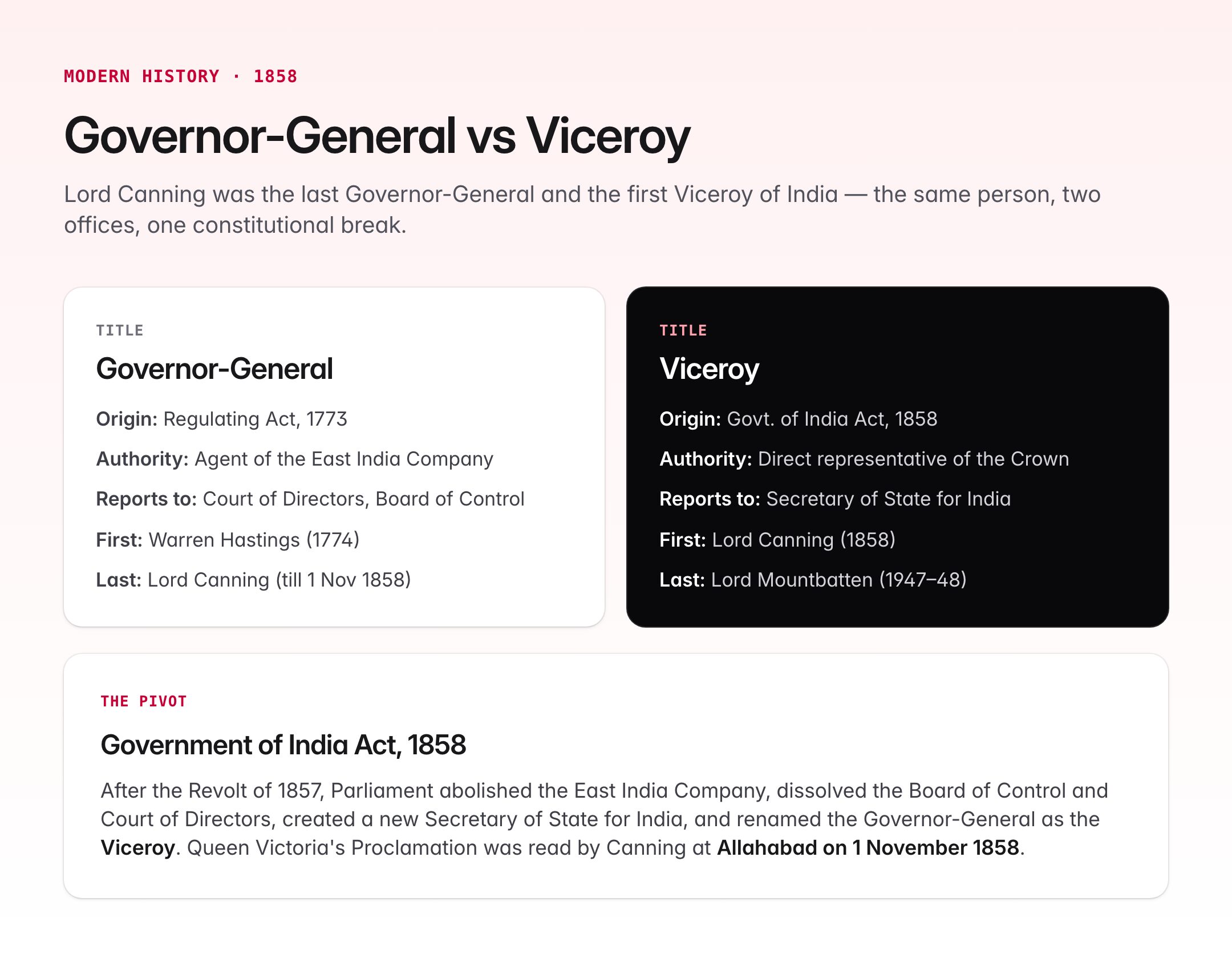
To understand why Canning was both the last Governor-General and the first Viceroy, candidates must distinguish the two titles.
| Feature | Governor-General | Viceroy |
|---|---|---|
| Origin | Regulating Act 1773 (Warren Hastings) | Government of India Act 1858 |
| Authority | Agent of East India Company (Board of Directors, Board of Control) | Direct representative of the British Crown |
| Reporting | Court of Directors, later Board of Control | Secretary of State for India, answerable to British Parliament |
| First holder | Warren Hastings (1774) | Lord Canning (1858) |
| Last holder | Lord Canning (till 1 Nov 1858) | Lord Mountbatten (1947-48) |
The Viceroyalty was therefore a new constitutional creation marking the Crown's direct sovereignty over India.
Lord Canning: Early Life and Arrival
Charles John Canning, the second son of George Canning, a former British Prime Minister, was born in 1812. After Oxford and a career in the House of Lords, he was appointed Governor-General of India in February 1856, arriving in Calcutta on 29 February 1856. He had barely settled in when the Revolt of 1857 erupted at Meerut on 10 May 1857, plunging him into the defining crisis of his career.
Government of India Act, 1858

The 1857 uprising forced the British Parliament to end Company rule. The Government of India Act, 1858, also called the Act for the Better Government of India, made the following changes.
| Provision | Effect |
|---|---|
| Abolished East India Company | All powers transferred to the Crown |
| Abolished the Board of Control and Court of Directors | Replaced by the Secretary of State for India |
| Created a 15-member Council of India | To advise the Secretary of State |
| Renamed the Governor-General as the Viceroy | Direct representative of the Crown in India |
| Ended the doctrine of lapse in spirit | Queen's Proclamation (1858) promised respect for Indian princes |
Lord Canning, as the sitting Governor-General, was elevated to Viceroy and read Queen Victoria's Proclamation at Allahabad on 1 November 1858, promising religious tolerance, amnesty to rebels who had not killed Britons, and the end of territorial annexation.
Handling of the Revolt of 1857
Canning oversaw the military suppression of the uprising, but his response was marked by an emphasis on measured justice rather than indiscriminate revenge.
- He restrained British officers and civilians calling for blanket executions of Indians in rebel territories.
- He issued the Resolution of 31 July 1857 forbidding the execution of captured sepoys without evidence of specific crimes.
- He reorganised the army, reducing the ratio of Indian to British troops and ensuring artillery remained exclusively in European hands.
- He ordered the disarmament of Awadh and reorganised the province.
This policy of relative leniency earned him the sarcastic nickname "Clemency Canning" from the Anglo-Indian press and many MPs at Westminster, who accused him of being soft on rebels. History, however, has vindicated his restraint as politically and ethically sound.
Indian Councils Act, 1861
Perhaps the most durable legislative achievement of Canning's viceroyalty was the Indian Councils Act, 1861, which laid the foundations of representative government in India.
| Provision | Significance |
|---|---|
| Added non-official members to the Viceroy's Legislative Council | First step towards Indian association with legislation |
| Restored legislative powers to Bombay and Madras presidencies | Reversed the centralisation of the Charter Act 1833 |
| Introduced the portfolio system, formalised by Canning | Each member of the executive took charge of a department – origin of the cabinet system |
| Authorised the Viceroy to issue ordinances valid for six months | Emergency legislative power |
| Permitted creation of new legislative councils for Punjab, North-West Provinces and Bengal | Regional decentralisation |
Canning nominated three Indians – the Raja of Benaras, the Maharaja of Patiala and Sir Dinkar Rao – to his Legislative Council, marking the first formal entry of Indians into the central legislative process.
Other Reforms under Canning
Canning's tenure saw a dense cluster of reforms that shaped modern India.
| Reform | Year | Significance |
|---|---|---|
| Indian Penal Code (IPC) | Drafted 1860, enforced 1862 | Based on Lord Macaulay's 1837 draft |
| Code of Criminal Procedure (CrPC) | 1861 | Procedural criminal law |
| Indian High Courts Act | 1861 | Established High Courts at Calcutta, Bombay and Madras, replacing Supreme Courts and Sadar Adalats |
| Universities Act | Universities of Calcutta, Bombay and Madras (1857) consolidated under Canning | Beginning of modern higher education |
| Indian Civil Service Act | 1861 | Opened ICS examination to Indians in principle |
| Income Tax Act | 1860 | Introduced by James Wilson to offset post-1857 deficits |
| Budget system | 1860 | First Indian budget, by James Wilson |
| Wahabi movement suppression | 1860s | Canning took early action against the Patna-centred movement |
Canning also presided over the reorganisation of the army following the Peel Commission recommendations, ensuring dominance of European troops.
Queen's Proclamation of 1858
Read at Allahabad by Canning, the Proclamation is sometimes called the Magna Carta of the Indian people. Key promises included:
- No further territorial annexations
- Respect for the rights, dignity and honour of Indian princes
- Religious toleration and non-interference in religious matters
- Equal treatment of Indians in government appointments regardless of race or creed
- Amnesty to all rebels except those directly guilty of murdering British subjects
Though honoured inconsistently, it remained a reference point for Indian constitutional demands well into the twentieth century.
Legacy of Lord Canning
Canning's health collapsed under the strain of office, and his wife Charlotte died in Calcutta in 1861. He left India in March 1862 and died shortly after returning to England in June 1862. His legacy is substantial.
- Transition architect from Company to Crown rule
- Codifier of Indian criminal law and courts
- Father of the portfolio (cabinet) system in Indian administration
- Moderate statesman whose restraint prevented further alienation of Indians after 1857
- First patron of Indian representation in legislative councils
Calcutta's Canning town, the Canning Street in Kolkata, and Port Canning in the Sundarbans commemorate him.
UPSC Relevance
Prelims: Frequently tested facts include – first Viceroy (Canning), last Governor-General (also Canning), date of Queen's Proclamation (1 November 1858, Allahabad), Indian Councils Act 1861, IPC enactment year, and establishment of the three High Courts. Candidates are often asked to match Viceroys with reforms.
Mains GS-1 (Modern History): Canning appears in themes such as aftermath of the Revolt of 1857, transition from Company to Crown, evolution of the Indian legislature, and codification of law in British India. His Clemency policy is a useful sub-theme on colonial governance ethics.
Mains GS-2 (Polity): The Indian Councils Act 1861 is a foundational statute in the genealogy of Indian constitutional development, leading eventually to the Acts of 1892, 1909, 1919, 1935 and ultimately the Constitution of 1950. Candidates should trace the portfolio system from Canning to the modern Council of Ministers.
Essay and Ethics (GS-4): Canning's moderation under extreme pressure exemplifies leadership ethics, justice, and moral courage – particularly valuable material when the essay demands discussion of statesmanship in moments of crisis.
For exam purposes, remember the crisp line: Lord Canning was the last Governor-General under the East India Company and the first Viceroy under the British Crown, presiding over the single most important constitutional break in nineteenth-century Indian history.
Tell Google you want more of this.
Add Anantam IAS as a preferred sourceOne tap, and this site shows up more often in your own Top Stories, AI Overviews and AI Mode. Remove it any time.