The French Revolution 1789 was the decade-long political and social upheaval that began with the calling of the Estates-General in May 1789 and ended with Napoleon Bonaparte’s coup of 18 Brumaire in November 1799. It abolished feudalism, beheaded a Bourbon king, declared the Rights of Man, fought a continental war and remade the political vocabulary of the modern world. For UPSC General Studies Paper I on world history, the French Revolution 1789 is the gateway event that links the Enlightenment to nineteenth-century nationalism, liberalism and the Indian freedom struggle.
This article reads the French Revolution 1789 in the sequence the mains examiner expects: the structural crisis of the Ancien Regime, the explosive summer of 1789 from the Tennis Court Oath to the storming of the Bastille, the constitutional phase of 1789 to 1792, the radical republic and the Reign of Terror under Maximilien Robespierre, the Thermidorian reaction and the rise of Napoleon, and the long shadow the Revolution cast over Europe and over a colonial India that read Rousseau and Voltaire in the libraries of Calcutta and Pune.
Bal Gangadhar Tilak called the principles of 1789 the most precious gift of modern Europe to humanity. M. N. Roy, Jawaharlal Nehru and B. R. Ambedkar all wrote at length on what 1789 meant for an Asian people fighting an imperial power that itself owed parts of its parliamentary tradition to the Revolution it had once opposed.
Quick Facts
- Dates: 5 May 1789 (opening of Estates-General) to 9 November 1799 (Napoleon’s coup of 18 Brumaire).
- Trigger: Fiscal bankruptcy of the French state after the American War of Independence and decades of court spending under Louis XVI.
- Key moments: Tennis Court Oath (20 June 1789), Storming of the Bastille (14 July 1789), Declaration of the Rights of Man and of the Citizen (26 August 1789), execution of Louis XVI (21 January 1793), Reign of Terror (September 1793 to July 1794), Napoleon’s coup (November 1799).
- Famous slogan: Liberte, Egalite, Fraternite. It was not adopted as the official motto of the French Republic until 1848.
- Casualties of the Terror: Around 17,000 official executions by guillotine, with estimates of overall revolutionary violence between 35,000 and 40,000 deaths.
- Indian linkage: Tippu Sultan planted a Tree of Liberty at Srirangapatnam in 1797 and called himself Citizen Tippu. Raja Rammohan Roy publicly celebrated French constitutional victories in the 1820s.
The Ancien Regime: Why the System Broke
The French Revolution 1789 was the product of a society where law, taxation and dignity were distributed by birth. Pre-revolutionary France was legally divided into three estates. The First Estate was the Catholic clergy, about 130,000 people who owned roughly ten percent of the land and paid no direct tax. The Second Estate was the nobility, about 400,000 people who held seigneurial rights over peasants, monopolised senior army and church positions and paid almost no direct tax. The Third Estate was everyone else, about 27 million people including the bourgeoisie, urban artisans, the sans-culottes and the peasantry. The Third Estate paid the taille, the gabelle on salt, the corvee labour service and the tithe to the Church.
Fiscal Crisis
By 1788 the French monarchy was effectively bankrupt. France had financed American independence at a cost of more than one billion livres, and the cumulative debt service swallowed close to half of all royal revenue. Finance ministers Turgot, Necker, Calonne and Brienne in turn proposed extending taxation to the privileged estates. Each was blocked by the Parlement of Paris and by the Assembly of Notables of 1787. With no domestic credit left, Louis XVI agreed in August 1788 to summon the Estates-General for the first time since 1614.
Intellectual Foundations
The Revolution was prepared by two generations of Enlightenment writing. Montesquieu’s Spirit of the Laws (1748) argued for the separation of powers. Rousseau’s Social Contract (1762) located sovereignty in the general will of the people. Voltaire attacked clerical privilege and judicial torture. Diderot’s Encyclopedie circulated useful knowledge against superstition. By 1789 these ideas had passed from salons to provincial cahiers de doleances, the lists of grievances each constituency drew up for its deputies. The cahiers asked for equal taxation, abolition of feudal dues, a written constitution and freedom of the press.
The Bad Harvest of 1788
The political crisis met an agricultural one. The harvest of 1788 failed across northern France. By spring 1789 the price of a four-pound loaf in Paris reached 14.5 sous, against an average urban wage of 20 to 30 sous a day. Hunger turned the urban poor into a political actor. The grain riots of the Reveillon affair in April 1789 in the Faubourg Saint-Antoine were the first sign that Paris would not wait quietly for Versailles to legislate.
Summer 1789: From Estates-General to Bastille
The Estates-General opened at Versailles on 5 May 1789 with 1,139 deputies. The Third Estate demanded that the three orders sit and vote together by head, not by order, which would give the commoner deputies a majority. The clergy and nobility refused. On 17 June the Third Estate, joined by sympathetic clergy, declared itself the National Assembly. On 20 June, locked out of their meeting hall, the deputies gathered in the indoor tennis court at Versailles and swore the Tennis Court Oath not to disperse until they had given France a written constitution.
The Storming of the Bastille
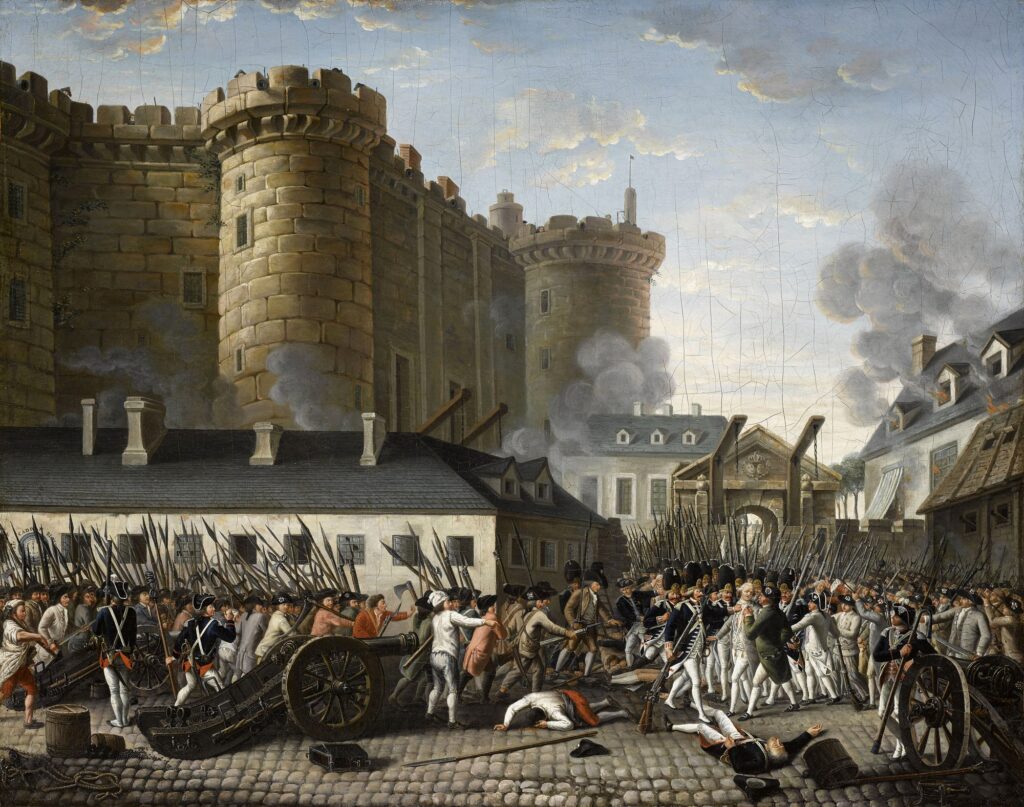
Louis XVI dismissed the popular finance minister Necker on 11 July. Within hours the news reached Paris. On 12 to 13 July, citizen militias formed and the Hotel des Invalides was raided for muskets. On the morning of 14 July 1789 a Paris crowd of around 8,000 surrounded the Bastille, a medieval fortress prison on the eastern edge of the city, to seize its gunpowder. The garrison commander de Launay refused entry, ordered fire and was overwhelmed. The Bastille held only seven prisoners that day but it stood as the symbol of arbitrary royal power, and its fall is celebrated as the birth of the French Revolution 1789. France’s national day is still 14 July.
The Great Fear and the Night of 4 August
Through July and early August 1789, rumours of armed brigands sent by the nobility raced through rural France. This Grande Peur led peasants to attack chateaux, burn feudal rolls and refuse seigneurial dues. The National Assembly responded on the night of 4 August 1789 by abolishing feudalism in a single emotional session. Nobles renounced hunting rights, tithes, corvee labour and venality of office. France ceased, in law, to be a society of orders.
Declaration of the Rights of Man and of the Citizen
On 26 August 1789 the Assembly adopted the Declaration of the Rights of Man and of the Citizen. Its seventeen articles declared that men are born and remain free and equal in rights, that sovereignty resides in the nation, that law is the expression of the general will, and that no one may be arrested except in cases determined by law. The Declaration drew on the American Bill of Rights, Rousseau and natural-law theory. It remains, with later additions, part of the constitution of the French Fifth Republic.
Constitutional Monarchy, 1789 to 1792
The Assembly drafted the Constitution of 1791, which created a limited monarchy with a unicameral Legislative Assembly elected on a property suffrage. The Civil Constitution of the Clergy of July 1790 nationalised church land, paid clergy as state employees and required an oath to the constitution, splitting the priesthood into juring and non-juring camps. Louis XVI’s attempted flight to Varennes in June 1791 destroyed the credibility of constitutional monarchy.
The Legislative Assembly declared war on Austria on 20 April 1792, opening the long French Revolutionary and Napoleonic wars that would last to 1815. The war went badly. On 10 August 1792 Parisian sans-culottes stormed the Tuileries Palace, the monarchy was suspended, and elections were called for a new National Convention.
The Republic and the Reign of Terror
The Convention met on 21 September 1792, abolished the monarchy and proclaimed the First French Republic. Louis XVI was tried for treason, convicted and guillotined on 21 January 1793. Marie Antoinette followed in October. A new revolutionary calendar dated history from Year I of Liberty.
Jacobins and Girondins
The Convention was divided between the Girondins, who favoured a moderate federal republic, and the Jacobins of the Mountain, led by Maximilien Robespierre, Georges Danton and Jean-Paul Marat, who allied with the Paris sections. Foreign invasion, royalist revolt in the Vendee and economic collapse pushed the Convention towards emergency rule. On 2 June 1793 the Paris National Guard purged the Girondins from the Convention.
Reign of Terror, September 1793 to July 1794
The Reign of Terror was the period when the Committee of Public Safety, dominated by Robespierre, governed France by decree. The Law of Suspects of September 1793 allowed detention of anyone considered a public enemy. The Revolutionary Tribunal accelerated trials. The guillotine claimed Marie Antoinette, the Girondin leaders, the chemist Lavoisier, the poet Andre Chenier and eventually Danton himself. Robespierre justified the Terror as the despotism of liberty against tyranny. The Convention turned on him after the Law of 22 Prairial removed the right to defence counsel. Robespierre was arrested on 9 Thermidor (27 July 1794) and guillotined the next day.
The Terror executed about 17,000 people by judicial verdict. The revolutionary wars in the Vendee and across the eastern provinces killed many more. Yet the same Convention abolished slavery in the French colonies on 4 February 1794, the first European power to do so.
Thermidorian Reaction and the Directory
After Thermidor, the Convention dismantled the apparatus of Terror, restored economic freedoms and adopted the Constitution of Year III in 1795. It created the Directory, a five-man executive and two-chamber legislature. The Directory survived royalist plots, the Babeuf conspiracy of the Equals, currency collapse and the brilliant Italian campaigns of a young Corsican general, Napoleon Bonaparte. By 1799 the Directory had become a hollow regime, and Napoleon’s coup of 18 Brumaire (9 November 1799) ended the Revolution as a parliamentary movement.
Napoleon and the Export of 1789
Napoleon Bonaparte ruled France as First Consul, then Consul for Life, then Emperor of the French from 1804. He consolidated the legal and administrative legacy of the Revolution in the Civil Code of 1804, known as the Code Napoleon, which established equality before the law, secular marriage, religious toleration and protection of private property. The Code spread across Europe with French armies and shaped legal systems from Belgium to Poland, Italy and parts of Spanish America.
Napoleonic Europe carried the Revolution’s anti-feudal core into Germany, Italy and the Netherlands. After his defeat at Leipzig (1813) and Waterloo (18 June 1815), the Congress of Vienna tried to restore the Bourbon order. It failed within a generation. The revolutions of 1830 and 1848 across Europe drew directly from the 1789 vocabulary of rights, citizenship and the sovereign people.
Legacy for World and Indian History
The French Revolution 1789 reshaped politics globally in three durable ways. First, it made popular sovereignty the default theory of legitimate government. Even monarchies after 1815 had to claim constitutional sanction. Second, it gave the world the modern political spectrum of left and right, from the seating of deputies in the Convention. Third, it linked the language of rights to the language of nation, opening the way for nineteenth-century nationalisms in Italy, Germany, Greece, Latin America and, eventually, Asia.
For colonial India, the impact was indirect but lasting. Tippu Sultan corresponded with the Jacobin Club at Srirangapatnam. Raja Rammohan Roy hung a French tricolour in his Calcutta home. Bankim Chandra Chatterjee, Surendranath Banerjee and Bipin Chandra Pal cited 1789 in their writings on Indian nationalism. Tilak called Liberty, Equality and Fraternity the watchwords of the freedom movement. The framers of the Indian Constitution lifted the words Liberty, Equality and Fraternity directly into the Preamble of the Constitution of India, where they sit beside Justice and the dignity of the individual.
The Jallianwala Bagh massacre of 1919, treated in detail in our article on the Jallianwala Bagh Massacre, prompted Rabindranath Tagore to renounce his knighthood with explicit reference to the universal principles the Allied powers had claimed to defend in the World War. The intellectual line from 1789 to 1919 runs through every Indian moderate and extremist who read European political theory in English translation.
Criticisms and Historiography
Edmund Burke’s Reflections on the Revolution in France (1790) called it an experiment in abstract reason that would end in military despotism, which it did. Thomas Paine answered in Rights of Man (1791) defending the Revolution as the legitimate sovereignty of the living over the dead. Alexis de Tocqueville in The Old Regime and the Revolution (1856) argued that the Revolution completed the centralising work of the Bourbon monarchy rather than overthrowing it. Marxist historians from Albert Mathiez to Albert Soboul read it as a bourgeois revolution. Revisionists like Francois Furet emphasised political culture and the autonomous logic of revolutionary discourse. UPSC mains answers should acknowledge this debate without taking sides.
Why It Still Matters for UPSC and for India
For GS Paper I, the French Revolution 1789 is asked in three recurring frames. First, as a cause-and-consequence question on why the Ancien Regime collapsed. Second, as a comparison with the American Revolution, the Russian Revolution or the Indian freedom struggle. Third, as a legacy question on liberty, equality, fraternity and modern constitutionalism. A strong answer ties the French Revolution 1789 to the Preamble of the Indian Constitution, cites Tilak, Rammohan Roy and Ambedkar by name, and acknowledges that the same revolution which proclaimed universal rights also produced the guillotine and the conquering empire of Napoleon. Greatness and violence belong to the same event.
Frequently Asked Questions
What were the main causes of the French Revolution 1789?
Four causes combined. Structural inequality of the three estates concentrated tax burden on the Third Estate while exempting clergy and nobility. Fiscal bankruptcy of the monarchy after the American war made reform unavoidable. Enlightenment ideas from Montesquieu, Rousseau and Voltaire delegitimised divine-right rule. The harvest failure of 1788 raised bread prices and politicised the urban poor.
What was the Tennis Court Oath?
On 20 June 1789, deputies of the Third Estate at the Estates-General were locked out of their meeting hall. They gathered in the indoor tennis court at Versailles and swore not to disperse until they had given France a written constitution. The Tennis Court Oath is the founding moment of the National Assembly and of popular sovereignty in France.
Why is the storming of the Bastille so important?
The Bastille was a medieval fortress prison in eastern Paris that had become the symbol of arbitrary royal imprisonment under lettres de cachet. Its fall on 14 July 1789 to a Paris crowd showed that the people could overpower royal authority by force. The date is now the French national day.
What did the Declaration of the Rights of Man and of the Citizen say?
Adopted on 26 August 1789, the Declaration’s seventeen articles affirmed that men are born free and equal in rights, that sovereignty resides in the nation, that law is the expression of the general will, that arbitrary arrest is forbidden, and that freedom of opinion and religion are protected. It remains part of the French constitution.
Who was Robespierre and what was the Reign of Terror?
Maximilien Robespierre was the Jacobin lawyer who dominated the Committee of Public Safety between September 1793 and July 1794. The Reign of Terror was the period when the Committee governed France by decree, used the Revolutionary Tribunal and the guillotine against suspected counter-revolutionaries, and executed around 17,000 people. Robespierre himself was guillotined on 28 July 1794.
How did Napoleon Bonaparte end the French Revolution 1789?
Napoleon, a young Corsican general who had won the Italian campaign, overthrew the Directory in the coup of 18 Brumaire on 9 November 1799. He ruled as First Consul, then Emperor from 1804. His Civil Code of 1804 codified the revolutionary principles of equality before the law and secular government and spread them across Europe through conquest.
What is the meaning of Liberty, Equality, Fraternity?
The slogan summarises the three central values of the French Revolution 1789. Liberty meant freedom from arbitrary power and freedom of speech, religion and the press. Equality meant the abolition of legal privilege by birth and equal taxation. Fraternity meant solidarity within the nation as a community of citizens. The motto became official in 1848 and is on every French public building today.
How did the French Revolution 1789 influence India?
Directly through Tippu Sultan’s correspondence with the Jacobin Club and indirectly through nineteenth-century Indian reformers and nationalists. Rammohan Roy, Bankim Chandra Chatterjee, Tilak, Gandhi and Ambedkar all read and quoted the Revolution. The phrase Liberty, Equality and Fraternity sits in the Preamble of the Constitution of India.
Tell Google you want more of this.
Add Anantam IAS as a preferred sourceOne tap, and this site shows up more often in your own Top Stories, AI Overviews and AI Mode. Remove it any time.