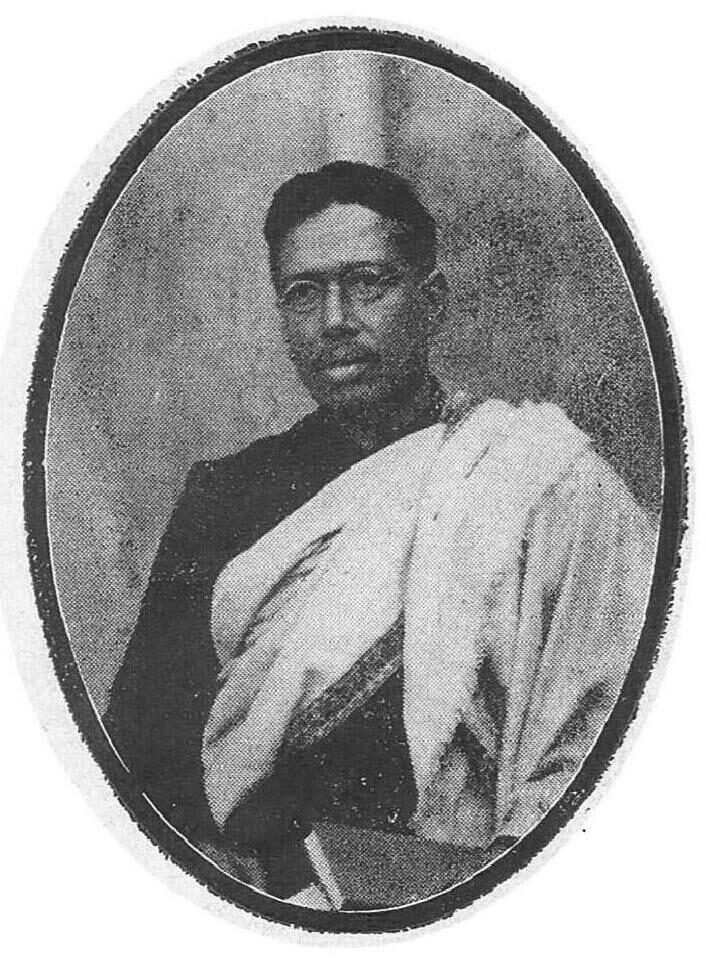
Bipin Chandra Pal (7 November 1858 – 20 May 1932) was the Bengali leader of the Lal-Bal-Pal trinity, a journalist, orator, biographer and political philosopher whose role in the Swadeshi movement of 1905-08 was decisive. Sri Aurobindo called him “one of the mightiest prophets of nationalism.” Indian historians have long described him as the “Father of Revolutionary Thought in India” — not because he advocated armed action, but because he gave the early extremist movement its conceptual vocabulary of composite Swaraj, federal nationalism and cultural self-recovery.
Bipin Chandra Pal stood with Bal Gangadhar Tilak and Lala Lajpat Rai at the centre of the most consequential generational shift in Indian nationalism. Where Tilak supplied the strategic centre and Lajpat Rai the organisational reach, Pal supplied the philosophical depth and the prose. His editorship of New India (1901), Bande Mataram (1906-07) and Swaraj (1908-11) gave the agitation against the Partition of Bengal a written voice that was both populist and intellectually rigorous.
Early Life and the Brahmo Influence
Born at Poil village in Sylhet district of present-day Bangladesh on 7 November 1858, Bipin Chandra Pal grew up in a wealthy Bengali Kayastha family. He studied at the Church Mission Society College and Presidency College Calcutta but did not graduate, opting instead for journalism and teaching. In 1881 he joined the Brahmo Samaj — Keshub Chunder Sen’s school of reform Hinduism — and broke with his orthodox family over an inter-caste, widow remarriage in 1891.
The Brahmo phase shaped Pal’s intellectual style. He acquired the comparative-religion vocabulary of Sen, the historicist temper of European liberalism, and a willingness to argue from first principles rather than scripture or tradition. Through the 1880s and 1890s he taught at schools in Bangalore, Sylhet and Calcutta, edited several Brahmo journals, and travelled to England (1898) and America (1900-01) where he studied comparative theology at Manchester and lectured widely.
Journalism: New India, Bande Mataram, Swaraj
Pal’s career as a nationalist journalist begins with the weekly New India (1901), founded on his return from England. The paper was English-language, Calcutta-based, and addressed an Anglicised middle-class readership. It became the principal forum for the new political ideas of the Bengal Renaissance.
In August 1906 Pal launched Bande Mataram — the daily English newspaper that gave the Swadeshi movement its name and its idiom. Sri Aurobindo joined as a contributor and later as editor; for fifteen months it was the most influential nationalist paper in India. After the British prosecuted Aurobindo for sedition in 1907 and the paper folded, Pal launched Swaraj (1908) which ran until 1911.
He also edited or contributed to Tribune (Lahore), Hindu Review, Independent India and the New York–based Modern Review.
Partition of Bengal and the Swadeshi Movement
The Partition of Bengal, announced by Lord Curzon on 19 July 1905 and implemented on 16 October 1905, divided the province along religious and administrative lines. The Bengali bhadralok response was the Swadeshi and Boycott movement — the first mass anti-imperial agitation of the twentieth century anywhere in the colonial world.
Pal’s Four-Plank Programme
Bipin Chandra Pal was the first to articulate the four-plank programme that became the Extremist platform at the Calcutta Congress of 1906:
- Swadeshi — promotion of indigenous goods and industries
- Boycott — refusal of British goods, services and institutions
- National Education — autonomous schools and colleges outside the colonial system
- Swaraj — self-government on the model of the white Dominions
The Calcutta resolutions of December 1906 incorporated all four. The Surat Split of December 1907 was provoked by the Moderate attempt to dilute them. Pal stood with Tilak at Surat.
Composite Federal Nationalism
Pal’s most original contribution was the doctrine of “composite federalism” — the argument that Indian nationalism could not replicate European single-nation models because India was a federation of communities, languages and religions. The political form of Swaraj therefore had to be federal, not unitary. He developed this position in The Soul of India (1911) and The Spirit of Indian Nationalism (1910). It pre-dates by decades the federal architecture that the Constituent Assembly would eventually adopt.
The Imprisonment and the Aurobindo Trial
In 1907 the colonial state prosecuted Aurobindo Ghosh for seditious articles published in Bande Mataram. Pal was summoned as a prosecution witness. He refused to depose against his editor and was sentenced to six months’ simple imprisonment for contempt of court. The refusal made him a national hero and confirmed his reputation as a man of conscience.
After release in 1908 he went again to England, where he stayed until 1911, lecturing and writing.
The Break with Tilak and Gandhi
Pal’s later political career was marked by sharp doctrinal disagreement with the dominant figures of the movement.
He broke first with Tilak over the Home Rule League. Pal supported Annie Besant’s broader-based All-India Home Rule League rather than Tilak’s narrower regional league and felt Tilak had abandoned the composite-federal vision for a Marathi-Hindu majoritarianism.
He broke more publicly with Gandhi in 1920-21 over Non-Cooperation. Pal accepted the goal but rejected the method. He thought the boycott of legislatures and courts would surrender the institutional terrain to the bureaucracy and to communalists. He thought the Khilafat alliance was a strategic error that committed Indian nationalism to a religious cause foreign to India. He thought satyagraha was philosophically incoherent — a “magic mantra” rather than a programme.
In his pamphlet The New Spirit (1922) and in many later articles Pal predicted, accurately, that Non-Cooperation would collapse over communal lines and that mass civil disobedience without state-building would leave the movement intellectually disarmed. The Chauri Chaura incident of February 1922 and the subsequent suspension of the movement vindicated his critique in the eyes of his admirers.
These breaks pushed Pal to the margins of the post-1920 Congress. He retained a seat in the Central Legislative Council but never again held national office.
Writings and Intellectual Legacy
Pal was the most prolific writer of the Lal-Bal-Pal trio. His major works include:
- The Soul of India (1911) — the canonical statement of his cultural nationalism
- The Spirit of Indian Nationalism (1910) — a London lecture series
- Nationality and Empire (1916)
- Studies in Hinduism (1893)
- Queen Victoria: A Sketch (1888)
- Memories of My Life and Times (1932, two volumes) — a foundational autobiography of late-nineteenth-century Bengal
His prose is dense, classical, and steeped in comparative philosophy. He read Hegel, Mazzini, T. H. Green and the Indian Vedantists with equal facility. The combination is unusual among the Extremists; Tilak was the historian-philologist, Lajpat Rai the polemicist-biographer, Pal alone the theorist.
Final Years and Death
Bipin Chandra Pal spent his last decade in semi-retirement at Calcutta, writing his memoirs, lecturing occasionally and corresponding with younger nationalists. The Bengal Congress he had helped build was now dominated by C. R. Das, Subhas Chandra Bose and Sarat Bose. He died on 20 May 1932 at Calcutta, aged 73. The official obituary in The Statesman described him as “the last of the great Bengali agitators of the Curzon era.”
Pal in the Lal-Bal-Pal Legacy
The Lal-Bal-Pal label is sometimes treated as a slogan rather than a working alliance. The three men did meet, correspond and coordinate. They shared platforms at the Calcutta (1906) and Surat (1907) Congresses. They were the public face of Extremism during the Swadeshi years. After 1908, however, their paths diverged: Tilak returned to constitutional politics through the Home Rule League, Lala Lajpat Rai shifted to constructive social work and the United States, and Pal moved into philosophical writing and journalism.
What unites them — and what makes the trio essential to UPSC GS-I — is their joint role in moving the Congress from petition to assertion between 1905 and 1907. Bipin Chandra Pal’s contribution was the intellectual scaffolding. Without his journalism and theory, the Extremist demand for Swaraj would have lacked its conceptual frame.
Pal and the Bengal Renaissance
Bipin Chandra Pal also occupies a distinctive place in the cultural history of nineteenth-century Bengal. He belongs to the generation that produced Bankim Chandra Chattopadhyay, Ramakrishna Paramahamsa, Swami Vivekananda, Rabindranath Tagore and Aurobindo Ghosh. Where Bankim supplied the literary nationalism of Anandamath and Vande Mataram, Vivekananda the religious self-confidence of the Parliament of Religions at Chicago, and Tagore the lyrical-cosmopolitan voice, Pal provided the political theory that translated cultural recovery into constitutional demand. His Manchester lectures of 1900-01, his comparative theology articles in New India, and his 1910 London lectures on the spirit of Indian nationalism are the missing link between the cultural ferment of the Bengal Renaissance and the political programme that the Lal-Bal-Pal trinity carried into the Indian National Congress at Calcutta in December 1906.
Frequently Asked Questions
Who was Bipin Chandra Pal?
Bipin Chandra Pal (1858-1932) was an Indian nationalist leader, journalist and political philosopher from Sylhet in Bengal. He was the Pal of the Lal-Bal-Pal trio, the founder of the journals New India, Bande Mataram and Swaraj, and the leading theorist of Extremist nationalism during the Swadeshi movement of 1905-08.
Why is Bipin Chandra Pal called the Father of Revolutionary Thought?
He is given the title because he supplied the Swadeshi movement with its intellectual architecture — the four-plank programme of Swadeshi, Boycott, National Education and Swaraj, and the doctrine of composite federal nationalism that integrated Indian diversity into a single political project.
What newspapers did Bipin Chandra Pal edit?
He founded or edited New India (1901), Bande Mataram (1906-07, alongside Sri Aurobindo), Swaraj (1908-11), Independent India and several Brahmo Samaj journals. Bande Mataram was the principal English-language voice of the Swadeshi movement.
What is the Lal-Bal-Pal trio?
Lal-Bal-Pal refers to Lala Lajpat Rai of Punjab, Bal Gangadhar Tilak of Maharashtra and Bipin Chandra Pal of Bengal — the three Extremist leaders who led the Swadeshi and Boycott movement against the 1905 Partition of Bengal. They were the first all-India militant nationalist leadership of the Indian National Congress.
What was Pal’s role in the Swadeshi movement?
Bipin Chandra Pal was the most prolific publicist of the Swadeshi movement. He coined or popularised the four-plank programme — Swadeshi, Boycott, National Education and Swaraj — that became the Extremist platform at the Calcutta Congress of 1906 and was reaffirmed at Surat in 1907.
Why did Pal break with Gandhi?
Pal accepted the goal of Swaraj but rejected Gandhi’s method of mass Non-Cooperation. He thought boycotting legislatures and courts would surrender institutional terrain, that the Khilafat alliance committed Indian nationalism to a religious cause, and that satyagraha was philosophically incoherent. His critique was published as The New Spirit (1922).
What was Pal’s idea of composite nationalism?
Pal argued that India could not adopt European single-nation models because it was a federation of communities, languages and religions. Indian Swaraj therefore had to be federal in form, accommodating cultural plurality. This argument anticipated the federal architecture of the 1950 Constitution.
What were Bipin Chandra Pal’s major books?
His major works are The Soul of India (1911), The Spirit of Indian Nationalism (1910), Nationality and Empire (1916), Studies in Hinduism (1893) and the two-volume autobiography Memories of My Life and Times (1932), a foundational source for the history of late-nineteenth-century Bengal.
Tell Google you want more of this.
Add Anantam IAS as a preferred sourceOne tap, and this site shows up more often in your own Top Stories, AI Overviews and AI Mode. Remove it any time.