A guide RNA finds an address in the genome. An enzyme called Cas9 cuts the DNA at that address. The cell then repairs the break, and in the repairing, the gene is changed. That is gene editing, and the reason it transformed biology is that the same three steps work in a bacterium, a rice plant and a human cell.
Casgevy, a CRISPR-based therapy, is already approved for sickle cell disease and beta-thalassaemia in eligible patients. The technology is past the point where it can be discussed as a future possibility.
How CRISPR-Cas9 Works
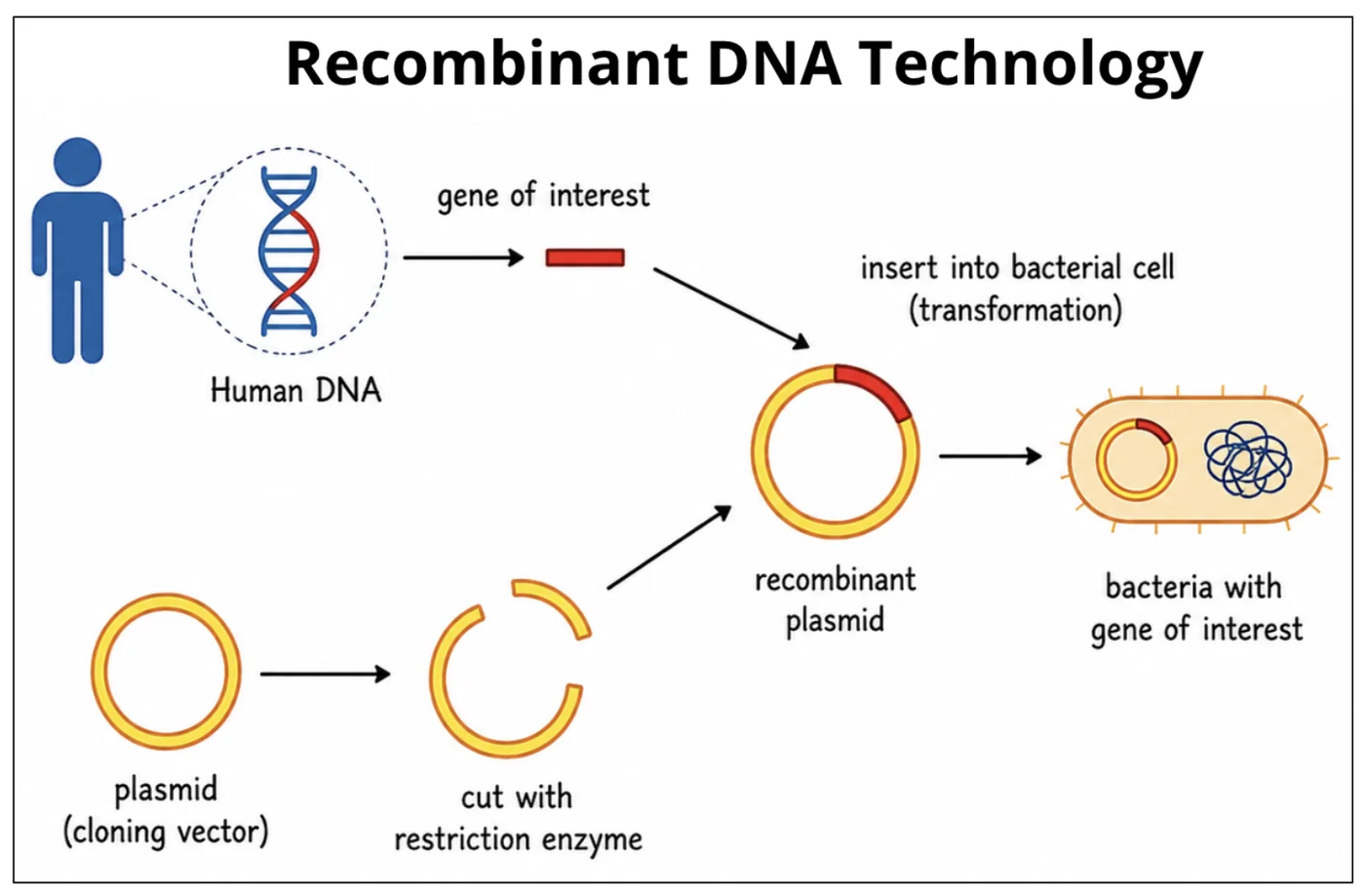
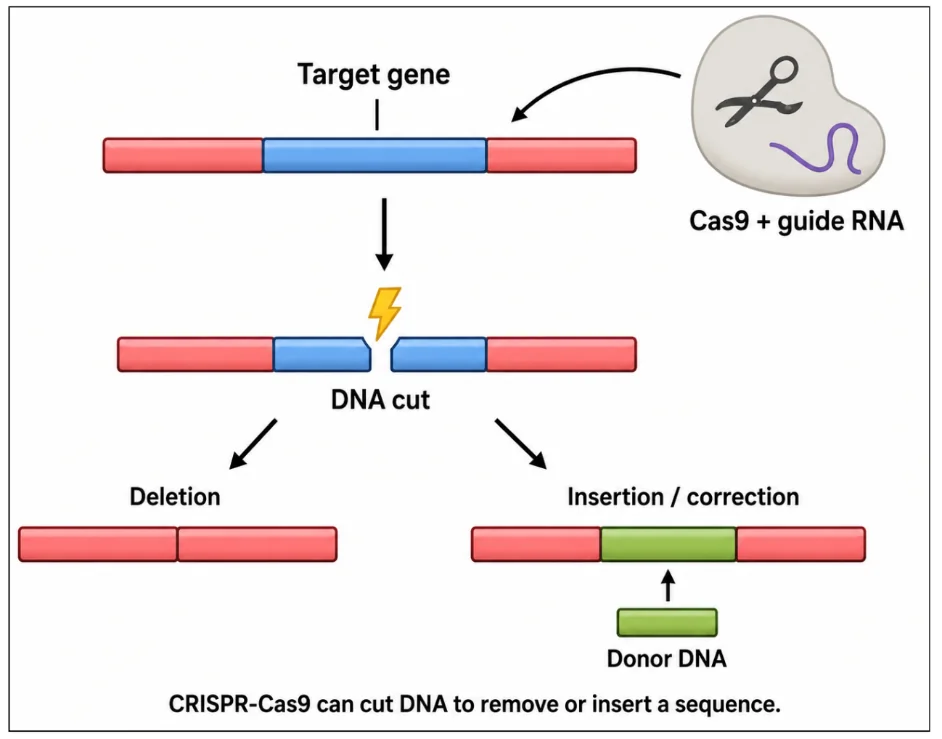
- Target identification. Scientists identify the specific DNA sequence that needs to be edited.
- Guide RNA design. A guide RNA complementary to that sequence is designed, which will direct Cas9 to the location.
- Target recognition and binding. The guide RNA binds the target DNA, bringing the Cas9 protein to the precise site.
- DNA cleavage. Cas9 acts as a molecular scissor, creating a double-stranded break.
- Repair and editing. The cell’s natural repair mechanisms fix the break, and in doing so allow gene disruption or deletion, gene insertion, or gene correction at specific nucleotides.
The elegance is in step 2. Earlier editing tools required engineering a new protein for every target. CRISPR only requires designing a new strand of RNA, which is why the cost and time of genome editing collapsed.
Medical Applications
- Genetic diseases. Correcting or disabling disease-causing genes, with the strongest potential in single-gene disorders such as sickle cell disease, beta-thalassaemia, cystic fibrosis and haemophilia. Casgevy is the proof of concept.
- Cancer and immunotherapy. Engineering immune cells to recognise and attack cancer cells more effectively, largely still in clinical trials.
- Vector-borne disease. Precision-guided sterile insect technique generates sterile males and flightless females to suppress mosquito populations transmitting malaria, dengue or Zika.
- Infectious disease. Targeting viral DNA or creating resistant cells. HIV research explores editing CCR5 or targeting integrated HIV DNA, and it is not yet a routine cure.
Single-gene disorders are where the technology fits best, because one defective gene is a tractable target. Most common diseases are polygenic, and editing dozens of interacting genes is a different order of problem.
Agricultural Applications
Higher yield, disease resistance, drought and salinity tolerance, improved nutrition, better taste and longer shelf life. CRISPR-edited tobacco has demonstrated nicotine levels around 95 to 98 percent below wild type.
Agricultural gene editing raises a regulatory question distinct from medicine. Where an edit produces a change that could have arisen through conventional breeding, and leaves no foreign DNA behind, several jurisdictions have chosen to regulate it differently from transgenic modification. That distinction, between editing a plant’s own genome and inserting a gene from another organism, is the axis on which most agricultural biotech regulation now turns.
The Concerns, Stated Properly
Germline editing. Editing embryos, eggs or sperm creates irreversible, heritable changes. Two objections follow: the risk of experimentation on humans whose outcomes cannot be reversed, and the absence of consent from generations who will inherit the edit and had no say in it. This is the reason germline editing is prohibited or tightly restricted almost everywhere.
Off-target and unintended effects. CRISPR is not 100 percent precise. It can produce unintended mutations, mosaicism, large deletions or incomplete edits. In a somatic cell, an error affects one patient. In a germline cell, it enters the human gene pool.
Designer babies. Editing for enhancement traits such as height, intelligence or appearance. The technical objection is that these traits are polygenic and poorly understood. The social objection is sharper: enhancement available only to those who can pay converts economic inequality into biological inequality, and that is not a reversible policy error.
Biosecurity. The same accessibility that democratised research lowers the barrier to misuse. A technology cheap enough for a university laboratory is cheap enough for actors with worse intentions.
The Honest Position
The somatic-germline line is the one that matters, and it is worth defending clearly. Editing a patient’s own cells to cure their sickle cell disease is medicine, and the ethical questions are the ordinary ones of safety, cost and access. Editing an embryo is something else, because the person affected cannot consent and neither can anyone descended from them.
Most public debate collapses these two into a single question about whether gene editing is acceptable. It is a bad framing. The right questions are which cells, for what purpose, with what consent, and under whose supervision.
Access is the second honest problem. A curative one-time therapy priced beyond the reach of the health systems where sickle cell disease is most prevalent is a scientific achievement and a distributional failure at the same time.
The Way Forward
- Maintain a clear statutory prohibition on heritable germline editing, with defined penalties.
- Build regulatory capacity for somatic gene therapy approval, so Indian patients are not dependent on foreign approvals and pricing.
- Separate gene-edited crops from transgenic regulation where no foreign DNA persists, with transparent criteria.
- Fund domestic manufacturing of gene therapies, since the affordability problem is a manufacturing problem.
- Strengthen institutional biosafety committees and laboratory oversight, which is where biosecurity is actually enforced.
Frequently Asked Questions
What is CRISPR-Cas9?
A genome-editing tool that uses a guide RNA and the Cas9 enzyme to make targeted cuts in DNA, enabling precise modification of genes for applications in medicine, agriculture and biotechnology. The guide RNA supplies the address and Cas9 acts as the molecular scissor.
How does CRISPR-Cas9 work, step by step?
Scientists identify the target DNA sequence; a guide RNA complementary to that sequence is designed; the guide RNA binds the target and brings Cas9 to the precise site; Cas9 creates a double-stranded break; and the cell’s natural repair mechanisms then allow gene disruption or deletion, gene insertion, or gene correction.
What is Casgevy?
A CRISPR-based therapy approved for sickle cell disease and beta-thalassaemia in eligible patients. It is the reference case for gene editing moving from laboratory to approved clinical use.
What are the medical applications of CRISPR?
Correcting or disabling disease-causing genes in single-gene disorders such as sickle cell disease, beta-thalassaemia, cystic fibrosis and haemophilia; engineering immune cells for cancer immunotherapy; controlling vector-borne disease through techniques such as precision-guided sterile insect technique; and research approaches to infectious disease including HIV, which is not yet a routine cure.
What are the agricultural applications?
Crops with higher yield, disease resistance, drought and salinity tolerance, improved nutrition, better taste and longer shelf life. CRISPR-edited tobacco has shown ultra-low nicotine levels, around 95 to 98 percent below wild type.
What is germline editing and why is it controversial?
Editing embryos, eggs or sperm, which creates irreversible and heritable changes passed to all future generations. It raises concerns about risky human experimentation and the impossibility of consent from people not yet born, which is why it is prohibited or tightly restricted in most jurisdictions.
What are off-target effects?
CRISPR is not perfectly precise. It may cause unintended mutations, mosaicism, large deletions or incomplete edits. These are manageable in somatic cells that die with the patient, and far more serious in germline cells where an error becomes heritable.
What is the designer baby concern?
The use of gene editing for enhancement traits such as height, intelligence or appearance rather than for treating disease. Beyond the technical uncertainty, it raises equity concerns, since enhancement available only to those who can pay would convert existing inequality into biological inequality.
Practice Questions
Prelims MCQs
- In CRISPR-Cas9, the role of the guide RNA is to
(a) Cut the DNA strand
(b) Direct Cas9 to the target DNA sequence
(c) Repair the double-stranded break
(d) Replicate the edited gene
Answer: (b) The guide RNA is complementary to the target sequence and brings Cas9 to the precise site; Cas9 does the cutting. - Casgevy is a CRISPR-based therapy approved for
(a) Type 1 diabetes
(b) Sickle cell disease and beta-thalassaemia
(c) Parkinson's disease
(d) Cystic fibrosis
Answer: (b) It is approved for sickle cell disease and beta-thalassaemia in eligible patients. - Germline editing differs from somatic editing because
(a) It is cheaper
(b) The changes are heritable by future generations
(c) It uses a different enzyme
(d) It does not require guide RNA
Answer: (b) Editing embryos, eggs or sperm produces irreversible changes passed to descendants, which is the source of the ethical objection. - Precision-guided sterile insect technique (pgSIT) is used for
(a) Increasing crop yield
(b) Suppressing disease-transmitting mosquito populations
(c) Producing recombinant insulin
(d) Editing human immune cells
Answer: (b) pgSIT generates sterile males and flightless females to suppress mosquito populations transmitting malaria, dengue or Zika. - CRISPR-edited tobacco has demonstrated nicotine reduction of approximately
(a) 20 to 30 percent
(b) 50 to 60 percent
(c) 95 to 98 percent
(d) 100 percent
Answer: (c) Reported reductions are around 95 to 98 percent below wild type.
Mains Questions
- Gene editing offers therapeutic promise and heritable risk. Examine the ethical and regulatory framework India needs. (250 words)
- Distinguish between somatic and germline gene editing, and explain why the regulatory treatment of the two differs. (150 words)
- Evaluate the potential of gene editing for Indian agriculture, including regulatory and public-acceptance constraints. (250 words)
- Gene editing could deepen inequality if enhancement applications become commercially available. Discuss. (150 words)
- Discuss the biosafety and biosecurity implications of widely accessible gene-editing technology. (250 words)
Tell Google you want more of this.
Add Anantam IAS as a preferred sourceOne tap, and this site shows up more often in your own Top Stories, AI Overviews and AI Mode. Remove it any time.