India imports almost all of the lithium and cobalt it uses, and buys most of its rare earth magnets from a single dominant supplier. Every solar module, wind turbine, transmission cable and electric vehicle battery in the country therefore rests on a supply chain India does not control. The National Critical Mineral Mission is the government’s attempt to change that, and it is the most consequential resource-policy decision India has taken in a decade.
The Mission was approved by the Union Cabinet in January 2025 and runs for seven years, from 2024-25 to 2030-31. Its ambition is not modest: it aims to cover the whole chain, from finding minerals in the ground to recovering them from discarded phones.
What the Mission Actually Commits To
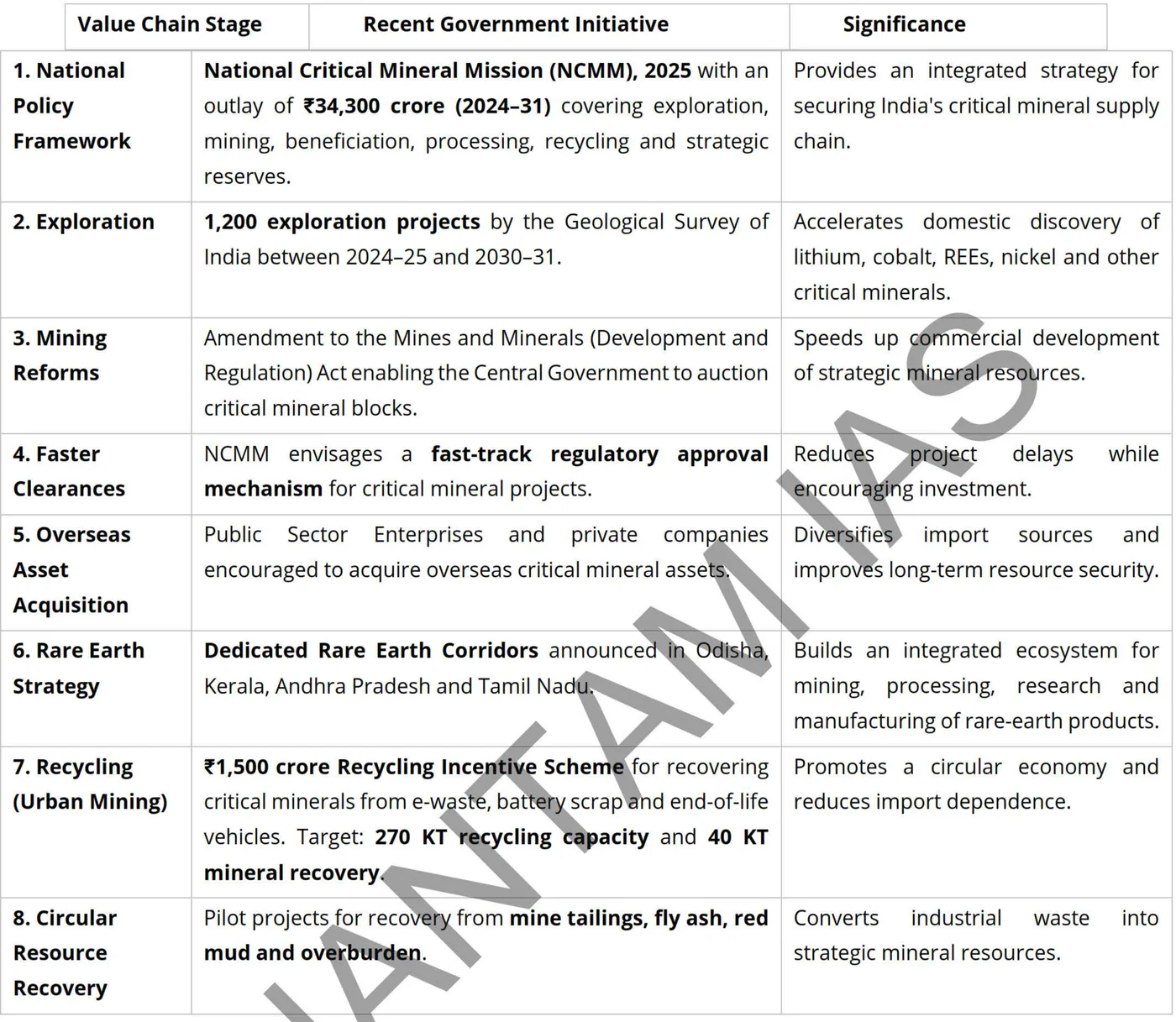
The headline numbers are worth getting right, because they are frequently misquoted.
- Government outlay: Rs 16,300 crore
- Expected investment from PSUs and private participants: about Rs 18,000 crore
- Combined headline figure: roughly Rs 34,300 crore
- Exploration target: around 1,200 projects by 2030-31, led by the Geological Survey of India
- Scope: exploration, mining, beneficiation, processing, recycling and strategic stockpiling
The mission period matters. Seven years is long enough to find deposits and short enough that processing capacity will not mature within it. That gap is the single most important thing to understand about the policy.
The Six Components
The Mission is built around six pillars, and each one targets a different failure point in the existing system.
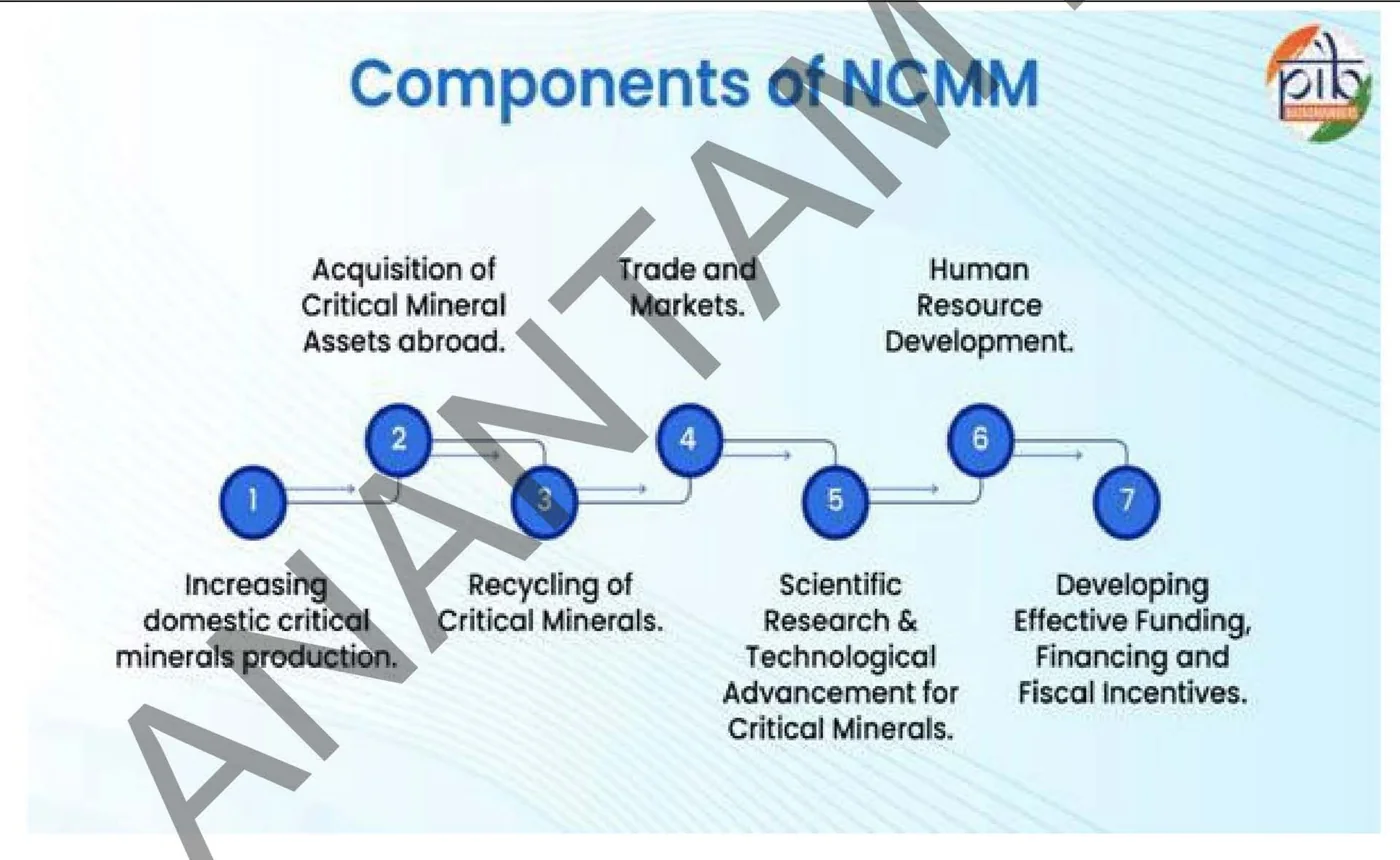
Increasing domestic production. Faster auctions of critical mineral blocks, backed by the amendment to the Mines and Minerals (Development and Regulation) Act that lets the Central Government auction specified critical and strategic minerals directly rather than leaving it to states.
Acquiring mineral assets abroad. Public sector enterprises and private firms are encouraged to buy into overseas deposits, in the pattern of the India-Australia critical minerals investment partnership.
Recycling of critical minerals. A recycling incentive scheme funds recovery from e-waste, spent batteries and end-of-life vehicles.
Scientific research and technological advancement. Indigenous technology, patents and substitute materials, so that a supply shock in one mineral does not halt an entire industry.
Human resource development. Trained geologists, metallurgists and process engineers, a constraint that is easy to overlook and slow to fix.
Effective funding, financing and fiscal incentives. Duty exemptions, viability support and blended finance for projects that are too capital-intensive and too long-dated for ordinary private capital.
Why India Is Exposed in the First Place
Import dependence is not an accident of geology alone. Four things compounded.
- Thin exploration history. India has explored shallow, and mostly for bulk minerals. Deep-seated and stratabound deposits, where critical minerals typically sit, were never a priority.
- Declining ore quality in legacy mines. Several older mines, including the Khetri copper belt, have passed their peak or are producing lower-grade ore.
- Absent mid-stream capacity. India can, in some cases, dig the ore. It largely cannot separate, refine or convert it into battery-grade or magnet-grade material.
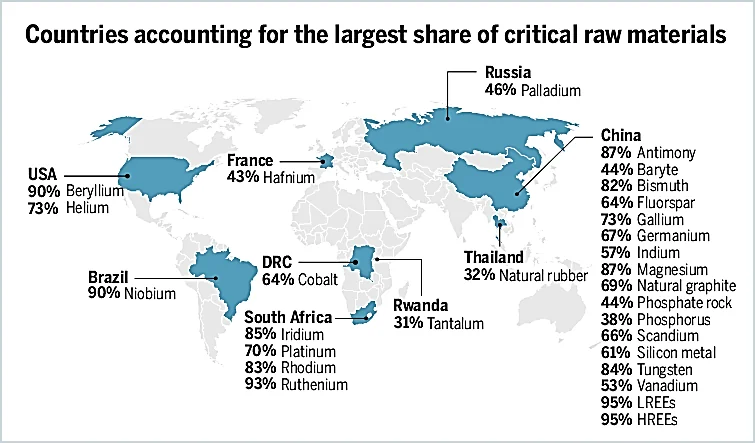
- Concentration risk abroad. Processing capacity for several of these minerals sits overwhelmingly in one country, which converts a commercial dependency into a strategic one.
The fourth point is what turned this from an industrial issue into a national security issue. When a supplier controls both the material and the processing step, an export restriction is a policy instrument.
The Environmental Cost Nobody Should Skip
Critical mineral extraction is not clean because its end use is clean. Mining these minerals carries higher emissions per unit of product than most bulk minerals, is water-intensive, and is often located in terrain exposed to flooding, landslides, heat stress and seismic risk.
A mission that expands mining without matching it with restoration standards, community consent and water accounting will buy energy security at the price of local ecological collapse. That is a trade, not a solution.
Recycling is the honest hedge here. Recovered metal needs no fresh lease, no new forest diversion and far less energy per tonne. The Mission’s recycling component is therefore not a side programme; it is the part with the best ratio of security gained to damage done.
Where the Mission Is Likely to Fall Short
My reading is that the NCMM is well designed for discovery and under-designed for processing.
Exploration is measurable, fundable and politically attractive. A count of 1,200 projects produces announcements. But a discovered deposit is an input, not a supply chain. The decisive stage is separation and refining, and that stage needs three things the Mission cannot supply on its own: guaranteed offtake so that a refinery is bankable, environmental clearances for chemically intensive processing, and a decade of stable policy.
The rare earth corridors are the most promising answer to this, precisely because they co-locate mining, separation, magnet manufacture and research rather than treating them as separate problems. Whether they are built at scale, and how fast, is the real test.
The Way Forward
- Treat processing capacity, not exploration count, as the headline metric of success.
- Build strategic stockpiles for the minerals where a single supplier holds decisive market share.
- Expand bilateral resource partnerships beyond Australia, including African and Latin American producers.
- Fund substitution research seriously, since the cheapest supply shock is the one you engineer around.
- Make recycling economics work through mandated collection and traceability, not incentives alone.
Mineral security is now inseparable from climate policy. India can build 500 GW of non-fossil capacity only if it can secure the copper, nickel, lithium and rare earths that capacity is made of. The Mission is the right instrument. Whether it is the right size is a question the next three years will answer.
Frequently Asked Questions
What is the National Critical Mineral Mission?
It is a seven-year mission approved by the Union Cabinet in January 2025, running from 2024-25 to 2030-31, to secure India’s supply of critical minerals such as lithium, cobalt, nickel, graphite and rare earth elements. It covers the entire value chain, from exploration and mining through beneficiation, processing, recycling and strategic stockpiling.
What is the outlay of the NCMM?
The Government’s own outlay is Rs 16,300 crore. A further Rs 18,000 crore is expected from public sector undertakings and private investment, taking the headline figure to about Rs 34,300 crore over the mission period.
Which minerals does India classify as critical?
The Ministry of Mines released a list of 30 critical minerals in 2023, including lithium, cobalt, nickel, graphite, vanadium, titanium, tungsten, tellurium, silicon, beryllium, niobium, zirconium and the rare earth group. The list is reviewed periodically as technology demand shifts.
Why is India dependent on imports for critical minerals?
India has limited proven reserves of several of these minerals, has historically under-invested in deep exploration, and lacks the mid-stream refining and separation capacity that turns ore into battery-grade or magnet-grade material. India imports close to all of its lithium and cobalt requirement, and most of its processed rare earth magnets.
What is urban mining and why does the NCMM emphasise it?
Urban mining is the recovery of critical minerals from end-of-life products such as electronics, batteries and vehicles rather than from ore. The Mission funds it through a recycling incentive scheme because recovered material shortens the supply chain, lowers emissions per unit of metal, and does not require a new mining lease or fresh forest clearance.
What are rare earth corridors?
These are geographically concentrated clusters that put mining, separation, magnet manufacturing and research in one place, so that ore does not have to leave the country for processing and return as a finished component. Announcements have focused on states with monazite-bearing beach sands.
How does the NCMM connect to India’s climate targets?
Solar modules, wind turbines, electric vehicle batteries, transmission cables and grid storage are all mineral-intensive. India’s 500 GW non-fossil capacity target and its EV transition are therefore only as secure as its access to copper, lithium, nickel, cobalt and rare earths. Mineral security is now a precondition for energy security, not a separate subject.
What is the biggest weakness of the Mission?
It is strongest on exploration and weakest on processing. Discovery does not deliver a supply chain: the refining and separation stage is where a small number of countries hold decisive market share, and building that capacity needs sustained industrial policy, offtake certainty and environmental clearances that the Mission alone cannot guarantee.
Practice Questions
Prelims MCQs
- The National Critical Mineral Mission covers which period?
(a) 2021-22 to 2026-27
(b) 2024-25 to 2030-31
(c) 2023-24 to 2028-29
(d) 2025-26 to 2032-33
Answer: (b) The Mission is a seven-year programme running from 2024-25 to 2030-31. - Consider the following statements about the NCMM. 1. It covers exploration, mining, beneficiation, processing and recycling. 2. It provides for acquisition of mineral assets abroad. 3. It excludes recovery of minerals from e-waste. Which are correct?
(a) 1 and 2 only
(b) 2 and 3 only
(c) 1 and 3 only
(d) 1, 2 and 3
Answer: (a) The Mission explicitly promotes recycling and urban mining, including recovery from e-waste and end-of-life vehicles, so statement 3 is wrong. - Which body is tasked with the bulk of the exploration projects under the Mission?
(a) Indian Bureau of Mines
(b) Geological Survey of India
(c) National Mineral Development Corporation
(d) Atomic Minerals Directorate
Answer: (b) The Geological Survey of India carries the main exploration mandate, with a target of about 1,200 projects over the mission period. - The amendment to the Mines and Minerals (Development and Regulation) Act relevant to critical minerals enabled which of the following?
(a) State governments to nationalise mineral blocks
(b) The Central Government to auction critical and strategic mineral blocks
(c) A complete ban on private participation in mining
(d) Automatic renewal of all existing leases
Answer: (b) The amendment empowered the Centre to auction blocks of specified critical and strategic minerals, including lithium and rare earths. - Why is mid-stream processing capacity considered India's key vulnerability in critical minerals?
(a) India has no mineral reserves at all
(b) Refining and separation capacity is globally concentrated in a few countries
(c) Processing is banned under Indian environmental law
(d) Processed minerals cannot be transported
Answer: (b) Even where ore is available, the separation and refining stage is dominated by a small number of producers, so discovery alone does not secure supply.
Mains Questions
- Critical mineral security has become an extension of energy security. Examine the National Critical Mineral Mission against this claim, and identify the stage of the value chain where India remains most exposed. (250 words)
- Exploration is necessary but not sufficient for supply-chain resilience. Discuss with reference to India's critical mineral strategy. (250 words)
- Evaluate urban mining as an instrument of resource security. What institutional and market conditions must exist for it to work at scale in India? (150 words)
- Overseas acquisition of mineral assets carries geopolitical as well as commercial risk. Discuss with suitable examples. (150 words)
- Critical mineral extraction is itself emission-intensive and ecologically disruptive. How should India reconcile this with its clean-energy transition? (250 words)
Tell Google you want more of this.
Add Anantam IAS as a preferred sourceOne tap, and this site shows up more often in your own Top Stories, AI Overviews and AI Mode. Remove it any time.