Introduction
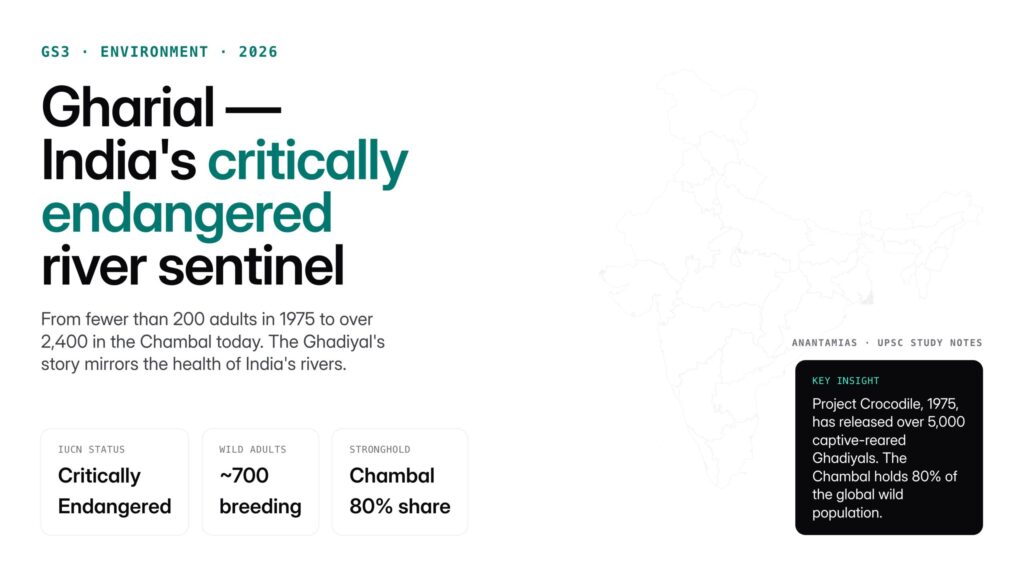
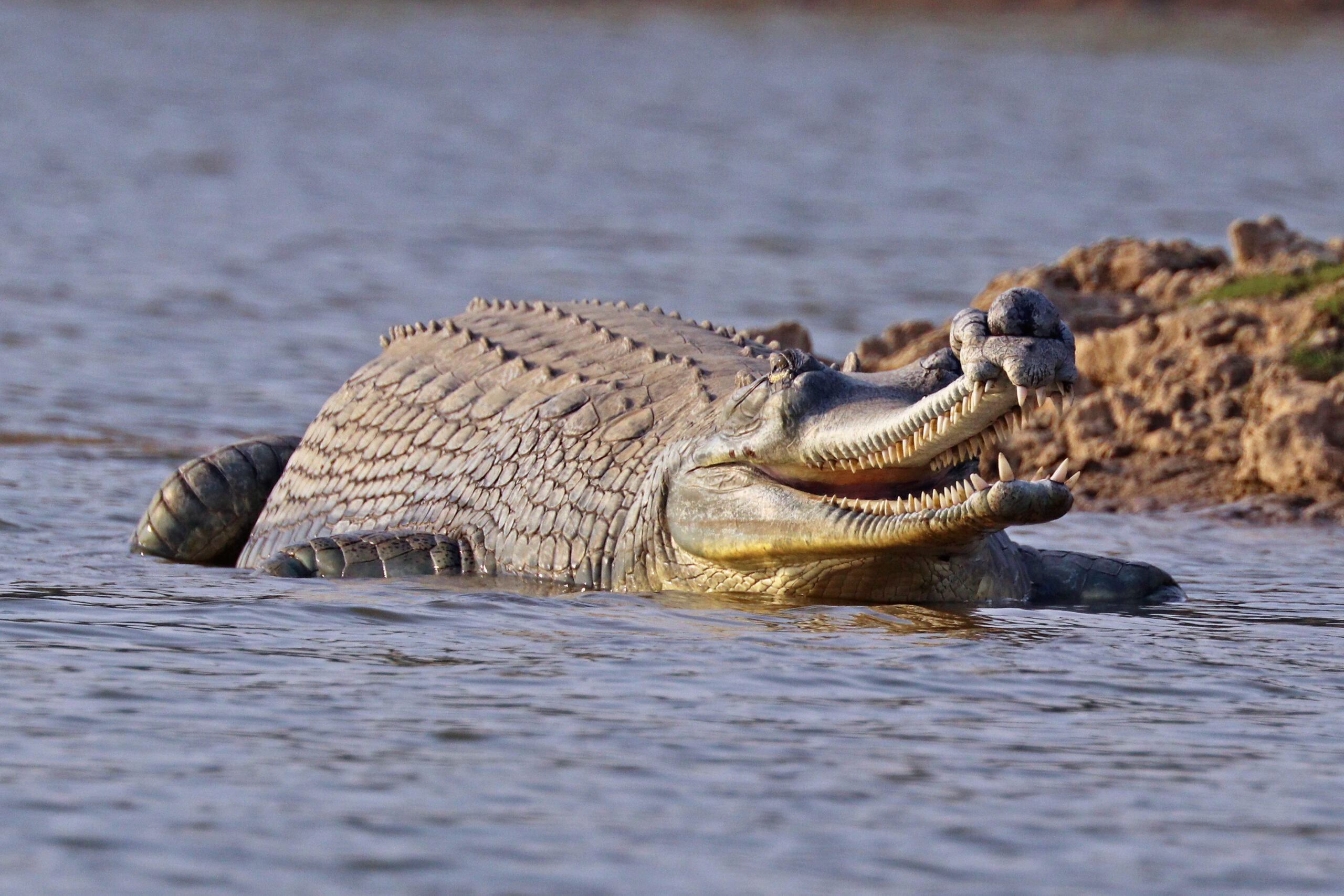
The Gharial, locally called the Ghadiyal, is the most distinctive crocodilian on the Indian subcontinent. With its extraordinarily long, slender snout and the bulbous nasal protuberance on adult males that resembles an earthen pot (ghara in Hindi), it is the only surviving member of the family Gavialidae. Once abundant across the river systems of the Indus, Ganga, Brahmaputra, Mahanadi and Irrawaddy, today the Ghadiyal survives in a fraction of its historical range and is listed as Critically Endangered on the IUCN Red List.
For UPSC aspirants, the Gharial is a recurring theme in Prelims species-in-news questions and in Mains answers on biodiversity, river ecosystems and conservation policy. This article consolidates taxonomy, habitat, population trends, the history of the Gharial Conservation and Breeding Programme, Project Crocodile, threats from sand mining and fishing nets, and the role of the National Chambal Sanctuary, India’s most important Ghadiyal stronghold.
Quick Facts at a Glance
| Attribute | Detail |
|---|---|
| Scientific name | Gavialis gangeticus |
| Family | Gavialidae |
| IUCN status | Critically Endangered |
| CITES | Appendix I |
| Wildlife (Protection) Act, 1972 | Schedule I |
| Adult length | 3.5 to 4.5 m (males up to 6 m) |
| Diet | Fish (piscivore) |
| Distribution | India, Nepal (extinct in Pakistan, Bhutan, Bangladesh, Myanmar) |
| Largest population | National Chambal Sanctuary |
| Estimated wild adults | Around 650 to 900 (2024 estimates) |
| National symbol | State reptile of Uttar Pradesh (proposed) |
Background and Historical Context
The Gharial is an ancient lineage. Fossil evidence traces gavialid crocodilians to the late Cretaceous, and molecular studies confirm that Gavialis diverged from other crocodilians over 40 million years ago. Unlike the broad-snouted Mugger and the Saltwater crocodile, the Ghadiyal’s narrow, needle-like snout and interlocking teeth are adapted almost exclusively for catching fish. This specialisation is both its signature and its vulnerability, because any disruption to riverine fisheries translates directly into nutritional stress for the species.
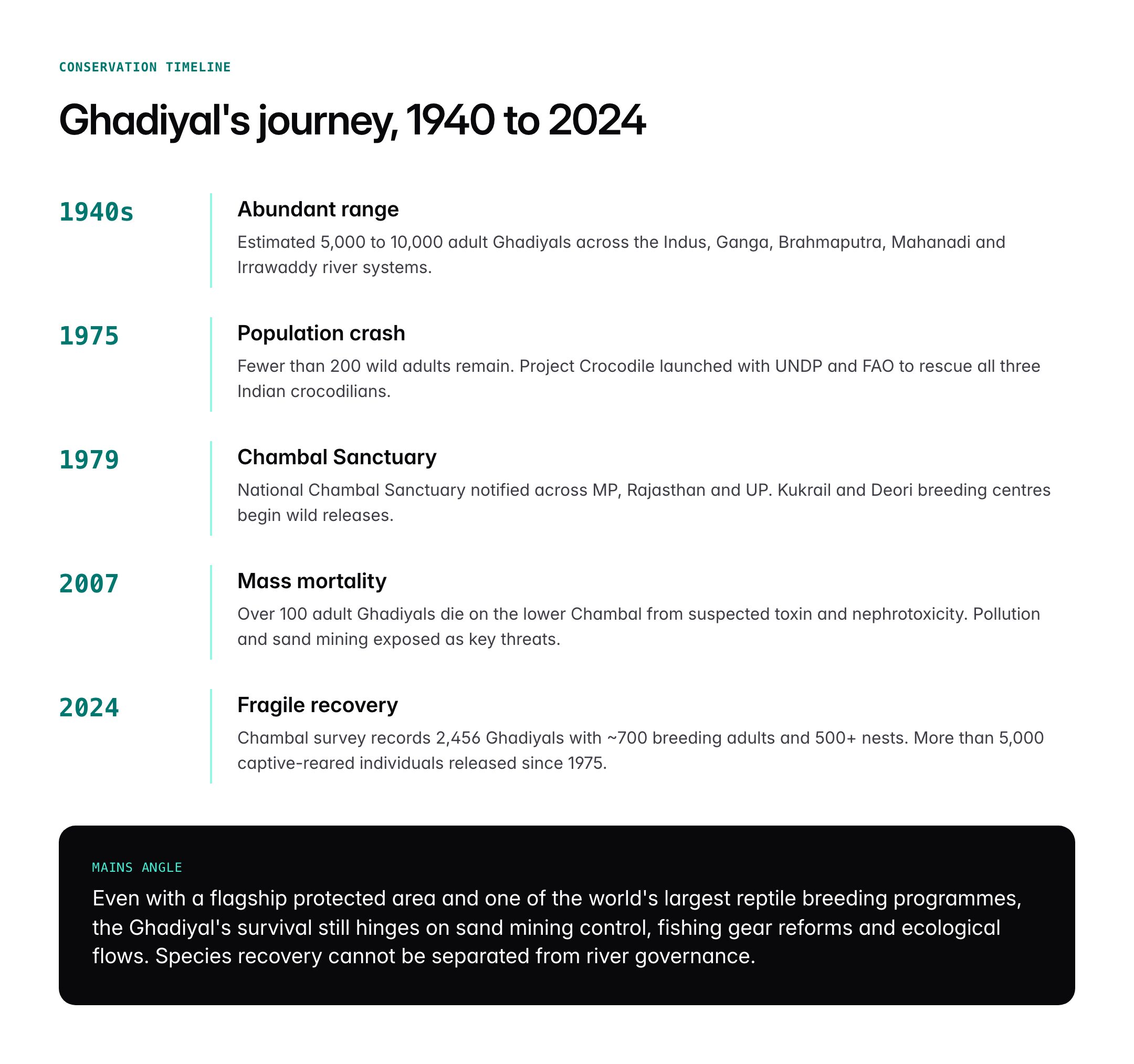
Historical accounts from the 19th century describe Ghadiyals as abundant in the Ganga, Yamuna, Chambal, Son, Mahanadi, Brahmaputra and Kosi. Colonial hunting records, skin trade and traditional medicine demand kept populations under pressure, but the catastrophic collapse happened between 1950 and 1975. Dam construction, conversion of riverbanks to agriculture, diversion of water for irrigation, mechanised fishing and egg collection reduced numbers from an estimated 5,000 to 10,000 adults in the 1940s to fewer than 200 by the mid-1970s.
The Government of India responded in 1975 by launching Project Crocodile with assistance from the United Nations Development Programme and the Food and Agriculture Organisation. The project covered all three Indian crocodilians, the Gharial, the Mugger and the Saltwater crocodile, and for the Ghadiyal it established captive rearing centres, egg collection protocols and the first rewilding releases. The National Chambal Sanctuary was notified in 1979 and remains the flagship protected area for the species. A second wave of conservation concern arose after the 2007 and 2008 mass mortality events on the lower Chambal, where more than 100 adult Ghadiyals died from suspected nephrotoxicity, underscoring that the species remains dangerously close to the edge.
Key Features
Morphology and Sexual Dimorphism
The Gharial is readily distinguished from other crocodilians by its thin, elongated snout that narrows towards a bulbous tip. Adult males develop a hollow, cartilaginous ghara on top of the snout around 10 to 12 years of age, used as a vocal resonator and visual sexual signal. Females are smaller, averaging 3.5 metres, while males reach 5 to 6 metres. Colouration is olive-green to grey, with juveniles showing dark cross-bands that fade with age. The hind feet are strongly webbed for powerful swimming, while the limbs are weaker on land, meaning adult Ghadiyals rarely stray more than a few metres from water.
Habitat Preferences
Ghadiyals require deep, fast-flowing freshwater rivers with high, sandy banks for nesting and mid-channel sandbars for basking. Unlike Muggers, they avoid ponds, backwaters and human-modified channels. Ideal habitat features clear water, abundant fish, minimal boat traffic and seasonal sandbar formation during the pre-monsoon dry season. The Chambal River offers the closest remaining approximation to these conditions in India.
Diet and Behaviour
Adults are obligate piscivores, sweeping the snout sideways through water to seize fish with their 106 to 110 interlocking teeth. Hatchlings supplement fish with insects, tadpoles and crustaceans. Ghadiyals are gregarious baskers, often seen in groups of five to twenty on sandbars. They are largely non-aggressive towards humans, and there is no reliable record of a fatal attack by a wild Ghadiyal on a person.
Reproduction
Mating occurs between November and January. Females nest between March and May, digging flask-shaped pits on sandy banks about one to three metres from the waterline. A clutch contains 20 to 90 eggs, the largest among crocodilians. Incubation lasts 70 to 90 days. Sex is determined by temperature, with cooler nests producing females and warmer nests producing males. Nest guarding is shared, and communal creches of hatchlings are led by dominant males.
Significance for UPSC and General Knowledge
- Flagship species for Indian riverine ecosystems and a priority under Project Crocodile, 1975
- Critically Endangered on IUCN Red List and listed on CITES Appendix I, restricting international trade
- Indicator species for river health, sand mining pressure and fisheries sustainability
- Subject of India’s largest reptile captive-breeding and reintroduction programme
- Linked to debates on ecological flows, Ganga rejuvenation and the Namami Gange Programme
- Frequently featured in Prelims questions on protected areas (Chambal, Katarniaghat, Son Gharial Sanctuary)
Detailed Analysis: Conservation Programme and Protected Area Network
The Gharial Conservation and Breeding Programme is one of the longest-running reintroduction efforts in Asia. Between 1975 and 2025, more than 5,000 captive-reared Ghadiyals have been released into Indian rivers. Eggs are collected from wild nests under controlled protocols, incubated at centres such as Kukrail near Lucknow, Deori in Morena district (Madhya Pradesh), Nandankanan Zoological Park in Odisha and the Madras Crocodile Bank Trust in Tamil Nadu. Juveniles are reared for two to three years until they reach about 1.2 metres, the size at which predation by jackals, otters and soft-shell turtles declines sharply, and then released.
The National Chambal Sanctuary, a 5,400 square kilometre tri-state reserve across Madhya Pradesh, Rajasthan and Uttar Pradesh, holds approximately 80 per cent of the global wild Ghadiyal population. Supporting populations survive in the Katarniaghat Wildlife Sanctuary on the Girwa River in Uttar Pradesh, the Son Gharial Sanctuary in Madhya Pradesh, parts of the Ramganga in Corbett Tiger Reserve, the Gandak in Bihar and the Mahanadi in Odisha. Nepal holds a small but genetically important population in the Rapti River within Chitwan National Park, managed through a bilateral captive-breeding tie-up at Kasara.
Recent population surveys by the Wildlife Institute of India and the Madhya Pradesh Forest Department in 2024 reported 2,456 Ghadiyals in the Chambal, of which around 700 were breeding adults. Nest counts crossed 500 in 2023, the highest since monitoring began. This recovery, however, remains fragile. The 2007 to 2008 Chambal mortality event, traced to a combination of uric acid accumulation and possible contaminant stress, killed over 100 adults in weeks. Oil spills from refineries, pesticide runoff from Yamuna agricultural belts and illegal sand mining along nesting beaches continue to threaten the trajectory. The species is also subject to incidental mortality in nylon gill nets used by riverine fishing communities, prompting experiments with net-exclusion zones and compensation schemes.
Comparative Perspective
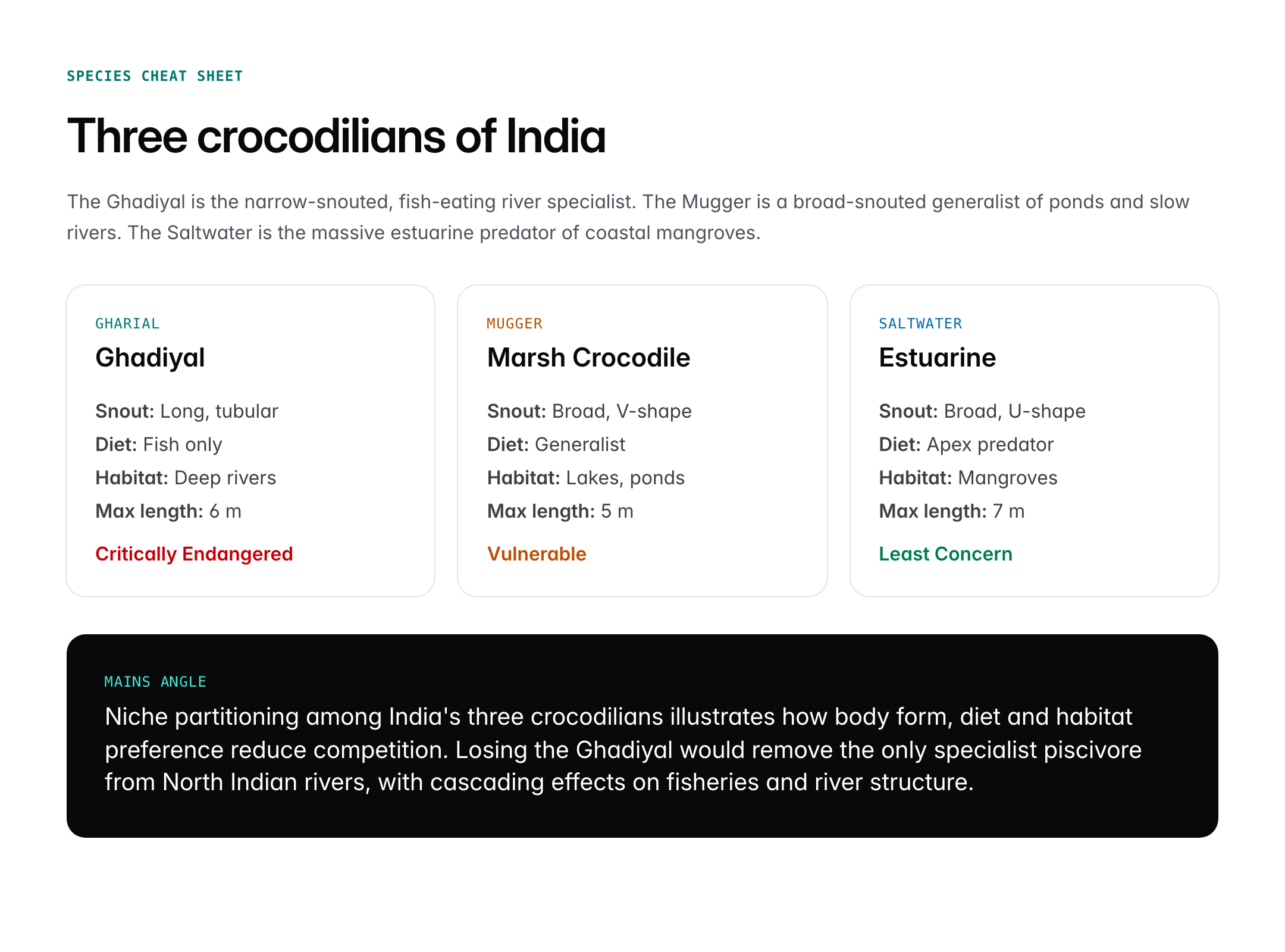
India hosts three crocodilian species, each occupying a distinct ecological niche. Understanding the differences is a frequent source of Prelims questions.
| Feature | Gharial (Ghadiyal) | Mugger Crocodile | Saltwater Crocodile |
|---|---|---|---|
| Scientific name | Gavialis gangeticus | Crocodylus palustris | Crocodylus porosus |
| Snout shape | Long, narrow, tubular | Broad, V-shaped | Broad, U-shaped |
| Habitat | Deep, fast rivers | Lakes, ponds, slow rivers | Estuaries, mangroves |
| Diet | Fish only | Fish, birds, mammals | Fish, mammals, reptiles |
| Max length | 5 to 6 m | 4 to 5 m | 6 to 7 m |
| IUCN status | Critically Endangered | Vulnerable | Least Concern |
| Indian stronghold | Chambal, Girwa | Sasan Gir, Ranganthittu | Bhitarkanika, Sundarbans |
| Danger to humans | Negligible | Occasional | Significant |
Globally, the Ghadiyal is compared with the False Gharial (Tomistoma schlegelii) of Southeast Asia. Earlier classified as a true crocodile, molecular phylogenetics now places Tomistoma within Gavialidae as the Ghadiyal’s closest living relative, a finding with implications for conservation taxonomy.
Challenges and Criticisms
Despite five decades of effort, the Ghadiyal remains on the knife-edge of extinction. Captive breeding has been criticised for being insufficiently coupled with habitat protection, producing many released juveniles that fail to survive in degraded river stretches. Sand mining for construction is endemic along the Chambal and Son, destroying nesting beaches even inside notified sanctuaries. The Supreme Court has repeatedly flagged illegal mining in the Chambal, but enforcement against politically connected mining mafias is patchy. Proposed river-linking projects, including the Ken-Betwa and Par-Tapi-Narmada links, could alter flow regimes critical for Ghadiyal nesting.
Conservationists also debate the genetic diversity of the recovering population, since most Chambal Ghadiyals descend from a small founder cohort. Disease outbreaks, toxin accumulation in apex predators and climate change pressures on sex ratios through temperature-dependent sex determination add uncertainty. Finally, the livelihoods of riverine fishing communities rarely receive attention in conservation planning, leading to persistent human-wildlife friction and incidental killings in fishing gear.
Prelims Pointers
- Gharial belongs to family Gavialidae, the only living member of genus Gavialis
- Scientific name: Gavialis gangeticus
- IUCN Red List status: Critically Endangered
- CITES listing: Appendix I
- Wildlife (Protection) Act, 1972: Schedule I
- Project Crocodile launched in 1975 with UNDP and FAO assistance
- National Chambal Sanctuary notified in 1979, covers parts of Madhya Pradesh, Rajasthan and Uttar Pradesh
- Chambal River is a tributary of the Yamuna; holds over 80 per cent of wild Ghadiyals
- Other key habitats: Katarniaghat Wildlife Sanctuary (UP), Son Gharial Sanctuary (MP), Corbett Tiger Reserve
- Male Ghadiyals have a bulbous nasal protuberance called ghara
- Ghadiyal is a piscivore with 106 to 110 teeth
- Largest clutch size among crocodilians: 20 to 90 eggs
Mains Practice Questions
- Discuss the factors responsible for the near-extinction of the Gharial in Indian rivers and evaluate the effectiveness of Project Crocodile in reversing the decline.
- Historical baseline and causes of decline: hunting, habitat loss, dams, fishing gear, egg collection
- Structure and outcomes of Project Crocodile: captive rearing, releases, sanctuary network
- Limitations: habitat still degrading, sand mining, mass mortality events, genetic bottleneck
- The Gharial is often described as an indicator species for river health. Critically examine this claim with reference to the Chambal and Ganga basins.
- Ecological role of Ghadiyal as a piscivorous apex predator
- Linkages between Ghadiyal survival and river flow, sediment, fisheries
- Policy implications for Namami Gange, ecological flows and inter-state river management
Conclusion
The Ghadiyal is both a biological marvel and a barometer of India’s river health. Its recovery from fewer than 200 individuals in the 1970s to over 2,000 in the Chambal today demonstrates that long-term, science-based conservation can work, but the species is not yet out of danger. Each nesting season depends on undisturbed sandbars, clean water and fish stocks that are themselves under unprecedented pressure.
For aspirants, the Ghadiyal story offers a template for writing about biodiversity. It weaves together taxonomy, protected area management, inter-state governance, livelihoods and climate vulnerability. A mature answer on the Ghadiyal should move beyond listing facts to engaging with the political economy of rivers, because saving this one species ultimately requires saving the rivers it inhabits.
Frequently Asked Questions
What is a Gharial (Ghadiyal)?
The Gharial, also called Ghadiyal, is a critically endangered fish-eating crocodilian (Gavialis gangeticus) native to Indian subcontinent rivers. It is the only surviving member of family Gavialidae, distinguished by its long, slender snout and the bulbous nasal protuberance called ghara that adult males develop. It survives mainly in the National Chambal Sanctuary.
Why is the Ghadiyal important for UPSC?
The Ghadiyal is frequently asked in UPSC Prelims as a species-in-news question and features in Mains answers on biodiversity, river ecosystems and conservation policy. It is a flagship species under Project Crocodile (1975), listed as Critically Endangered on the IUCN Red List, on CITES Appendix I, and on Schedule I of the Wildlife Protection Act.
How is the Gharial related to the Mugger crocodile?
Both are Indian crocodilians, but they belong to different families and occupy different niches. The Gharial is Gavialidae, slender-snouted and fish-eating, found in deep, fast rivers. The Mugger is Crocodylidae, broad-snouted and opportunistic, found in lakes, ponds and slow rivers. The Mugger is Vulnerable while the Ghadiyal is Critically Endangered.
Where is the largest Gharial population in India?
The National Chambal Sanctuary, a tri-state protected area across Madhya Pradesh, Rajasthan and Uttar Pradesh, holds around 80 per cent of the global wild Ghadiyal population. The 2024 survey recorded over 2,400 Ghadiyals in the Chambal, with around 700 breeding adults and more than 500 nests in the 2023 season.
What is Project Crocodile?
Project Crocodile was launched by the Government of India in 1975 with UNDP and FAO assistance to conserve all three Indian crocodilians: Gharial, Mugger and Saltwater crocodile. It established captive rearing centres, egg collection protocols, rewilding releases and a protected area network. More than 5,000 Ghadiyals have been released into Indian rivers under the programme.
Why did the Gharial population collapse?
Between 1950 and 1975 the Gharial declined from an estimated 5,000 to 10,000 adults to fewer than 200 due to hunting for skins, dam construction, habitat destruction, sand mining of nesting beaches, egg collection, competition from fisheries, and drowning in nylon gill nets. Many of these pressures continue to threaten the species today.
Is the Gharial dangerous to humans?
No. Despite reaching lengths of five to six metres, the Gharial feeds almost exclusively on fish using its narrow, needle-toothed snout, which is poorly suited to seizing large prey. There is no reliable record of a fatal attack by a wild Gharial on a person. It is one of the most docile large crocodilians in the world.
What is the ghara in a Gharial?
The ghara is a hollow, cartilaginous, pot-shaped protuberance on top of the snout of adult male Gharials, from which the species gets its Hindi name. Males develop it around 10 to 12 years of age. It acts as a vocal resonator during courtship and a visual signal of sexual maturity, and is absent in females.
Tell Google you want more of this.
Add Anantam IAS as a preferred sourceOne tap, and this site shows up more often in your own Top Stories, AI Overviews and AI Mode. Remove it any time.