Disclosure: this guide contains Amazon affiliate links. As an Amazon Associate, Anantam IAS earns from qualifying purchases — at no extra cost to you.
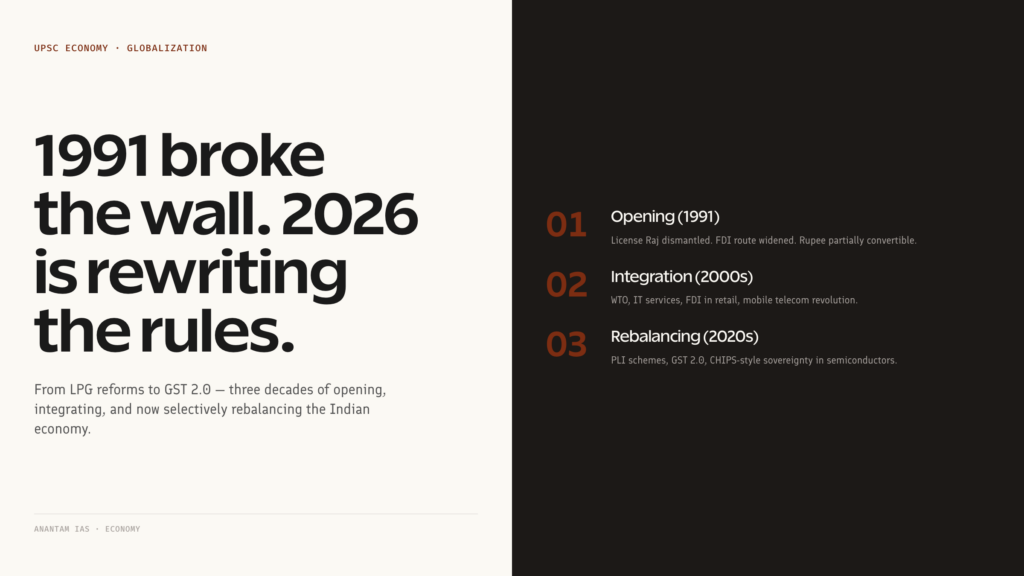
July 1991. India's forex reserves had collapsed to two weeks of imports. The Reserve Bank flew 47 tonnes of gold to the Bank of England as collateral for an IMF loan. That humiliation rewrote the Indian economy. Manmohan Singh's budget speech on July 24, 1991 — quoting Victor Hugo about ideas whose time has come — kicked off the globalization and the Indian economy story we're still living. Thirty-five years on, the verdict is mixed. Software exports crossed $220 billion. Foreign direct investment hit $81 billion. But manufacturing failed to scale. Inequality widened. And in 2025-26, the world is busy "reshoring" while India is still trying to plug into the global tape. This explainer walks the full arc — pre-1991 closed economy, the BoP crisis, LPG reforms, three-and-a-half decades of effects, India versus China, and where deglobalisation leaves us.
What is globalization and the Indian economy?
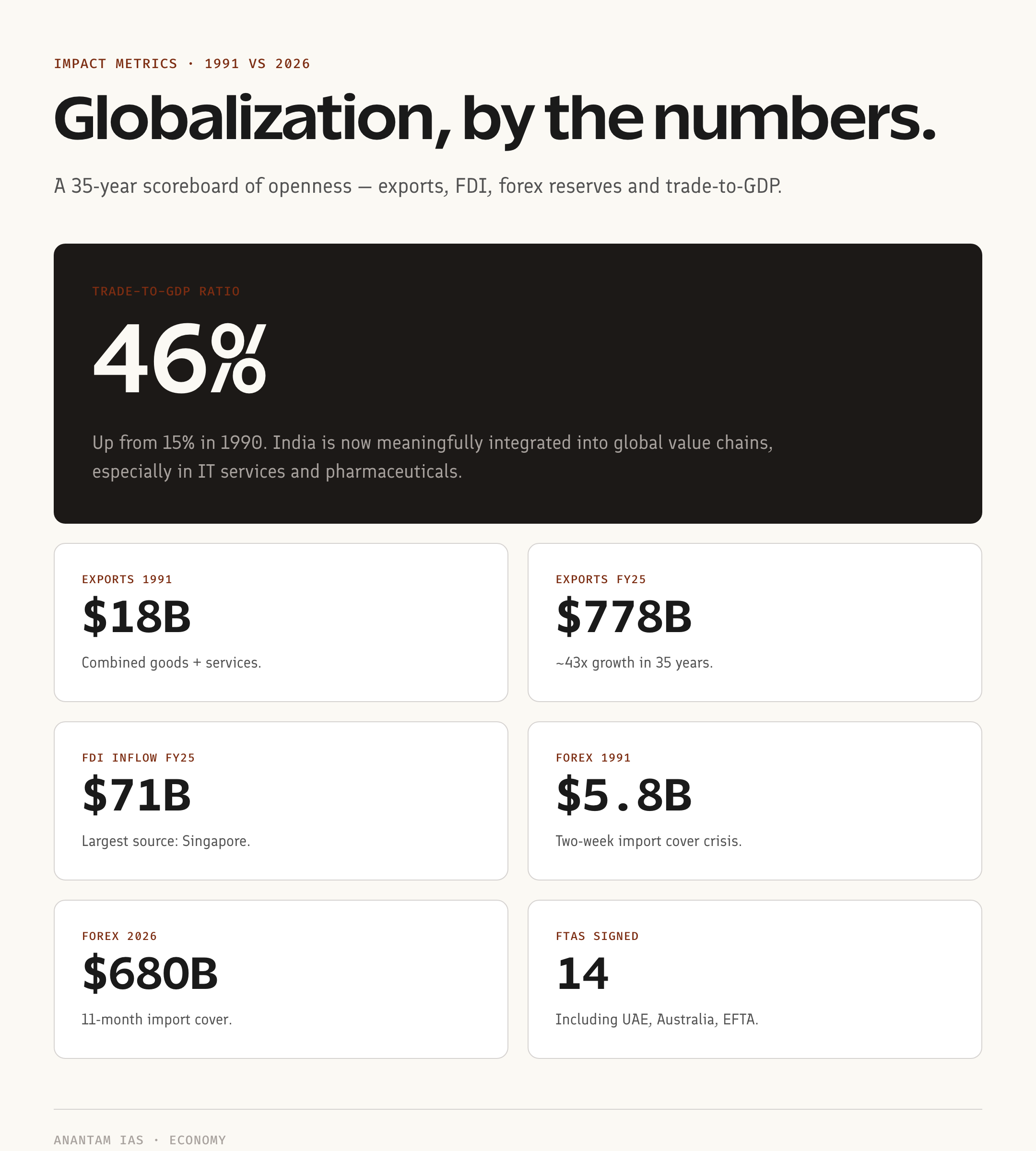
Globalization and the Indian economy refers to the process by which India integrated with the world economy through trade, capital, technology, and labour flows after the 1991 LPG reforms — Liberalisation, Privatisation, and Globalisation. It moved India from a state-directed, import-substitution model toward an open, market-driven economy. By 2026, India's trade-to-GDP ratio stands at ~46%, FDI inflows at $81 billion (FY25), and software exports at $220+ billion — but agriculture and manufacturing remain partially insulated, and inequality has widened.
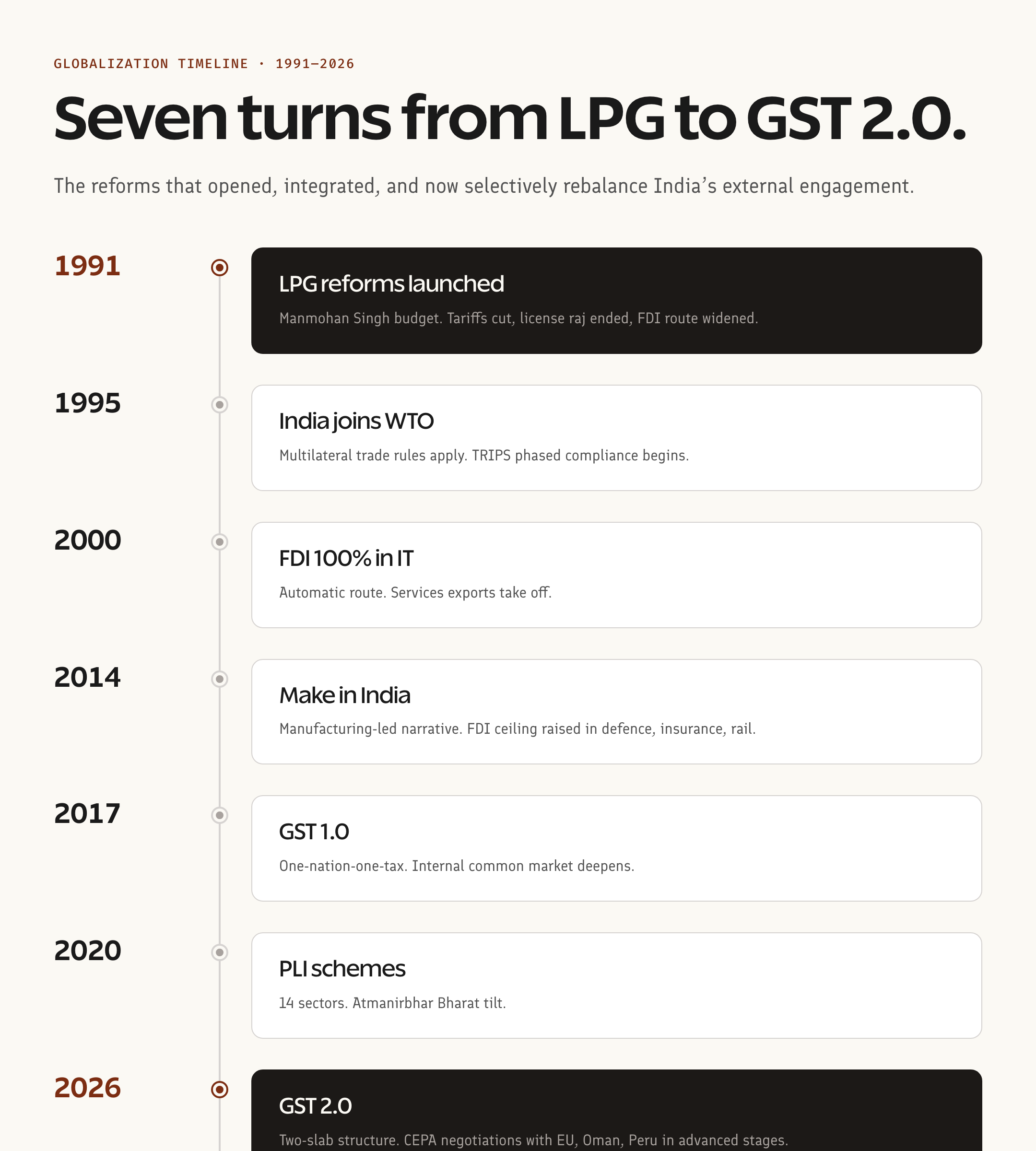
- Date of LPG reforms — July 24, 1991 — Union Budget under Finance Minister Manmohan Singh, PM Narasimha Rao.
- Pre-LPG forex reserves — $1.2 billion (June 1991) — sufficient for ~2 weeks of imports.
- Trade-to-GDP ratio — rose from ~15% (1990) to ~46% (2025-26).
Pre-1991 closed economy — what we left behind
Independent India inherited a colonial export model — raw materials out, manufactured goods in. Nehru and Mahalanobis flipped it to import substitution industrialisation (ISI). The logic was reasonable. The execution… became a problem.
Key features of the pre-1991 closed economy:
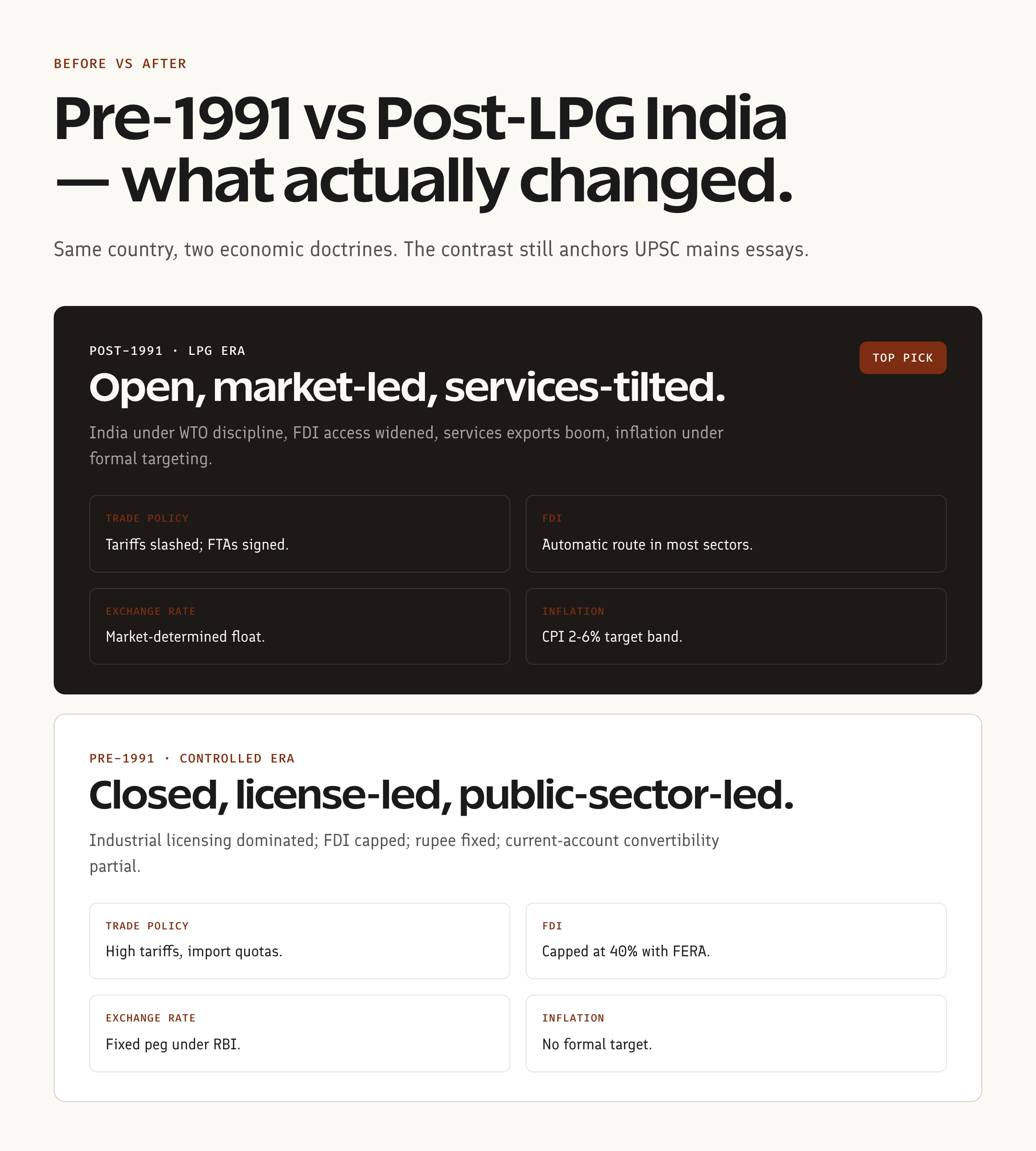
- License Raj — every industrial expansion needed government approval. The Industries Development and Regulation Act, 1951 was the engine.
- MRTP Act, 1969 — Monopolies and Restrictive Trade Practices Act capped large business expansion. Small was beautiful, big was suspect.
- FERA, 1973 — Foreign Exchange Regulation Act. Coca-Cola and IBM left India in 1977 because they wouldn't dilute equity to 40%.
- Import tariffs — peak rate ~150%, average ~85% in 1990. Quantitative restrictions on most consumer goods.
- Public sector dominance — IPR 1956 reserved 17 industries for the state. Banks nationalised in 1969 (14) and 1980 (6).
- Hindu rate of growth — 3.5% average, 1950-1980.
By the late 1980s, the model was creaking. Rajiv Gandhi started loosening telecom and computers. But the fiscal arithmetic kept worsening — borrowing at 8.4% of GDP, current account deficit at 3.1%. Then the Gulf War (1990) spiked oil prices. Remittances from Kuwait collapsed. NRI deposits fled. The crisis was manufactured by structural fragility, triggered by an external shock.
The 1991 BoP crisis — six weeks that changed everything
Read the balance of payments explainer for the full mechanics. Quick summary:
- June 1991 — forex reserves at $1.2 billion. Two weeks of imports.
- July 1991 — RBI airlifted 47 tonnes of gold to the Bank of England and Bank of Japan as collateral. India almost defaulted.
- July 1, 3 — rupee devalued in two steps, ~24% cumulative.
- July 24, 1991 — Manmohan Singh's budget speech. Liberalisation announced.
- Industrial Policy Statement, July 24, 1991 — abolished licensing for most industries. Reduced reserved sectors from 17 to 8.
Read the full analysis of 1991 LPG reforms for the policy shifts and gains-vs-gaps balance sheet.
LPG — what each letter actually did
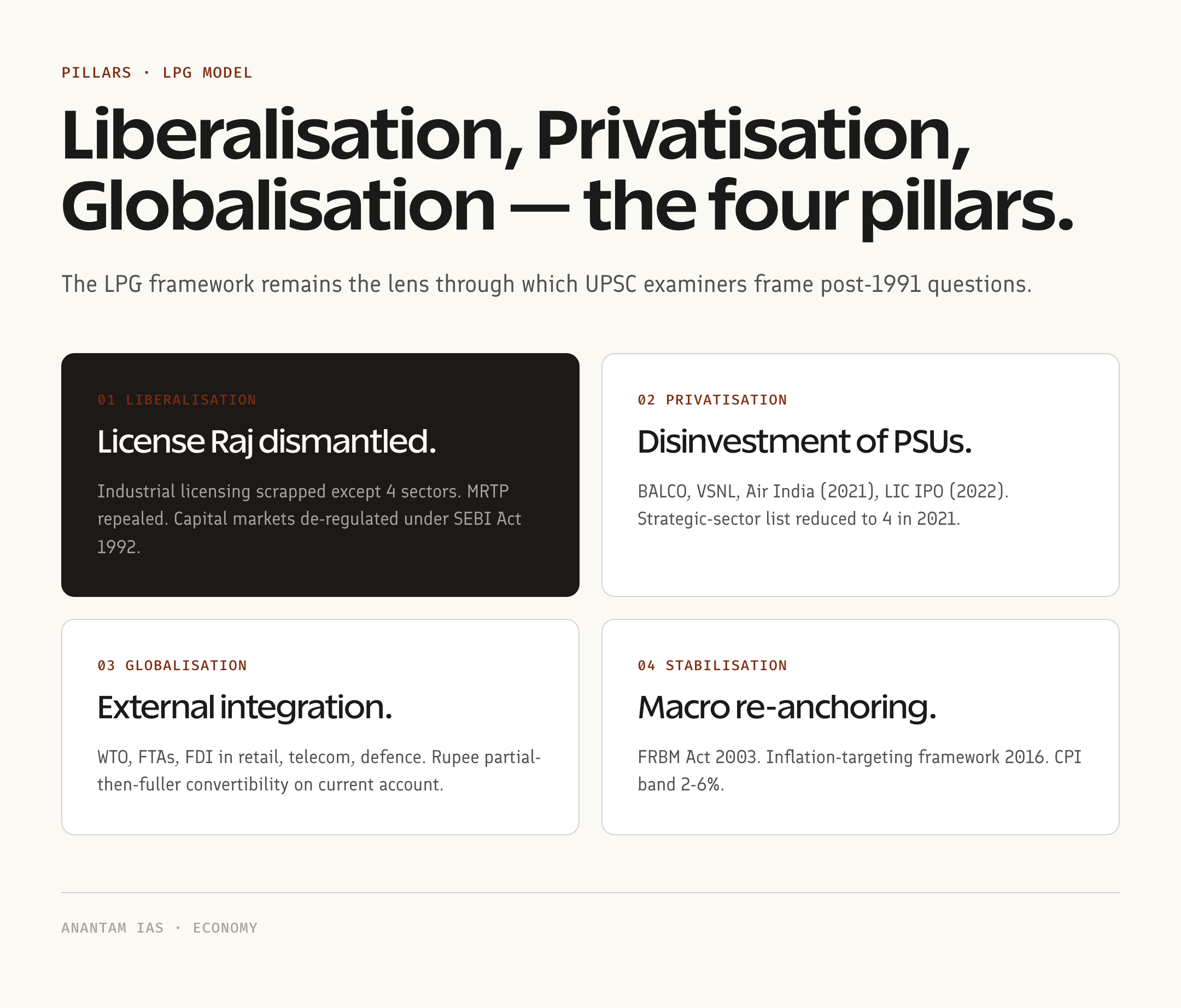
L — Liberalisation. Removed industrial licensing, abolished MRTP, scrapped most import quantitative restrictions, simplified tax structure, deregulated interest rates, reduced peak customs duty from 150% to 10% by 2007.
P — Privatisation. Disinvestment of PSUs began (initially minority stakes, later strategic sales — Maruti 1992, BALCO 2001, Air India 2022). Many reserved sectors opened to private players — telecom (1994), aviation (1994), insurance (2000), banking (1993 new private banks, 2003 Bharti Airtel-style).
G — Globalisation. Foreign trade and investment opened up. FERA (1973) replaced by FEMA (1999). FDI caps raised. WTO membership in 1995 (India was a founder of GATT in 1947, transitioned to WTO). Capital account opened gradually.
The 35-year effects ledger — what worked, what didn't
Three and a half decades of globalization and the Indian economy produced clear winners and clear losers. Honestly, the verdict isn't even close in some sectors.
Services boom (winner). IT-BPM industry grew from $4 billion (1995) to $220+ billion (FY26). India captures 55% of global services outsourcing. Read service exports for the modes breakdown. Honestly, this was the single biggest payoff of globalisation.
FDI inflows (winner). From under $100 million (1990) to $81 billion (FY25). Read FDI full form for routes and sectors. Cumulative FDI since April 2000 has crossed $1 trillion.
Forex reserves (winner). From $1.2 billion (1991) to $701.4 billion (Jan 2026 peak). India is now 4th-largest reserve holder globally.
Consumer choice (winner). From two car brands (Ambassador, Premier) to forty. From two TV brands to global supply chain. Mobile penetration at 87% (2024).
Manufacturing (loser). Share of GDP stuck at 13–14% for 30 years. China hit 32% before manufacturing peaked. We never had a mass-employment manufacturing phase. PLI is trying to fix this 30 years late… and the jury's still out on whether it'll deliver.
Agriculture (mixed). Globalisation exposed Indian farmers to volatile world prices without adequate insurance. WTO obligations limit subsidies. MSP regime continues but is fragile. Farmer protests of 2020-21 traced back to globalisation anxieties.
Inequality (loser). Top 1% income share rose from 6% (1990) to 22.6% (2022-23) — World Inequality Database. India is now more unequal than the British Raj era on some measures.
Brain drain → brain circulation (mixed). Earlier, IIT-IIM grads left and didn't return. Now Indian-origin CEOs lead Google, Microsoft, IBM, Adobe, Chanel, Pepsi. Reverse migration is happening — but for the top 1%, not the bulk.
India vs China — two paths through globalisation
China opened in 1978 with Deng Xiaoping. India opened in 1991 with Manmohan Singh. Thirteen years apart, but the trajectories diverged radically.
- Manufacturing strategy — China built export-led mass manufacturing (~32% of GDP at peak). India tried services-led growth (~54% of GVA).
- FDI policy — China focused on greenfield manufacturing FDI in special economic zones. India received more services FDI; SEZs underperformed.
- Labour markets — China had a 'flexible' labour regime tied to internal migration. India's labour codes only consolidated in 2020.
- Infrastructure — China built 40,000 km of high-speed rail by 2024. India is at ~2,000 km of semi-high-speed.
- Per-capita income — China $13,400, India $2,900 (nominal, 2026). Started roughly equal in 1990.
- Trade-to-GDP — China peaked at ~64% (2006), now ~37%. India at ~46%.
The lesson? Globalisation pays off most for countries that pair openness with infrastructure capacity, manufacturing scale, and labour mobility. India got the openness right, mostly missed the rest… and that one sentence is worth a whole Mains essay.
OK, here's the counter-to-popular-advice take — "we should have liberalised earlier, like China" is wrong. Pre-1991 India also lacked the road network, port capacity, and labour pool depth that China had built up by 1978 with prior state investment. Liberalisation without absorptive capacity would have produced a different kind of crisis.
WTO and the Indian economy — what membership did
India joined the WTO at its founding in January 1995. Read WTO and India for the disputes and obligations.
Key impacts:
- Tariff binding — peak rates capped, agricultural tariffs partially bound.
- TRIPS compliance — India shifted to product patents in pharmaceuticals (2005), with the famous Section 3(d) flexibility.
- Agriculture obligations — MSP regime stays under "amber box" — capped at 10% of production value (developing country threshold).
- Services agreement (GATS) — opened domestic services to foreign players.
India has won landmark cases (US-shrimp/turtle, US-poultry) and lost some (US-solar). The WTO membership remains central to globalisation policy.
Deglobalisation — the post-2018 reversal
Trump's tariffs (2018), Covid (2020), Russia-Ukraine war (2022), and the US-China decoupling triggered the deglobalisation wave. Read deglobalization for the deep dive.
For India, deglobalisation creates two opportunities:
- China+1 sourcing — global manufacturers diversifying away from China. Apple shifted ~14% of iPhone production to India by 2024.
- Friend-shoring — US, EU, Japan, Australia building India-friendly supply chains. Chip Quad, Indo-Pacific Economic Framework.
But it also threatens India's services exports if the US restricts H1B visas or "data localisation" walls rise. The Atmanirbhar Bharat framework is India's hedge — selective re-globalisation, not retreat.
Why globalization and the Indian economy matters for UPSC
This topic shows up across the syllabus. For CBSE Class 10, it's a full chapter (Economics, Chapter 4). For UPSC:
- Prelims — WTO years, FDI rules, FEMA vs FERA, BoP crisis dates.
- Mains GS3 — "Discuss the impact of globalisation on Indian agriculture / manufacturing / women / informal sector." Asked in 2017, 2018, 2020, 2022, 2024.
- Essay — "Globalisation has been more globalised in language than in outcomes" (2019). "Has India gained more from globalisation than it has lost?"
- Interview — Almost mandatory. Be ready with a balanced view, not cheerleading and not condemnation.
Common misconceptions
Myth 1 — "Globalisation = Westernisation." No. Globalisation is the integration of economies through trade, capital, technology, labour. Westernisation is a cultural phenomenon. K-pop, Japanese anime, Chinese apps, Indian yoga and Bollywood — globalisation flows in many directions.
Myth 2 — "1991 was a free-market revolution." Half-true. Trade and industry liberalised significantly. But labour markets stayed rigid. Land acquisition stayed bureaucratic. Banking remained dominated by public sector. The reform was incomplete… and it's still incomplete in 2026.
Myth 3 — "Globalisation hurt agriculture." Partly. WTO disciplines limited subsidies, but agriculture's share of GDP would have fallen anyway as services grew. The real issue is not globalisation but the failure of off-farm job creation.
Myth 4 — "Pre-1991 India was self-sufficient." No. Pre-1991 India was import-controlled, not self-sufficient. We imported oil, weapons, fertilisers, capital goods. The 1991 forex crisis happened precisely because we couldn't pay for those imports.
How to revise globalisation in 30 minutes
- NCERT Class 10, Chapter 4 (Globalisation and the Indian Economy) — the foundation. Read it once, fully.
- Ramesh Singh — Indian Economy — Chapters 7 (Economic Reforms), 16 (External Sector).
- Manmohan Singh's 1991 budget speech — read the full text on indiabudget.gov.in. The closing Victor Hugo quote alone is worth memorising.
- PRS India explainers on FDI policy and FEMA amendments.
- Economic Survey 2025-26 — Chapter on external sector and trade.
Build a two-column ledger: pre-1991 features vs post-1991 features. That ledger answers half of CBSE Class 10 and a third of UPSC Mains questions.
Frequently Asked Questions
What is globalization and the Indian economy?
Globalization and the Indian economy is the process of integrating the Indian economy with the global economy through trade, capital, technology, and labour flows after the 1991 LPG (Liberalisation, Privatisation, Globalisation) reforms.
When did globalisation start in India?
The formal start was July 24, 1991, with the Union Budget presented by Finance Minister Manmohan Singh under PM Narasimha Rao, triggered by the BoP crisis.
What were the LPG reforms?
LPG = Liberalisation (removing licenses, opening trade), Privatisation (disinvestment, opening sectors to private players), Globalisation (FDI liberalisation, WTO membership, FEMA replacing FERA).
What is the impact of globalisation on the Indian economy?
Positives: services boom, $701B forex reserves, $81B FDI inflows, consumer choice, brain circulation. Negatives: manufacturing stagnation, agricultural distress, widened inequality (top 1% income share at 22.6%), informal sector vulnerability.
What is the difference between globalisation and globalization?
Spelling only. Globalisation is Indian/British English; globalization is American English. Both refer to the same process.
Is India still globalising in 2026?
Yes, but selectively. Trade-to-GDP is still ~46%, FDI flows continue. But Atmanirbhar Bharat, PLI schemes, and import tariff increases on selected goods (electronics, solar) signal a more curated globalisation.
How has globalisation affected agriculture in India?
Mixed effects. Indian farmers got access to global markets (basmati, spices, cotton exports rose). But also faced volatile world prices, WTO subsidy ceilings (10% of production value for developing countries), and competition from subsidised farmers in OECD countries.
Tell Google you want more of this.
Add Anantam IAS as a preferred sourceOne tap, and this site shows up more often in your own Top Stories, AI Overviews and AI Mode. Remove it any time.