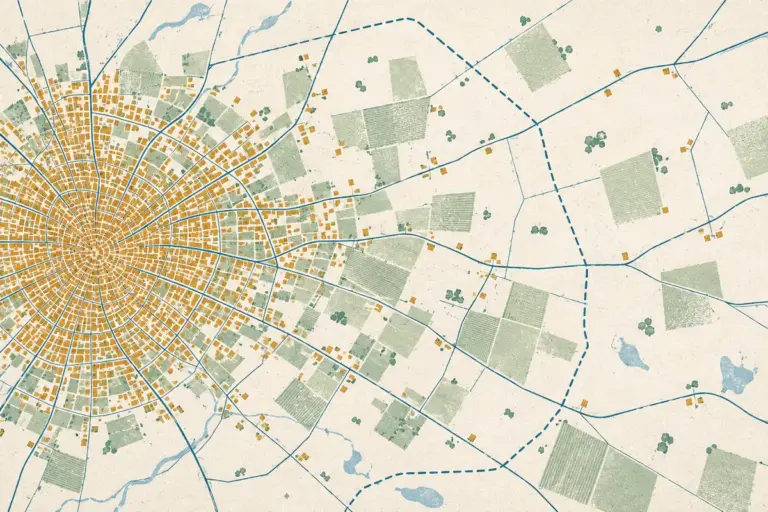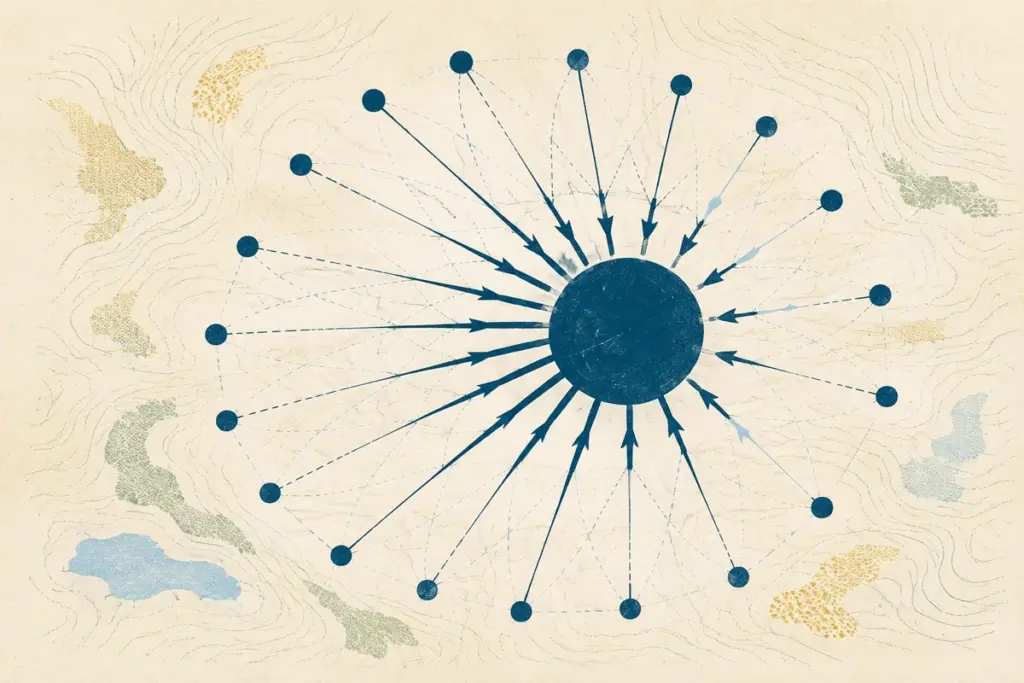
Growth pole theory begins from an observation that ordinary economics tends to bury: growth does not appear everywhere at once. It appears at points, with varying intensity, and it spreads from those points through channels and with effects that differ. François Perroux wrote that sentence in 1955, and the whole of regional development policy since has been an argument about the second half of it.
The idea matters for India because every industrial and regional policy since the Second Five Year Plan has assumed, in one form or another, that concentrating investment somewhere will eventually benefit everywhere. Whether it does is the question this note is about.
Perroux: a Pole Is Not a Place
The first thing to get right is the one most often got wrong. Perroux was an economist writing about abstract economic space, not about geography. His pole was a propulsive industry, a firm or sector, not a town. It was François Perroux’s followers, principally Jacques Boudeville, who put the idea on a map and made the pole a place.
A propulsive industry has four properties, and an industry lacking any of them will not drive a pole.
- It is large, so its decisions register on the regional economy rather than being absorbed by it.
- It grows faster than the economy around it, so it pulls rather than drifts.
- It is technically advanced, so its presence raises the capability of what surrounds it.
- It has strong linkages, which is what actually transmits the growth.
Linkages: How Growth Is Supposed to Travel
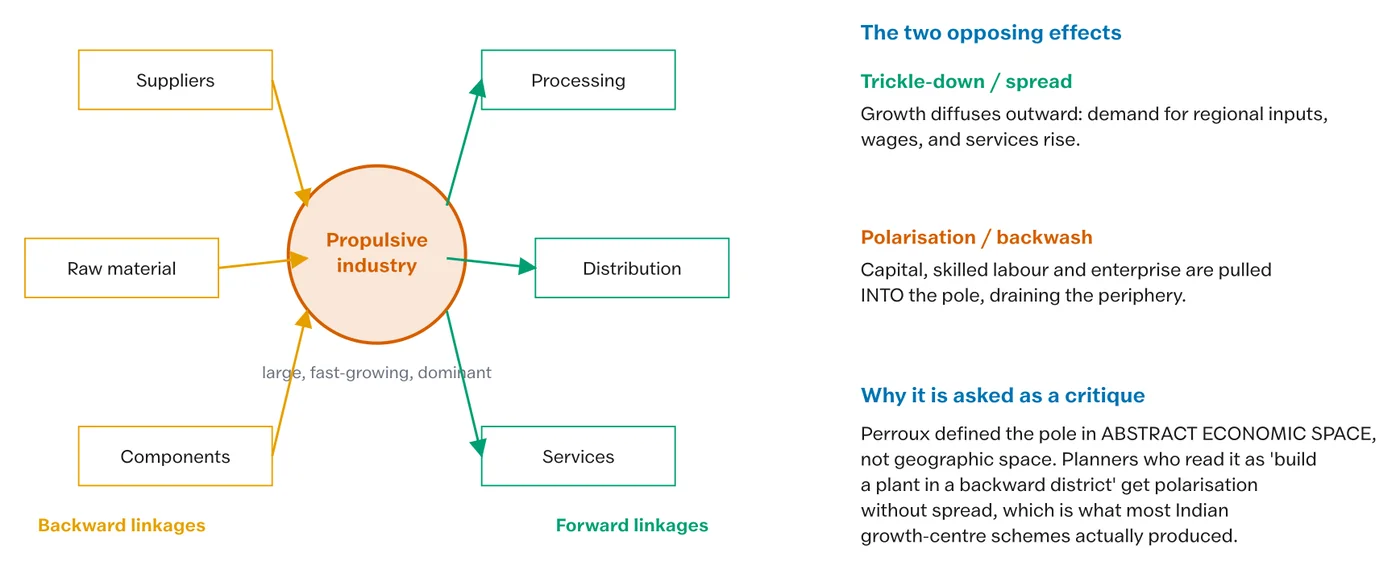
Albert Hirschman supplied the mechanism, and naming his two linkage types is the difference between describing a growth pole and explaining one.
- Backward linkages run to the suppliers. A steel plant creates demand for ore, coke, limestone, refractories, transport and maintenance, and firms appear to meet it.
- Forward linkages run to the users. That same steel makes fabrication, engineering, shipbuilding and construction possible downstream.
A third channel is induced demand: wages paid at the pole are spent on housing, food, schooling and services, which supports an economy having nothing to do with the propulsive industry itself. The strength of these three channels decides whether a pole develops a region or merely occupies it.
Polarisation Against Trickle Down
Perroux was clear that a pole does two opposing things at once, and the balance between them is the whole argument.
| Effect | What it does | Typical outcome |
|---|---|---|
| Polarisation | Draws capital, skilled labour, enterprise and public investment inward from the surrounding region | Concentration intensifies; the periphery is drained of exactly what it needs to develop |
| Trickle down | Transmits growth outward through linkages, wages and demand for regional produce | The surrounding region benefits, but usually later and less than the policy assumed |
Perroux’s own judgement, and the empirical record since, is that polarisation usually dominates in the short and medium term. That is not an argument against growth poles; it is an argument against expecting them to correct regional imbalance on their own.
Myrdal and the Reason Imbalance Persists
Gunnar Myrdal gave the same pair of effects different names and a much stronger theory to sit in. His terms are backwash for the inward drain and spread for the outward benefit, and his contribution is the argument for why the first ordinarily beats the second.
That argument is circular and cumulative causation. An initial advantage, whether a port, a coalfield or an administrative decision, attracts investment. Investment raises incomes and skills, which attracts more investment. Meanwhile the region losing its capital and its ablest workers becomes less attractive still, so it loses more. Each round reinforces the last.
Convergence is not the default outcome of market forces. Divergence is, unless something intervenes.
This is why Myrdal is the more useful theorist for Indian regional policy. The equilibrium models predict that returns to capital will eventually fall in the core and rise in the periphery, drawing investment outward. Myrdal explains why that has not happened between, say, western Maharashtra and Vidarbha over 60 years.
Hirschman, and the Case for Deliberate Imbalance
Albert Hirschman drew the opposite policy conclusion from very similar mechanics, and the contrast is worth holding because it is the standard comparison question.
- Myrdal: cumulative causation makes divergence self-sustaining, so the state must intervene deliberately and continuously to counter backwash.
- Hirschman: a developing economy cannot afford balanced growth everywhere, so it should invest at points and let the resulting shortages and bottlenecks signal where investment is needed next. Imbalance is the engine, not the failure.
Hirschman also expected the political process to correct excessive concentration, since a neglected region votes. Whether that mechanism works is an empirical question, and in India it plainly works slowly and unevenly.
Boudeville and the Geographical Pole
Jacques Boudeville translated Perroux’s economic space into geographic space and defined three kinds of region that are worth naming precisely, because the third is what a growth pole is meant to create.
- A homogeneous region is uniform in some chosen characteristic, such as a cropping pattern or a soil type.
- A polarised or nodal region is defined by flows toward a centre rather than by uniformity, such as a market area or a commuter belt.
- A planning region is a unit defined for the purpose of applying a policy, and it need match neither of the other two.
The Indian Record
India adopted growth pole thinking early and applied it repeatedly, which makes the record unusually informative.
- The public sector steel plants of the Second and Third Plans, at Bhilai, Rourkela, Durgapur and Bokaro, are textbook propulsive industries placed deliberately in backward mineral-bearing regions.
- The growth centre scheme and the later backward area incentives extended the logic to smaller towns.
- Special Economic Zones and the industrial corridors continue it, with the pole now defined by policy and infrastructure rather than by a single plant.
The outcome is mixed in an instructive way. The steel towns did generate backward and forward linkages and did create local employment. What they largely failed to do was transform their surrounding rural regions, because the linkages ran to other industrial centres rather than to the villages next door, and because the skilled jobs were filled by migrants while the displaced were mostly not.
That last point is the sharpest criticism available, and it is a distributional one: a growth pole can succeed as an industrial project and fail as a regional development project at the same time, and Indian experience shows both outcomes occurring together in the same place.
The Standing Criticisms
- The theory is vague about the mechanism of spread. It asserts that growth transmits, without specifying how far, how fast or under what conditions.
- It underestimates polarisation in practice, as Myrdal argued and as the record confirms.
- It assumes a receptive hinterland. Where the surrounding region lacks skills, credit and connectivity, there is nothing for the growth to attach to.
- It has an enclave problem. A capital-intensive plant in a poor agrarian region often produces an island with a different wage structure and workforce, connected to the national economy and disconnected from its immediate surroundings.
- It ignores displacement, which is the cost borne by exactly the population the pole was meant to help.
What is a growth pole in simple terms?
It is a concentration of fast-growing, technically advanced, strongly linked industry whose expansion is expected to drive growth in the region around it. Perroux defined it as a propulsive industry in economic space; later writers placed it on a map and made it a town.
Who gave the growth pole theory?
François Perroux, in 1955. Jacques Boudeville gave it a geographical form, Albert Hirschman supplied the linkage mechanism, and Gunnar Myrdal supplied the account of why the effects are usually unequal.
What is the difference between polarisation and trickle down?
Polarisation is the pole drawing capital, skilled labour and enterprise inward from its region. Trickle down is growth transmitting outward through linkages, wages and demand. Perroux held that polarisation usually dominates in the short and medium term.
What is circular and cumulative causation?
Myrdal’s argument that an initial advantage reinforces itself. Investment raises incomes and skills, which attracts more investment, while the region losing capital and skilled labour becomes less attractive and loses more. Each round compounds the last, so divergence rather than convergence is the default.
How do Myrdal and Hirschman differ?
They describe similar mechanics and draw opposite policy conclusions. Myrdal holds that divergence is self-sustaining and requires continuous state intervention. Hirschman holds that a developing economy should invest at points deliberately, because the resulting bottlenecks signal where to invest next.
Were India’s growth poles successful?
Partly. The public sector steel towns generated real linkages and local employment. They largely failed to transform their surrounding rural regions, because the linkages ran to other industrial centres rather than to nearby villages, and because skilled jobs went to migrants while displacement fell on local populations.
Practice Questions
Prelims
1. A propulsive industry, in Perroux’s sense, is characterised by all of the following EXCEPT
- (a) large size relative to the regional economy
- (b) a growth rate above the regional average
- (c) strong backward and forward linkages
- (d) a location in a densely populated metropolitan area
Answer: (d)
2. Backwash and spread effects were formulated by
- (a) François Perroux
- (b) Albert Hirschman
- (c) Gunnar Myrdal
- (d) Jacques Boudeville
Answer: (c)
3. A polarised region is defined by
- (a) uniformity in a chosen characteristic
- (b) flows converging on a node
- (c) an administrative boundary
- (d) a single dominant crop
Answer: (b)
4. Backward linkages from a steel plant would include demand for
- (a) shipbuilding
- (b) construction
- (c) coking coal and refractories
- (d) consumer durables
Answer: (c)
5. Hirschman’s argument for unbalanced growth rests on the claim that
- (a) balanced growth is politically impossible
- (b) bottlenecks signal where to invest next
- (c) polarisation does not occur
- (d) market forces produce convergence
Answer: (b)
Mains
- Define a growth pole and distinguish it from a growth centre. (10 marks)
- Explain the role of backward and forward linkages in transmitting growth from a propulsive industry. (10 marks)
- “Polarisation usually outweighs trickle down.” Examine this proposition with reference to Indian industrial location. (15 marks)
- Compare Myrdal’s and Hirschman’s accounts of regional imbalance and their differing policy implications. (15 marks)
- Critically evaluate the growth pole strategy as an instrument of balanced regional development in India. (20 marks)
Tell Google you want more of this.
Add Anantam IAS as a preferred sourceOne tap, and this site shows up more often in your own Top Stories, AI Overviews and AI Mode. Remove it any time.