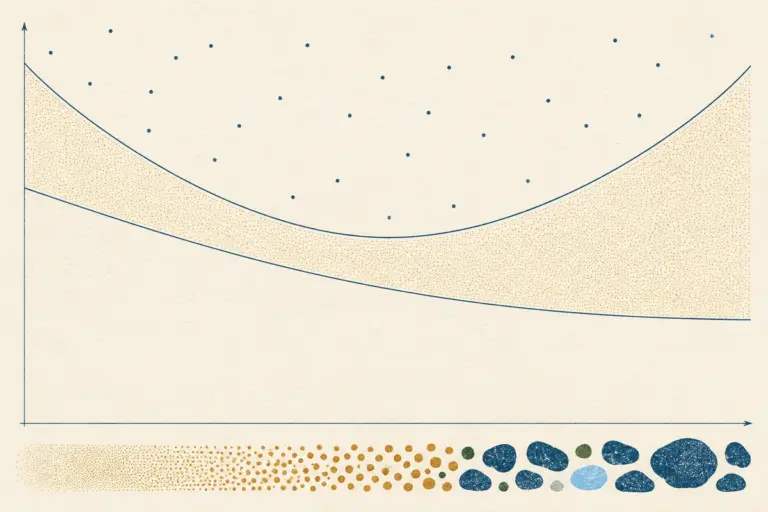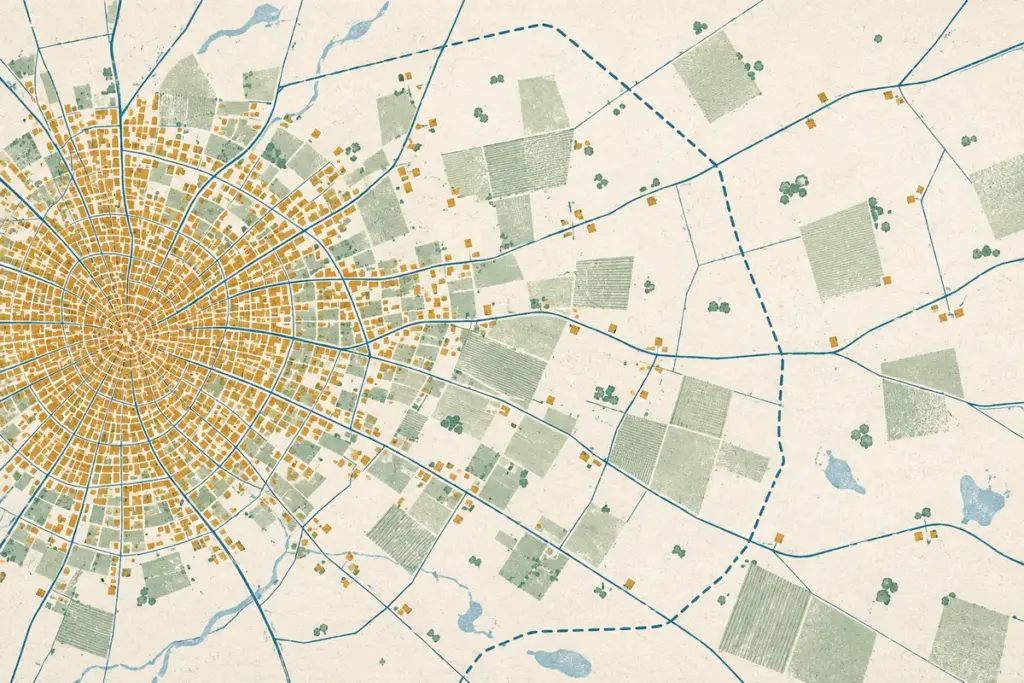
Over-urbanisation, under-urbanisation and peri-urbanisation are three ways a country’s urban growth can fail to match its economy, and India shows all three at once in different places. They are relational terms rather than thresholds: none of them can be read off a percentage. What each compares urban population against is the whole content of the concept.
The Three Conditions
| Term | Urban population compared against | Symptom |
|---|---|---|
| Over-urbanisation | What the urban economy can employ | A surplus appearing as informal work and slum housing rather than as measured unemployment |
| Under-urbanisation | The level of industrialisation | Industry grows without drawing population into cities in proportion; the socialist economies of eastern Europe were the classic case |
| Peri-urbanisation | The administrative boundary of the city | Urban land use spreading past the municipal limit, with urban services absent and urban regulation weak |
How India Counts Its Towns
Before any of this can be measured, the definition matters, and India’s is unusual.
- A statutory town has a notified urban local body: a municipal corporation, municipality, cantonment board or notified town area committee. Its status is administrative and takes no account of its demographic character.
- A census town has no urban local body but meets three demographic criteria together: at least 5,000 people, at least 75 per cent of male main workers in non-agricultural work, and a density of at least 400 per square kilometre.
- An outgrowth is a clearly identifiable settlement adjoining a statutory town, urban in character, counted with it in the urban agglomeration.
The consequence is the single most important fact about recent Indian urbanisation. Census towns nearly tripled between 2001 and 2011, from about 1,360 to about 3,890. A large share of the decade’s urban growth therefore came from reclassification rather than from migration or natural increase: places that were already becoming urban were finally counted as such.
Those places have urban populations and rural governance. They are administered by panchayats, funded on rural norms and planned by nobody, and that mismatch is where much of India’s urban service deficit actually sits.
Is India Over-Urbanised?
The honest answer is that the question is usually asked wrongly. India’s urban share, around 31 per cent at Census 2011, is low for its income level, so by the conventional comparison India is under-urbanised rather than over-urbanised.
What India has instead is a distributional problem. Growth concentrates in a small number of very large agglomerations while the small and medium towns that should absorb it stagnate for want of investment. So the accurate statement is:
India is under-urbanised in aggregate and over-urbanised at its largest nodes. Both are true because they are measured against different things.
The Peri-Urban Zone
The rural-urban fringe is the transition zone beyond the built-up edge where urban and rural land uses interleave and change is fastest. Because it has no administrative boundary, it has to be delimited by measurement rather than looked up, using land use mix, commuting share, land price gradient or population density.
Four processes characterise it, and they compound one another.
- Land conversion from agriculture to housing, industry and warehousing, usually informally and ahead of any plan.
- Speculation, which withdraws land from cultivation long before it is built on, so the zone contains a great deal of idle land.
- A services gap. Water, sewerage, drainage and solid waste collection are designed for the municipal area and stop at its edge, while the population does not.
- A governance gap. The panchayat lacks the capacity and the finance for urban infrastructure; the municipal body lacks the jurisdiction.
The result is the characteristic Indian peri-urban landscape: unplanned layouts, private borewells, septic tanks, no storm drainage, and land whose price reflects its future use rather than its present one.
Generative and Parasitic Towns
Bert Hoselitz’s distinction remains the sharpest way to ask whether a town is worth having for the region around it.
- A generative town raises the income and productivity of its hinterland, by supplying markets for its produce, services, processing capacity and employment.
- A parasitic town extracts rent, revenue and labour from its hinterland without returning a comparable stimulus.
The distinction is not fixed: a town can be generative for one activity and parasitic for another, and colonial port cities were characteristically generative for export agriculture and parasitic for everything else. It remains a useful test of a growth centre policy, because a centre that fails it is simply concentrating poverty in a new place.
Why the Distinctions Matter for Policy
- Reclassification is not investment. A census town’s population is counted as urban the day the criteria are met, but no municipal finance follows. Recognising them as statutory towns is the single cheapest urban reform available.
- The fringe needs a planning authority before it needs infrastructure. Building services into a zone with no land-use control simply raises the value of unauthorised layouts.
- Small and medium towns are the missing middle. If growth is to be diverted from the largest agglomerations, the towns that should receive it need the capacity to absorb it, and at present most do not.
What is over-urbanisation?
A condition in which the urban population exceeds what the urban economy can employ, so the surplus appears as informal work and slum housing rather than as measured unemployment. It is a relation between population and economy, not a percentage threshold.
What is the difference between a statutory town and a census town?
A statutory town has a notified urban local body such as a municipality or cantonment board, irrespective of its demographic character. A census town has no urban local body but meets three criteria: at least 5,000 people, at least 75 per cent of male main workers in non-agricultural work, and a density of at least 400 per square kilometre.
Why did India’s urban population rise sharply between 2001 and 2011?
Largely through reclassification. Census towns nearly tripled from about 1,360 to about 3,890, so a large share of the decade’s urban growth came from places already becoming urban finally being counted, rather than from migration or natural increase.
Is India over-urbanised?
In aggregate, no. India’s urban share is low for its income level, which is under-urbanisation. The accurate statement is that India is under-urbanised in aggregate and over-urbanised at its largest agglomerations, because the two are measured against different things.
What is the rural-urban fringe?
The transition zone beyond a town’s built-up edge where urban and rural land uses interleave and change is fastest. Having no administrative boundary, it must be delimited by measurement using land use mix, commuting share, land price gradient or density.
What is the difference between a generative and a parasitic town?
Hoselitz’s distinction. A generative town raises the income and productivity of its hinterland through markets, services, processing and employment. A parasitic town extracts rent, revenue and labour without returning a comparable stimulus.
Practice Questions
Prelims
1. A census town in India must have a male main worker share in non-agricultural activity of at least
- (a) 50 per cent
- (b) 60 per cent
- (c) 75 per cent
- (d) 90 per cent
Answer: (c)
2. Under-urbanisation describes a situation where the urban population is small relative to
- (a) total area
- (b) the level of industrialisation
- (c) the birth rate
- (d) the number of villages
Answer: (b)
3. An outgrowth in census usage is
- (a) a slum within a municipal area
- (b) a settlement adjoining a statutory town, counted with it
- (c) a village converted to a town
- (d) a planned satellite township
Answer: (b)
4. The distinction between generative and parasitic towns was made by
- (a) Mark Jefferson
- (b) Bert Hoselitz
- (c) Ashok Mitra
- (d) Patrick Geddes
Answer: (b)
5. The principal governance problem of the peri-urban zone is that
- (a) it has too many municipal bodies
- (b) the panchayat lacks urban capacity and the municipality lacks jurisdiction
- (c) it is uninhabited
- (d) it lies outside the state
Answer: (b)
Mains
- Distinguish between over-urbanisation and under-urbanisation with examples. (10 marks)
- Explain the difference between statutory towns and census towns, and the significance of the growth in the latter. (15 marks)
- Describe the processes at work in the rural-urban fringe and the problems they create. (15 marks)
- “India is under-urbanised in aggregate and over-urbanised at its largest nodes.” Examine. (20 marks)
- Assess the relevance of the generative-parasitic distinction to India’s growth centre policy. (20 marks)
Tell Google you want more of this.
Add Anantam IAS as a preferred sourceOne tap, and this site shows up more often in your own Top Stories, AI Overviews and AI Mode. Remove it any time.