Disclosure: this guide contains Amazon affiliate links. As an Amazon Associate, Anantam IAS earns from qualifying purchases — at no extra cost to you.
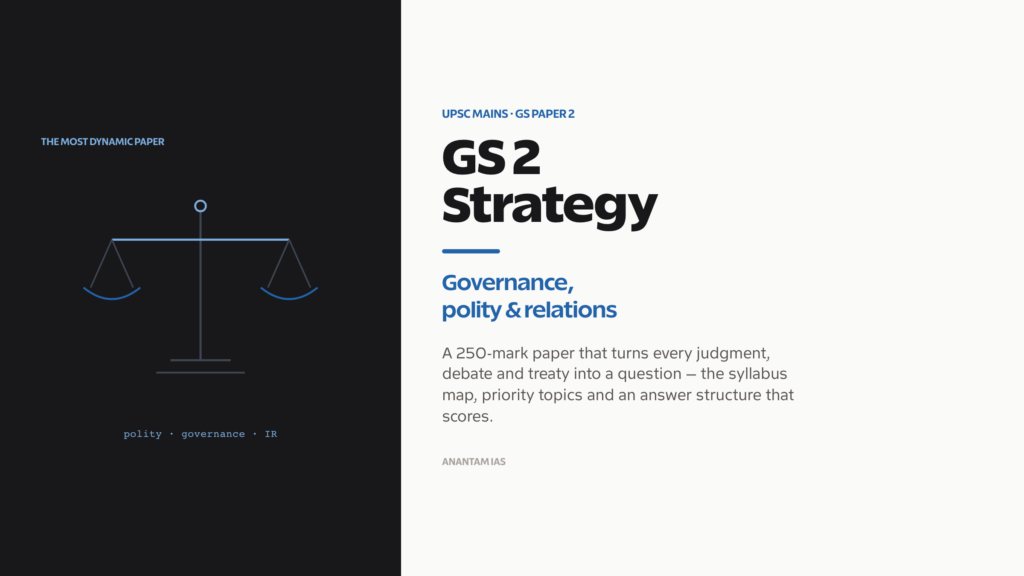
UPSC Mains GS 2 Strategy: Governance & Polity
GS Paper 2 is the most dynamic paper in the UPSC Mains — it tests governance, the Constitution, social justice, and international relations through the lens of current developments. The paper carries 250 marks with 20 questions, and scoring well requires blending constitutional knowledge with contemporary governance analysis. Every Supreme Court judgment, parliamentary debate, and diplomatic development becomes potential question material.
This paper rewards candidates who read newspapers analytically and can connect institutional frameworks to real-world governance challenges.
GS 2 Syllabus: The Complete Map
Section-Wise Breakdown
| Section | Topics | Weightage |
|---|---|---|
| Indian Constitution & Polity | Constitutional provisions, amendments, basic structure, fundamental rights | 25–30% |
| Governance | Government policies, e-governance, transparency, accountability | 20–25% |
| Social Justice | Welfare schemes, health, education, vulnerable sections | 15–20% |
| International Relations | India’s foreign policy, bilateral/multilateral relations, international organizations | 20–25% |
| Statutory/Constitutional Bodies | Regulatory bodies, quasi-judicial institutions | 10–15% |
Key Syllabus Topics in Detail
Constitution and Polity:
- Functions and responsibilities of the Union and States
- Parliament and State Legislatures — structure, functioning, conduct of business
- Executive and Judiciary — structure, organization, functioning
- Separation of powers, dispute redressal mechanisms
- Comparison of Indian constitutional scheme with other countries
- Representation of People’s Act
Governance:
- Government policies and interventions in various sectors
- Development processes and the development industry — NGOs, SHGs
- Important aspects of governance, transparency, and accountability
- E-governance — applications, models, successes, limitations
- Role of civil services in a democracy
Social Justice:
- Welfare schemes for vulnerable sections
- Issues relating to development and management of social sector/services
- Mechanisms, laws, institutions for protection of vulnerable sections
International Relations:
- India and its neighborhood relations
- Bilateral, regional, and global groupings involving India
- Effect of policies and politics of developed/developing countries on India’s interests
- Important international institutions, agencies, and forums
Indian Constitution: Salient Features & Preamble
Subject-Wise Preparation Approach
Indian Constitution and Polity
Laxmikanth’s “Indian Polity” remains the bible. But for Mains, reading Laxmikanth isn’t enough — understanding the spirit behind constitutional provisions and their contemporary application is essential.
Preparation Layers:
- Laxmikanth — Complete reading with focus on chapters on Parliament, Executive, Judiciary, Federalism
- D.D. Basu — For deeper understanding of constitutional law (selective reading)
- Subhash Kashyap — “Our Parliament” for legislative processes
- Current Affairs — Every SC judgment, amendment, and governance reform
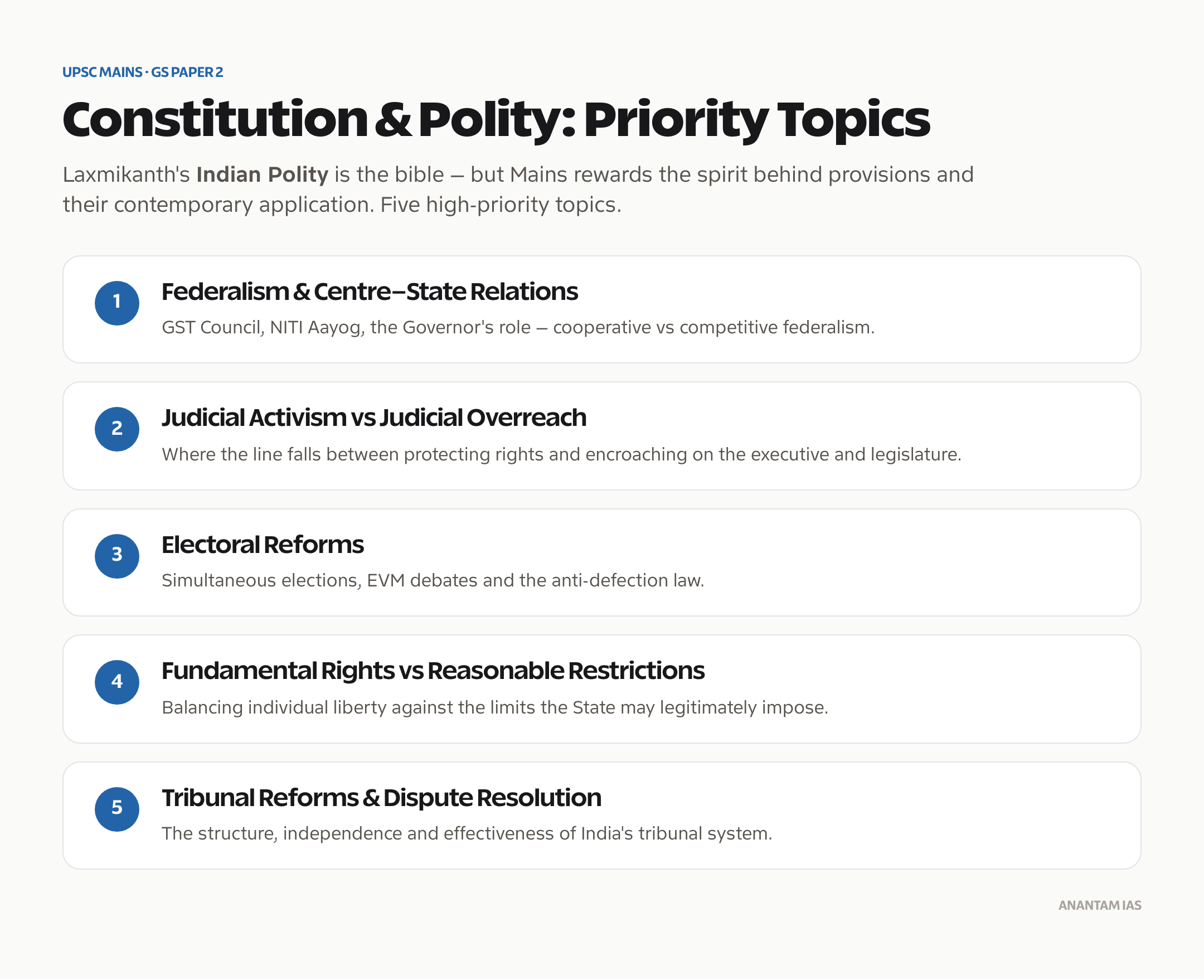
High-Priority Topics:
- Federalism and Centre-State relations (GST Council, NITI Aayog, Governor’s role)
- Judicial activism vs judicial overreach
- Electoral reforms (simultaneous elections, EVM debates, anti-defection law)
- Fundamental rights vs reasonable restrictions
- Tribunal reforms and dispute resolution
Governance and E-Governance
This section requires knowledge of government schemes, institutional mechanisms, and governance models.
| Topic Area | What to Study |
|---|---|
| Government Schemes | Major flagship programs (PM-JAY, DBT, JAM trinity) |
| E-Governance | Digital India, Aadhaar, UPI, e-courts, DigiLocker |
| Transparency | RTI Act, Lokpal, whistleblower protection |
| Accountability | CAG, parliamentary committees, social audit |
| Civil Services Reform | Lateral entry, performance evaluation, training |
Key Resources:
- Second Administrative Reforms Commission (ARC) reports
- NITI Aayog reports and strategy documents
- Economic Survey chapters on governance
- PRS Legislative Research for bill analysis
Social Justice
Questions here test understanding of welfare architecture and its effectiveness. Knowledge of specific schemes, their coverage, and implementation challenges is essential.
Focus Areas:
- Education: NEP 2020, RTE Act, Samagra Shiksha
- Health: Ayushman Bharat, National Health Mission, health infrastructure
- Women: POSH Act, Beti Bachao Beti Padhao, women’s reservation
- SC/ST/OBC: Reservation policy, NCSC, NCST, atrocities act
- Children: POCSO, juvenile justice, child labor laws
- Elderly and Disabled: Rights of Persons with Disabilities Act, old age pension
Right to Education Act (RTE): Article 21A Explained
International Relations
IR questions demand familiarity with India’s foreign policy doctrine, neighborhood relations, and global governance structures.
Preparation Framework:
| Region/Theme | Key Topics |
|---|---|
| Neighborhood | India-China (LAC, trade), India-Pakistan (Kashmir, terrorism), India-Sri Lanka, India-Bangladesh |
| Major Powers | India-US (QUAD, defence), India-Russia (legacy, energy), India-EU (trade) |
| Regional Groups | SAARC, BIMSTEC, ASEAN, SCO |
| Global Forums | UN (UNSC reform), G20 (India’s presidency), WTO |
| Themes | Indo-Pacific strategy, climate diplomacy, nuclear doctrine, diaspora diplomacy |
Resources:
- Rajiv Sikri — “India’s Foreign Policy” (for doctrinal understanding)
- MEA website (for bilateral relations and treaties)
- IDSA/ORF publications (for analysis)
- Newspapers (The Hindu, Indian Express IR coverage)
India’s Foreign Policy: Principles & Key Relations
Answer Writing Strategy for GS 2
GS 2 Answer Characteristics
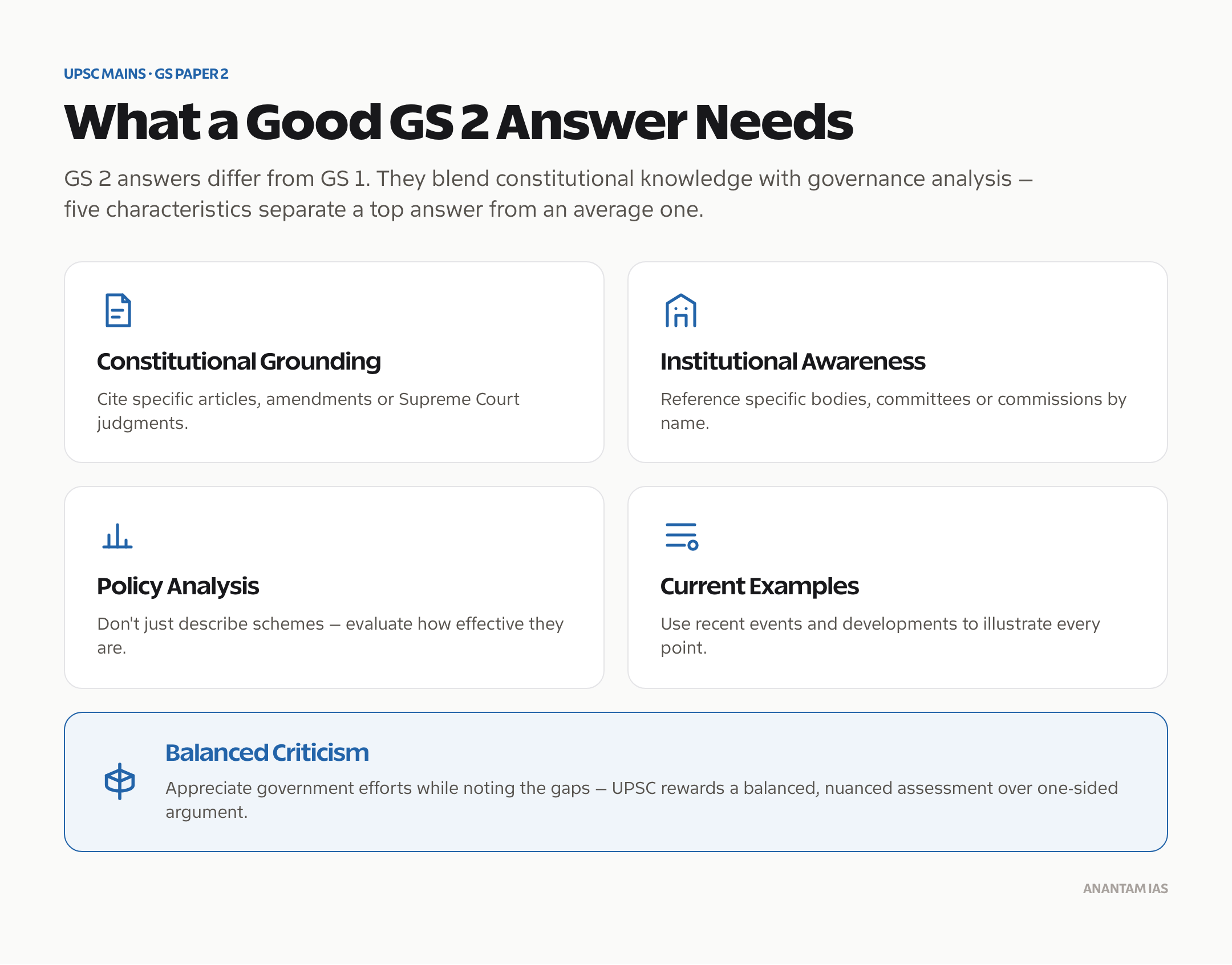
GS 2 answers differ from GS 1. They need:
- Constitutional grounding — Cite specific articles, amendments, or Supreme Court judgments
- Institutional awareness — Reference specific bodies, committees, or commissions
- Policy analysis — Not just describe schemes but evaluate their effectiveness
- Current examples — Use recent events to illustrate points
- Balanced criticism — Appreciate government efforts while noting gaps
Answer Structure for Different Question Types
“Discuss the role of…” questions:
- Define the institution/mechanism (1–2 lines)
- Constitutional/legal mandate
- Key functions with examples
- Challenges and limitations
- Way forward
“Critically analyze…” questions:
- Brief context
- Arguments in favor (with evidence)
- Arguments against (with evidence)
- Balanced assessment
- Reform suggestions
IR questions:
- Historical context of the relationship
- Areas of cooperation
- Areas of friction
- Recent developments
- Way forward for India
Using SC Judgments Effectively
Citing Supreme Court judgments elevates GS 2 answers significantly. Maintain a running list:
| Judgment | Relevance |
|---|---|
| Kesavananda Bharati (1973) | Basic structure doctrine |
| Maneka Gandhi (1978) | Expanded Article 21 |
| Vishaka (1997) | Sexual harassment at workplace |
| Puttaswamy (2017) | Right to privacy |
| Navtej Johar (2018) | Section 377, LGBTQ rights |
| Indian Young Lawyers (2018) | Sabarimala, religious practices |
PYQ Trends in GS 2 (2019–2025)
| Area | Trend |
|---|---|
| Polity | Increasing focus on federalism, judicial reforms, electoral processes |
| Governance | More questions on e-governance, citizen-centric services, accountability |
| Social Justice | Growing emphasis on healthcare and education policy effectiveness |
| IR | China relations, Indo-Pacific, multilateral diplomacy dominant |
| New Themes | Data governance, social media regulation, pandemic governance |
Emerging Focus Areas
- Digital governance and data protection
- Climate diplomacy and green transitions
- Supply chain resilience and economic diplomacy
- Regulatory bodies and their independence
- Cooperative vs competitive federalism
Revision and Practice Schedule
| Activity | Frequency |
|---|---|
| Newspaper analysis (governance/IR focus) | Daily |
| GS 2 answer writing | 3–4 answers daily |
| PYQ topic-wise analysis | Weekly |
| Scheme/policy fact sheet revision | Weekly |
| IR developments compilation | Fortnightly |
| Full-length GS 2 mock test | Monthly |
Quick-Reference Preparation
Create one-pagers for:
- All constitutional bodies and their composition
- Major SC judgments (last 5 years)
- India’s relations with 10 key countries
- 15 major government schemes (with targets and outcomes)
- Key governance reform recommendations (ARC reports)
Frequently Asked Questions
Is Laxmikanth sufficient for GS 2 Mains?
Laxmikanth provides the constitutional foundation — essential but not sufficient. For Mains, supplement with current affairs analysis, SC judgments, government reports, and institutional critiques. Laxmikanth gives the u0022whatu0022; GS 2 Mains demands the u0022so whatu0022 and u0022what next.u0022
How to cover international relations for GS 2?
Follow a three-layer approach: understand India’s foreign policy doctrine (non-alignment to multi-alignment), study bilateral relations with 10–12 key countries, and track current diplomatic developments through newspapers. MEA press releases and monthly IR compilations from standard sources complete the preparation.
What’s the best way to write about government schemes?
Avoid writing scheme descriptions as promotional content. Instead, state the objective briefly, mention key features, then focus on implementation challenges, outcome data, and reform suggestions. An answer that says u0022PM-JAY covers 50 crore beneficiaries but faces challenges in provider empanelment and fraud preventionu0022 scores higher than a description of benefits.
How important is the Second ARC report for GS 2?
The Second Administrative Reforms Commission’s 15 reports cover ethics, RTI, local governance, disaster management, and more — making them directly relevant to GS 2 and GS 4. Reading the key recommendations (not the full reports) is highly valuable. Many model answers cite ARC recommendations.
Should GS 2 answers include global comparisons?
Yes, when relevant. Comparing India’s federal structure with the US or Australia, referencing the UK’s NHS when discussing healthcare policy, or mentioning Singapore’s e-governance model adds analytical depth. Keep comparisons brief (2–3 lines) and relevant.
Tell Google you want more of this.
Add Anantam IAS as a preferred sourceOne tap, and this site shows up more often in your own Top Stories, AI Overviews and AI Mode. Remove it any time.