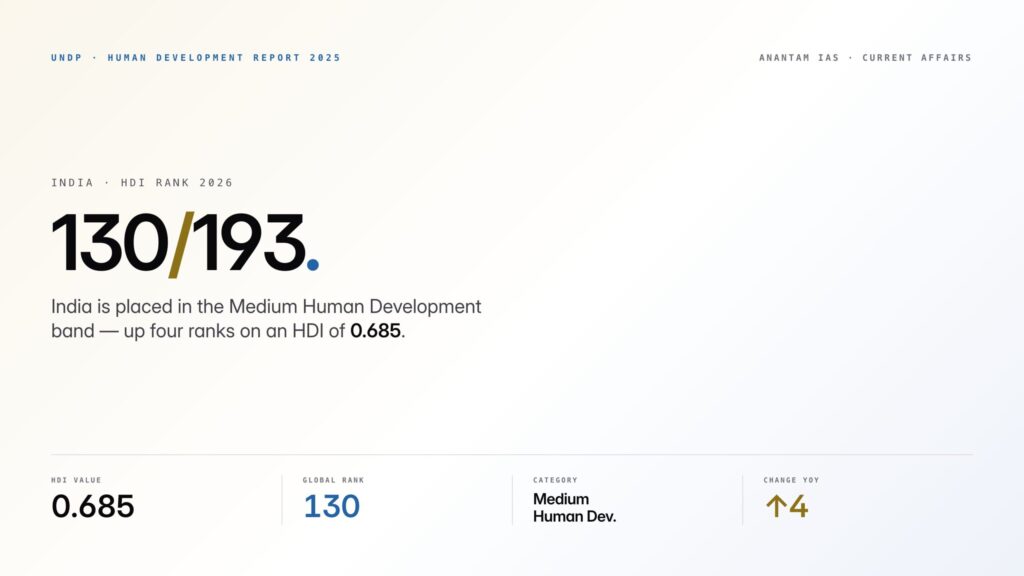
The HDI rank of India — as per the latest Human Development Report (HDR) 2025 released by the United Nations Development Programme (UNDP) in May 2025 — stands at 130 out of 193 countries and territories. India's HDI value is 0.685, placing the country in the "Medium Human Development" category. The 2025 report, titled "A Matter of Choice: People and Possibilities in the Age of AI", assesses data for the reference year 2023 and is the most recent edition guiding policy discussions in 2026.
Is there an HDI 2026 report? Not yet — the UNDP has not released a new Human Development Report in 2026, so India's current HDI rank in 2026 remains 130 of 193 (HDI 0.685) from HDR 2025. The next edition is expected later, and this page is updated as soon as it appears.
The Human Development Index (HDI), conceived by economists Mahbub ul Haq and Amartya Sen, is a composite measure of three dimensions — a long and healthy life, knowledge, and a decent standard of living. It has been published annually by UNDP since 1990.
India's HDI Performance at a Glance
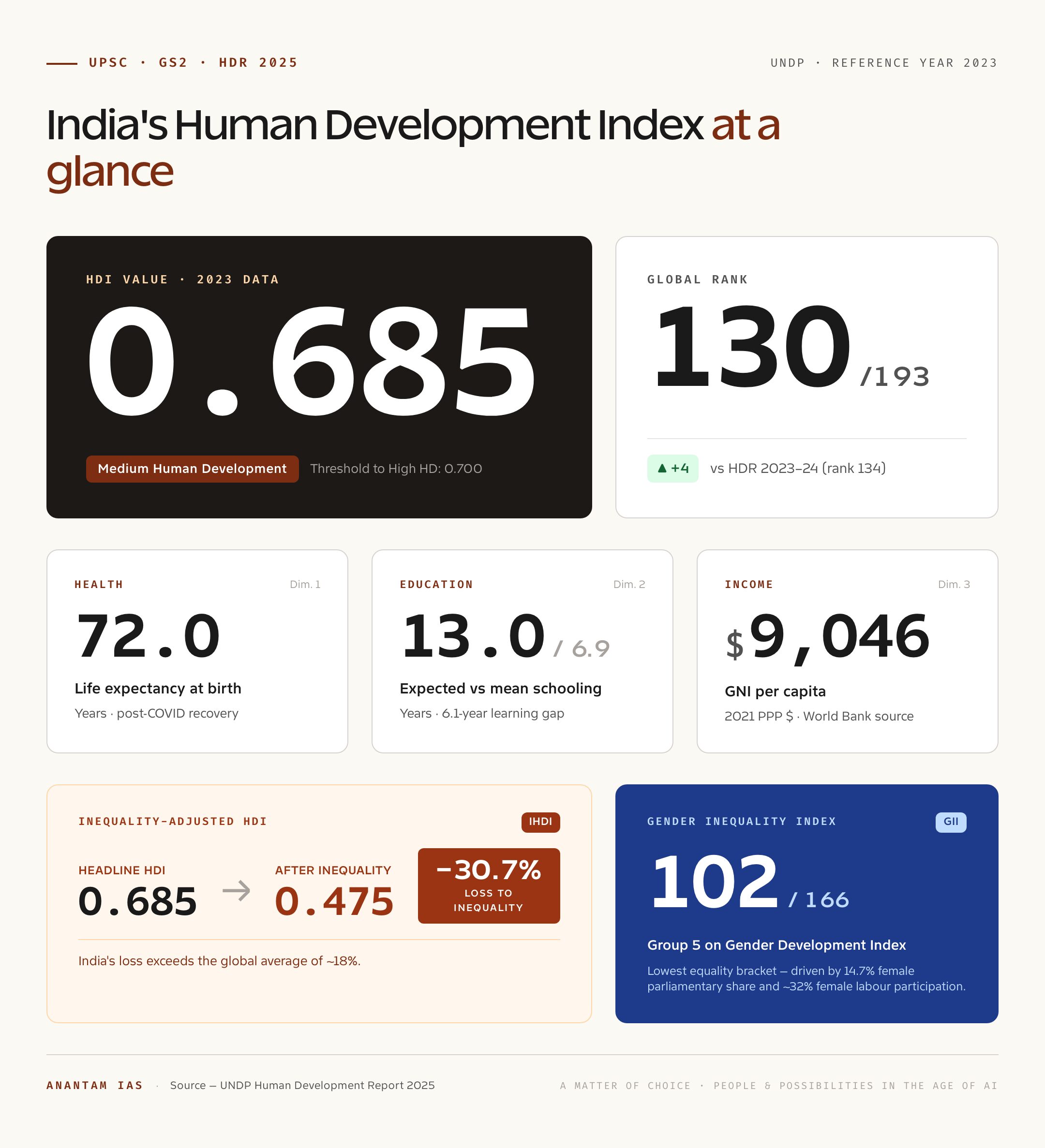
| Indicator | Value (HDR 2025) |
|---|---|
| HDI value | 0.685 |
| HDI rank | 130 out of 193 |
| Category | Medium Human Development |
| Life expectancy at birth | 72.0 years |
| Expected years of schooling | 13.0 years |
| Mean years of schooling | 6.9 years |
| GNI per capita (2021 PPP $) | 9,046 |
| Inequality-Adjusted HDI (IHDI) | 0.475 |
| Loss due to inequality | ~30.7% |
| Gender Inequality Index (GII) rank | 102 out of 166 |
| Gender Development Index (GDI) group | Group 5 (lowest equality) |
India moved up from rank 134 in HDR 2023–24 (HDI 0.644) to rank 130 in HDR 2025 — an improvement driven by gains in life expectancy post-COVID recovery and rising GNI per capita.
The Three Dimensions of HDI
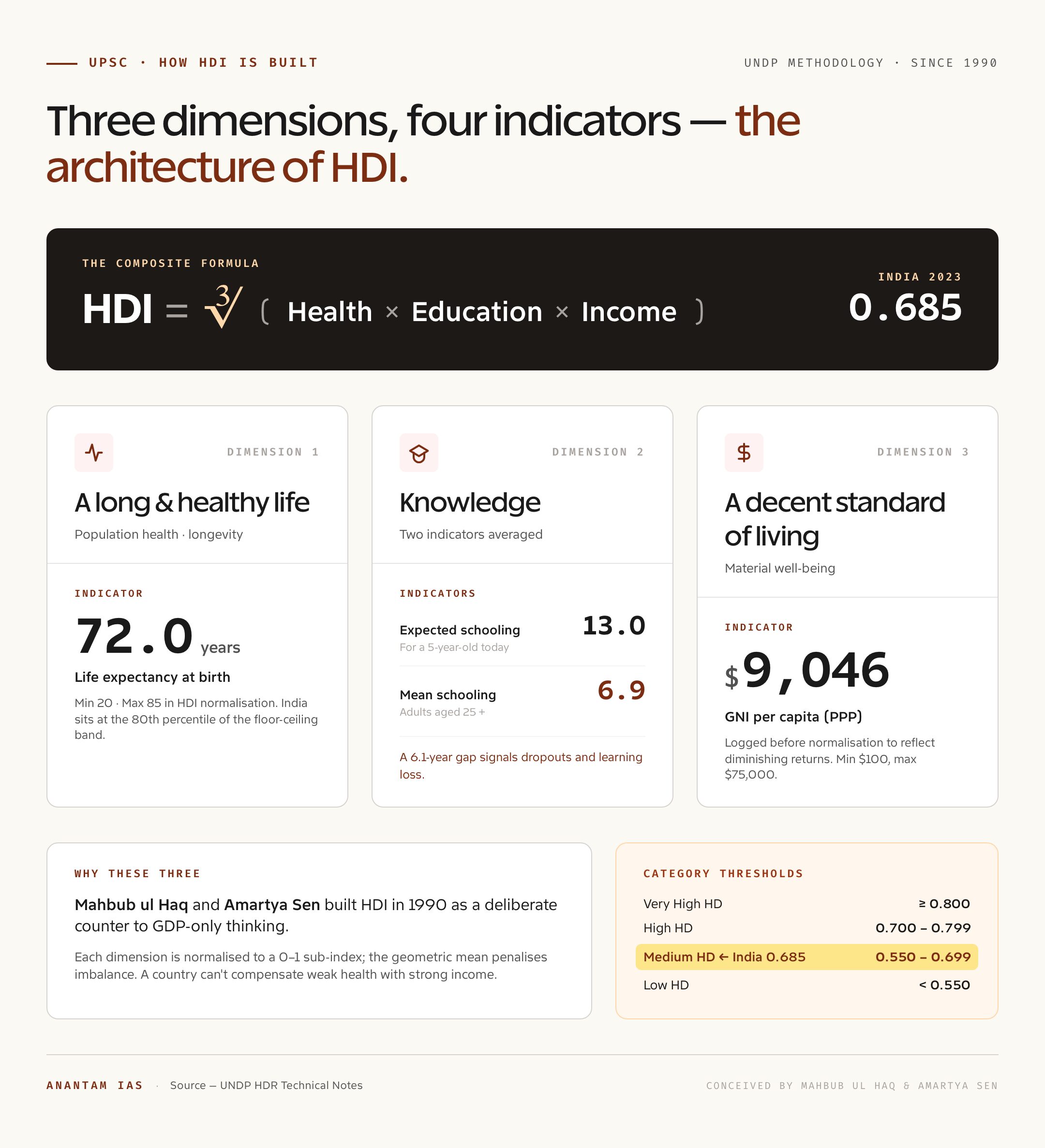
The HDI aggregates four indicators across three dimensions:
1. A Long and Healthy Life
Measured by life expectancy at birth. India's value of 72.0 years reflects steady improvement from ~58 years in 1990.
2. Knowledge
Measured by two indicators:
- Expected years of schooling — years a child entering school today can expect to receive (India: 13.0)
- Mean years of schooling — average years of schooling received by adults aged 25+ (India: 6.9)
3. A Decent Standard of Living
Measured by Gross National Income (GNI) per capita, converted to 2021 Purchasing Power Parity (PPP) dollars — India: $9,046.
The HDI is computed as the geometric mean of the three normalised dimension indices.
HDI Categories
UNDP classifies countries into four tiers:
| Category | HDI Range |
|---|---|
| Very High Human Development | 0.800 and above |
| High Human Development | 0.700 – 0.799 |
| Medium Human Development | 0.550 – 0.699 |
| Low Human Development | Below 0.550 |
India at 0.685 is close to crossing into the "High Human Development" category but has not yet done so.
India vs. South Asian Neighbours (HDR 2025)
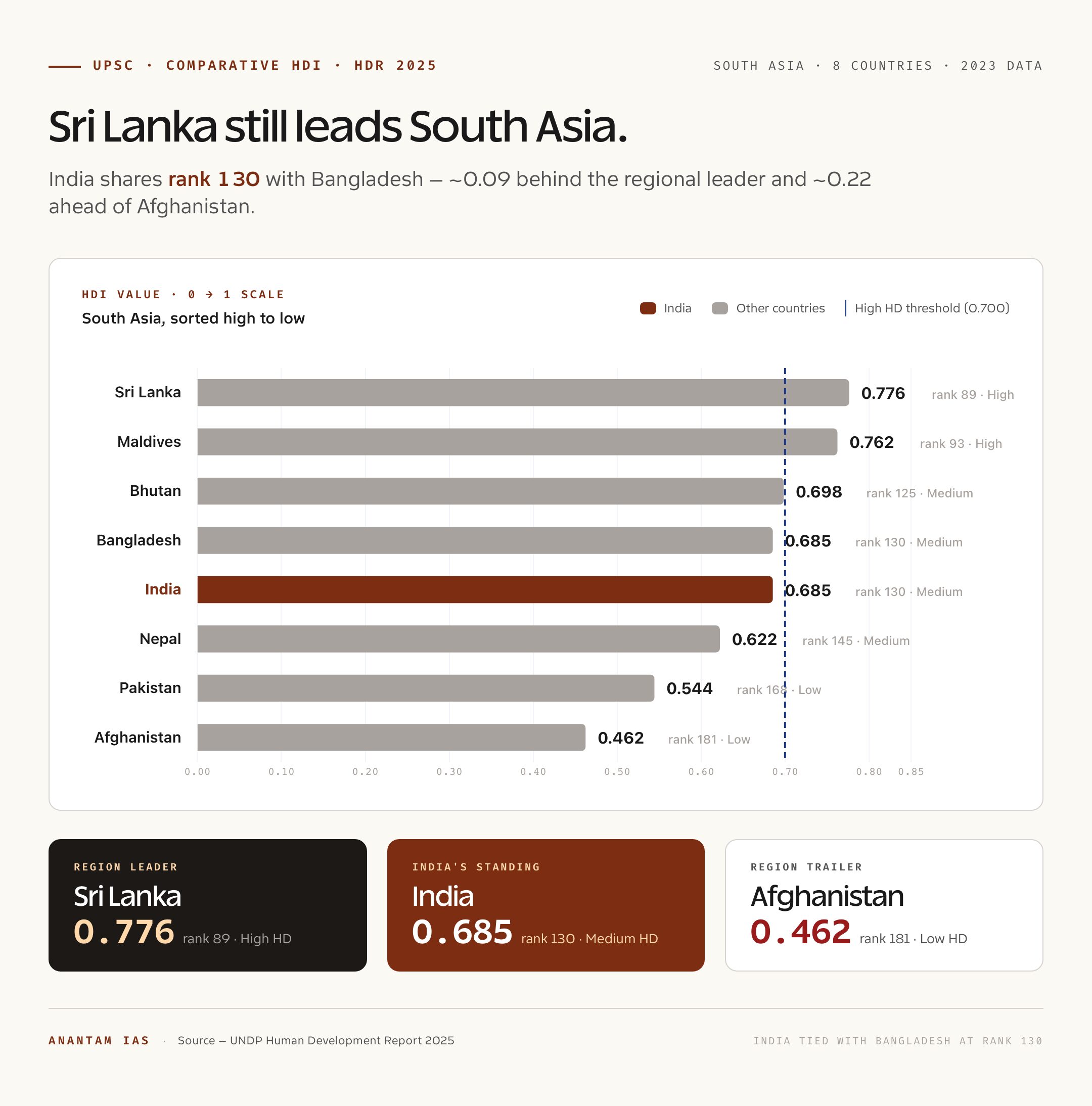
| Country | HDI Value | Global Rank | Category |
|---|---|---|---|
| Sri Lanka | 0.776 | 89 | High |
| Maldives | 0.762 | 93 | High |
| Bhutan | 0.698 | 125 | Medium |
| Bangladesh | 0.685 | 130 | Medium |
| India | 0.685 | 130 | Medium |
| Nepal | 0.622 | 145 | Medium |
| Pakistan | 0.544 | 168 | Low |
| Afghanistan | 0.462 | 181 | Low |
India and Bangladesh share the same HDI value. Sri Lanka continues to lead South Asia on human development metrics.
India's Long-Term HDI Trajectory (1990–2023)
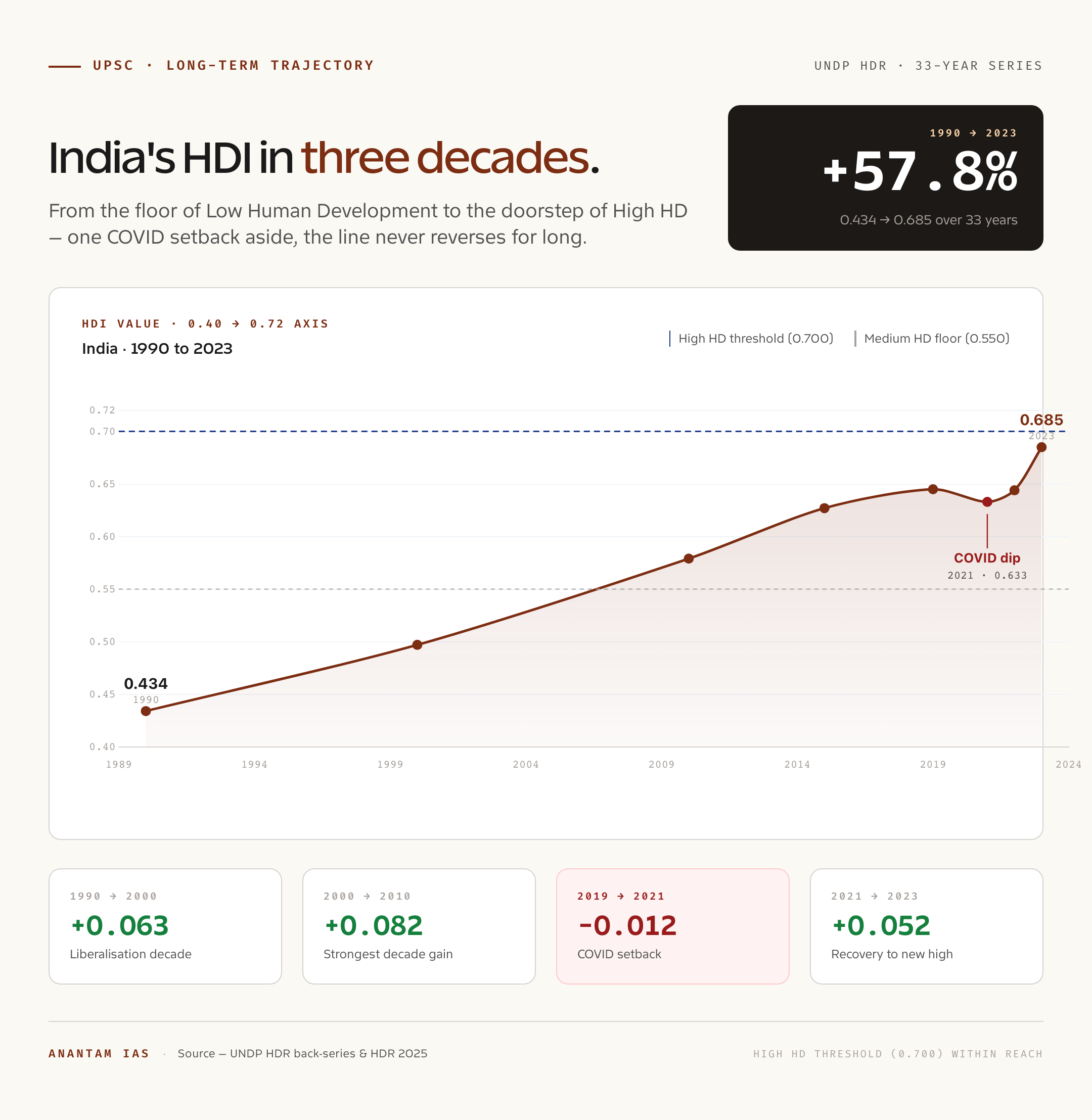
| Year | HDI Value | Change |
|---|---|---|
| 1990 | 0.434 | Baseline |
| 2000 | 0.497 | +0.063 |
| 2010 | 0.579 | +0.082 |
| 2015 | 0.627 | +0.048 |
| 2019 | 0.645 | +0.018 |
| 2021 | 0.633 | -0.012 (COVID impact) |
| 2022 | 0.644 | +0.011 |
| 2023 | 0.685 | +0.041 |
Between 1990 and 2023, India's HDI grew by roughly 58%, one of the fastest improvements among large developing economies. Life expectancy increased by over 14 years, mean years of schooling more than doubled, and GNI per capita grew several-fold.
Inequality-Adjusted HDI (IHDI)
The IHDI discounts the HDI for inequality in each dimension. For India:
- HDI: 0.685
- IHDI: 0.475
- Loss due to inequality: ~30.7%
India's loss is higher than the global average (~18%) and reflects persistent gaps in income, health, and education outcomes.
Gender Inequality Index (GII)
The GII measures gender-based disadvantage across three dimensions — reproductive health, empowerment, and labour market participation. India's GII rank is 102 out of 166, with key indicators:
- Maternal Mortality Ratio: 103 per 100,000 live births
- Adolescent birth rate: 16.3 per 1,000 women aged 15–19
- Female share of parliamentary seats: ~14.7%
- Female labour force participation: ~32% (compared to ~76% for males)
India also falls in Gender Development Index (GDI) Group 5, indicating the largest absolute deviation from gender parity.
Theme of HDR 2025: AI and Human Development
The HDR 2025 focuses on Artificial Intelligence and its implications for human development. Key arguments:
- AI is a general-purpose technology with transformative potential comparable to the steam engine or electricity.
- Outcomes depend on choices — governance, access, skills, and equity — not on technology alone.
- Risks include job displacement, algorithmic bias, digital divides, and concentration of power.
- Opportunities include accelerated health diagnostics, personalised learning, climate modelling, and productivity gains in low-income settings.
- A global AI governance framework anchored in human rights is recommended.
For India, the report flags both opportunity (demographic dividend, large digital public infrastructure like Aadhaar, UPI, DigiLocker) and risk (skill mismatch, platform labour, concentration in a few firms).
Criticisms of the HDI
- Ignores environmental sustainability (addressed partly by the Planetary pressures-adjusted HDI, or PHDI)
- Uses national averages, masking regional, caste, and gender disparities
- Data lags — HDR 2025 uses 2023 data
- Gives equal weight to three dimensions, which may not reflect country priorities
- Does not capture political freedoms, security, or quality of governance
Related UNDP Indices
- IHDI — Inequality-Adjusted HDI
- GII — Gender Inequality Index
- GDI — Gender Development Index
- MPI — Multidimensional Poverty Index (jointly with OPHI)
- PHDI — Planetary pressures-adjusted HDI
Policy Implications for India
- Education quality — India's mean years of schooling (6.9) lags behind its expected years of schooling (13.0), signalling high dropout and poor learning outcomes.
- Female labour force participation — raising it from ~32% would boost both HDI and GDP.
- Health system strengthening — especially in nutrition, maternal health, and non-communicable diseases.
- Inequality reduction — the ~30.7% loss under IHDI suggests that growth is not translating equally into well-being.
- AI-era skilling — aligning NEP 2020, Skill India, and Digital India with frontier technology shifts.
UPSC Relevance
GS2 (International Relations / Social Issues): UNDP reports, comparative human development, welfare indices.
GS3 (Economy): Growth vs. development, inequality, human capital, demographic dividend.
GS1 (Society): Gender inequality, education, health indicators.
Key Prelims facts:
- HDR 2025 released by UNDP in May 2025
- India's HDI value: 0.685
- India's rank: 130 out of 193
- Category: Medium Human Development
- Reference year of data: 2023
- HDI dimensions: Health, Education, Standard of Living
- Indicators: Life expectancy; Expected & Mean years of schooling; GNI per capita (PPP)
- HDI conceptualised by Mahbub ul Haq and Amartya Sen
- First HDR published: 1990
- GII rank: 102 of 166
- IHDI value: 0.475 (~30.7% loss)
- HDR 2025 theme: "A Matter of Choice: People and Possibilities in the Age of AI"
- South Asia leader: Sri Lanka (rank 89, HDI 0.776)
- India shares rank 130 with Bangladesh
- HDI category thresholds: Very High HD ≥ 0.800; High HD 0.700–0.799; Medium HD 0.550–0.699; Low HD < 0.550
- HDI uses the geometric mean of three sub-indices (since HDR 2010); arithmetic mean was used pre-2010
- Multidimensional Poverty Index (MPI) is published jointly by UNDP and OPHI (Oxford Poverty and Human Development Initiative)
- UNDP headquarters: New York; current Administrator Achim Steiner
- Amartya Sen won the Nobel Memorial Prize in Economic Sciences in 1998 for work on welfare economics and capability approach
- Mahbub ul Haq — Pakistani economist who founded the Human Development Report at UNDP in 1990
- GII three domains: reproductive health, empowerment, and labour-market participation
- India’s previous HDI value (HDR 2023–24): 0.644 at rank 134 — improved by +0.041 and +4 ranks in HDR 2025
- Female labour force participation in India: ~32% versus ~76% for males
- Maternal Mortality Ratio (India): 103 per 100,000 live births
- Adolescent birth rate (India): 16.3 per 1,000 women aged 15–19
- Gender Development Index (GDI): India falls in Group 5 — the lowest equality bracket on the GDI scale
Frequently Asked Questions
What is India’s HDI rank in HDR 2025?
India ranks 130 out of 193 countries and territories in the Human Development Report 2025, with an HDI value of 0.685. This is an improvement of four positions over HDR 2023–24, when India stood at rank 134 with HDI 0.644.
Which UN body publishes the Human Development Report?
The United Nations Development Programme (UNDP), headquartered in New York, has published the HDR annually since 1990. HDR 2025 was released in May 2025 under the title u0022A Matter of Choice: People and Possibilities in the Age of AI.u0022
Who conceptualised the Human Development Index?
HDI was conceived by Pakistani economist Mahbub ul Haq in collaboration with Amartya Sen. Sen later won the Nobel Memorial Prize in Economic Sciences in 1998 for his work on welfare economics and the capability approach that underpins HDI.
What three dimensions and four indicators make up HDI?
HDI combines three dimensions — a long and healthy life (life expectancy at birth), knowledge (expected years of schooling and mean years of schooling), and a decent standard of living (GNI per capita in 2021 PPP $). The four indicators are normalised to 0–1 sub-indices and combined using the geometric mean.
Why is India still in the Medium Human Development category?
India’s HDI of 0.685 sits just below the High Human Development threshold of 0.700. The drag comes mainly from a 6.1-year gap between expected (13.0) and mean (6.9) years of schooling, plus a 30.7% loss to inequality recorded in the IHDI.
What is the difference between HDI and IHDI?
HDI is the headline composite, while the Inequality-adjusted HDI (IHDI) discounts each dimension by the inequality observed within it. India’s IHDI of 0.475 is 30.7% lower than its HDI of 0.685 — well above the global average loss of ~18%.
How does India compare with its South Asian neighbours?
Sri Lanka leads South Asia at HDI 0.776 (rank 89, High HD), followed by Maldives (0.762, rank 93). India ties Bangladesh at 0.685 (rank 130), ahead of Nepal, Pakistan, and Afghanistan.
What is India’s rank on the Gender Inequality Index (GII)?
India ranks 102 out of 166 on the GII, with a maternal mortality ratio of 103 per 100,000 live births, an adolescent birth rate of 16.3 per 1,000 women aged 15–19, and female labour force participation of about 32% versus 76% for males.
What is the theme of HDR 2025?
The HDR 2025 is titled u0022A Matter of Choice: People and Possibilities in the Age of AI.u0022 It treats AI as a general-purpose technology with potential comparable to electricity, but argues that outcomes depend on choices around governance, access, skills, and equity.
What other indices does UNDP publish alongside HDI?
UNDP publishes the IHDI (inequality-adjusted), GII (gender inequality), GDI (gender development), and PHDI (planetary pressures-adjusted HDI). The MPI (Multidimensional Poverty Index) is produced jointly with the Oxford Poverty and Human Development Initiative (OPHI).
Tell Google you want more of this.
Add Anantam IAS as a preferred sourceOne tap, and this site shows up more often in your own Top Stories, AI Overviews and AI Mode. Remove it any time.