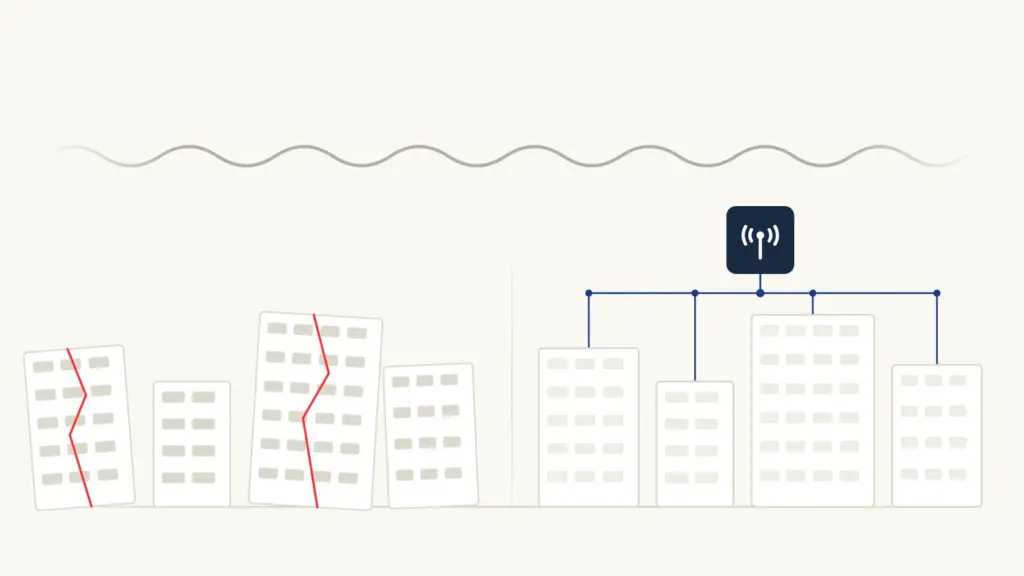
Disaster risk reduction is the practice of lowering disaster losses before an event happens, by acting on vulnerability and exposure rather than waiting to respond to the hazard. The shift matters because the hazard itself is usually not controllable. An earthquake of a given magnitude cannot be prevented; whether it kills two hundred people or twenty thousand is decided by building codes, land use and preparedness, all of which can be changed.
The Risk Equation
Disaster risk is conventionally written as a function of three things, and separating them is what makes the concept operational.
- Hazard — the physical event: an earthquake, cyclone, flood, landslide, heatwave or industrial accident. Largely not reducible.
- Exposure — the people, buildings and assets located where the hazard occurs. Reducible through land-use planning and zoning.
- Vulnerability — the susceptibility of those exposed: weak construction, poverty, age, disability, absence of warning. The most reducible of the three, and the most neglected.
- Capacity — the resources and coping ability available, which sits in the denominator: higher capacity, lower risk.
A disaster is what happens when a hazard meets vulnerable exposure. That is why two countries hit by comparable cyclones can record death tolls that differ by three orders of magnitude.
Disaster Risk Reduction Versus Disaster Management
| Dimension | Response paradigm | Risk reduction paradigm |
|---|---|---|
| Timing | After the event | Before the event, continuously |
| Focus | Relief, rescue, compensation | Prevention, mitigation, preparedness |
| Lead actor | Emergency services | Planning, public works, urban development |
| Metric | Relief delivered | Losses avoided |
| Financing | Response fund | Mitigation fund and mainstreamed development budgets |
| View of the event | An exception | A predictable consequence of development choices |
India made this transition legally with the Disaster Management Act, 2005, which replaced a relief-centred administrative practice with a statutory prevention-and-mitigation mandate.
The Sendai Framework
- Adopted at the Third UN World Conference in Sendai, Japan, in March 2015, running to 2030, succeeding the Hyogo Framework for Action.
- Four priorities for action: understanding disaster risk; strengthening disaster risk governance; investing in disaster risk reduction for resilience; and enhancing preparedness for effective response and to “build back better”.
- Seven global targets, four on reduction — mortality, affected people, economic loss and damage to critical infrastructure — and three on enhancement: national and local strategies, international cooperation, and access to multi-hazard early warning.
- Voluntary and non-binding, monitored through the Sendai Framework Monitor.
- India is a signatory, and the Prime Minister’s Ten Point Agenda on Disaster Risk Reduction (2016) is the national articulation of it.
Our detailed note on the Sendai Framework covers the targets and India’s reporting against them.
India’s Architecture
- Disaster Management Act, 2005, creating the three-tier NDMA, SDMA and DDMA structure, with the 2025 amendment adding statutory backing for state and urban disaster authorities.
- National Disaster Management Plan (2016, revised 2019), the first national plan aligned to the Sendai priorities.
- National Disaster Response Force for response, and the National Institute of Disaster Management for training and research.
- National Disaster Mitigation Fund and National Disaster Response Fund, with the Finance Commission allocating a share specifically to mitigation and preparedness.
- Early warning agencies: IMD for cyclones and heat, INCOIS for tsunami, Central Water Commission for floods, GSI for landslides, and the Common Alerting Protocol based Sachet platform for last-mile alerts.
- Coalition for Disaster Resilient Infrastructure (CDRI), launched by India in 2019, the main Indian contribution to global risk governance.
Recurrent hazard-specific work such as the landslide risk mitigation scheme for the Himalayan states sits under this framework.
Where It Breaks
- Risk reduction is not mainstreamed into development approvals. Individual environmental clearances are granted without cumulative impact assessment, so ten projects in one valley are each assessed as if the other nine did not exist.
- Building code enforcement is weak, and most construction in seismic zones IV and V is non-engineered.
- Local plans exist on paper. District and village plans are prepared and rarely drilled, so capacity does not survive between events.
- Financing tilts to relief. Mitigation spending remains a small fraction of response spending, because relief is politically visible and prevention is not.
- Urban risk is growing faster than urban capacity, as Joshimath showed for a hill town and as repeated urban flooding shows for the plains.
- Climate change is shifting the baseline, so hazard maps built on historical return periods progressively understate risk.
The single highest-return correction is to make risk assessment a precondition of development clearance rather than a parallel exercise.
Frequently Asked Questions
What is disaster risk reduction?
It is the practice of reducing disaster losses before an event occurs by acting on vulnerability and exposure rather than only responding after the hazard. Since the hazard itself usually cannot be prevented, the losses are determined by construction quality, land use, warning systems and preparedness.
What is the difference between disaster management and disaster risk reduction?
Disaster management historically meant relief and rescue after an event. Disaster risk reduction shifts the focus before the event to prevention, mitigation and preparedness, and measures success by losses avoided rather than relief delivered.
What is the Sendai Framework?
A voluntary, non-binding agreement adopted in Sendai, Japan, in March 2015, running to 2030. It has four priorities for action and seven global targets covering mortality, affected people, economic loss, damage to critical infrastructure, national and local strategies, international cooperation, and early warning access.
What are the components of disaster risk?
Hazard, exposure and vulnerability, moderated by capacity. Hazard is the physical event, exposure is what is located in its path, and vulnerability is the susceptibility of those exposed. Vulnerability is the most reducible component.
What is the Coalition for Disaster Resilient Infrastructure?
A global partnership launched by India in 2019 to promote infrastructure systems that are resilient to climate and disaster risk. It is India’s principal contribution to international disaster risk governance.
Why does disaster risk reduction fail in practice in India?
Chiefly because it is not built into development approvals. Clearances are granted project by project without cumulative impact assessment, building codes are weakly enforced, local plans are prepared but not drilled, and financing remains tilted towards relief rather than mitigation.
Practice Questions
Prelims MCQs
1. The Sendai Framework for Disaster Risk Reduction was adopted in:
- (a) 2005
- (b) 2010
- (c) 2015
- (d) 2019
Answer: (c) 2015
2. How many global targets does the Sendai Framework contain?
- (a) Four
- (b) Five
- (c) Seven
- (d) Ten
Answer: (c) Seven
3. Which of the following is the most reducible component of disaster risk?
- (a) Hazard
- (b) Exposure
- (c) Vulnerability
- (d) Return period
Answer: (c) Vulnerability
4. The Coalition for Disaster Resilient Infrastructure was launched by India in:
- (a) 2015
- (b) 2016
- (c) 2019
- (d) 2022
Answer: (c) 2019
5. Tsunami early warning for India is issued by:
- (a) IMD
- (b) INCOIS
- (c) Central Water Commission
- (d) Geological Survey of India
Answer: (b) INCOIS
Mains Questions
- Distinguish between disaster management and disaster risk reduction, and examine how far India has made the transition. (15 marks, 250 words)
- Discuss the four priorities and seven targets of the Sendai Framework and assess India’s progress against them. (15 marks, 250 words)
- “A disaster is what happens when a hazard meets vulnerable exposure.” Analyse this statement with Indian examples. (10 marks, 150 words)
- Examine why disaster risk reduction is not mainstreamed into development planning in India, and suggest correctives. (15 marks, 250 words)
- Discuss the adequacy of India’s institutional and financing architecture for disaster mitigation. (10 marks, 150 words)
Tell Google you want more of this.
Add Anantam IAS as a preferred sourceOne tap, and this site shows up more often in your own Top Stories, AI Overviews and AI Mode. Remove it any time.