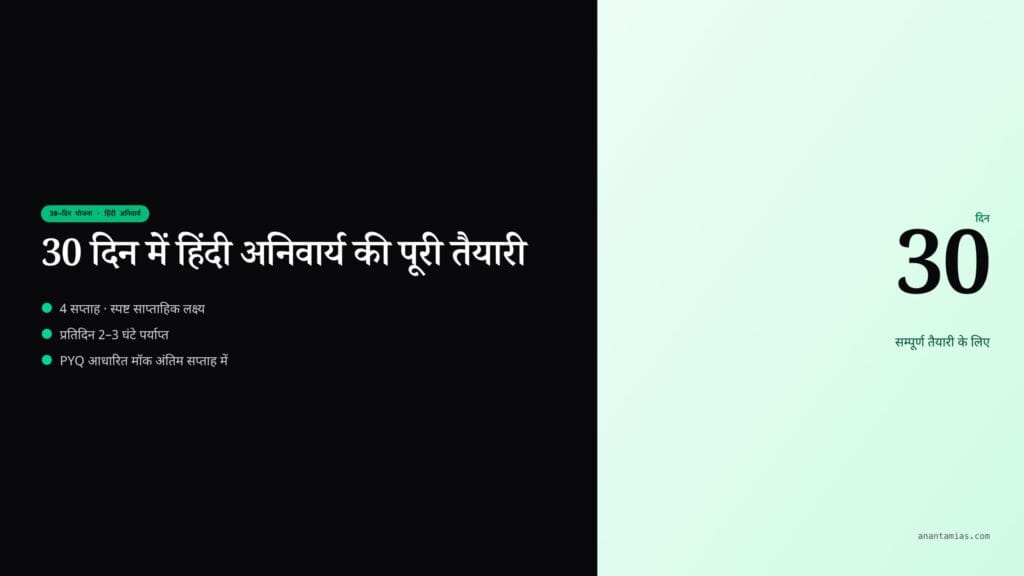
You have one month before the UPSC Mains. The Hindi Compulsory paper is looming and you have not started dedicated preparation. Sound familiar? This 30-day plan is built for exactly that situation — minimum daily time (60–90 minutes), maximum qualifying score.
Follow it honestly and you will walk into the exam hall with 150+ ready marks. The plan assumes you already have basic Hindi reading ability; if not, add one week of NCERT Hindi Class 9 upfront.
Prerequisites
- Basic Hindi reading and writing ability.
- Lucent Samanya Hindi or equivalent grammar book.
- UPSC last 10 years PYQ papers (free on upsc.gov.in).
- One essay book (Drishti IAS Hindi Nibandh recommended).
- A dedicated Hindi practice notebook (200+ pages).
Time Requirement
| Phase | Daily Time |
|---|---|
| Week 1 (Grammar foundation) | 90 minutes |
| Week 2 (Precis + Translation) | 75 minutes |
| Week 3 (Essay + Comprehension) | 90 minutes |
| Week 4 (Full mocks + Revision) | 2 hours |
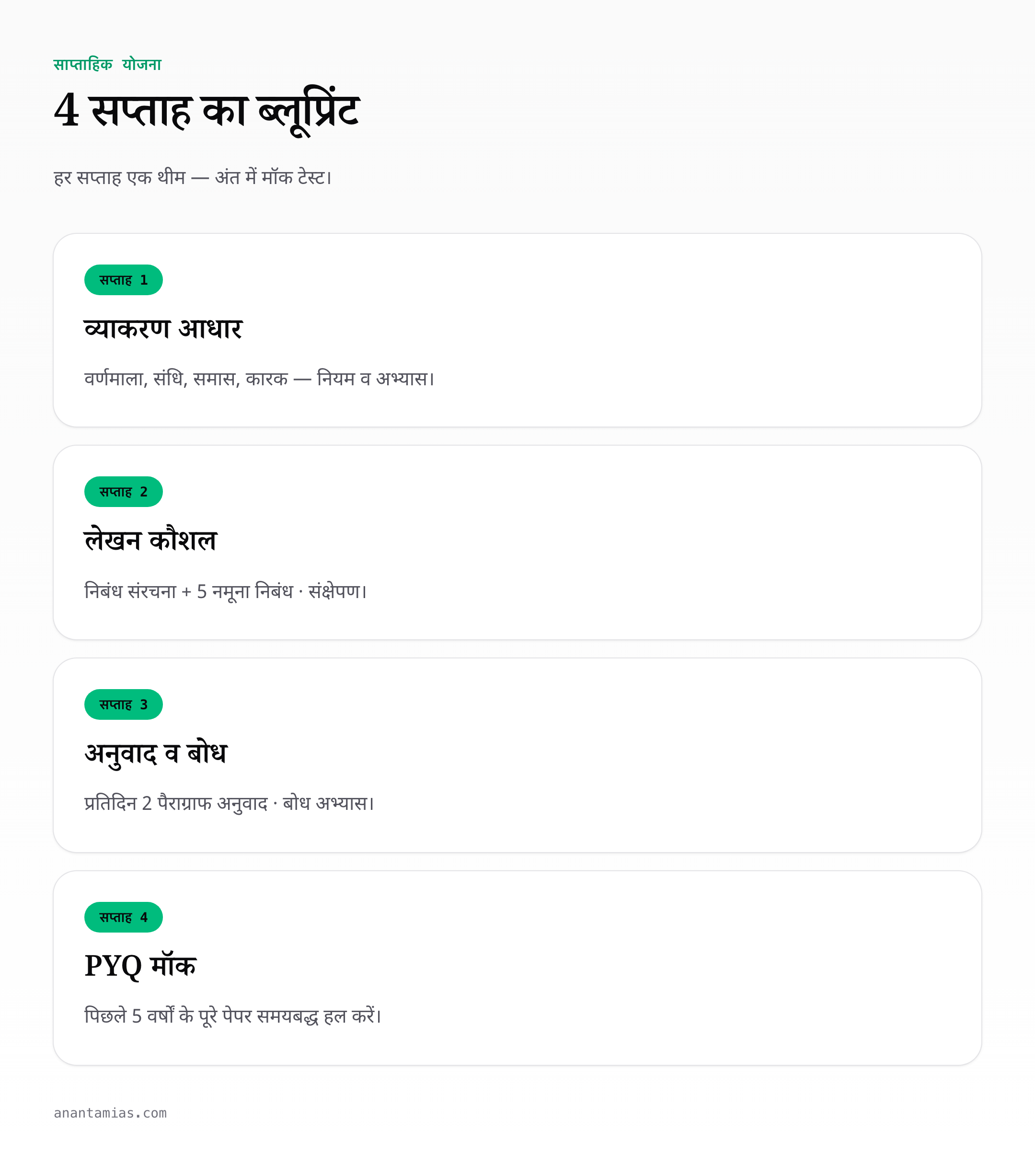
Week 1 (Days 1–7): Grammar Foundation
Day 1
- संधि — read Lucent chapter, make flashcards of 20 examples.
- 15 idioms with meanings and sentences.
Day 2
- समास — read Lucent chapter, practise identifying 30 examples.
- 15 more idioms.
Day 3
- कारक (8 कारक) — memorise vibhakti chart, 20 example sentences.
- 20 synonyms (पर्यायवाची).
Day 4
- वाच्य (कर्तृ, कर्म, भाव) — 30 example conversions.
- 20 antonyms (विलोम).
Day 5
- काल — all tenses, 20 sentences each.
- Spelling list: compile 30 commonly misspelt words.
Day 6
- वाक्य शुद्धि — 40 incorrect sentences, correct each.
- 15 more idioms (running total: 45).
Day 7: Revision day
- Revise all 7 days. Take a mini-test: 20 grammar MCQs from PYQ.
- Target: 15+ out of 20 correct.
Week 2 (Days 8–14): Precis + Translation
Day 8
- Read Arihant Sankshepan intro. Do 1 precis from book.
- 1 English→Hindi translation (100 words).
Days 9–11
- 1 precis + 1 translation daily (alternate direction).
- Compare with model answer; note corrections.
Day 12–13
- 2 precis + 2 translations daily (increased pace).
- Time yourself — precis in 25 min, translation in 10 min each.
Day 14: Mini-mock
- 60-minute mini-mock: 1 precis + 2 translations + 10 grammar MCQs.
- Self-score strictly.
Week 3 (Days 15–21): Essay + Comprehension
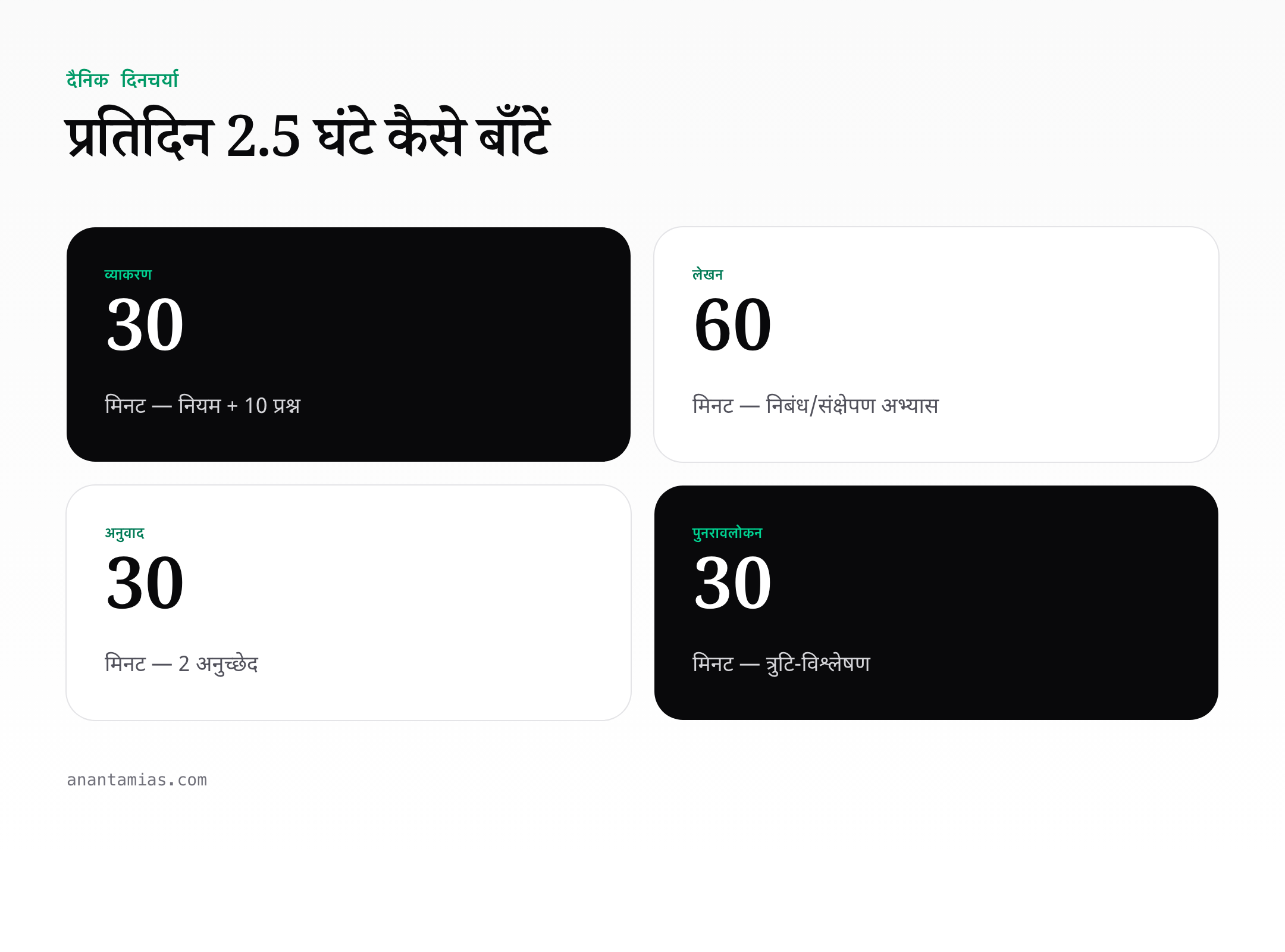
Day 15
- Read 3 model essays from Drishti IAS Nibandh.
- Identify the 5-part structure in each.
Day 16
- Write 1 full essay (600 words) in 75 minutes: topic ‘विज्ञान: वरदान या अभिशाप’.
- Self-review using structure checklist.
Day 17
- Read a Hindi editorial (Jansatta / Dainik Jagran). Write 5 comprehension questions and answer them.
- Memorise 5 quotations for essay use.
Day 18
- Essay: ‘डिजिटल भारत — अवसर और चुनौतियाँ’ in 75 minutes.
- Self-evaluate.
Day 19
- Comprehension practice: 1 passage + 5 Q&A (30 min).
- 1 translation practice.
Day 20
- Essay: ‘महिला सशक्तिकरण’ — 75 minutes.
- 15 new idioms (running total: 100).
Day 21: Mini-mock
- 90-minute mini-mock: 1 essay + 1 comprehension passage.
- Target: 80+ out of 160 in these two sections.
Week 4 (Days 22–30): Full Mocks + Revision
Days 22–24: Full-length mocks
- Each day: full 3-hour paper (PYQ-based).
- Mock 1 = 2015 paper, Mock 2 = 2018 paper, Mock 3 = 2022 paper.
- Strict timing, strict self-evaluation.
Days 25–26: Error log revision
- List every error from mocks.
- Revise weak grammar topics once more.
Days 27–28: Two more PYQ mocks
- Day 27 = 2019 paper, Day 28 = 2023 paper.
- Aim for 150+ total in each.
Day 29: Final revision
- Revise 100 idioms list.
- Revise 50 spelling words.
- Revise essay quotations and linking phrases.
- Revise kaarak and samas tables.
Day 30: Exam prep
- Light revision only. No new material.
- Sleep 8 hours.
- Keep pen, admit card, watch ready.
What to Practise vs. What to Skip
| Practise | Skip |
|---|---|
| Essay structure and 5 core topics | 30 different essay topics |
| 100 high-frequency idioms | 500 obscure idioms |
| Kaarak, samas, sandhi basics | Deep Sanskrit grammar |
| Newspaper translation daily | Literary translation |
| Last 10 PYQ full mocks | Random online quizzes |
Daily Non-Negotiables
- 10 new idioms every day (Weeks 1–3).
- At least 1 written task per day (essay, precis, translation, or comprehension).
- 15 minutes of Hindi reading — newspaper, novel, or NCERT.
- Weekly self-scoring under exam conditions.
Expected Score Trajectory
| Week | Likely Score if Plan Followed |
|---|---|
| Before plan | 50–70 / 300 (below cutoff) |
| End of Week 1 | 90–110 / 300 |
| End of Week 2 | 120–140 / 300 |
| End of Week 3 | 140–170 / 300 |
| Day 30 | 160–200 / 300 |
A 160+ score is a 2x buffer over the 75-mark cutoff. That is the margin of safety no sensible UPSC aspirant should skip. Thirty disciplined days give you that cushion.
Frequently Asked Questions
Can I really prepare for Hindi Compulsory in 30 days?
Yes, if you can read and write Hindi at a basic level already. Grammar, idioms, and writing drills compound fast when practised daily.
How much daily time does this 30-day plan require?
60–120 minutes per day — 90 minutes average. Serious aspirants may stretch to 2 hours during Week 4 mocks.
What if I cannot read Hindi at all yet?
Add one prep week before Day 1 using NCERT Class 9 Hindi (Kshitij). Rebuild reading fluency before starting this plan.
Do I need a coaching test series for this plan?
Not necessary. Official UPSC PYQs (last 10 years) plus Drishti / Vision sample answers are sufficient. Test series is a bonus, not a requirement.
What score should I target by Day 30?
Aim for 150+ out of 300 in your last mock. That gives a 2x safety cushion over the 75-mark qualifying cutoff.
Tell Google you want more of this.
Add Anantam IAS as a preferred sourceOne tap, and this site shows up more often in your own Top Stories, AI Overviews and AI Mode. Remove it any time.