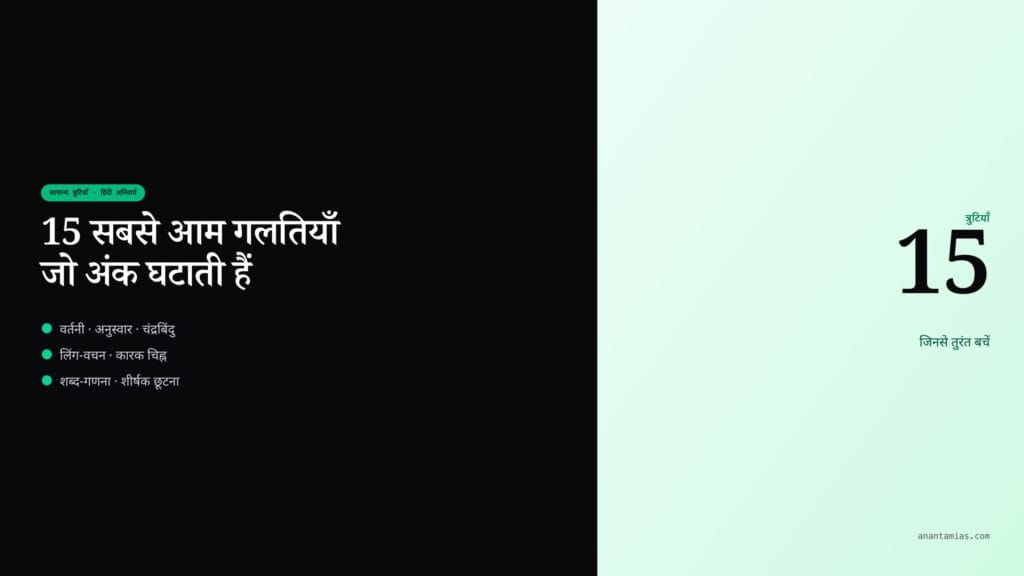
Every year thousands of UPSC aspirants write the Hindi Compulsory paper. A majority comfortably qualify, but a meaningful percentage — including some very strong candidates — fail. The reason is almost always the same: avoidable errors. Here are the 15 most common ones, each with a fix.
Error 1: Exceeding Word Limits in Precis
Writing 140 words for a 300-word precis passage (instead of ~100) causes automatic 3–5 mark deduction. Fix: count words after every 25 words; strictly stop at 110.
Error 2: Skipping the Precis Title
The title (शीर्षक) carries about 5 marks. Many candidates either forget it or write something vague. Fix: title must be 3–6 words, capturing the central idea — e.g., ‘भारतीय कृषि की चुनौतियाँ’.
Error 3: Copy-Pasting Sentences in Precis
A precis must be in your own words. Direct copy of source sentences triggers ‘own-words’ mark deduction. Fix: close the question paper after the second read; draft from memory.
Error 4: Gender Agreement in Hindi
Classic mistake: लड़की खा रहा है instead of लड़की खा रही है. Fix: before writing any verb, identify subject gender. Feminine nouns demand feminine verb forms.
Error 5: Misuse of ‘ने’ (Ergative)
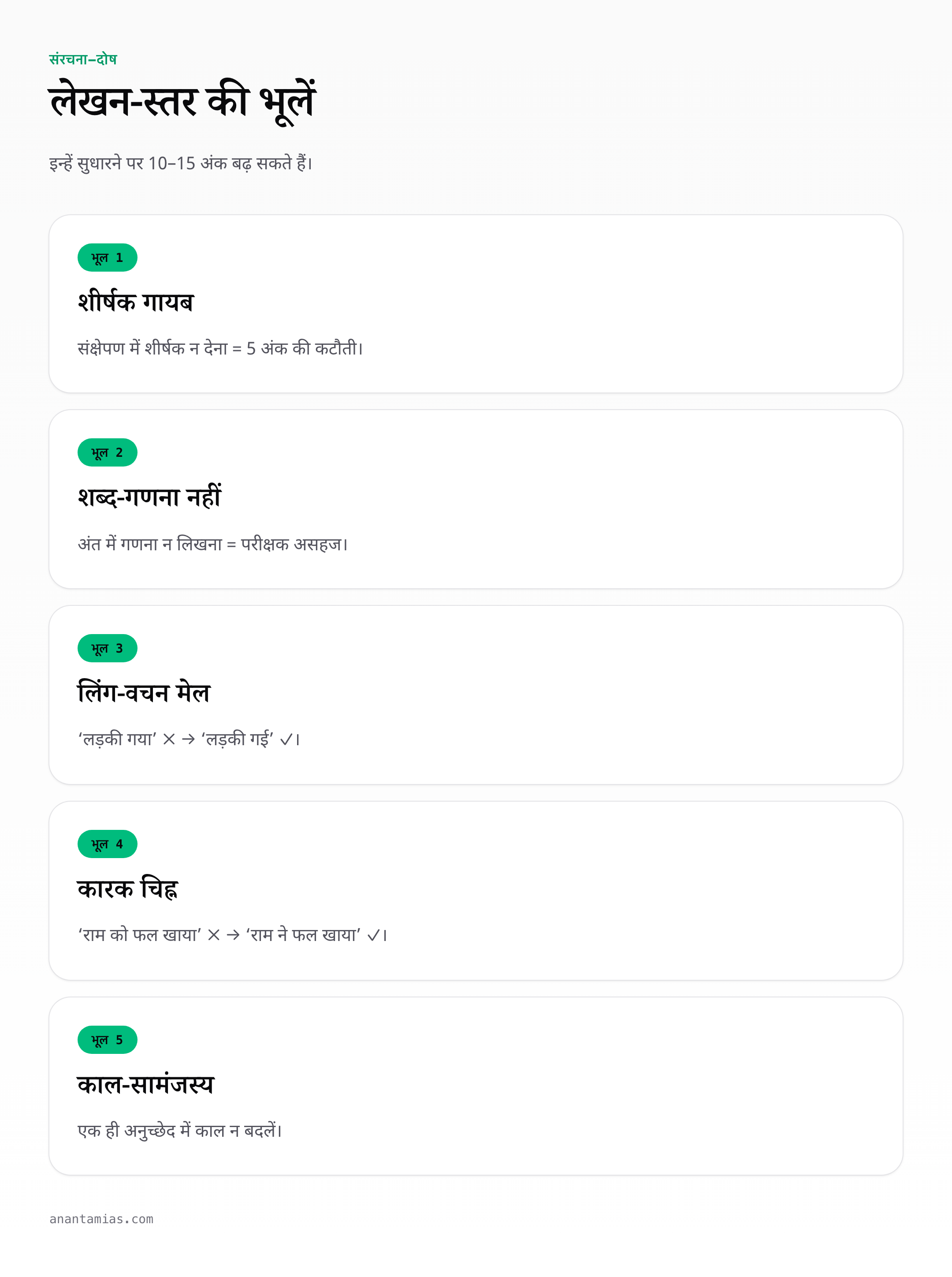
मैंने किताब पढ़ा (wrong) → मैंने किताब पढ़ी (correct). In past tense with transitive verbs, Hindi uses the ergative ‘ने’ and the verb agrees with the object’s gender. Fix: remember — when ‘ने’ is used, verb agrees with object, not subject.
Error 6: Literal Translation of Idioms
Translating ‘cats and dogs’ as ‘बिल्ली-कुत्ते बरस रहे हैं’ is absurd. Fix: always use the idiomatic Hindi equivalent — मूसलाधार वर्षा हो रही है.
Error 7: Skipping Sentences in Translation
Every sentence in the source must appear in the target. Skipping one means 4–5 marks lost instantly. Fix: tick off each sentence as you translate it.
Error 8: Mixing Scripts
Writing ‘Pradhan Mantri’ in Roman inside a Hindi answer is disqualifying for that answer. Fix: use Devanagari throughout — ‘प्रधानमंत्री’.
Error 9: Poor Essay Structure
Writing the entire essay as one long paragraph, or without intro/conclusion, loses structural marks. Fix: mandatory 5-part structure — भूमिका, मुख्य पक्ष, अन्य पक्ष, समाधान, उपसंहार.
Error 10: Over-Sanskritised Hindi
Using rare Sanskrit words you are not fluent in leads to errors. Fix: write in the Hindi you would speak to an educated friend — clear, simple, correct.
Error 11: Not Attempting the Full Paper
Many aspirants run out of time and leave grammar/comprehension unattempted. 40 marks of grammar left blank almost guarantees failure. Fix: strict time management — essay 75 min, comprehension 25 min, precis 25 min, translation 20 min, grammar 25 min, buffer 10 min.
Error 12: Spelling Errors (अशुद्ध वर्तनी)
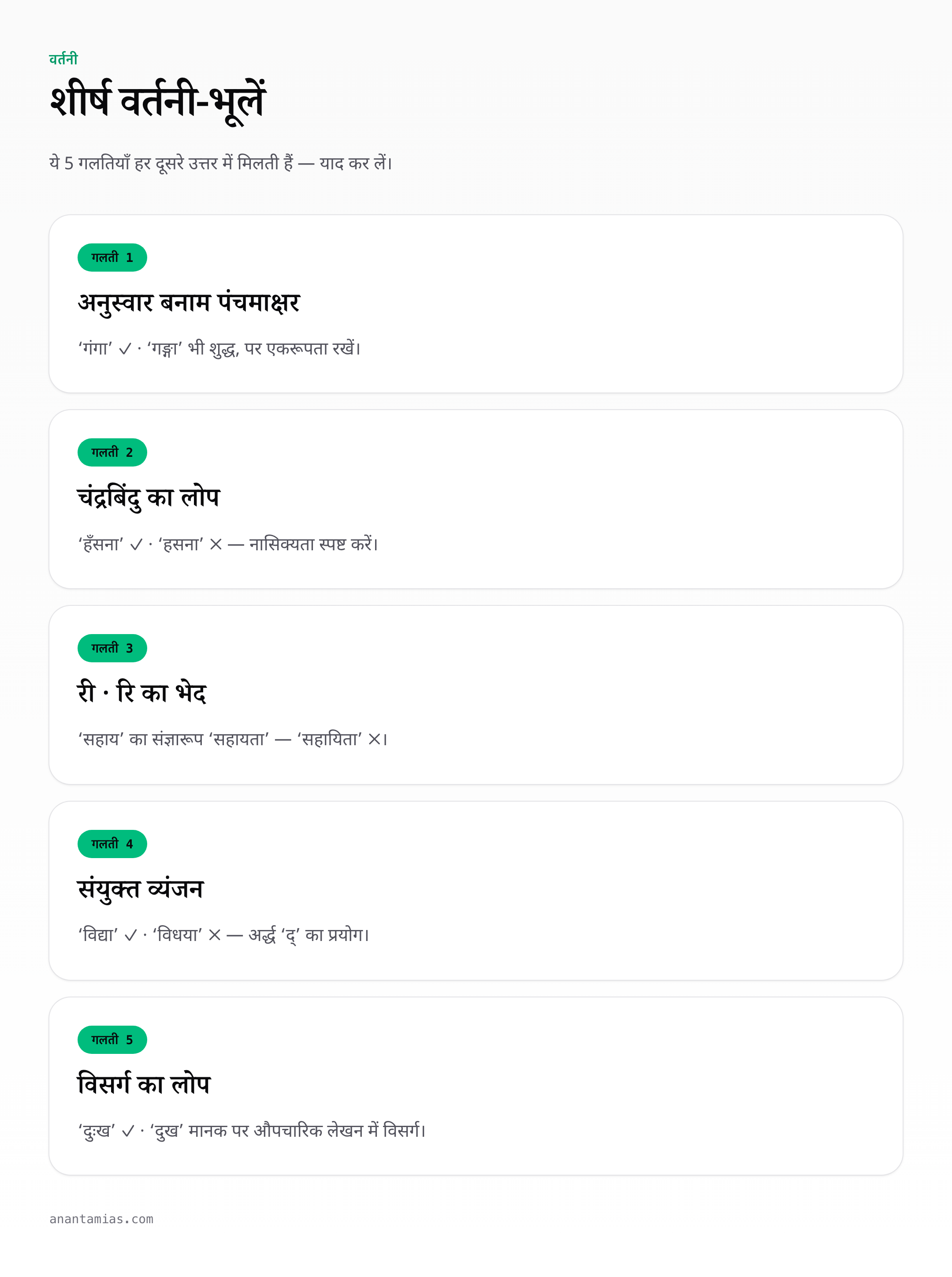
Common misspellings: संशार (correct: संसार), आर्शीवाद (correct: आशीर्वाद), परिक्षा (correct: परीक्षा). Fix: keep a personal list of 50 commonly misspelt words and revise it weekly.
Error 13: Wrong Use of अनुस्वार vs चंद्रबिंदु
हँस (to laugh) uses चंद्रबिंदु; हंस (swan) uses अनुस्वार. Mixing these changes meaning. Fix: learn the common pairs — हँस/हंस, माँ/मान, आँगन/अंगन (angan).
Error 14: Translating Tone Incorrectly
A formal English passage should yield formal Hindi, not casual. Using ‘यार’ in a government-style passage is a tone mismatch. Fix: match register — formal passages get formal Hindi vocabulary.
Error 15: Adding Personal Opinion in Precis/Comprehension
Precis is a summary, not commentary. Adding ‘मेरे विचार में’ or ‘यह बहुत अच्छा विचार है’ is penalised. Fix: stay neutral and stick to what the passage says.
Summary Table
| Error | Quick Fix |
|---|---|
| Word-limit breach | Count every 25 words |
| Missing precis title | Write title first |
| Copy-paste precis | Close paper before drafting |
| Gender disagreement | Check subject gender first |
| ‘ने’ misuse | Verb agrees with object after ‘ने’ |
| Literal idiom translation | Use idiomatic equivalent |
| Skipped sentence | Tick off each source sentence |
| Script mixing | Strict Devanagari |
| Poor essay structure | Use 5-part frame |
| Over-Sanskritised | Write simple Hindi |
| Unattempted sections | Strict time table |
| Spelling errors | Personal 50-word list |
| अनुस्वार/चंद्रबिंदु mix | Learn common pairs |
| Tone mismatch | Match register |
| Personal opinion in precis | Stay neutral |
Pre-Exam Checklist
- Have I revised my 50-word spelling list?
- Do I know the top 100 idioms?
- Have I practised at least 10 full-length essays?
- Have I done 15 precis under timed conditions?
- Have I done 20 translations, alternating directions?
- Have I memorised my time table (75+25+25+20+25+10)?
The aspirant who eliminates these 15 errors doesn’t just clear the paper — they score 150+ effortlessly. Discipline with the basics beats brilliance at the advanced level.
Frequently Asked Questions
What is the single most common error in UPSC Hindi Compulsory?
Running out of time and leaving 40–60 marks of grammar and comprehension unattempted. A strict time table (75+25+25+20+25+10 minutes) eliminates this.
Is writing in Roman script for Hindi answers penalised?
Yes. The paper must be written in Devanagari. Answers in Roman script can be rejected outright or heavily penalised.
How do I fix gender agreement errors?
Before writing any Hindi verb, pause and identify subject gender. Feminine subjects require feminine verb forms (रही है, पढ़ी), masculine subjects take masculine forms.
Can spelling errors fail me?
A few spelling errors are tolerated. But if 10–15 high-visibility words are wrong, it creates a negative impression that bleeds into overall marks. Keep a personal 50-word misspelling list.
Is personal opinion allowed in the essay but not precis?
Correct. Essay is your view, so opinions are welcome. Precis is a neutral summary — no opinion. Comprehension depends: stick to the passage unless a ‘give your view’ sub-question appears.
Tell Google you want more of this.
Add Anantam IAS as a preferred sourceOne tap, and this site shows up more often in your own Top Stories, AI Overviews and AI Mode. Remove it any time.