
Ten years of UPSC Hindi Compulsory papers reveal a striking pattern: the same topic categories, question formats, and difficulty levels repeat almost every year. This PYQ analysis maps 2014–2023 and shows you exactly what to expect.
The takeaway is simple — if you prepare for the recurring patterns below, you are preparing for 90% of the real paper.
Paper Structure: Same Every Year
| Section | Format (Unchanged) | Marks |
|---|---|---|
| Essay | 1 essay, 600 words, from 3 choices | 100 |
| Comprehension | 1 passage + 5 sub-questions | 60 |
| Precis | 1 passage, 1/3 reduction | 60 |
| Translation | English→Hindi + Hindi→English | 40 |
| Grammar | Mixed items | 40 |
Essay Topics by Year (Selected)
| Year | Essay Topic (Selected) |
|---|---|
| 2023 | डिजिटल भारत: अवसर और चुनौतियाँ |
| 2022 | भारतीय संस्कृति की विशेषताएँ |
| 2021 | महिला सशक्तिकरण: आज की आवश्यकता |
| 2020 | कोविड-19 और बदलता समाज |
| 2019 | स्वच्छ भारत अभियान |
| 2018 | विज्ञान: वरदान या अभिशाप |
| 2017 | भारत में युवाओं की भूमिका |
| 2016 | पर्यावरण संरक्षण |
| 2015 | भ्रष्टाचार: कारण एवं निवारण |
| 2014 | शिक्षा और राष्ट्र निर्माण |
Theme Frequency Analysis (Last 10 Years)
| Theme | Times Asked |
|---|---|
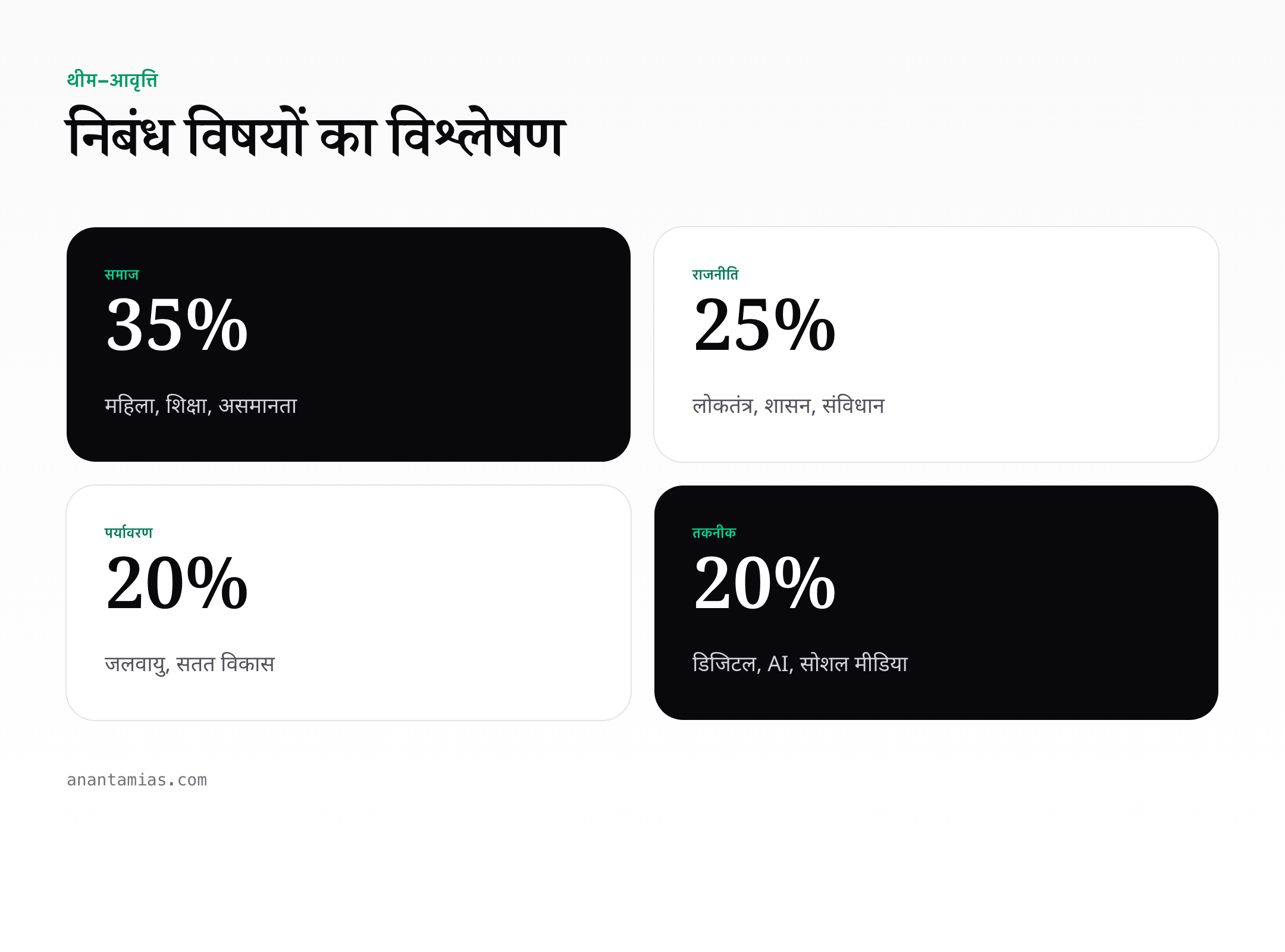
| Social issues (women, corruption, youth) | 4 |
| Science/Technology | 2 |
| Environment | 1 |
| Indian culture | 1 |
| Current policy (Digital India, Swachh Bharat) | 2 |
Comprehension Passage Themes
Passages have consistently been sourced from five broad categories:
- Indian philosophy / Gandhian thought
- Environment and ecology
- Social change and inequality
- Science and technology impact
- Education and youth
Precis Passage Themes
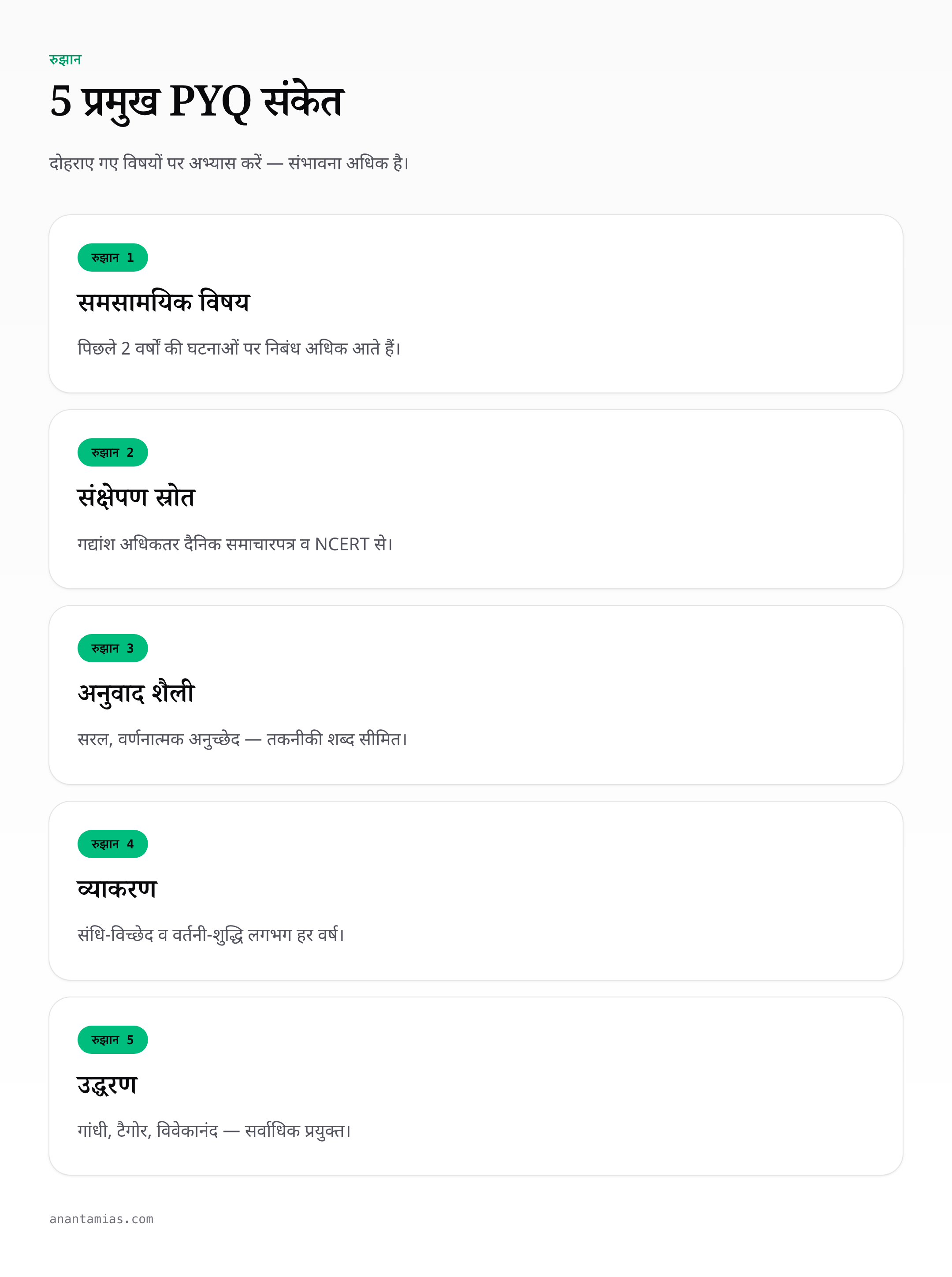
Precis passages almost always come from formal prose on policy, history, or social issues. Expect passages of 280–320 words. Word count ceiling for the precis is 110 ± 10.
Translation Patterns
English → Hindi
Topics over the last decade: Indian democracy, environment, women’s rights, economic planning, technology and society. Register is consistently formal.
Hindi → English
Typically drawn from Hindi editorials or official documents on topics like agriculture, education, national unity, and rural development.
Grammar Sub-Topic Frequency
| Sub-Topic | Average Questions per Year |
|---|---|
| Vaaky shuddhi (sentence correction) | 4–5 |
| Idioms/Proverbs | 3–4 |
| Antonyms/Synonyms | 3–4 |
| Sandhi/Samas | 2–3 |
| Spelling correction | 1–2 |
Observed Patterns
- Essay topics rotate between societal, scientific, cultural, and policy themes. Prepare one essay in each category — you will always have a match.
- Precis passages are always formal, never literary poetry.
- Translation register is always formal — no colloquial or slang.
- Grammar drills on the 5 sub-topics above. Prepare these and score 32+ out of 40 almost guaranteed.
- Comprehension passages reward careful reading more than creative interpretation.
Changes Over the Decade
The paper format has remained remarkably stable. Minor shifts:
- From 2019 onwards, essay topics lean slightly more toward current governance (Digital India, COVID-19) than abstract philosophy.
- Translation passages have shortened from ~120 words to ~100 words.
- Grammar MCQs have reduced slightly in favour of more subjective grammar work.
- Emphasis on handwriting quality appears higher — candidates with illegible scripts report lower marks.
Your Preparation Implication
- Prepare 6 essays covering: society, environment, science/tech, governance, culture, women.
- Do 15 comprehension passages from PYQs.
- Do 20 precis passages with strict word-count discipline.
- Do 25 translations — alternating English→Hindi and Hindi→English.
- Drill the 5 grammar sub-topics above until 90%+ accuracy.
High-Probability Essay Topics for Upcoming Exam
Based on pattern analysis, these are likely to appear in upcoming years:
- कृत्रिम बुद्धिमत्ता (Artificial Intelligence) और मानव भविष्य
- जलवायु परिवर्तन और भारत
- आत्मनिर्भर भारत अभियान
- भारतीय कृषि में सुधार
- लोकतंत्र में मीडिया की भूमिका
- शिक्षा नीति 2020 का प्रभाव
Mistake Patterns from PYQ Evaluation
Published toppers’ interviews consistently mention these as the highest-loss areas:
- Grammar sub-topics skipped due to time pressure — big red flag.
- Precis over-length — easy 5 marks lost.
- Translation sentences skipped — 4–6 marks lost.
- Essay without conclusion — penalty.
- Comprehension answered in bullet points instead of prose — register mismatch.
Year-Over-Year Score Trend
Average qualifying candidates score between 110–150 out of 300. Toppers often score 200–240. The gap is almost entirely explained by (a) completed paper, (b) precis word discipline, (c) grammar preparation. Fix these three and you move from ‘just qualified’ to ‘comfortably qualified’.
Frequently Asked Questions
How many years of PYQs should I practise?
Last 10 years is sufficient. The format and theme patterns have been stable; older papers add diminishing value.
Are essay topics repeated exactly?
Rarely verbatim, but the same broad themes (science, society, environment, governance) rotate year to year. Preparing 6–8 theme-based essays covers almost any topic that can appear.
Where can I get UPSC Hindi Compulsory PYQs?
Free PDFs are available on upsc.gov.in under the ‘Previous Year Question Papers’ section. Compiled books by Arihant or Drishti are also useful.
Has the difficulty level increased recently?
Not meaningfully. The paper has remained accessible to candidates with basic Hindi literacy plus disciplined prep. What has increased is handwriting and presentation weight.
What is the most predictable section?
Grammar. Sub-topic frequency (vaaky shuddhi, idioms, sandhi, samas) barely changes. A 14-day focused grammar drill yields 32+ out of 40 almost every year.
Tell Google you want more of this.
Add Anantam IAS as a preferred sourceOne tap, and this site shows up more often in your own Top Stories, AI Overviews and AI Mode. Remove it any time.