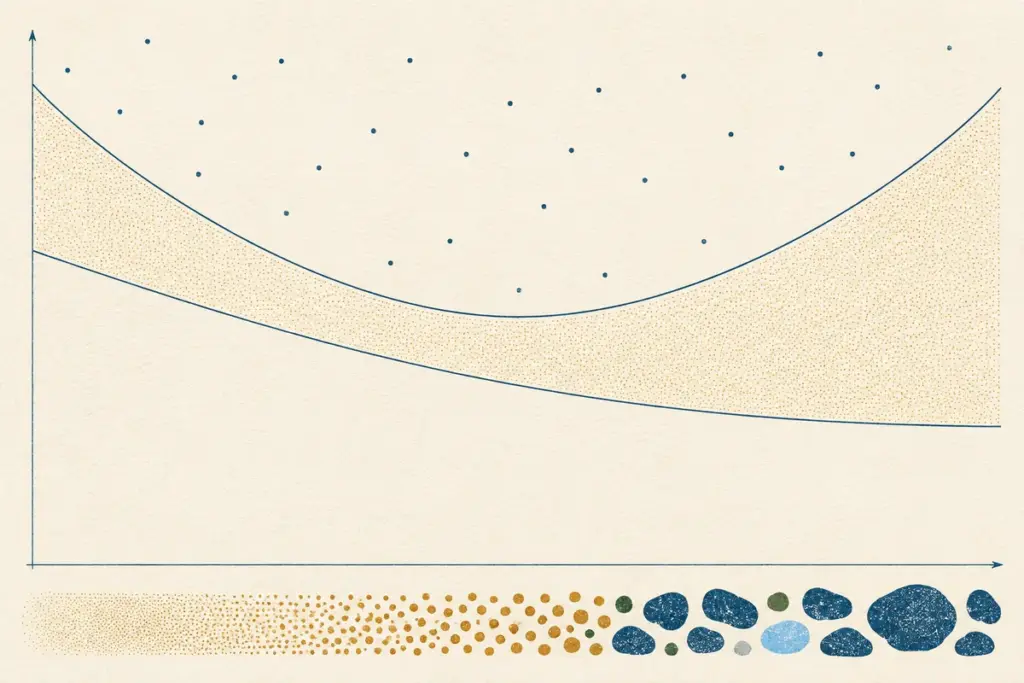
The Hjulström curve plots stream velocity against particle size and marks out three fields: erosion, transport and deposition. It is worth learning because its central result is counter-intuitive and explains a great deal about river behaviour that the landform vocabulary alone does not. Fine clay requires a higher velocity to erode than sand does.
Reading the Curve
Two curves cross the diagram. The upper one is the critical erosion velocity, the speed at which a particle of a given size is picked up. The lower one is the settling or deposition velocity, the speed below which it drops out of the flow.
- Above the upper curve, material of that size is being eroded.
- Between the two curves it is being transported, already in motion but not being newly entrained.
- Below the lower curve it is being deposited.
The Counter-Intuitive Result
Sand of roughly 0.2 to 0.5 millimetres is entrained at the lowest velocity of any grain size. Move away from that size in either direction and the required velocity rises, but for two entirely different reasons.
- Coarser material needs a higher velocity because it is heavier. That is expected, and it is simply a question of the force needed to lift a larger mass.
- Finer material also needs a higher velocity, because of cohesion. Silt and especially clay are platy particles with large surface areas and electrostatic attraction between them. They stick together, and the flow must prise them apart rather than merely lift them.
So the erosion curve is J-shaped rather than a simple rising line, with its minimum in the sand range.
Two Consequences That Explain Real Rivers
- Once fine clay is deposited it is very hard to re-erode. This is why cohesive mud banks are stable while sand bars shift with every flood, why the outer bank of a meander cut in clay retreats slowly, and why a clay-lined channel holds its form.
- The deposition threshold lies well below the erosion threshold. A stream carries its load at velocities far lower than it needed to pick that load up. This is why suspended sediment travels enormous distances, and why a river deposits only when it slows substantially rather than as soon as it slows at all.
A river picks up sand easily and clay with difficulty, then carries both a long way and puts the clay down last.
Competence and Capacity
Two related quantities are often confused, and keeping them apart is worth doing.
- Competence is the largest particle a stream can move. It rises very steeply with velocity, approximately with its sixth power, which is why a flood that doubles in speed can move boulders it could not previously shift at all.
- Capacity is the total quantity of load a stream can carry. It rises with discharge as well as velocity.
The sixth-power relationship is the reason nearly all geomorphic work in a river channel is done during a small number of high-flow events, and almost none during the long periods of ordinary flow.
How a Stream Carries Its Load
| Mode | What moves | How |
|---|---|---|
| Traction | Largest particles | Rolled or dragged along the bed |
| Saltation | Sand-sized particles | Bounced along the bed in short hops |
| Suspension | Silt and clay | Held up within the body of the flow by turbulence |
| Solution | Dissolved minerals | Carried chemically, independent of velocity |
Solution load is the one that behaves differently from all the others: it does not settle out when the stream slows, so it travels all the way to the sea. That is why river water is not pure even where the water runs clear.
Hydraulic Geometry
The Hjulström curve describes single particles. Hydraulic geometry, from Leopold and Maddock in 1953, describes the channel as a whole, through power-law relationships between discharge and the channel’s width, depth and velocity.
- At-a-station hydraulic geometry describes how one cross-section changes as discharge rises and falls through a flood. Depth and velocity increase sharply; width increases less.
- Downstream hydraulic geometry describes how the channel changes along the river as discharge grows. Width and depth both increase, and, contrary to intuition, velocity also increases slightly downstream.
That last point is the standard misconception. A mountain torrent looks faster than a lowland river because it is turbulent and shallow over a rough bed, but the mean velocity of the lowland channel is usually higher, because the great reduction in bed roughness and the increase in hydraulic radius more than offset the gentler gradient.
Grade
A stream is described as graded when slope, discharge, channel form and sediment load are mutually adjusted so that it transports its load with neither net erosion nor net deposition over a period of years.
Grade is a dynamic equilibrium rather than a fixed state. A graded stream still erodes in one place and deposits in another; what is constant is the balance across the system. Disturb any variable, by damming, by land-use change upstream, or by a fall in base level, and the channel adjusts its slope and form until a new balance is reached. That adjustment is why a dam causes scour downstream and aggradation upstream for decades after it is built.
What does the Hjulström curve show?
The relationship between stream velocity and particle size, divided into fields of erosion, transport and deposition by two curves: the critical erosion velocity above and the settling velocity below.
Why does clay need a higher velocity to erode than sand?
Because of cohesion. Clay particles are platy with large surface areas and electrostatic attraction between them, so they stick together and the flow must prise them apart rather than simply lift them. Sand grains have no such cohesion.
Which particle size is eroded at the lowest velocity?
Sand of roughly 0.2 to 0.5 millimetres. Coarser material needs more velocity because it is heavier; finer material needs more because it is cohesive.
What is the difference between competence and capacity?
Competence is the largest particle a stream can move, and it rises with roughly the sixth power of velocity. Capacity is the total quantity of load it can carry, and depends on discharge as well as velocity.
Does a river flow faster in the mountains or on the plains?
Usually on the plains. A mountain torrent appears faster because it is turbulent and shallow over a rough bed, but mean velocity generally increases downstream, since reduced bed roughness and greater hydraulic radius more than offset the gentler gradient.
What is a graded stream?
One in which slope, discharge, channel form and sediment load are mutually adjusted so that it transports its load with neither net erosion nor net deposition over a period of years. It is a dynamic equilibrium, not a static state.
Practice Questions
Prelims
1. According to the Hjulström curve, the particle size entrained at the lowest velocity is
- (a) clay
- (b) fine silt
- (c) sand of about 0.2 to 0.5 mm
- (d) fine gravel
Answer: (c)
2. Clay requires a high velocity for erosion mainly because of
- (a) its mass
- (b) cohesion between particles
- (c) its density
- (d) its angularity
Answer: (b)
3. The competence of a stream varies approximately with velocity raised to the power
- (a) two
- (b) three
- (c) six
- (d) one
Answer: (c)
4. Material carried in solution differs from other load in that it
- (a) settles first
- (b) does not settle out when the stream slows
- (c) moves by saltation
- (d) is confined to the bed
Answer: (b)
5. Downstream hydraulic geometry shows that mean velocity generally
- (a) decreases downstream
- (b) increases slightly downstream
- (c) remains constant
- (d) fluctuates randomly
Answer: (b)
Mains
- Explain the Hjulström curve and account for its J-shaped erosion threshold. (10 marks)
- Distinguish between competence and capacity, and explain why most geomorphic work occurs during floods. (10 marks)
- Describe the four modes of stream load transport and state which is independent of velocity. (10 marks)
- “Mean velocity increases downstream.” Examine this statement with reference to hydraulic geometry. (15 marks)
- What is a graded stream? Discuss how a river adjusts to the construction of a dam. (20 marks)
Tell Google you want more of this.
Add Anantam IAS as a preferred sourceOne tap, and this site shows up more often in your own Top Stories, AI Overviews and AI Mode. Remove it any time.