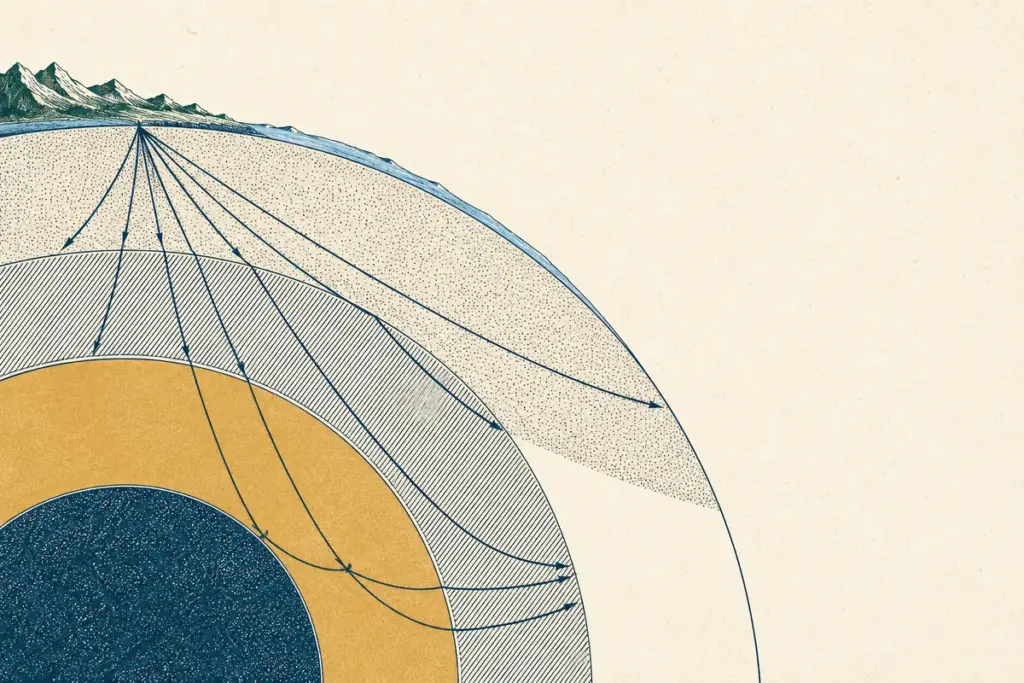
The deepest borehole ever drilled reached about 12 kilometres. The earth’s radius is about 6,371. Rather less than one five-hundredth of the distance to the centre has ever been physically sampled, and the interior of the earth is nevertheless known to within a few kilometres at each major boundary. How that is possible is the most instructive thing in the topic, and a better answer to any question about the interior than the list of layers alone.
The Five Lines of Evidence
- Seismic waves, and above all the shadow zones they produce, which give the layer boundaries and their physical state.
- Mean density. The earth’s average density is about 5.5 grams per cubic centimetre while surface rock averages about 2.7. Something far denser must lie beneath.
- Meteorites, particularly iron meteorites, taken as fragments of the cores of destroyed planetesimals and therefore analogues for the earth’s own core.
- The magnetic field, which requires a convecting, electrically conducting liquid layer to sustain it.
- High-pressure laboratory experiments, which match candidate minerals to the seismic velocities observed at each depth.
No one line settles the question. The layered model is what all five converge on, and saying that is a stronger statement than reciting the layers.
Seismic Waves and What They Cannot Do
Two body waves carry the argument.
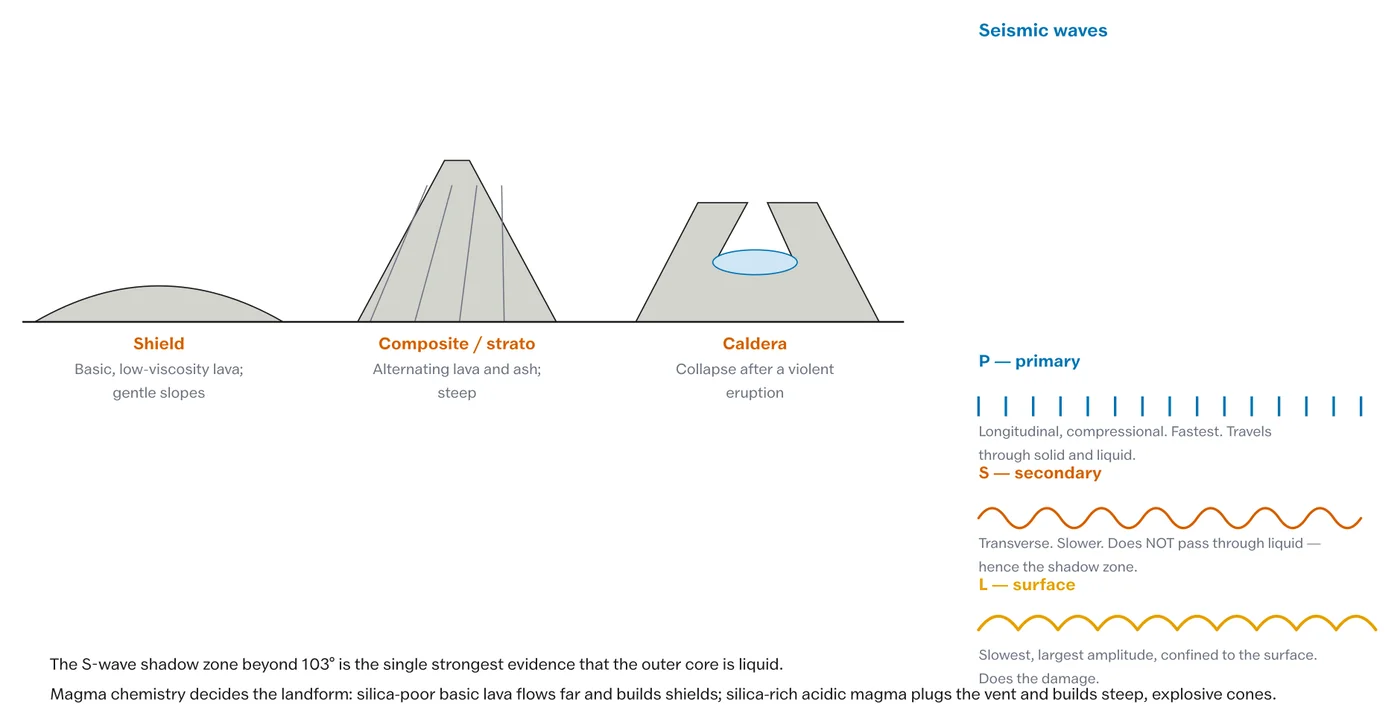
| P-wave | S-wave | |
|---|---|---|
| Motion | Compressional, particles move along the direction of travel | Shear, particles move at right angles to travel |
| Speed | Faster; arrives first | Slower; arrives second |
| Through liquid | Yes | No: a liquid has no shear strength |
| Through solid | Yes | Yes |
That single asymmetry, that shear waves cannot cross a liquid, is what reveals the outer core.
The Shadow Zones
This is the core of the reasoning and worth stating exactly.
- No S-waves are recorded beyond about 103 degrees of arc from an epicentre. The S-wave shadow covers the whole far side of the earth. Since S-waves cannot cross a liquid, the outer core must be liquid.
- P-waves are absent between about 103 and 142 degrees. They are not blocked, they are refracted: on entering the much slower liquid core they bend sharply, leaving a ring where none arrive.
- Faint P-waves reappear inside the shadow, which indicates a further boundary within the core refracting them back. Inge Lehmann drew that conclusion in 1936, and the inner core is the result.
The outer core is liquid because of what is missing from the seismogram, and the inner core is solid because of what unexpectedly reappears.
The Discontinuities
| Boundary | Depth | Separates | Discovered by |
|---|---|---|---|
| Mohorovičić (Moho) | About 35 km under continents, 5 to 10 km under oceans | Crust from mantle | Andrija Mohorovičić, 1909 |
| Gutenberg | About 2,900 km | Mantle from outer core | Beno Gutenberg, 1914 |
| Lehmann | About 5,150 km | Outer core from inner core | Inge Lehmann, 1936 |
Two further internal boundaries are worth naming. The Conrad discontinuity separates upper and lower continental crust, and the Repetti discontinuity lies within the mantle at around 700 km. The asthenosphere, a low-velocity zone between roughly 100 and 250 km, is not a discontinuity but a layer of partial melt, and it is the layer on which the plates of Chapter 2 move.
Composition of Each Shell
- Crust. Continental crust is granitic, silica- and aluminium-rich, averaging about 35 km and up to 70 under mountain belts. Oceanic crust is basaltic, silica- and magnesium-rich, denser and only 5 to 10 km thick.
- Mantle. Silicate rock dominated by olivine and pyroxene, extending to 2,900 km and holding most of the earth’s mass. It is solid but capable of very slow creep, which is what convects.
- Outer core. Liquid iron with nickel and lighter elements, from 2,900 to 5,150 km. Its convection generates the magnetic field.
- Inner core. Solid iron and nickel below 5,150 km. It is solid despite being hotter than the outer core, because pressure raises the melting point faster than temperature rises with depth.
That last point is the one most often got wrong, and it is a good test of whether the model is understood rather than memorised.
The Geoid and the Shape of the Earth
The interior also determines the earth’s figure. The geoid is the equipotential surface of the earth’s gravity field that mean sea level would follow if extended under the continents. It departs from a smooth ellipsoid by up to about 100 metres in either direction, because mass is unevenly distributed inside.
The largest negative anomaly on earth, a depression of about 100 metres, lies in the Indian Ocean south of Sri Lanka. Its cause is still debated and is generally attributed to a mass deficit in the mantle beneath, possibly related to the sinking remains of an ancient ocean floor.
Isostasy
Finally, the crust floats. Isostasy is the buoyant equilibrium in which crustal blocks float on the denser mantle beneath, so a thicker or lighter block stands higher.
- Airy’s model explains height by root depth at constant density: a higher mountain has a deeper root, as a taller iceberg sits deeper.
- Pratt’s model explains it by density difference above a common level of compensation: a higher block is a less dense one.
Both are flotation, and the modern view is that both operate: Airy compensation dominates under young mountain belts with thick crustal roots, Pratt-type density variation under regions of contrasting crustal composition. Isostatic rebound, the slow rise of crust once depressed by an ice sheet, is the direct observational proof, and Scandinavia and the Canadian shield are still rising today.
How is the earth’s interior known if it cannot be drilled?
From five converging lines of evidence: seismic waves and their shadow zones, the earth’s mean density against surface rock density, the composition of iron meteorites, the requirements of the magnetic field, and high-pressure laboratory experiments matching minerals to observed seismic velocities.
What is the S-wave shadow zone?
The region beyond about 103 degrees of arc from an epicentre where no shear waves are recorded. Since shear waves cannot travel through a liquid, this is the evidence that the outer core is liquid.
Why is there a P-wave shadow zone?
Because P-waves entering the much slower liquid outer core are refracted sharply, leaving a ring between roughly 103 and 142 degrees where none arrive. They are bent away rather than blocked.
Name the major discontinuities inside the earth.
The Mohorovičić discontinuity at about 35 km under continents separates crust from mantle; the Gutenberg discontinuity at about 2,900 km separates mantle from outer core; and the Lehmann discontinuity at about 5,150 km separates outer from inner core.
Why is the inner core solid when the outer core is liquid?
Because pressure rises with depth faster than temperature does, and pressure raises the melting point of iron. The inner core is hotter than the outer core and is nevertheless solid, because at that pressure iron’s melting point exceeds the temperature.
What is the geoid?
The equipotential surface of the earth’s gravity field that mean sea level would follow if extended beneath the continents. It departs from a smooth ellipsoid by up to about 100 metres because mass is unevenly distributed inside the earth.
What is the difference between Airy’s and Pratt’s models of isostasy?
Airy explains height by root depth at constant density, so a higher mountain has a deeper root. Pratt explains it by density difference above a common level of compensation, so a higher block is a less dense one. Both describe flotation and both operate in different settings.
Practice Questions
Prelims
1. S-waves do not travel through the outer core because
- (a) it is too hot
- (b) it is liquid and has no shear strength
- (c) it is too dense
- (d) the waves are absorbed by iron
Answer: (b)
2. The Gutenberg discontinuity lies at a depth of approximately
- (a) 35 km
- (b) 700 km
- (c) 2,900 km
- (d) 5,150 km
Answer: (c)
3. The inner core was inferred from the reappearance of faint P-waves by
- (a) Andrija Mohorovičić
- (b) Beno Gutenberg
- (c) Inge Lehmann
- (d) Harold Jeffreys
Answer: (c)
4. The asthenosphere is best described as
- (a) a discontinuity
- (b) a low-velocity zone of partial melt
- (c) the base of the inner core
- (d) the upper continental crust
Answer: (b)
5. In Pratt’s model of isostasy, a higher-standing block is
- (a) thicker
- (b) less dense
- (c) denser
- (d) supported by a deeper root
Answer: (b)
Mains
- How is the internal structure of the earth known without direct sampling? (10 marks)
- Explain the P-wave and S-wave shadow zones and what each demonstrates. (15 marks)
- Name the major discontinuities within the earth and state what each separates. (10 marks)
- Why is the inner core solid although it is hotter than the liquid outer core? (10 marks)
- Compare Airy’s and Pratt’s models of isostasy, and cite the evidence for isostatic adjustment. (20 marks)
Tell Google you want more of this.
Add Anantam IAS as a preferred sourceOne tap, and this site shows up more often in your own Top Stories, AI Overviews and AI Mode. Remove it any time.