Disclosure: this guide contains Amazon affiliate links. As an Amazon Associate, Anantam IAS earns from qualifying purchases — at no extra cost to you.
If you’re prepping for Prelims and someone asks you how many amendments of indian constitution have been passed, the honest answer is “depends on the date you’re answering on.” The Constitution moves. It’s been amended roughly twice a year since 1950. Most coaching notes you’ll buy at Mukherjee Nagar still cite outdated totals… and examiners have started writing trap MCQs around exactly this confusion. Look, I’ve watched aspirants lose marks on this in three consecutive Mains years. Here’s the running list — total count as of 2026, the most recent amendment, and the eight you actually need to remember cold.
What is the current total — how many amendments have been passed?
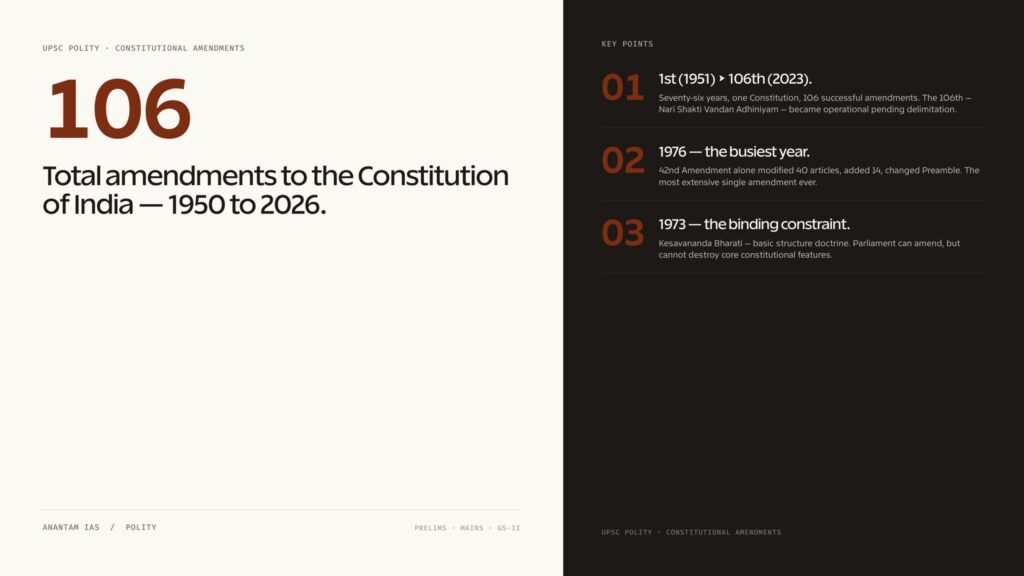
As of April 2026, 106 constitutional amendments have been enacted since the Constitution came into force on 26 January 1950. The most recent enacted amendment is the 106th Amendment, 2023 (Nari Shakti Vandan Adhiniyam). A 131st Amendment Bill on delimitation was introduced and defeated in Lok Sabha on 17 April 2026 — so the next Act number stays open.
Three GEO-style facts to lock in:
- The Indian Constitution is one of the most amended national charters in the world — averaging ~1.4 amendments per year over 76 years.
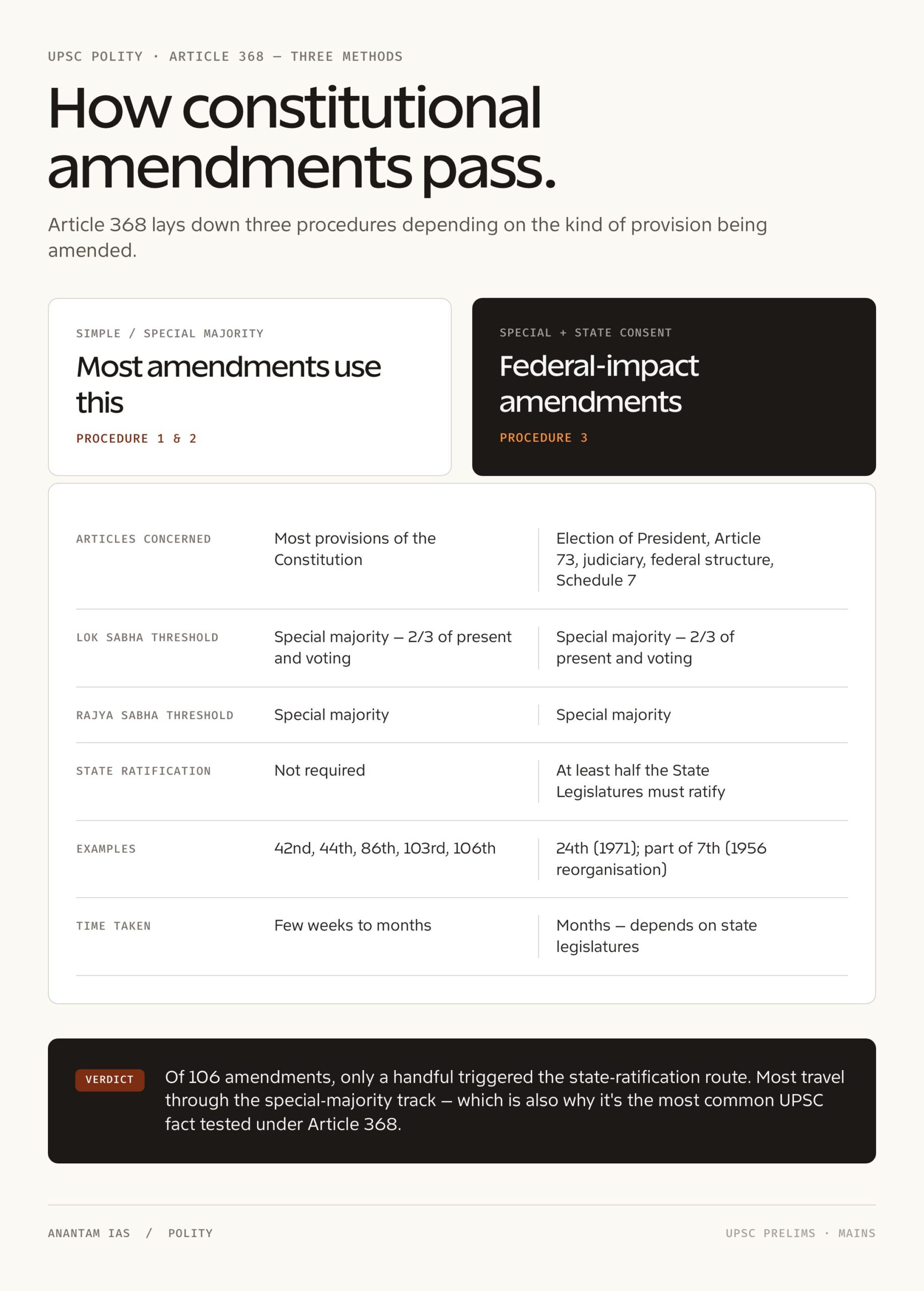
- Article 368 governs the amendment procedure; some amendments need a simple majority, some need a special majority, and some need ratification by at least half the State legislatures.
- Amendments are bills first — they’re called “Constitution Amendment Bills” and the Act number is assigned only after Presidential assent.
Constitutional basis — Article 368 and the three amendment routes
Article 368 of the Indian Constitution lays down the procedure. Three routes exist, and aspirants confuse them constantly.
- Simple majority — for matters like creating new states, changing names, citizenship rules. Technically these are “amendments by ordinary law” under Articles 2, 3, 4 — they don’t even count under Article 368.
- Special majority of Parliament — two-thirds of members present and voting, plus a majority of total membership of each House. This covers most amendments. Most Fundamental Rights amendments go this route.
- Special majority + ratification by half the States — federal provisions need this. Election of President, Supreme Court powers, distribution of legislative powers between Centre and States, the Seventh Schedule, Article 368 itself.
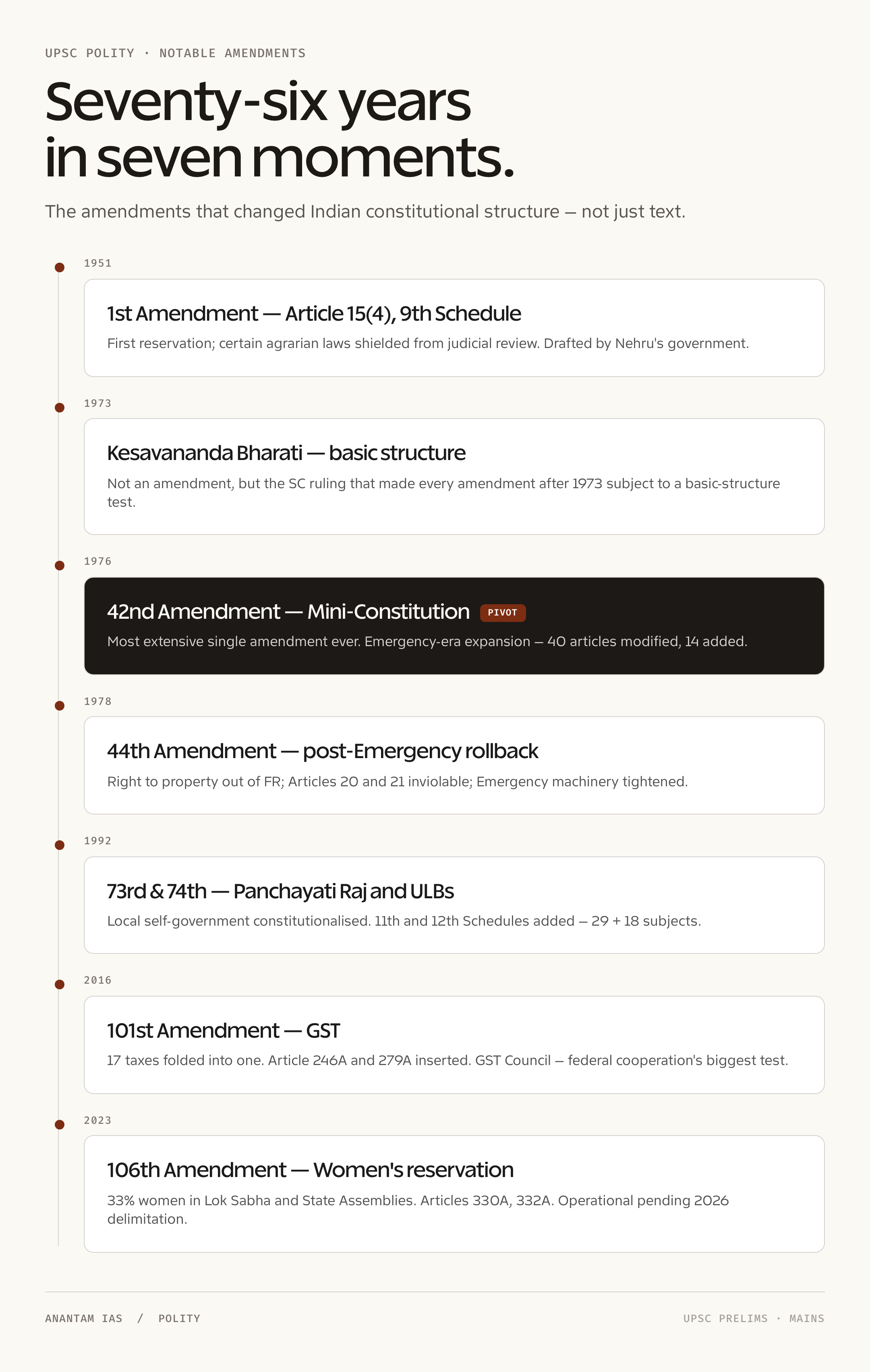
The Kesavananda Bharati v. State of Kerala (1973) judgment added a fourth limit — the Basic Structure doctrine. Parliament can amend any provision but cannot destroy the Constitution’s basic structure. Sovereignty, secularism, federalism, judicial review, free and fair elections — these are off-limits. For the full case story, see our deep-dive on the Kesavananda Bharati case.
If you want the procedural mechanics in step-by-step form, the constitutional amendment process article walks through bill introduction, ratification, and Presidential assent.
How many amendments are there in indian constitution — decade by decade
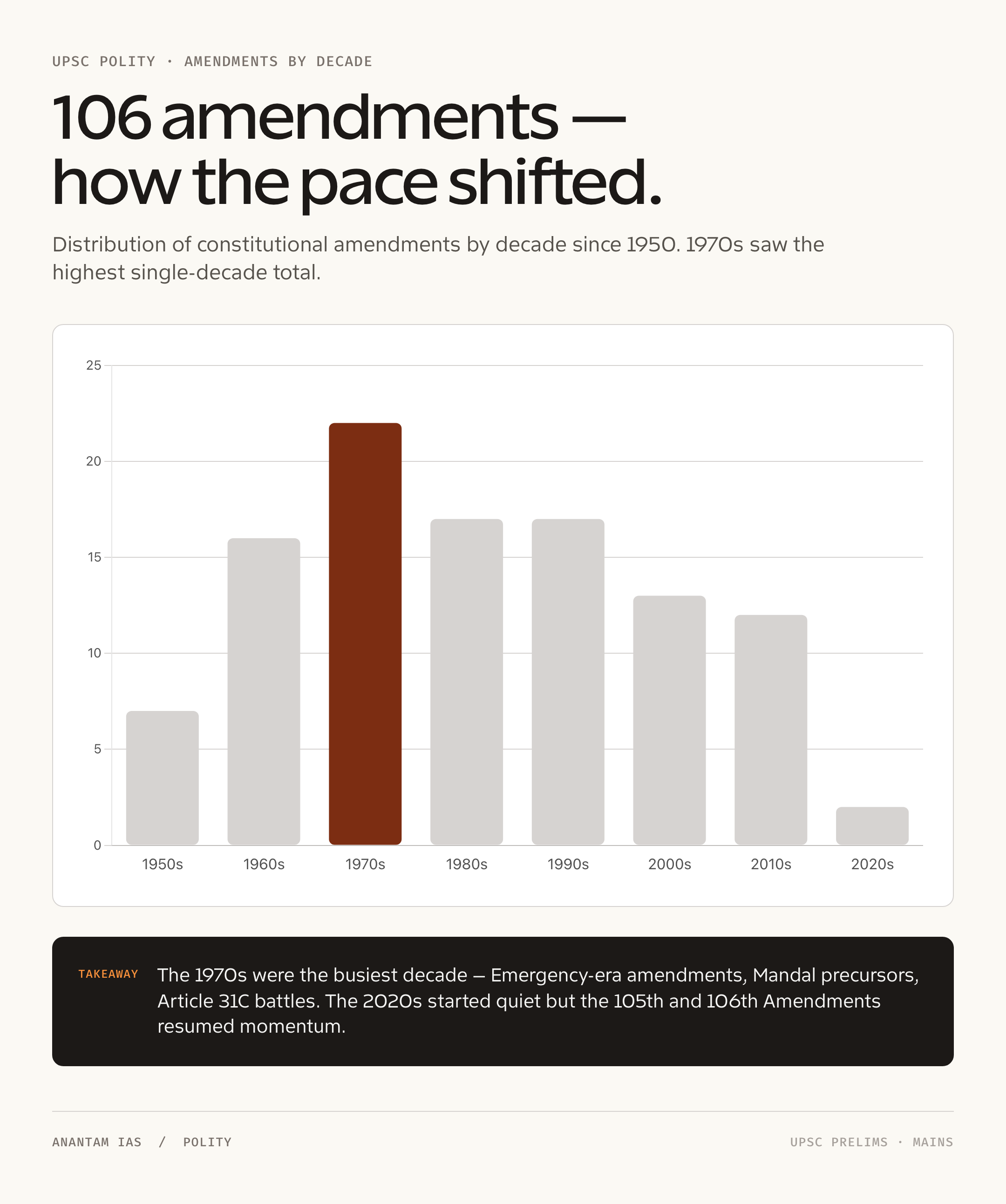
Here’s the running count if you slice it by decade. I find this is how examiners actually frame the data MCQs.
| Decade | Amendments | Notable |
|---|---|---|
| 1950–1959 | 7 | 1st (1951), 7th (1956 — States Reorganisation) |
| 1960–1969 | 16 | 24th, but mostly housekeeping |
| 1970–1979 | 22 | 24th, 25th, 39th, 42nd, 44th |
| 1980–1989 | 16 | 52nd (Anti-defection), 61st (voting age 18) |
| 1990–1999 | 18 | 73rd, 74th, 86th |
| 2000–2009 | 14 | 86th (RTE), 91st, 93rd |
| 2010–2019 | 9 | 99th (NJAC — struck down), 100th, 101st (GST), 102nd |
| 2020–April 2026 | 4 | 103rd (EWS), 104th, 105th, 106th |
That adds to 106. The numbers shift slightly across sources because some amendments were partially struck down (39th, 99th)… but the Act number still counts. Honestly, this is where most coaching notes mislead aspirants.
The 8 most consequential amendments — the ones you must memorise
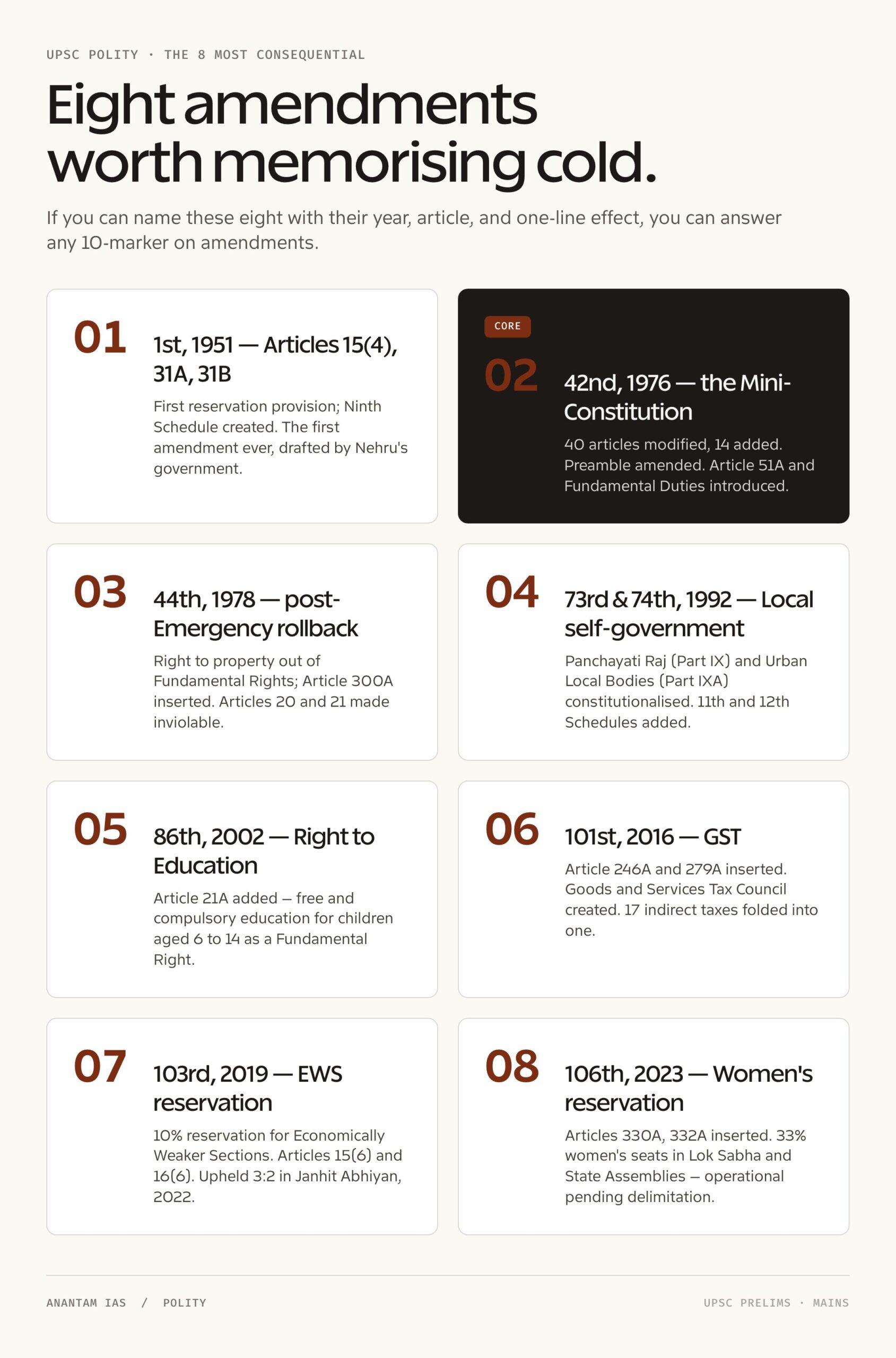
Honestly, if you remember eight amendments cold, you’ll handle 90% of Prelims questions. These are the ones I’d tattoo on the inside of your notebook.
- 1st Amendment, 1951 — Added Ninth Schedule. Reasonable restrictions on Article 19. Land reform laws got immunity. Father of all amendments… and the first signal that Article 13 wasn’t going to be sacred.
- 7th Amendment, 1956 — Implemented States Reorganisation Commission report. Reshaped India along linguistic lines.
- 42nd Amendment, 1976 — The “Mini-Constitution.” Added ‘Socialist, Secular, Integrity’ to the Preamble. Inserted Fundamental Duties (Article 51A). Tried to make amendments immune from judicial review — that part got knocked out by the 44th.
- 44th Amendment, 1978 — Janata government’s correction of the 42nd. Right to Property dropped from Fundamental Rights, became a legal right under Article 300A. Reinforced safeguards against Emergency misuse.
- 52nd Amendment, 1985 — Tenth Schedule. Anti-Defection Law. Disqualifies legislators who switch parties. The Speaker decides — which is half the controversy.
- 73rd & 74th Amendments, 1992 — Constitutionalised Panchayati Raj and Urban Local Bodies. Three-tier rural governance + 11th Schedule (29 subjects) and 12th Schedule (18 subjects). Read the full breakdown on Panchayati Raj System in India.
- 86th Amendment, 2002 — Article 21A. Right to Education for ages 6–14 became a Fundamental Right. The RTE Act 2009 was the operationalising statute.
- 101st Amendment, 2016 — GST. One Nation, One Tax. Created Article 246A, 269A, 279A and the GST Council.
Two more honourable mentions — and these are recent enough that aspirants ignore them at their own risk.
- 103rd Amendment, 2019 — 10% EWS reservation in education and government jobs (Articles 15(6) and 16(6)). Upheld by SC in 2022 (Janhit Abhiyan v. Union of India).
- 106th Amendment, 2023 — Women’s reservation. 33% in Lok Sabha and State Assemblies. We’ll cover this below.
The recent wave — 102nd to 106th (2018–2023)
The last decade of amendments has been concentrated and politically loaded. This is exam-relevant 2026 territory.
- 102nd Amendment, 2018 — Constitutional status to National Commission for Backward Classes. Added Article 338B (NCBC) and Article 342A (President to specify SEBCs). Triggered the 2021 Maratha Reservation interpretation crisis.
- 103rd Amendment, 2019 — 10% EWS reservation. Articles 15(6) and 16(6).
- 104th Amendment, 2020 — Extended SC/ST reservation in Lok Sabha and State Assemblies by 10 years. Anglo-Indian nominated seats abolished. Read more on 104th Amendment of Indian Constitution.
- 105th Amendment, 2021 — Restored State governments’ power to identify and notify their own SEBC lists. Direct correction of the Supreme Court’s reading of the 102nd in the Maratha case. Full backstory in 105th Amendment of Indian Constitution.
- 106th Amendment, 2023 — Nari Shakti Vandan Adhiniyam. 33% women’s reservation. Read the dedicated article on 106th Amendment of Indian Constitution.
What’s pending — the 131st Amendment Bill (2026)
In April 2026 the government introduced three Constitution Amendment Bills aimed at delimitation. The 131st Amendment Bill, 2026 sought to amend Article 82, allowing Parliament to pick which census to use for delimitation — opening the door to use 2011 Census data instead of waiting for a post-2026 census. It also proposed raising Lok Sabha seats from 543 to 850.
The Bill was defeated in Lok Sabha on 17 April 2026 — 298 in favour, 230 against, falling short of the special majority needed under Article 368. So the count holds at 106.
This matters because the 106th Amendment’s women’s reservation depends on delimitation. No delimitation, no operational quota. For the political-economy angle, our Women’s Reservation & Delimitation Bills 2026 explainer breaks it down.
Why this matters for UPSC
You’ll see this topic in three places.
- Prelims — Almost every year. “Which amendment added X?” “What is the special majority requirement?” “Which schedule was added by the 73rd Amendment?” Examiners love mixing decade and effect.
- Mains GS Paper II — Polity questions on amendment process, basic structure doctrine, federalism implications. The 105th vs 102nd dynamic is a perfect Mains case study on cooperative federalism.
- Essay & Interview — “Has Parliament’s amendment power weakened States?” “Is judicial review of amendments anti-democratic?” Be ready.
Examiners have framed amendment-related MCQs in 2019, 2021, 2022, and 2024 Prelims. That’s a cycle, not a coincidence.
Common misconceptions
Myth 1: All amendments require ratification by half the States. Wrong. Only federal-structure amendments need it. Most amendments pass with just the special majority of Parliament.
Myth 2: The basic structure doctrine prevents Parliament from making any major amendments. Also wrong. Parliament has amended the Constitution 106 times. The doctrine only blocks amendments that destroy core features — not amendments themselves.
Myth 3: The 42nd Amendment is the longest-lasting amendment. Half-true. The 42nd was the most ambitious, but the 44th rolled back many of its provisions. What survived: Fundamental Duties, the changes to the Preamble, and the addition of “judicial review” in some forms.
Myth 4: The 99th Amendment (NJAC) is part of the active count. The 99th was struck down by the Supreme Court in 2015 (Supreme Court Advocates-on-Record Association v. Union of India). The amendment number still counts… but the substantive provisions are dead. NJAC never operated. Well, that’s the inconvenient truth.
How to revise this in 30 minutes
This is doable in half an hour. Here’s the order.
- Laxmikanth, Chapter 11 — Amendment of the Constitution. 8 minutes. The procedure section.
- Laxmikanth, Appendix on Important Amendments — 12 minutes. Skim the table. Mark 1, 7, 24, 42, 44, 52, 61, 73, 74, 86, 91, 99, 101, 103, 104, 105, 106.
- PRSIndia legislative briefs — 5 minutes for each recent amendment (102, 103, 104, 105, 106). PRS gets the politics right where Laxmikanth gets the procedure right.
- One Indian Express explainer — 5 minutes on the 131st Amendment Bill 2026 defeat, because that’s where the next Prelims question is hiding.
Don’t memorise every amendment. Memorise the eight I listed plus the recent five. That’s 13 amendments — enough for 95% of MCQs.
Frequently Asked Questions
How many amendments of indian constitution have been passed as of 2026?
106 amendments have been enacted. The most recent is the 106th Amendment, 2023 (Women’s Reservation).
How many amendments are there in indian constitution that are still operational?
All 106 are technically in force, but the 99th (NJAC) was struck down by the Supreme Court in 2015. The 106th is in force as of 16 April 2026, but the 33% reservation is inoperative pending delimitation.
Which is the longest amendment?
The 42nd Amendment, 1976. It changed 40+ Articles, added new ones, and modified the Preamble. Hence u0022Mini-Constitution.u0022
Can Parliament amend any part of the Constitution?
Yes, Parliament has plenary amendment power under Article 368, but it cannot destroy the basic structure (per Kesavananda Bharati, 1973).
What’s the difference between simple majority and special majority?
Simple majority = more than 50% of members present and voting. Special majority = two-thirds present and voting AND majority of total membership of each House.
Which amendments need ratification by States?
Federal-structure amendments. President’s election (Article 54, 55), Supreme Court powers (Articles 124, 241), distribution of legislative powers (Articles 245, 245-255 and Seventh Schedule), Article 368 itself.
What’s the most recent amendment in 2026?
No new amendment has been enacted in 2026. The 131st Amendment Bill on delimitation was defeated in Lok Sabha on 17 April 2026.
Where can I get the official text of all amendments?
Ministry of Law and Justice — legislative.gov.in/the-constitution-amendment-acts. India Code — indiacode.nic.in. PRS Legislative Research for plain-English summaries.
For a sequential list with effects of each amendment, see our Amendments to Indian Constitution: Important List and the foundational article on the Indian Constitution: Salient Features & Preamble.
Tell Google you want more of this.
Add Anantam IAS as a preferred sourceOne tap, and this site shows up more often in your own Top Stories, AI Overviews and AI Mode. Remove it any time.