Disclosure: this guide contains Amazon affiliate links. As an Amazon Associate, Anantam IAS earns from qualifying purchases — at no extra cost to you.
If you searched how many fundamental rights are there in india constitution, you’ve probably hit two contradicting answers — one source says six, another says seven. Old textbooks say seven. UPSC Prelims keys since 2014 say six. The discrepancy isn’t an error — it’s an unrevised textbook. The 44th Constitutional Amendment, 1978 changed the count and most Class 9 civics books quietly forgot to update. I’ve seen aspirants lose 2 marks in Prelims because they trusted a 1990s reference. This article gives you the one-line answer, the full disambiguation, and the article-number proof so you never get caught between editions again.
How many fundamental rights are there in india constitution?
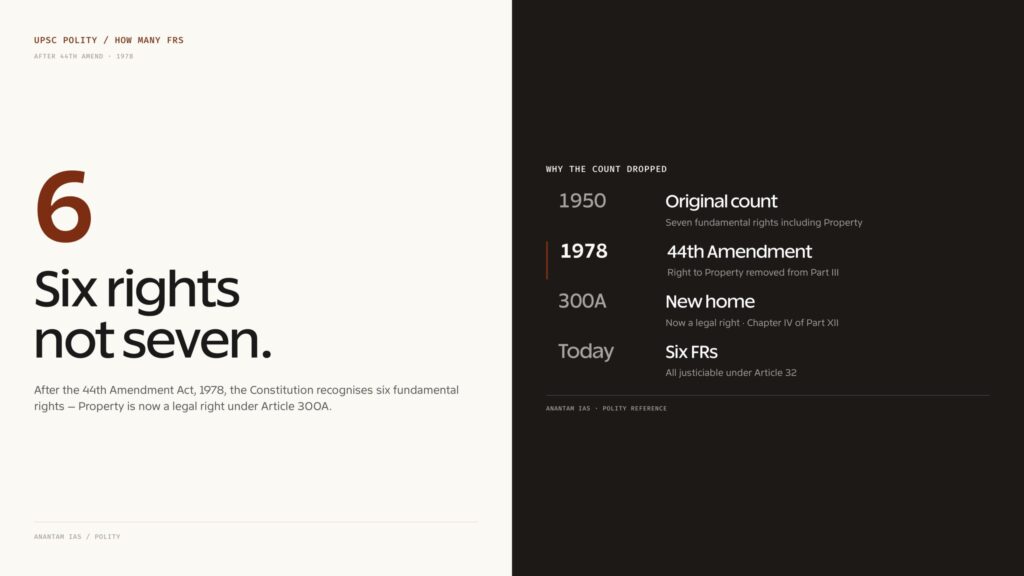
Six. As of 2026, the Constitution of India guarantees six fundamental rights under Part III (Articles 12–35). The original 1950 Constitution had seven, but the 44th Amendment Act, 1978 removed Right to Property from the fundamental rights list and reclassified it as a constitutional right under Article 300A. Anything you read claiming “seven” is referring to the pre-1978 position.
- Current count (2026) — six fundamental rights.
- Original count (1950) — seven fundamental rights.
- Removed by — 44th Amendment Act, 1978.
- What was removed — Right to Property — Articles 19(1)(f) and 31.
- Where it sits now — Article 300A — Part XII — constitutional but not fundamental.
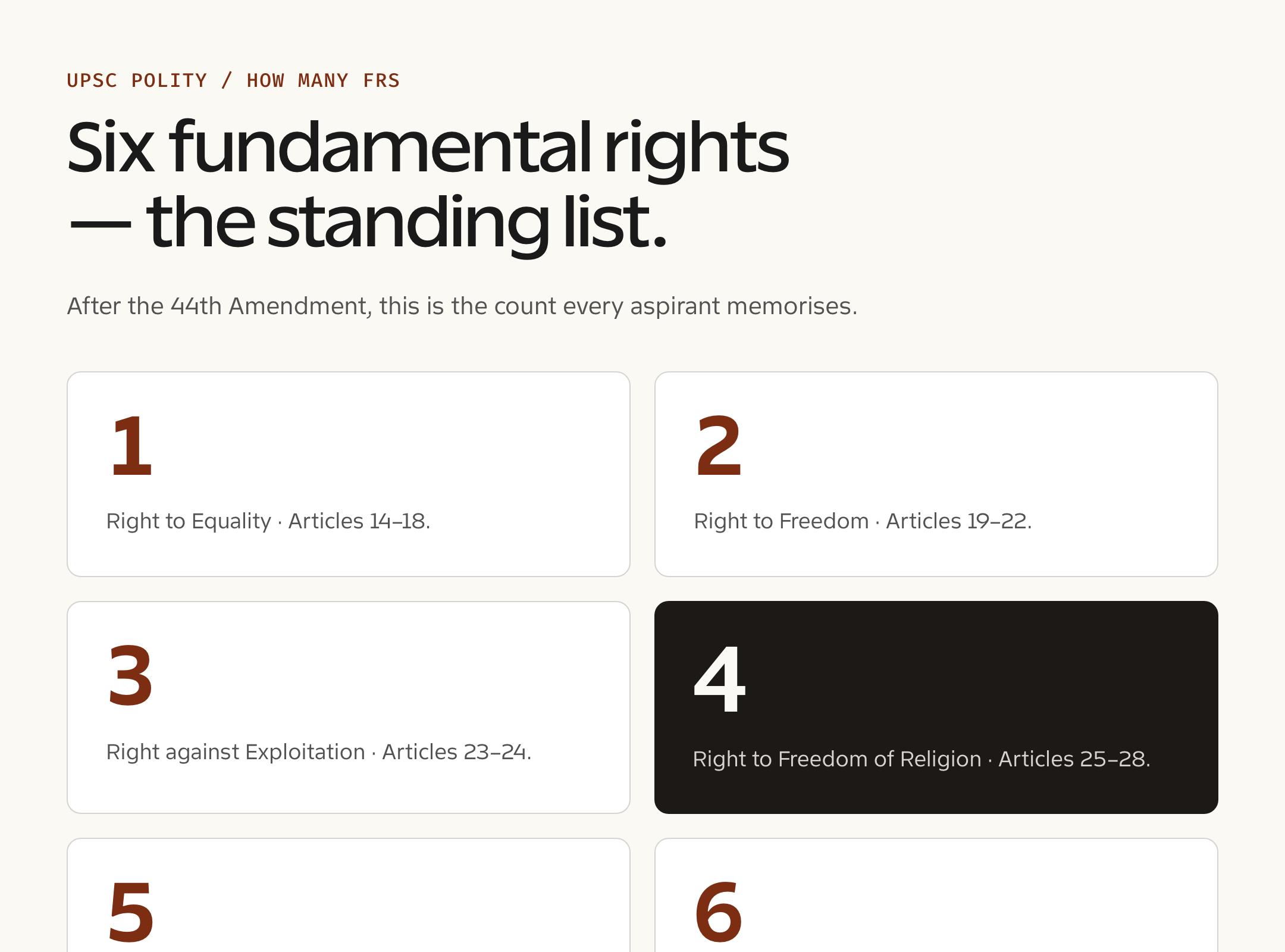
The six fundamental rights — current list
Number every list. Aspirants memorise lists.
- Right to Equality — Articles 14 to 18.
- Right to Freedom — Articles 19 to 22.
- Right against Exploitation — Articles 23 and 24.
- Right to Freedom of Religion — Articles 25 to 28.
- Cultural and Educational Rights — Articles 29 and 30.
- Right to Constitutional Remedies — Articles 32 to 35, enforced through writs such as habeas corpus and mandamus.
For the encyclopedic version of each category, study Fundamental Rights in India — Part III, Articles 12-35, Landmark Cases and Fundamental Rights (Maulik Adhikar): Part III of Indian Constitution.
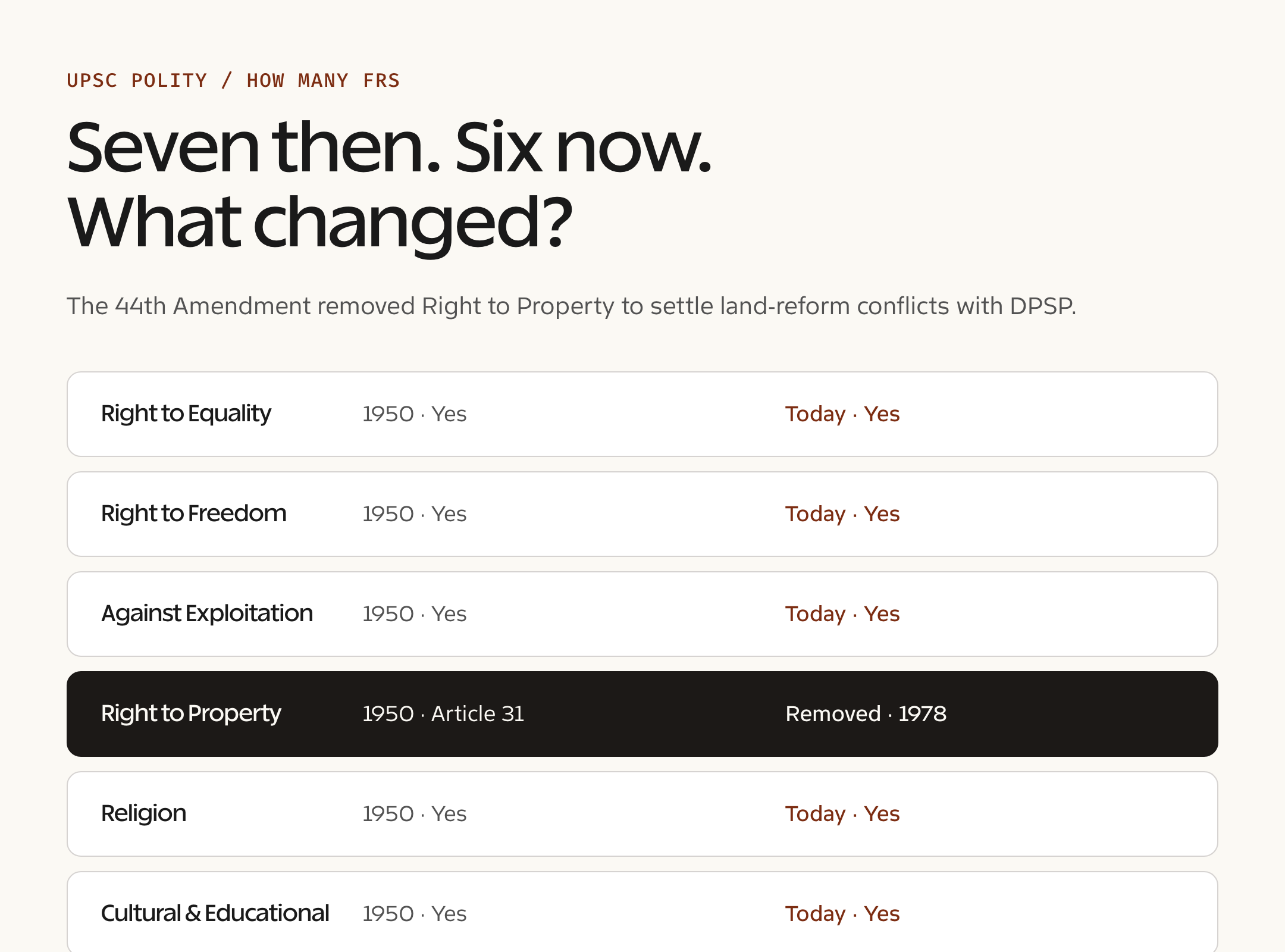
Why some sources still say “seven”
The original Constitution of 1950 listed seven fundamental rights. The seventh was the Right to Property, distributed across two articles:
- Article 19(1)(f) — Right of citizens to acquire, hold, and dispose of property.
- Article 31 — No deprivation of property except by authority of law; compensation for compulsory acquisition.
This right caused friction from the start. Land reform legislation, urban property regulation, and abolition of zamindari kept colliding with Article 31. Parliament passed multiple amendments — the 1st, 4th, 17th, 25th, 39th, 42nd — each chipping away at the property right to make socio-economic legislation easier to enact. By the mid-1970s the right was already weak. The 44th Amendment Act, 1978 made it official.
Year + Subject + Effect: 1978 — 44th Amendment — removed Right to Property from Part III; inserted Article 300A in Part XII.
So if your reference book was printed before 1979, it’ll say seven. After 1978, the correct answer is six.
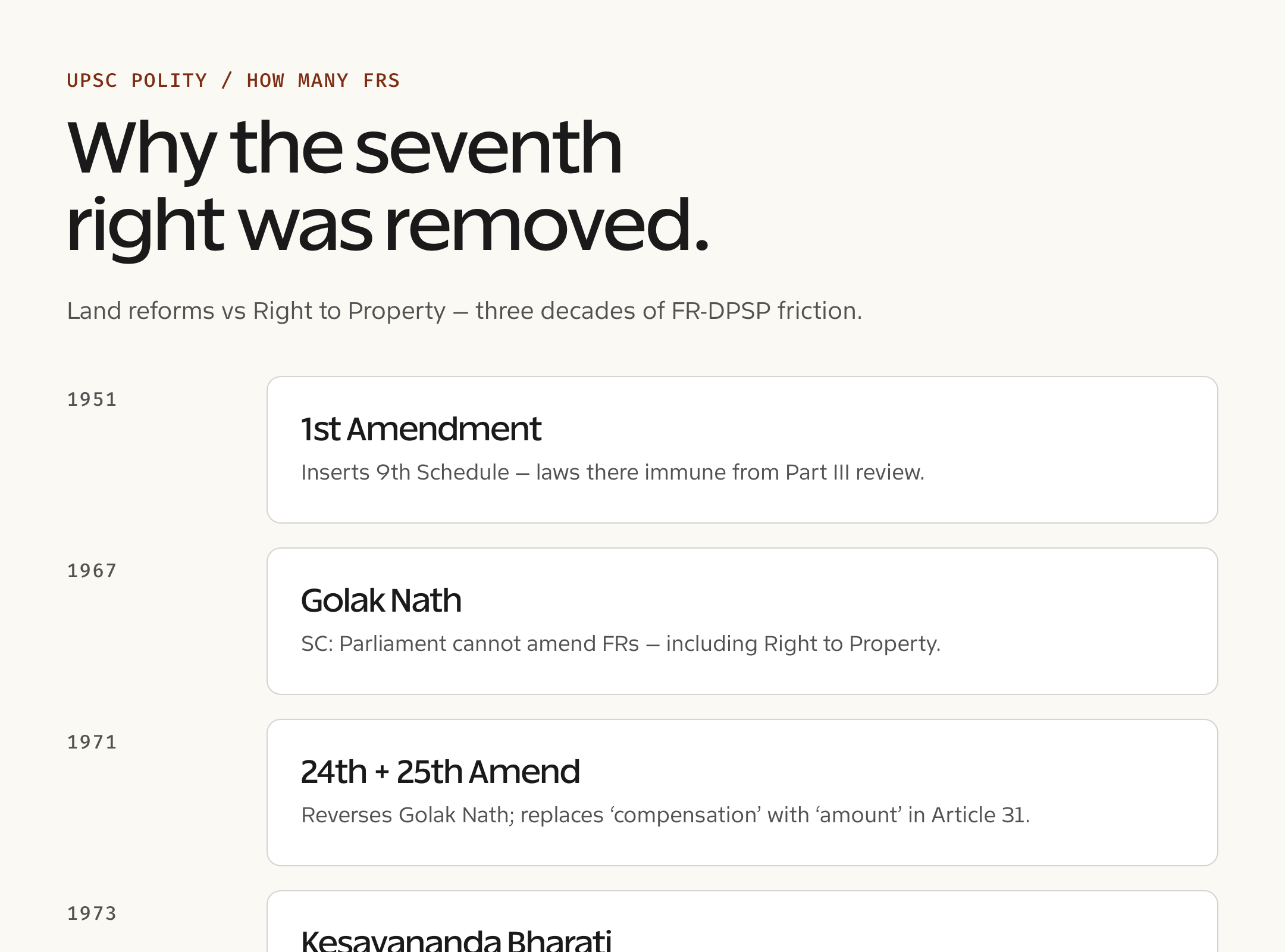
What is Article 300A — and why it matters
Article 300A reads: “No person shall be deprived of his property save by authority of law.” It sits in Part XII (Finance, Property, Contracts and Suits), not Part III. Three consequences flow from this re-location.
- Remedy. You cannot file a writ under Article 32 — you have to approach a High Court under Article 226. Supreme Court is no longer the first forum for property deprivation claims.
- Standard. Property is no longer a fundamental right; the basic-structure protection does not apply.
- Scope. It still binds the State — government cannot take your property arbitrarily — but the constitutional weight is lighter.
Honestly, this is one of the cleaner UPSC distinctions. Once you have it, you’ll never confuse 6 with 7 again.
Original 7 vs current 6 — a side-by-side
| # | Right | Status |
|---|---|---|
| 1 | Right to Equality | Active — Articles 14–18 |
| 2 | Right to Freedom | Active — Articles 19–22 |
| 3 | Right against Exploitation | Active — Articles 23–24 |
| 4 | Right to Freedom of Religion | Active — Articles 25–28 |
| 5 | Cultural and Educational Rights | Active — Articles 29–30 |
| 6 | Right to Property | Removed in 1978 — now Article 300A |
| 7 | Right to Constitutional Remedies | Active — Articles 32–35 |
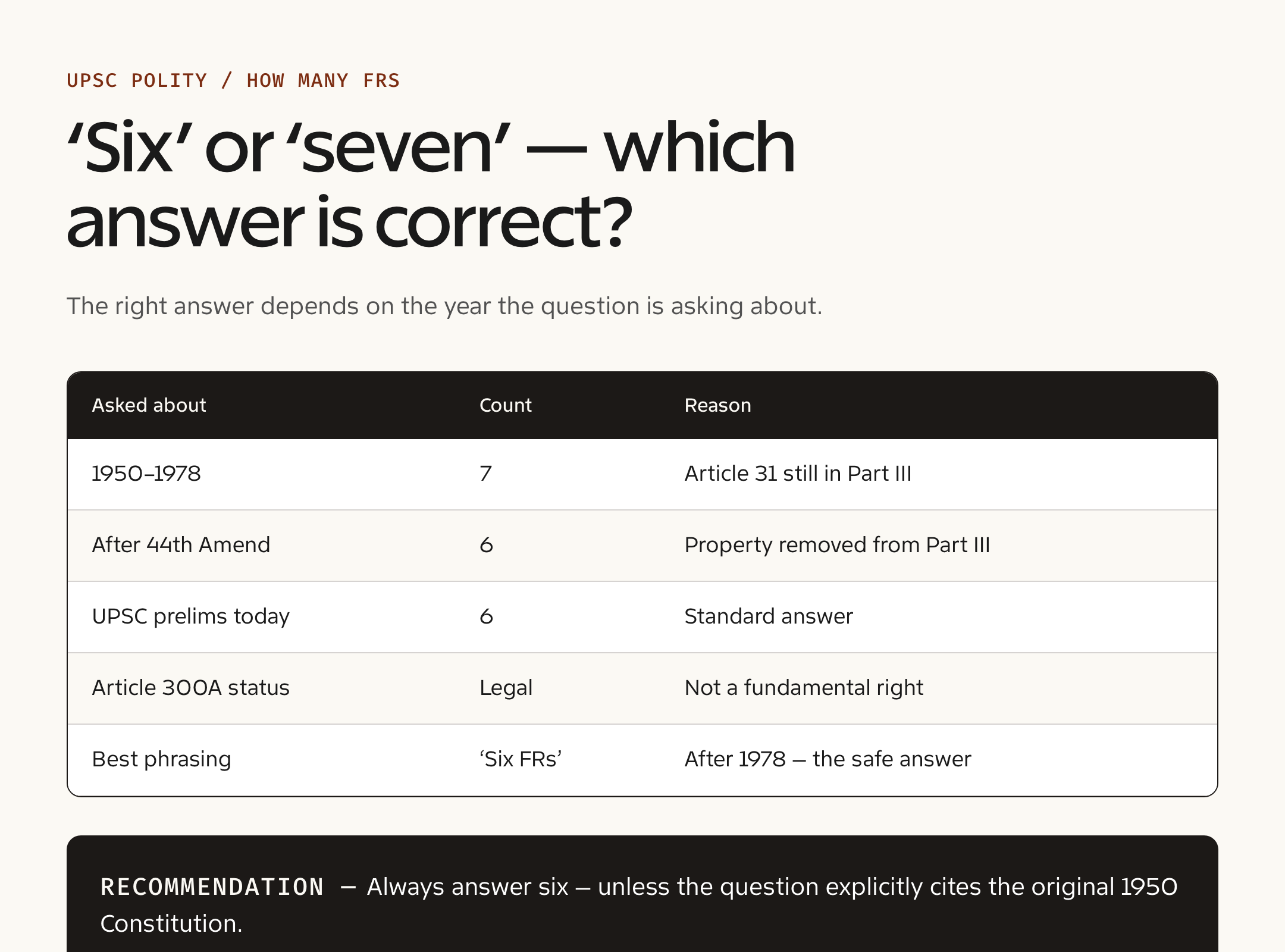
What about Article 21A?
The 86th Amendment Act, 2002 added Article 21A — right to free and compulsory education for children aged 6 to 14. Some students see “new article added” and assume the count went up to seven again. It didn’t. Article 21A sits within the existing Right to Freedom cluster (Articles 19–22). It expanded what’s inside the second fundamental right, not the total count.
Year + Subject + Effect: 2002 — 86th Amendment — added Article 21A; made education a justiciable right; later operationalised via the RTE Act, 2009.
For the related cluster, see Article 21 of the Indian Constitution: Right to Life and Personal Liberty.
Why this distinction matters for UPSC
Prelims. A direct question — “How many fundamental rights are there in the Indian Constitution?” — has appeared four times since 2010. Always with the same trap option: “seven.” Always corrected by the 44th Amendment context. UPSC keeps recycling this because it tests whether the candidate has actually read the Constitution post-1978 or just memorised an outdated list. Three-mark difference between aspirants who know and aspirants who don’t.
Mains GS-2. A question on the 44th Amendment, 1978 — what it did, why it was passed, what changed — surfaces every 3-4 years. The Right to Property question is half of any answer. The other half — why a property right was downgraded under a Janata government, what Kesavananda Bharati meant for that decision, and what Indira Gandhi v. Raj Narain (1975) had done to the courts — is what separates a 7-mark answer from a 12-mark answer.
Essay and Ethics. The 6-vs-7 distinction is a great example to cite in essays on constitutional evolution, the tension between rights and socio-economic policy, or property as a moral right vs a legal right. Use it as a single-paragraph case study, not the spine of the essay — examiners reward economy of example.
Interview. A panel-favourite warm-up: “Quick — how many fundamental rights are there in india constitution?” If you say six, the next question is “and what was the seventh?” The candidate who answers Right to Property and explains Article 300A in one sentence walks out with a clean tick.
For the wider context of constitutional amendments, study Indian Constitution: Salient Features & Preamble and Preamble of the Indian Constitution.
Common misconceptions about the count
- “There are seven fundamental rights in the Indian Constitution.” Outdated. After the 44th Amendment, 1978, there are six. Right to Property is no longer fundamental.
- “Right to Property was abolished entirely.” No. It was downgraded — moved from Part III (fundamental right) to Article 300A (constitutional right). It still binds the State but no longer carries fundamental-right protections.
- “Article 21A added a new fundamental right.” Misleading. Article 21A expanded the Right to Freedom cluster but did not add a new category. Total count is still six.
- “The Supreme Court can hear all property-related cases.” Not anymore. Since 1978, property deprivation claims go to High Courts under Article 226, not directly to the Supreme Court under Article 32.
How to revise this in 15 minutes
This is the shortest revision in Polity if you do it right.
- Memorise the six categories with article ranges. 5 minutes.
- Memorise one fact about the 44th Amendment — year (1978), what it removed (Right to Property), where it parked it (Article 300A). 3 minutes.
- Memorise one fact about the 86th Amendment — year (2002), what it added (Article 21A on education), why count stays six. 3 minutes.
- Read PRS or Indian Express on the latest property-rights ruling — refresh on 2024–2025 cases under Article 300A. 4 minutes.
Source priority: Laxmikanth → NCERT Class 11 Indian Constitution at Work → PRS Legislative Brief.
Frequently Asked Questions
How many fundamental rights are there in india constitution in 2026?
Six. The Constitution originally listed seven, but the 44th Amendment Act, 1978 removed Right to Property and reclassified it as a constitutional right under Article 300A.
Which fundamental right was removed?
Right to Property — earlier protected under Article 19(1)(f) and Article 31. Both articles were repealed by the 44th Amendment, 1978.
Where does Right to Property sit now?
Under Article 300A in Part XII of the Constitution. It is a constitutional right — not a fundamental right.
Did the 86th Amendment add a seventh fundamental right?
No. The 86th Amendment, 2002 added Article 21A on right to education, but it sits within the existing Right to Freedom cluster. The total count remains six.
Which is the most important fundamental right?
Article 32 — the Right to Constitutional Remedies — was called the u0022heart and soulu0022 of the Constitution by Dr B.R. Ambedkar. It allows direct approach to the Supreme Court.
Are fundamental rights absolute?
No. Each right carries reasonable restrictions. Article 19’s freedoms have explicit grounds for restriction in clauses (2) to (6).
Can fundamental rights be amended?
Yes — but Parliament cannot destroy the basic structure of the Constitution. The doctrine was established by the 1973 Kesavananda Bharati judgment. See Kesavananda Bharati Case (1973): Basic Structure Doctrine Explained.
Tell Google you want more of this.
Add Anantam IAS as a preferred sourceOne tap, and this site shows up more often in your own Top Stories, AI Overviews and AI Mode. Remove it any time.