Introduction
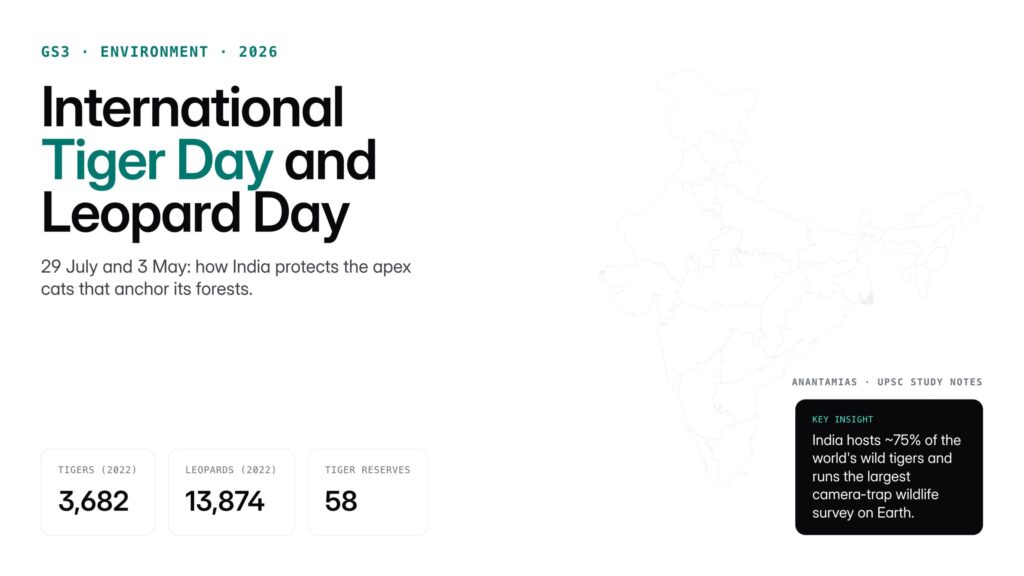
Every 29 July, wildlife agencies, governments and conservation groups mark International Tiger Day to remind the world that the big cat that once roamed from the Caspian shore to the Sunda Islands is still clinging to survival. For aspirants preparing the UPSC Civil Services Examination, the day is not just a calendar entry. It is a convenient hook to revise Project Tiger, the National Tiger Conservation Authority (NTCA), the All India Tiger Estimation cycle, the Global Tiger Forum, and India’s growing role as home to roughly three out of every four wild tigers on the planet.
Sitting alongside this flagship observance is International Leopard Day on 3 May, first observed in 2023 after a campaign by the Cape Leopard Trust and partners. The leopard is India’s most adaptable big cat, found from the sugarcane belts of Maharashtra to the cold rocks of Ladakh, and the 2022 Status of Leopards report placed the Indian population at 13,874 animals. Together, the two days frame a single syllabus-friendly theme: how a developing country with 1.4 billion people manages to keep the apex predators of its forests alive.
Quick Facts at a Glance
| Item | International Tiger Day | International Leopard Day |
|---|---|---|
| Date | 29 July | 3 May |
| First observed | 2010 | 2023 |
| Origin | St Petersburg Tiger Summit, Russia | Cape Leopard Trust campaign |
| Flagship species | Panthera tigris | Panthera pardus |
| India population (latest) | 3,682 (2022) | 13,874 (2022) |
| IUCN status | Endangered | Vulnerable |
| CITES listing | Appendix I | Appendix I |
| WPA 1972 Schedule | Schedule I | Schedule I |
| Lead Indian agency | NTCA, MoEFCC | WII, MoEFCC |
Background and Historical Context
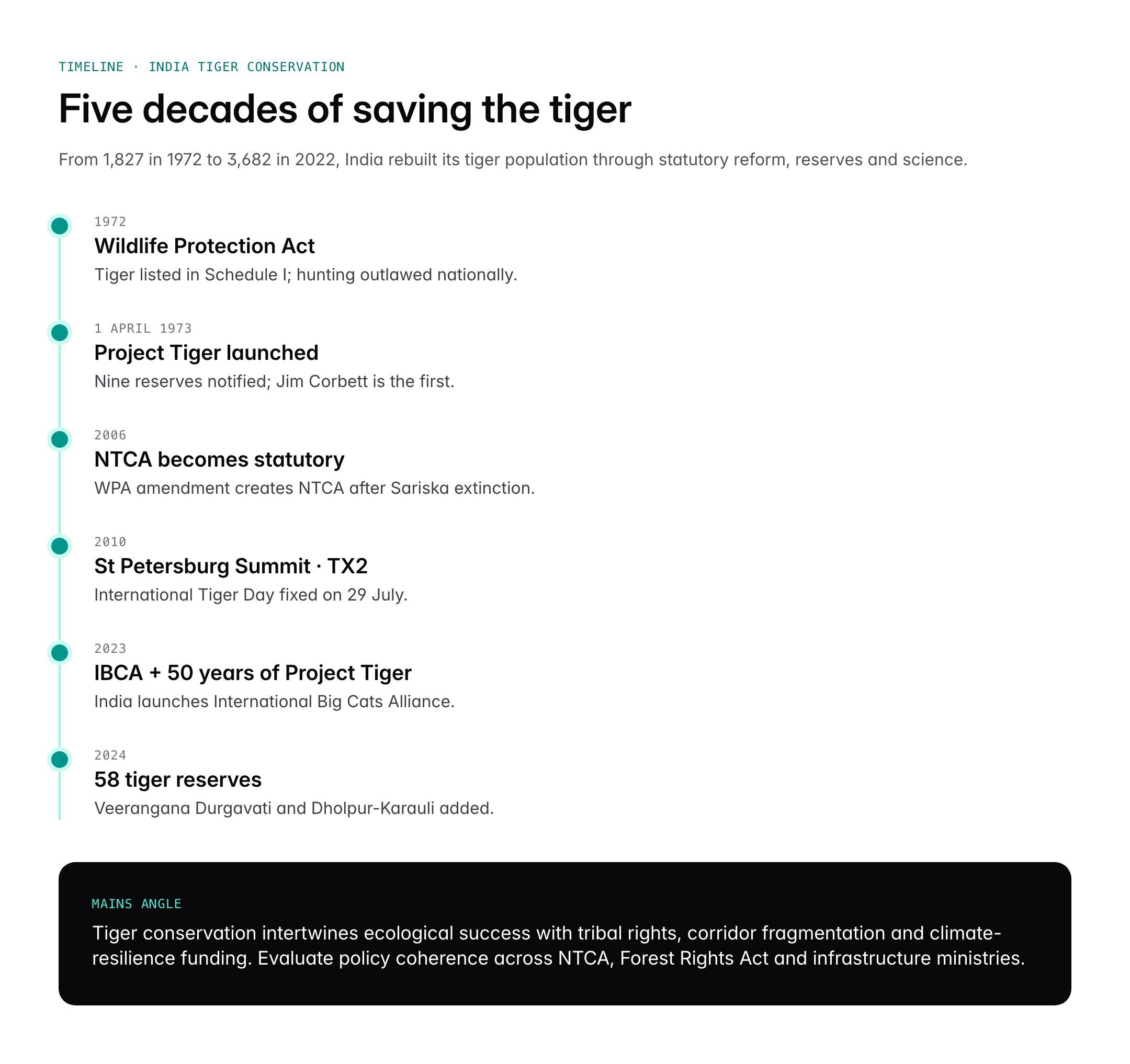
International Tiger Day was born at the St Petersburg Tiger Summit convened by Russian President Vladimir Putin in November 2010. Leaders of the 13 tiger range countries adopted the Global Tiger Recovery Programme with a headline goal called TX2, short for doubling the world’s wild tiger population by 2022, the next Chinese zodiac Year of the Tiger. The summit fixed 29 July as an annual day of advocacy. At the time the global wild tiger count had collapsed to roughly 3,200 from an estimated 1,00,000 at the start of the twentieth century.
India’s engagement predates the summit. After a 1972 census by Kailash Sankhala revealed fewer than 1,827 tigers, Prime Minister Indira Gandhi launched Project Tiger on 1 April 1973 at Jim Corbett National Park with nine reserves. The Wildlife (Protection) Act, 1972 had already given the tiger Schedule I status. The NTCA was created as a statutory body in 2006 through an amendment to the Act, following the embarrassing local extinction at Sariska. Today India runs 58 notified tiger reserves covering over 82,000 square kilometres.
International Leopard Day has a much shorter history. The Cape Leopard Trust, Panthera and Saving the Survivors proposed it in 2022 and the first observance fell on 3 May 2023. The date was chosen because leopards, unlike tigers, had no dedicated global day despite declines of as much as 75 percent in parts of Africa and near-extinction of the Javan and Arabian sub-species. In India, the Wildlife Institute of India‘s quadrennial leopard estimation, run alongside the tiger census, provides the backbone of the national dataset.
Key Features and Conservation Architecture
Project Tiger and NTCA
Project Tiger is a centrally sponsored scheme of the Ministry of Environment, Forest and Climate Change. It funds core-buffer tiger reserves, anti-poaching camps, the Special Tiger Protection Force, voluntary village relocation from critical tiger habitats, and the use of M-STrIPES (Monitoring System for Tigers: Intensive Protection and Ecological Status) for patrol tracking. The NTCA approves tiger conservation plans, notifies new reserves on recommendation of state governments and lays down normative standards.
All India Tiger Estimation
The All India Tiger Estimation is conducted every four years by the NTCA and the Wildlife Institute of India. The 2022 cycle, released in 2023, estimated 3,682 tigers (upper bound 3,925) using camera traps at 32,588 locations and the largest wildlife survey by area anywhere in the world. It also won a Guinness World Record for the 2018 edition.
Global Tiger Forum and CA|TS
The Global Tiger Forum headquartered in New Delhi is the only intergovernmental body devoted exclusively to tigers. Conservation Assured | Tiger Standards (CA|TS) is an accreditation system; 14 Indian reserves have achieved CA|TS status, including Kaziranga and Sundarbans.
Leopard Framework
Leopards are not covered by a dedicated scheme but benefit from Project Tiger, Project Snow Leopard (2009) for Panthera uncia in the Himalayas, and the Integrated Development of Wildlife Habitats umbrella. The 2022 Status of Leopards report notes that Madhya Pradesh holds the largest share with 3,907 leopards, followed by Maharashtra with 1,985 and Karnataka with 1,879.
Legal Instruments
The Wildlife (Protection) Act, 1972 penalises hunting of Schedule I species with three to seven years of imprisonment. The CITES Appendix I listing bars international commercial trade. The Convention on Migratory Species and the Convention on Biological Diversity provide a broader multilateral overlay.
Significance for UPSC and General Knowledge
- Tigers and leopards are tagged umbrella species; protecting them conserves entire forest ecosystems, watersheds and climate sinks worth lakhs of crores in ecological services.
- India hosts roughly 75 percent of the world’s wild tigers, giving it disproportionate diplomatic leverage in multilateral biodiversity forums.
- The NTCA is a favourite Prelims topic for its statutory origin under the 2006 amendment.
- Tiger conservation intersects with tribal rights under the Forest Rights Act, 2006, village relocation policy, and the Supreme Court’s Niyamgiri and Sariska jurisprudence.
- Leopard-human conflict in peri-urban belts like Mumbai’s Sanjay Gandhi National Park illustrates the syllabus theme of biodiversity and coexistence.
- India launched the International Big Cats Alliance in 2023 covering seven species including tiger, lion, leopard and snow leopard.
Detailed Analysis: State-wise Distribution and Flagship Reserves
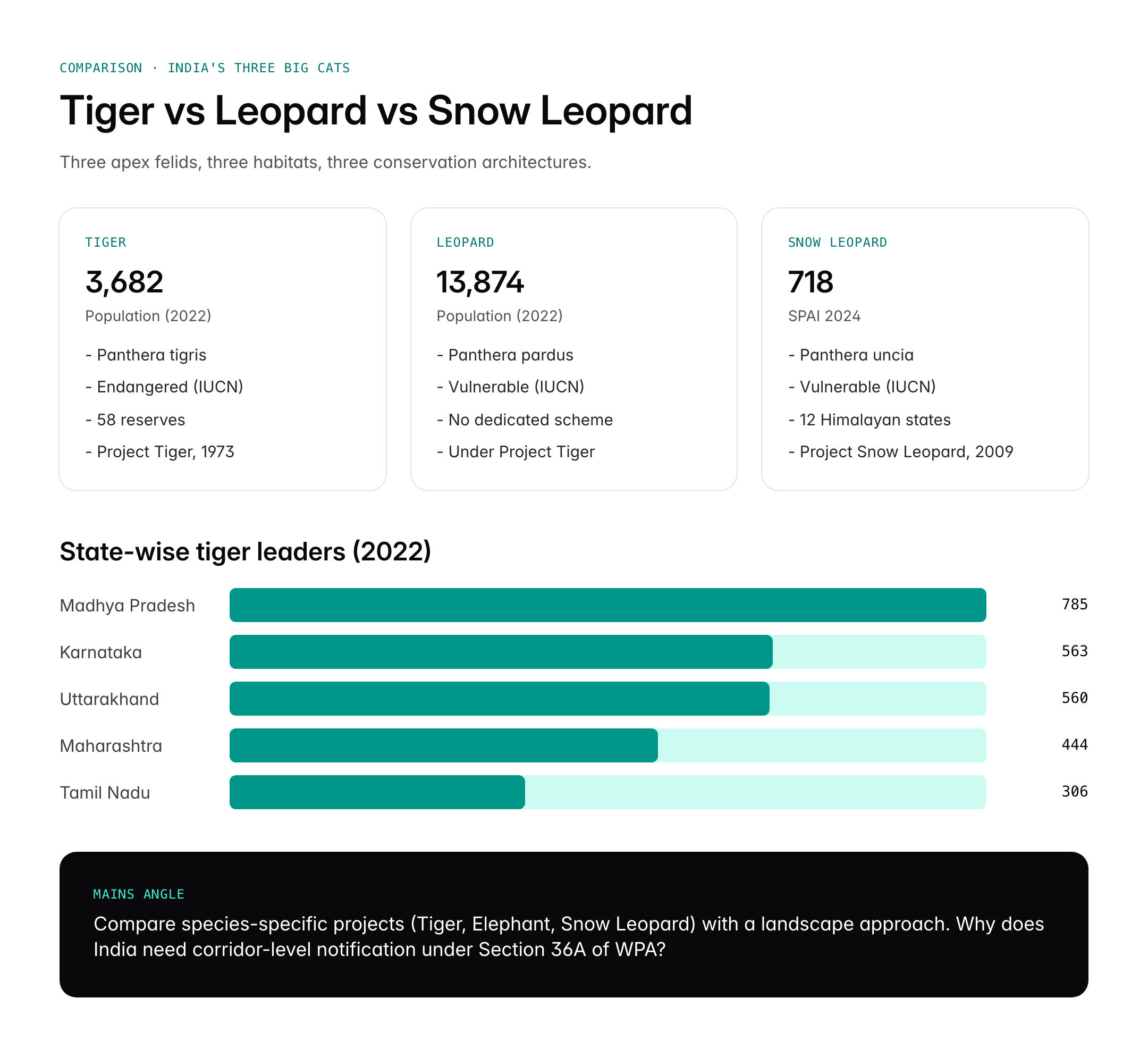
Madhya Pradesh reclaimed the title of Tiger State of India in the 2022 estimation with 785 tigers, ahead of Karnataka at 563, Uttarakhand at 560 and Maharashtra at 444. The Shivalik-Gangetic plains landscape, dominated by Corbett and Rajaji, contains the densest single cluster in the country. Jim Corbett Tiger Reserve alone holds around 260 tigers, the highest for any single reserve worldwide.
The Central Indian and Eastern Ghats landscape, anchored by Kanha, Pench, Bandhavgarh, Satpura, Melghat and Tadoba-Andhari, is the heartland that appears in NCERT and Mains essays. Kanha was the setting for Rudyard Kipling’s Jungle Book. Bandhavgarh records some of the country’s highest tiger densities, crossing 8 per 100 square kilometres. The Western Ghats landscape with Nagarhole, Bandipur, Mudumalai, Wayanad, Periyar and Anamalai forms the second crucial stronghold, boosted by high prey biomass.
The Sundarbans cluster is unique for mangrove-swimming tigers and shared management with Bangladesh. The North East Hills landscape, including Kaziranga, Manas, Namdapha, Pakke and Orang, contributes smaller numbers but holds exceptional gene-flow value. A worrying pocket is the Simlipal–Satkosia belt in Odisha, where the tiger count fell to 20 in 2022, raising questions about habitat fragmentation and mining pressures.
For leopards, the 2022 report estimates 13,874 individuals across tiger-range habitats, a 7.8 percent rise over 2018, although the surveyed area excludes Himalayan high altitudes and the north east where leopards also occur. Madhya Pradesh, Maharashtra, Karnataka and Tamil Nadu host the densest leopard populations. Human-leopard conflict, road kills and poaching for skin and claws remain serious threats; India seizes about 150-200 leopard skins every year according to TRAFFIC data.
Comparative Perspective
| Parameter | Tiger (India) | Leopard (India) | Snow Leopard (India) |
|---|---|---|---|
| Population | 3,682 (2022) | 13,874 (2022) | 718 (SPAI 2024) |
| Range states | 18 | 20+ | 12 Himalayan |
| Flagship scheme | Project Tiger, 1973 | Covered under Project Tiger | Project Snow Leopard, 2009 |
| Major habitat | Sal and teak forests | Scrub, agriculture, urban fringe | Alpine cold desert |
| Primary threat | Poaching, corridor loss | Conflict, road kills | Retaliatory killing, climate |
| IUCN status | Endangered | Vulnerable | Vulnerable |
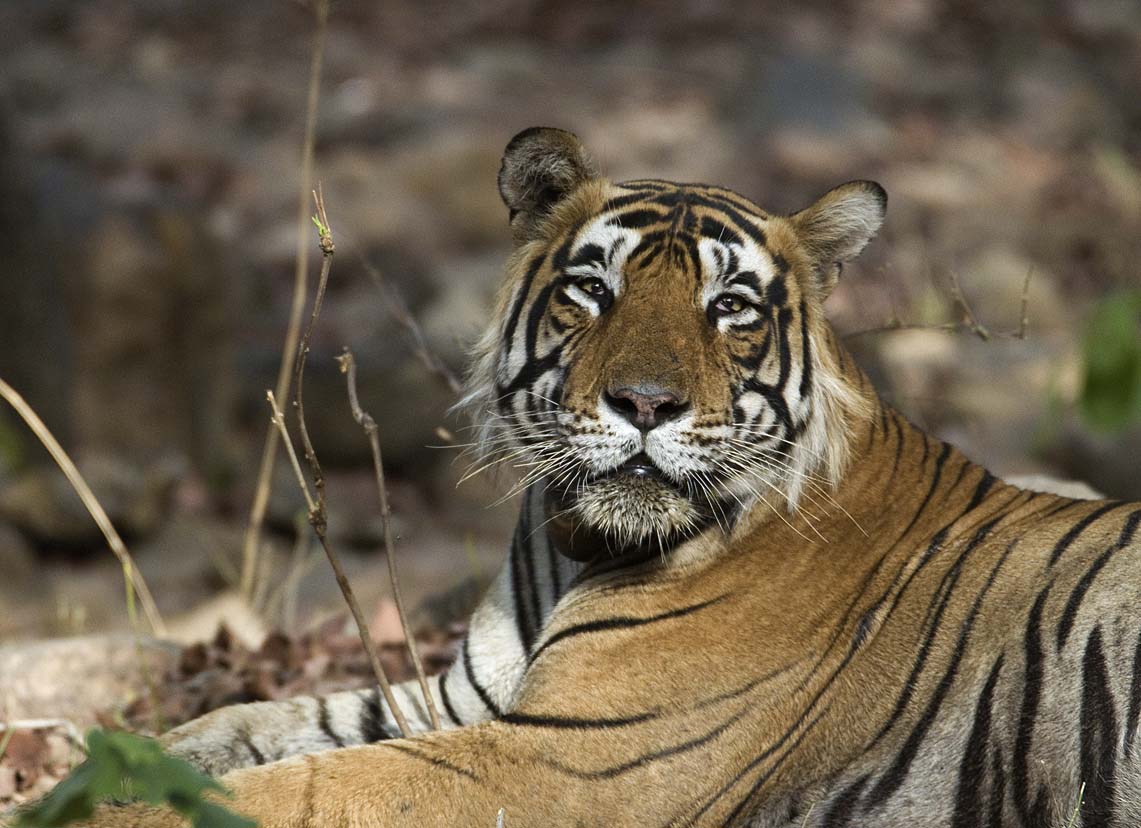
Tigers are strict forest specialists; leopards thrive in mosaic landscapes including sugarcane fields and tea gardens. Snow leopards depend on ibex and blue sheep and occupy elevations above 3,000 metres. This adaptability gradient is why leopards outnumber tigers almost four to one in India even though both species are under similar legal protection.
Challenges and Criticisms
Critics point out that the tiger census remains methodologically contested. Scientists like K Ullas Karanth have argued that the double sampling approach over-weights indirect sign surveys and under-reports statistical uncertainty. The NTCA has responded by moving progressively towards 100 percent camera-trap coverage in tiger-bearing blocks.
Village relocation from core critical habitats has been challenged on human-rights grounds. The Forest Rights Act, 2006 requires free, prior and informed consent before displacement, and Parliamentary Standing Committees have flagged compensation backlogs at reserves like Similipal and Melghat. Infrastructure projects such as the NH-44 widening through Kanha-Pench corridor, coal blocks in Hasdeo Arand near Achanakmar, and the Ken-Betwa river linking near Panna have all raised concerns about corridor fragmentation.
For leopards, the chief criticism is that conservation remains reactive. There is no dedicated recovery plan, no mandatory conflict-compensation standard across states, and the trade in body parts routes through the same networks that service the tiger trade. Wildlife forensic laboratories remain under-resourced, and conviction rates for wildlife crime are below 15 percent.
Prelims Pointers
- International Tiger Day is observed on 29 July, first celebrated in 2010 after the St Petersburg Tiger Summit.
- The TX2 goal aimed to double wild tigers by 2022.
- Project Tiger began on 1 April 1973 at Jim Corbett National Park.
- NTCA is a statutory body created by the 2006 amendment to the Wildlife Protection Act, 1972.
- India had 58 tiger reserves as on 2024; latest additions include Veerangana Durgavati (MP) and Dholpur-Karauli (Rajasthan).
- The 2022 estimate placed India’s tiger count at 3,682, making it roughly 75 percent of global wild tigers.
- Madhya Pradesh is the Tiger State of India with 785 tigers (2022).
- India’s leopard population was 13,874 in 2022; Madhya Pradesh topped with 3,907.
- International Leopard Day was first observed on 3 May 2023.
- India launched the International Big Cats Alliance in April 2023.
- The Global Tiger Forum is headquartered in New Delhi.
- M-STrIPES is the patrol-monitoring tool of the NTCA.
Mains Practice Questions
Q1. “India’s success in tiger conservation is a diplomatic and ecological asset, but it conceals uneven institutional capacity.” Critically examine. (250 words, GS3)
- Recognise India’s 75 percent global share and leadership at GTF, IBCA, CITES; link to soft power and climate narratives.
- Analyse uneven performance: Similipal decline, conflict zones, Project Tiger staff vacancies, state-level CA|TS gaps.
- Suggest reforms: strengthen NTCA compliance audits, fund leopard-specific plan, integrate Forest Rights Act with reserve management, expand IBCA financing.
Q2. Distinguish between Project Tiger, Project Elephant and Project Snow Leopard in terms of mandate, architecture and outcomes. How can India move from species-specific to landscape-level conservation? (250 words, GS3)
- Map each project’s origin, statutory backing, geographic scope and flagship indicators.
- Contrast governance: NTCA is statutory, Project Elephant steering committee is advisory, Project Snow Leopard has state-led plans.
- Recommend ecoregion-based planning, corridor notification under Section 36A of WPA, convergence with climate and tribal welfare funds.
Conclusion
International Tiger Day and International Leopard Day serve a larger didactic purpose than a single calendar headline. They remind governments, citizens and aspirants that conserving apex predators is fundamentally a test of state capacity. India has used the 29 July anniversary to unveil tiger estimations, new reserves and budget allocations, while 3 May is still earning its place in the national conservation calendar.
For UPSC preparation, the two days anchor a dense cluster of static and current topics: NTCA, All India Tiger Estimation, Project Tiger at 50, IBCA, the 2022 leopard report, CITES listings and human-wildlife conflict frameworks. Aspirants who understand the legal, institutional and ecological scaffolding behind the headline numbers will be able to answer both factual Prelims questions and analytical Mains prompts on biodiversity governance.
Frequently Asked Questions
What is International Tiger Day?
International Tiger Day is an annual global observance on 29 July, established at the 2010 St Petersburg Tiger Summit, to raise awareness about tiger conservation. It marks progress on the Global Tiger Recovery Programme and its TX2 goal of doubling wild tigers by 2022. India uses the day to release tiger estimation data and announce new reserves.
Why is International Tiger Day important for UPSC?
The day acts as a hook for multiple syllabus themes: Project Tiger, the statutory NTCA, the Wildlife Protection Act 1972, CITES Appendix I listings, the Global Tiger Forum, the International Big Cats Alliance and the All India Tiger Estimation. It appears regularly in Prelims current affairs and Mains GS3 environment questions.
When is International Leopard Day celebrated?
International Leopard Day is observed on 3 May every year. It was first marked in 2023 after a campaign by the Cape Leopard Trust, Panthera and Saving the Survivors to draw attention to sharp declines of leopards across Africa and Asia and the near extinction of sub-species like the Javan and Arabian leopards.
How is International Tiger Day related to Project Tiger?
Project Tiger, launched on 1 April 1973 at Jim Corbett, is India’s flagship conservation scheme and the institutional backbone referenced on International Tiger Day. The day typically coincides with NTCA announcements, tiger-reserve notifications and the release of the quadrennial All India Tiger Estimation conducted jointly with the Wildlife Institute of India.
What was India’s tiger population in 2022?
The 2022 All India Tiger Estimation, released in 2023, recorded 3,682 tigers with an upper bound of 3,925. This is roughly 75 percent of all wild tigers globally. Madhya Pradesh led with 785 tigers, followed by Karnataka with 563, Uttarakhand with 560 and Maharashtra with 444. The survey covered 32,588 camera-trap locations.
How many tiger reserves does India have?
India has 58 notified tiger reserves covering more than 82,000 square kilometres as of 2024. Recent additions include Veerangana Durgavati in Madhya Pradesh and the Dholpur-Karauli reserve in Rajasthan. Reserves are managed under the NTCA framework with core critical tiger habitats and buffer zones demarcated under Section 38V of the Wildlife Protection Act.
What is the International Big Cats Alliance?
The International Big Cats Alliance is a treaty-based grouping launched by India in April 2023 to coordinate conservation of seven big cat species: tiger, lion, leopard, snow leopard, cheetah, jaguar and puma. It is headquartered in India with a planned secretariat corpus of 800 crore rupees over five years.
What are the main threats to tigers and leopards in India?
Key threats include habitat fragmentation from linear infrastructure, poaching for skins and bones driven by demand in East Asia, prey-base depletion, retaliatory killings after livestock loss, and road and rail mortalities in corridors. Leopards face heightened human conflict because they adapt to sugarcane fields, tea gardens and peri-urban landscapes near cities like Mumbai.
Tell Google you want more of this.
Add Anantam IAS as a preferred sourceOne tap, and this site shows up more often in your own Top Stories, AI Overviews and AI Mode. Remove it any time.