Introduction
Jagadish Chandra Bose (1858–1937) was a polymath Indian scientist whose work spans physics, biophysics, botany, and early radio science. He is widely credited as one of the first to demonstrate wireless transmission of electromagnetic waves, years before Marconi's famous patent, and for pioneering research proving that plants respond to stimuli much like animals. For UPSC aspirants, Bose is a frequent figure in modern Indian history, science and technology, and personalities sections.
This guide covers his life, major inventions, scientific legacy, institutions he founded, honours received, and his UPSC significance.
Early Life and Education
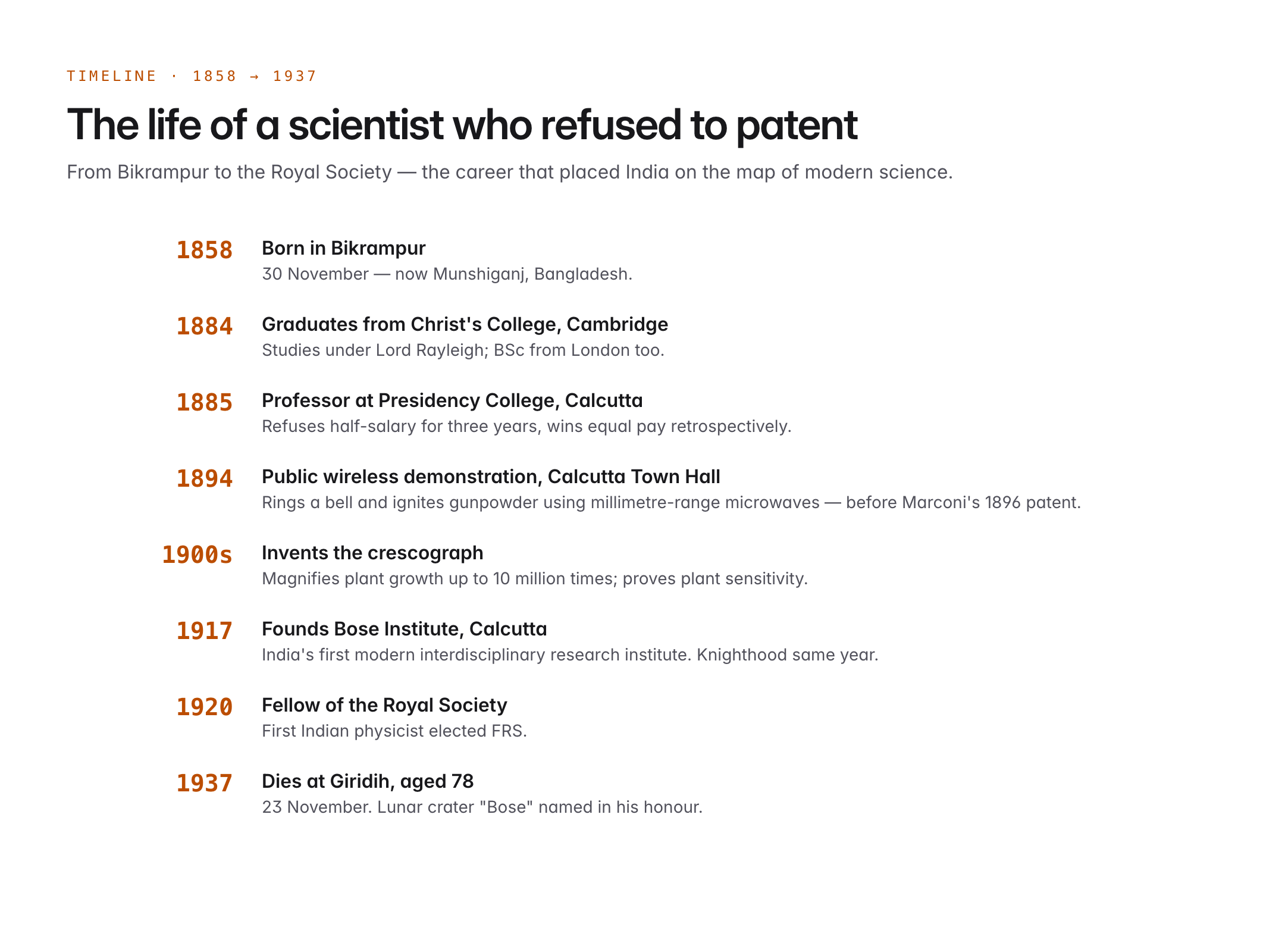
- Born: 30 November 1858 in Bikrampur (now Munshiganj, Bangladesh).
- Father: Bhagawan Chandra Bose, a deputy magistrate and nationalist influence.
- Schooling: Attended a vernacular school before St Xavier's School and College in Calcutta, where Father Eugene Lafont inspired his interest in natural sciences.
- Higher studies: Went to Christ's College, Cambridge, studied under luminaries like Lord Rayleigh, and graduated in Natural Sciences (1884). Also earned a BSc from the University of London.
On returning to India he was appointed officiating professor of physics at Presidency College, Calcutta (1885) — initially on a discriminatory half salary, which he refused for three years until the college granted him equal pay retrospectively.
Pioneering Work on Electromagnetic Waves
In November 1894, at the Calcutta Town Hall, Bose publicly demonstrated wireless signalling — he rang a bell and ignited gunpowder at a distance using millimetre-range microwaves. His demonstration preceded Marconi's first patent (1896).
Key contributions:
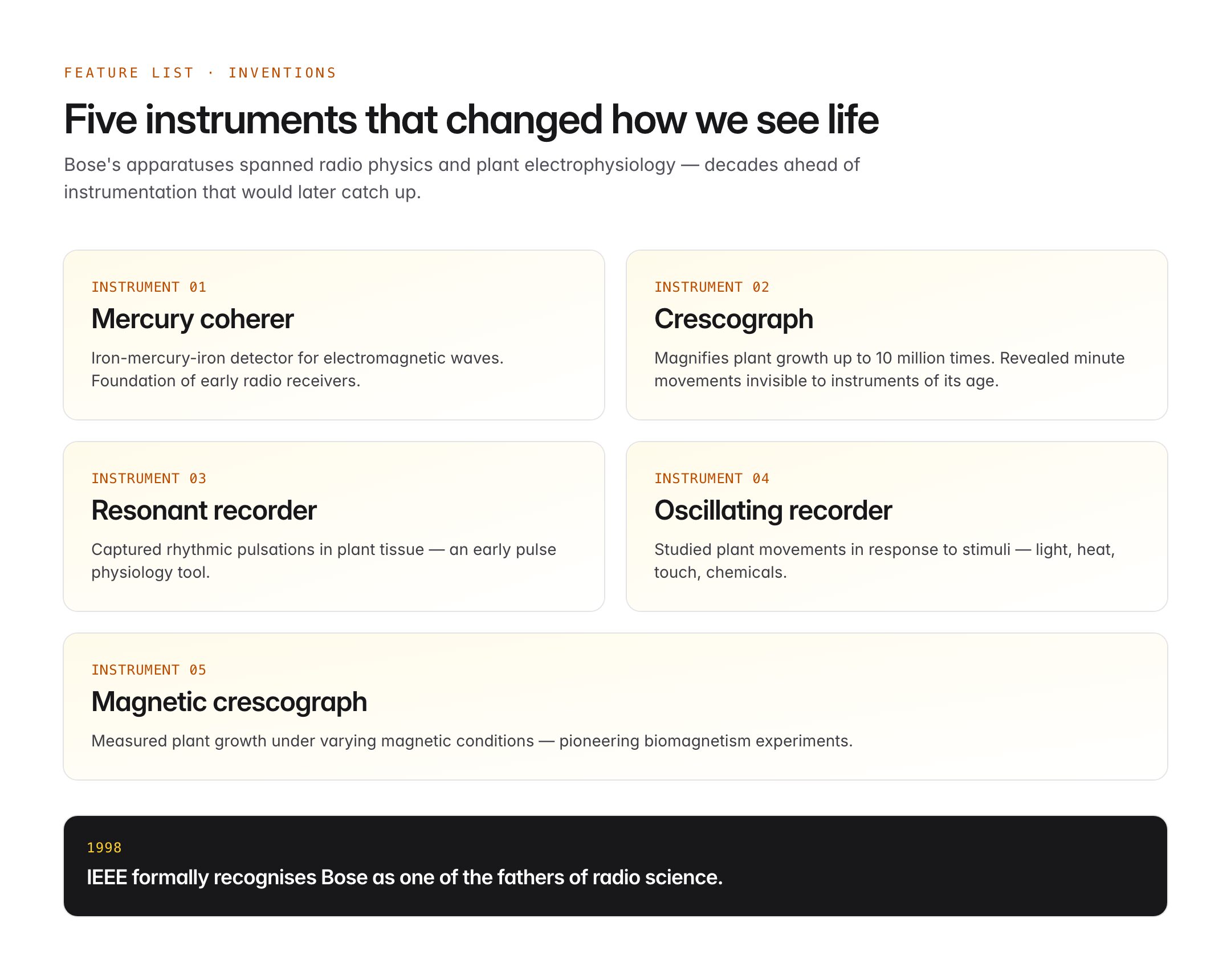
- Invention of the coherer (Mercury coherer / iron-mercury-iron coherer) used in early radio receivers.
- Horn antennas, polarisers, and dielectric lenses for short wavelengths.
- Study of wavelengths from 5 mm to 25 mm — an area largely ignored at the time.
In 1998, IEEE formally recognised Bose as one of the fathers of radio science. He famously refused to patent most inventions, publishing them for free scientific use.
The Crescograph and Plant Physiology
Bose turned to biophysics around 1900 and made his most celebrated contribution: showing that plants possess a form of sensitivity and response.
- Invented the crescograph, an instrument that magnifies plant growth up to 10 million times, enabling measurement of minute movements.
- Demonstrated that plants respond to light, heat, electricity, touch, and chemicals with electrical signals similar to animal nerves.
- Argued that metals, plants, and animals share a common physiological continuum.
His findings were published in works such as Response in the Living and Non-Living (1902) and Plant Response as a Means of Physiological Investigation (1906).
Major Inventions and Instruments
| Invention | Significance |
|---|---|
| Mercury coherer | Early wireless detector |
| Crescograph | Measures plant growth at microscopic scale |
| Resonant recorder | Records pulsations in plants |
| Oscillating recorder | Studies plant movements |
| Magnetic crescograph | Plant growth under magnetic conditions |
Bose Institute
In 1917, Bose founded the Bose Institute (Basu Vigyan Mandir) in Calcutta — India's first modern research institute dedicated to interdisciplinary science. Its founding objectives included:
- Free pursuit of knowledge without commercial constraint.
- Integration of physics, chemistry, and biology.
- Making research accessible to Indian students.
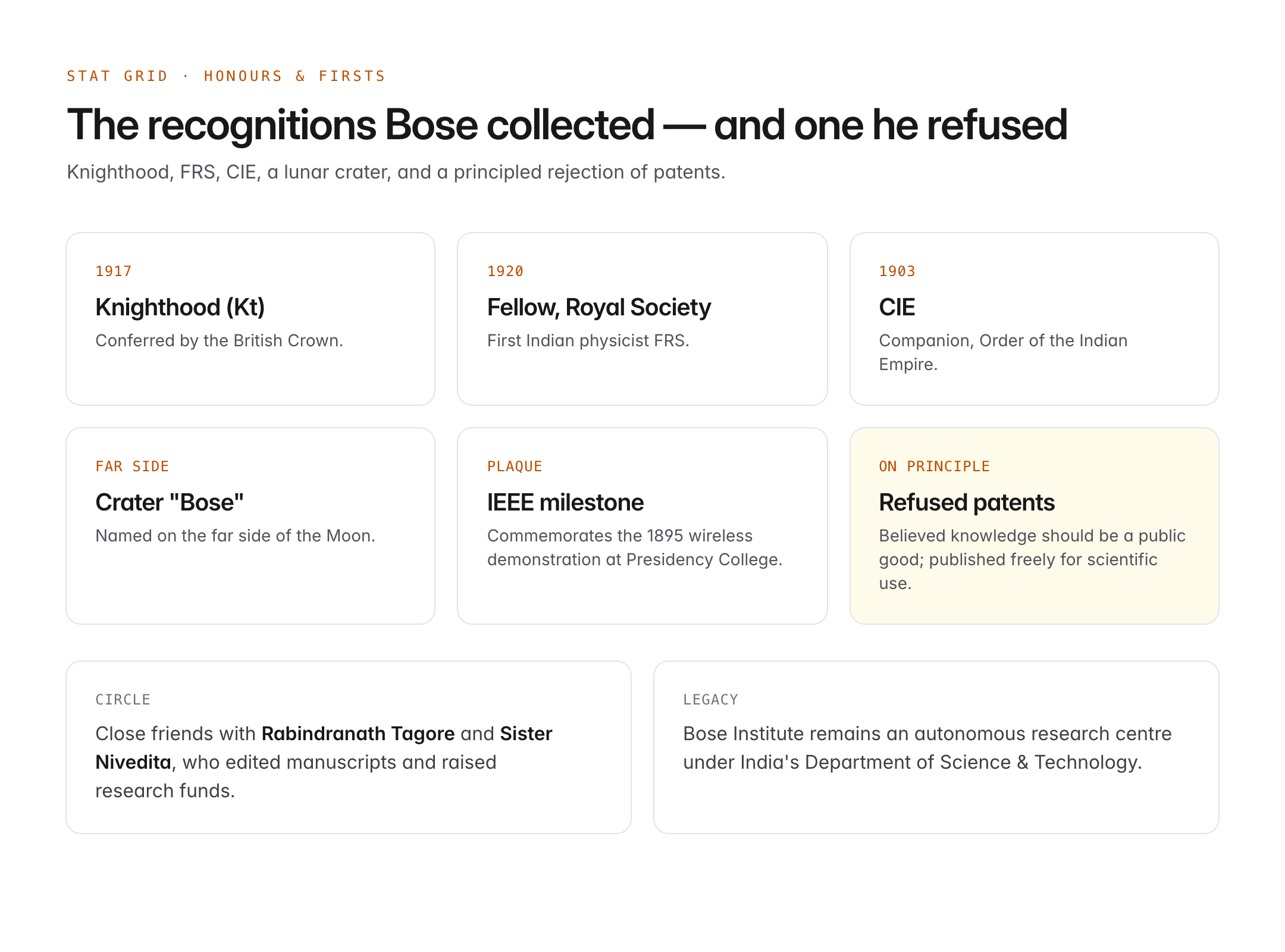
Bose Institute remains a premier autonomous research centre under India's Department of Science & Technology.
Honours and Recognition
- Knighthood (Kt) conferred by the British Crown, 1917.
- Fellow of the Royal Society (FRS), 1920 — the first Indian physicist to be so elected.
- Companion of the Order of the Indian Empire (CIE), 1903.
- Commander of the Order of the Indian Empire (CIE) — earlier distinction.
- Crater on the far side of the Moon named "Bose" in his honour.
- IEEE milestone plaque at Presidency College commemorating his 1895 wireless demonstration.
Nationalism and Scientific Temper
Bose was a close friend of Rabindranath Tagore, Sister Nivedita, and other nationalists. He saw scientific research as an assertion of India's intellectual independence. He rejected patents on principle, believing knowledge should be a public good — a stance shaped both by ethics and by anti-colonial thought.
Nivedita helped secure funding for his research and edited some of his English manuscripts. Tagore dedicated works to him and often consulted him on scientific questions.
Death and Legacy
Bose died on 23 November 1937 in Giridih, then in Bihar, aged 78. His legacy covers several domains:
- Radio science: Acknowledged internationally as a pioneer alongside Hertz and Marconi.
- Plant neurobiology: His hypothesis that plants "feel" is increasingly supported by modern electrophysiology and signalling research.
- Institution building: Bose Institute has trained generations of Indian scientists.
- Cultural icon: Featured on Indian postage stamps and in NCERT textbooks; recognised by UNESCO.
UPSC Relevance
Prelims angle: Expect MCQs on key facts — founder of Bose Institute (1917), pioneer of microwave/wireless research before Marconi, inventor of the crescograph, first Indian physicist FRS (1920), and his work on plant response. Bose is a reliable candidate in "Match the following" questions pairing scientists with contributions.
Mains GS I angle: Use Bose as an example under personalities of modern India and the scientific renaissance theme — the cultural nationalism of Tagore-Bose-Nivedita circles, and science as an anti-colonial enterprise. In GS III, link to India's tradition of open science and current patent debates.
PYQ angle:
- Prelims has repeatedly tested scientists' contributions (e.g., question on Indian physicists' international recognition).
- Essay topic: "Science is what you know, philosophy is what you don't know" — Bose blurs the line.
- Ethics/Culture questions on Indian contributions to modern science.
Studying Bose gives aspirants a ready example linking science, culture, and the freedom movement.
Tell Google you want more of this.
Add Anantam IAS as a preferred sourceOne tap, and this site shows up more often in your own Top Stories, AI Overviews and AI Mode. Remove it any time.