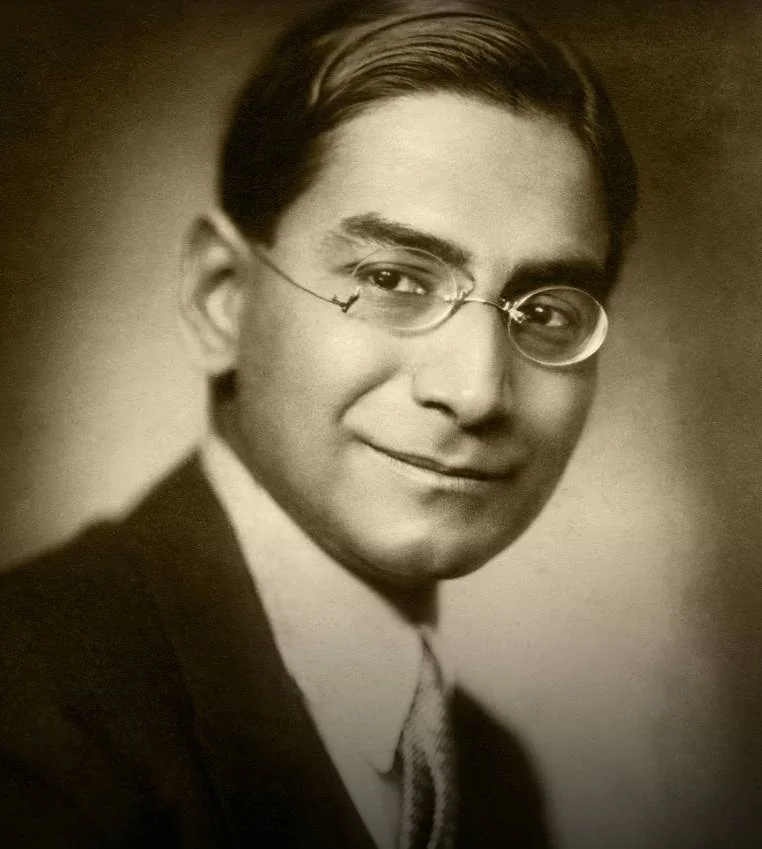
Three names define the Indian scientific imagination in the twentieth century — Sir C.V. Raman (physicist and 1930 Nobel laureate), Srinivasa Ramanujan (self-taught mathematician of unearthly intuition) and Dr Har Gobind Khorana (molecular biologist and 1968 Nobel laureate for cracking the genetic code). Each was a different kind of genius; together they anchor India's claim on modern science. For UPSC, these three figures appear in GS Paper I (post-independence science and contributions of eminent personalities), GS Paper III (Science & Technology) and are recurring essay / interview anchors.
Sir C.V. Raman (1888-1970)
Life at a glance
- Born 7 November 1888 in Tiruchirappalli; full name Chandrasekhara Venkata Raman.
- Topped Presidency College, Madras (B.A. 1904, M.A. 1907).
- Joined the Finance Department as a civil servant (Accountant General, Calcutta) at age 19.
- Used off-hours at the Indian Association for the Cultivation of Science (IACS), Calcutta to pursue physics.
- Left service to become Palit Professor of Physics at Calcutta University (1917).
- Later Director of IISc Bangalore (1933-37), founded the Raman Research Institute (1948).
The Raman effect
On 28 February 1928 (celebrated as National Science Day), Raman and K.S. Krishnan discovered that a small fraction of light scattered by molecules changes frequency — evidence that photons exchange energy with molecular vibrations.
- Called "Raman Scattering" or the Raman Effect.
- Provided experimental proof of the quantum nature of light.
- Gave birth to Raman spectroscopy — used in materials science, pharmacy, art restoration, forensics and food-safety testing today.
He was awarded the 1930 Nobel Prize in Physics, the first Asian and first non-white Nobel laureate in the sciences.
Wider contributions
- Acoustics of Indian musical instruments — violin, tabla, mridangam.
- Crystal physics, optics, colloid chemistry.
- Theories of blue colour of the sea — disproved Rayleigh's theory that it was purely due to reflection of sky.
- Founder of the Indian Academy of Sciences (1934).
- Mentor to a generation of Indian physicists — including S. Chandrasekhar, G.N. Ramachandran, S. Bhagavantam.
Honours
- Nobel Prize 1930.
- Knighthood 1929 (renounced in protest after independence).
- Bharat Ratna (1954) — among the first recipients.
- Lenin Peace Prize (1957).
Legacy
India celebrates National Science Day on 28 February annually. The CSIR, DST, Raman Research Institute, and the Raman Academy of Arts & Sciences all carry forward his work.
Srinivasa Ramanujan (1887-1920)
Life at a glance
- Born 22 December 1887 in Erode, Tamil Nadu; family of Brahmin priestly heritage.
- Raised in Kumbakonam.
- Self-taught prodigy; Carr's "Synopsis of Pure Mathematics" reportedly ignited his imagination.
- Struggled in college due to singular focus on mathematics.
- Sent handwritten results to G.H. Hardy at Cambridge in 1913 — leading to passage to Cambridge (1914).
- Collaborated with Hardy and J.E. Littlewood; elected Fellow of the Royal Society (FRS, 1918) and Fellow of Trinity College.
- Returned to India in 1919 in ill health; died in Kumbakonam on 26 April 1920, aged 32.
Mathematical contributions
- Partition function — with Hardy, showed asymptotic formula; Hardy-Ramanujan-Rademacher circle method.
- Highly composite numbers.
- Mock theta functions — developed in the last year of his life; foundation of modern modular forms theory (today connected to black-hole entropy and string theory).
- Ramanujan prime, Ramanujan tau function, Ramanujan-Petersson conjecture.
- Ramanujan-Hardy 1729 — "the taxicab number" — smallest number expressible as sum of two cubes in two different ways (1729 = 1³+12³ = 9³+10³).
- ~3,900 results in his notebooks, many proved decades later.
Legacy
- SASTRA Ramanujan Prize for young mathematicians.
- National Mathematics Day — 22 December (Ramanujan's birth anniversary).
- Centre of Ramanujan-related research — Tata Institute, SASTRA University, Ramanujan Institute (Madras).
- India's International Centre for Theoretical Sciences (ICTS) regularly hosts Ramanujan-themed conferences.
Mathematical historians call Ramanujan the "man who knew infinity" — a self-taught genius whose intuitive leaps continue to guide modern number theory, physics and cryptography.
Dr Har Gobind Khorana (1922-2011)
Life at a glance
- Born 9 January 1922 in Raipur village, Multan district (now in Pakistan).
- Educated at D.A.V. High School, Punjab University (Lahore), and University of Liverpool.
- Post-doc at ETH Zurich, Cambridge (with Lord Todd).
- Moved to the University of British Columbia, University of Wisconsin-Madison, and MIT in the 1960s-70s.
- Became a naturalised US citizen.
Scientific contributions
- Cracked the genetic code alongside Robert W. Holley and Marshall W. Nirenberg.
- Showed how the order of nucleotides (A, T, G, C) codes for specific amino acids.
- Awarded the 1968 Nobel Prize in Physiology or Medicine.
- Led the first chemical synthesis of a gene (1970s) — a yeast tRNA gene — laying foundations for recombinant DNA technology.
- Developed methods for oligonucleotide synthesis — the basis of today's PCR, sequencing and CRISPR.
- Studied the rhodopsin gene and the molecular basis of vision.
Honours
- Nobel Prize 1968.
- Padma Vibhushan (1969).
- National Medal of Science, USA (1987).
Legacy
- Khorana Program for Scholars (DBT, Govt of India + Indo-US Science and Technology Forum) funds Indian students in US biology labs.
- Khorana’s techniques underpin mRNA vaccines (COVID-19), gene therapy and synthetic biology.
Why these three matter for UPSC
Raman, Ramanujan and Khorana together illustrate:
- Indian scientific potential even with limited resources.
- The global outflow and inflow of ideas — each engaged deeply with institutions abroad.
- The value of fundamental research as a national asset.
- Modern India's need to attract, retain and reward scientific talent.
India's current scientific ecosystem — carrying forward
- National Research Foundation (NRF) set up 2024; Rs 50,000 crore outlay through 2028.
- Anusandhan scheme for PhD scholarships.
- Vigyan Ratna, Vigyan Shri, Yuva Vigyanik — restructured national awards replacing S.S. Bhatnagar Prize's predecessor schemes (from 2024).
- National Science Day (Feb 28) and National Mathematics Day (Dec 22) — honouring Raman and Ramanujan.
- PRIME (Promotion of Research and Innovation in Emerging Areas) and MATRICS — SERB schemes.
Latest developments (2024-26)
- NRF operationalised (2024) — aggregating S&T research funding; Rs 50,000 crore envelope.
- Vigyan Dhara scheme (2024) — DST umbrella programme consolidating innovation and HR.
- First cohort of Khorana fellows post-pandemic hiatus (2024).
- SASTRA Ramanujan Prize 2024 — Sun Xin (MIT) for contributions to additive combinatorics.
- National Award Reforms (2024) — Vigyan Ratna (lifetime), Vigyan Shri (distinguished), Vigyan Yuva, Vigyan Team, Vigyan Bhushan.
- AI Action Summit, Paris (Feb 2025) — India pitched AI for scientific discovery.
- India Semiconductor Mission and DeepTech Policy 2024 — building on the applied-science legacy of Khorana and Raman.
- National Quantum Mission (2024) — quantum physics research inheriting the Raman tradition.
- Chandrayaan-4 plan and Gaganyaan progress — milestones extending Sarabhai-Bhabha-Raman institutional legacies.
UPSC Relevance
GS Paper I
- Contributions of Indian scientists; post-independence nation-building.
GS Paper III — Science & Technology
- Raman effect, spectroscopy, genetic code, Ramanujan mathematics.
GS Paper IV — Ethics
- Scientific integrity; the ethics of recognition and opportunity.
Essay
- "Indian science — from Raman's table to the Moon's south pole."
Prelims pointers — C.V. Raman (1888-1970, Nobel 1930, 28 Feb 1928), National Science Day, Srinivasa Ramanujan (1887-1920, FRS 1918, 1729 taxicab number), 22 December Mathematics Day, Har Gobind Khorana (Nobel 1968 genetic code, Padma Vibhushan 1969), SASTRA Ramanujan Prize.
Interview probes — brain drain and return; why funding fundamental science matters; role of mentorship; India's prospects of future Nobel laureates.
Raman showed what a civil servant with a microscope could do. Ramanujan showed what pure intuition could do. Khorana showed what immigrant Indian talent could do on a global frontier. Together, they remain the patron saints of Indian science.
Tell Google you want more of this.
Add Anantam IAS as a preferred sourceOne tap, and this site shows up more often in your own Top Stories, AI Overviews and AI Mode. Remove it any time.