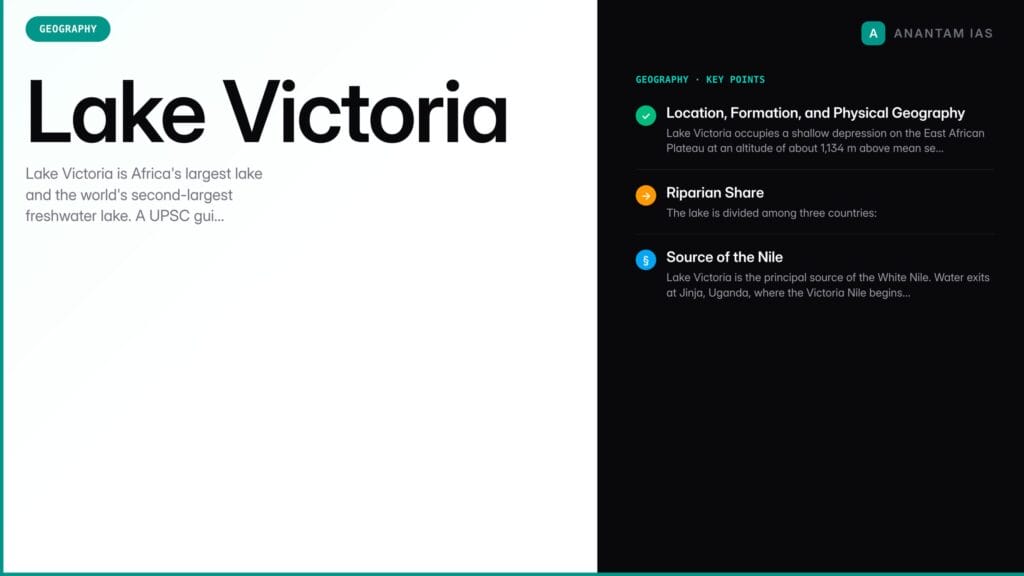
Lake Victoria is the largest lake in Africa, the second-largest freshwater lake in the world by surface area (after Lake Superior), and the principal source of the White Nile. Shared between Tanzania, Uganda, and Kenya, it covers approximately 68,800 square kilometres — roughly the size of Sri Lanka — and holds about 2,750 cubic kilometres of water. Beyond size, the lake's significance for UPSC is threefold: it is a transboundary water body central to the Nile Basin Initiative, the host of one of the largest ecological collapses in recorded limnology (the Nile perch crisis), and a working example of hydropolitics in East Africa.
Location, Formation, and Physical Geography
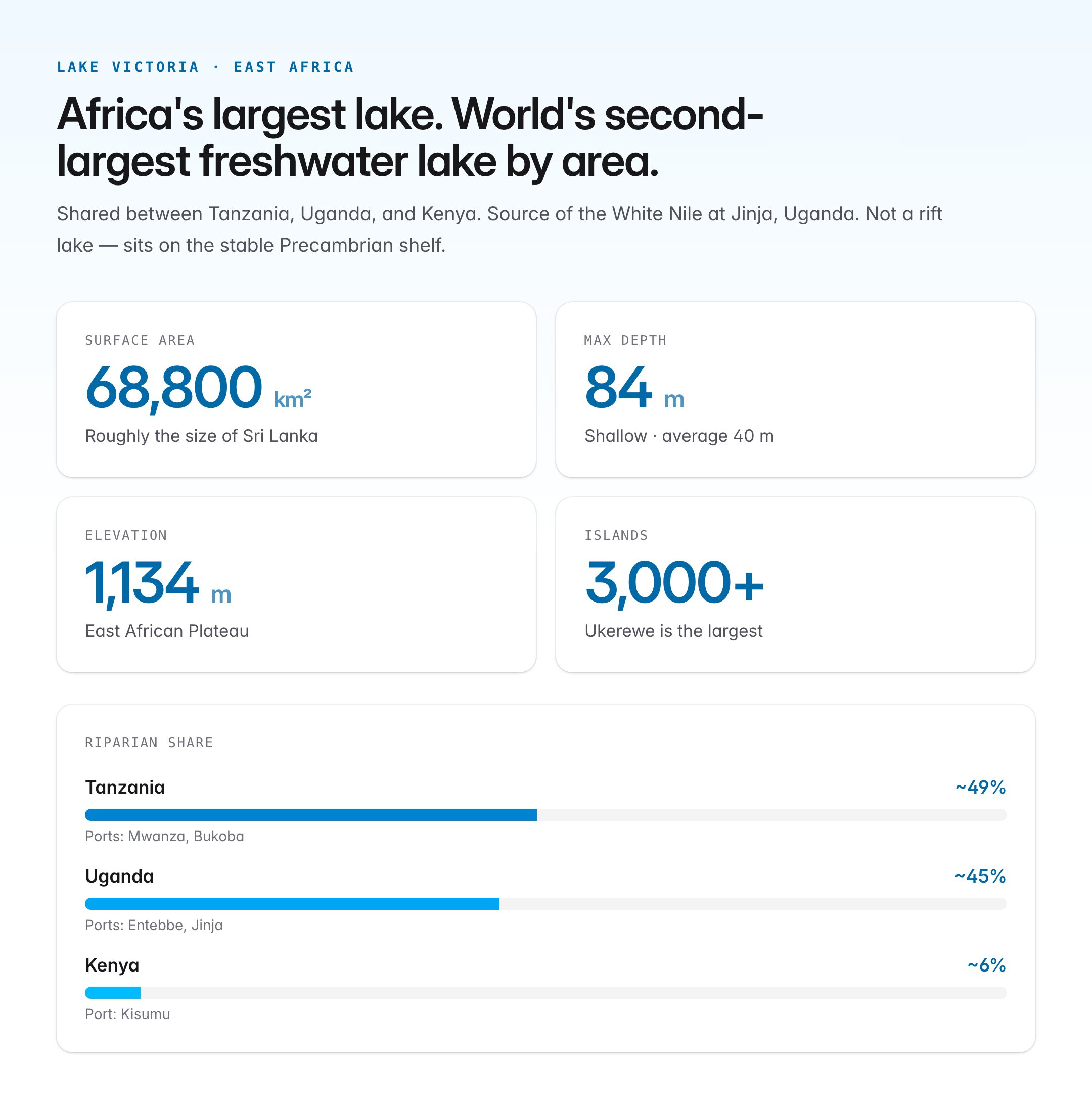
Lake Victoria occupies a shallow depression on the East African Plateau at an altitude of about 1,134 m above mean sea level. Unlike the deep rift-valley lakes (Tanganyika, Malawi), Victoria is not tectonic in origin — it sits on the stable Precambrian shelf between the Western and Eastern Rift Valleys, in a basin formed by back-tilting of the plateau about 400,000 years ago. This explains its shallow profile — an average depth of just 40 m and a maximum of about 84 m.
| Parameter | Value |
|---|---|
| Surface area | 68,800 sq km |
| Volume | 2,750 cubic km |
| Length (N-S) | 337 km |
| Breadth (E-W) | 240 km |
| Average depth | 40 m |
| Maximum depth | 84 m |
| Elevation | 1,134 m |
| Shoreline | ~3,440 km |
| Islands | 3,000+ (including Ukerewe, the largest) |
| Bordering countries | Tanzania, Uganda, Kenya |
| Catchment area | 184,000 sq km (also covers Rwanda, Burundi) |
Riparian Share
The lake is divided among three countries:
| Country | % of Surface | Major Port |
|---|---|---|
| Tanzania | ~49% | Mwanza, Bukoba |
| Uganda | ~45% | Entebbe, Jinja, Kampala (adjacent) |
| Kenya | ~6% | Kisumu |
The catchment basin additionally includes Rwanda and Burundi through the Kagera River system, making Lake Victoria a five-country drainage system even if the lake itself touches only three.
Source of the Nile
Lake Victoria is the principal source of the White Nile. Water exits at Jinja, Uganda, where the Victoria Nile begins, flowing north through Lake Kyoga and over Murchison Falls before entering Lake Albert. From Albert it continues as the Albert Nile, then enters South Sudan as the Bahr al-Jabal, reaches Khartoum, meets the Blue Nile (from Lake Tana, Ethiopia), and becomes the Nile proper flowing through Sudan and Egypt to the Mediterranean.
The Kagera River, rising in Burundi and Rwanda, is the longest feeder of Lake Victoria and is therefore considered by many geographers as the remotest headwater of the Nile — making Mount Kikizi (Burundi) the hydrological source.
The Owen Falls Dam (1954), now replaced by the Nalubaale and Kiira power stations at Jinja, regulates the outflow and generates much of Uganda's hydropower.
Climate and Hydrology
The lake's catchment receives between 1,200 and 2,000 mm of rainfall annually, but evaporation accounts for about 80% of water loss — only about 20% exits as the Victoria Nile. The lake is highly sensitive to rainfall anomalies; the 1961–64 rise added 2.5 m to lake levels and altered the Nile's outflow for decades. The recent 2020–2022 rise crossed historical maxima, displacing thousands along the shoreline.
Ecosystem: A Case Study in Species Collapse
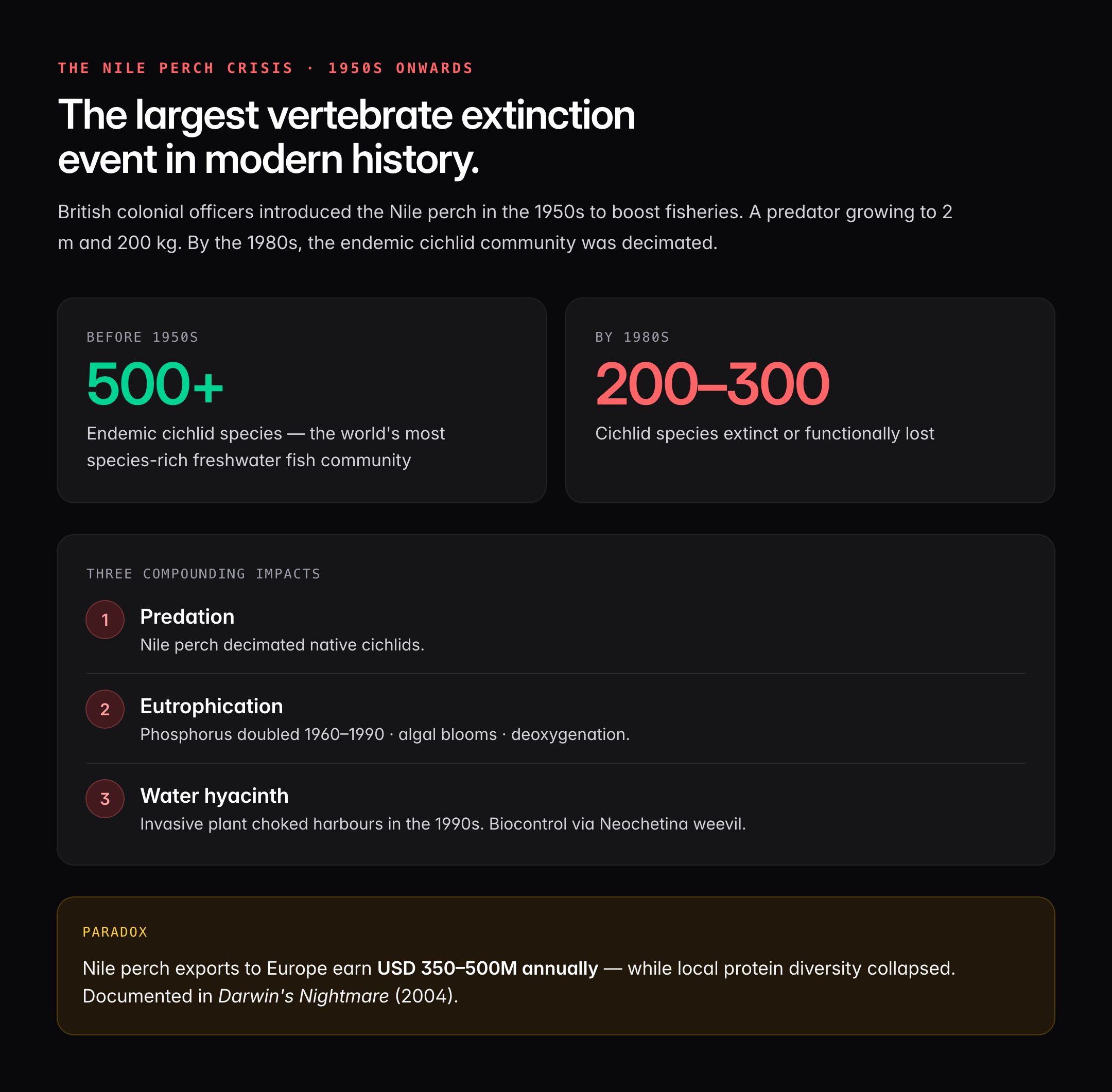
Before the 1950s, Lake Victoria hosted one of the most famous adaptive radiations in evolutionary biology — over 500 species of cichlid fish (haplochromines), most of them endemic. This was the world's most species-rich freshwater fish community.
Introduction of the Nile Perch
In the 1950s, British colonial fishery officers introduced the Nile perch (Lates niloticus) and the Nile tilapia (Oreochromis niloticus) to boost commercial fisheries. By the 1980s, the Nile perch — a large predator growing up to 2 m and 200 kg — had decimated the endemic cichlid community. An estimated 200–300 cichlid species are extinct or functionally lost, in what is described as the largest extinction event in a vertebrate community in modern history.
Eutrophication
Simultaneously, population growth around the lake triggered nutrient loading from sewage, agricultural runoff, and soil erosion. Phosphorus levels doubled between 1960 and 1990. Outcomes:
- Algal blooms reduced water transparency.
- Deoxygenation of deeper waters.
- Water hyacinth (Eichhornia crassipes) — an invasive free-floating plant — covered vast areas in the 1990s, choking harbours and fishing grounds. Biological control through the Neochetina weevil reduced hyacinth cover by the 2000s.
Nile Perch Economy
Paradoxically, the Nile perch created a billion-dollar export industry to Europe, as documented in the 2004 film Darwin's Nightmare. Local communities, however, suffered loss of protein diversity — the cichlids were dietary staples — while most perch fillets were flown to Europe and the discarded fish heads and skeletons returned as low-grade local food.
Lake Victoria in African Geopolitics
The lake sits within the Nile Basin, shared by 11 countries (Burundi, DRC, Egypt, Eritrea, Ethiopia, Kenya, Rwanda, South Sudan, Sudan, Tanzania, Uganda). The 1929 and 1959 Nile Waters Agreements — imposed under British colonial rule — allocated the bulk of the Nile's flow to Egypt and Sudan, giving upstream countries virtually nothing. Independent upstream states have challenged this arrangement through:
- Nile Basin Initiative (NBI), 1999 — cooperative framework.
- Cooperative Framework Agreement (CFA), 2010 — signed by six upstream states including Uganda, Kenya, Tanzania.
- Grand Ethiopian Renaissance Dam (GERD) on the Blue Nile — escalating Egypt–Ethiopia tensions since 2011.
Lake Victoria's outflow at Jinja directly affects White Nile contributions, making it a pressure point for any upstream water release policy.
Economic and Social Importance
- Fisheries: Employs over 200,000 fishers; Nile perch exports earn USD 350–500 million annually.
- Transport: Ferries link Mwanza, Bukoba, Kisumu, Port Bell, Entebbe.
- Drinking water: Serves 30+ million people in the basin.
- Hydropower: Supplies much of Uganda's electricity.
- Tourism: Entebbe, Ssese Islands, Rusinga Island.
Environmental Challenges and Conservation
| Challenge | Cause | Response |
|---|---|---|
| Cichlid extinction | Nile perch predation, eutrophication | Species restoration in satellite lakes |
| Water hyacinth | Nutrient loading, invasive spread | Biocontrol (Neochetina weevil), manual harvest |
| Pollution | Urban sewage (Kampala, Kisumu), agrochemicals | LVEMP I & II (World Bank-funded) |
| Climate-linked level changes | Rainfall extremes | Regional early-warning systems |
| Overfishing | High demand, weak enforcement | Net-size regulations, closed seasons |
| Shoreline erosion | Wave action + rising levels | Coastal zone management |
The Lake Victoria Environmental Management Project (LVEMP) and the Lake Victoria Basin Commission (LVBC) under the East African Community coordinate trans-border action.
Lake Victoria vs Other Major Lakes
| Lake | Location | Area (sq km) | Depth (max) | Significance |
|---|---|---|---|---|
| Victoria | Africa | 68,800 | 84 m | Largest African lake, White Nile source |
| Superior | N. America | 82,100 | 406 m | Largest freshwater lake (area) |
| Tanganyika | Africa | 32,900 | 1,470 m | Longest freshwater lake; 2nd deepest |
| Malawi/Nyasa | Africa | 29,500 | 706 m | High endemic cichlid diversity |
| Baikal | Russia | 31,500 | 1,642 m | Deepest lake; 20% of world's fresh water |
UPSC Relevance
Lake Victoria is a high-yield geography topic. For Prelims, memorise: largest lake in Africa, second-largest freshwater lake in the world (by area), three countries — Tanzania, Uganda, Kenya, outflow at Jinja, Uganda, source of the White Nile, longest feeder Kagera River. A frequent distractor — Lake Victoria is the second-largest freshwater lake by surface area, but not by volume (that distinction goes to Baikal). For GS Paper I (World Geography), Victoria anchors the East African Plateau lake system and illustrates non-rift tectonic lakes in contrast to Tanganyika, Malawi, and the Ethiopian rift lakes. For GS Paper II (International Relations), the lake is central to the Nile Basin Initiative, the 1929 and 1959 Nile Waters Agreements, and GERD-related tensions. For GS Paper III (Environment), Lake Victoria is a classic case of invasive species impact (Nile perch, water hyacinth) and eutrophication — useful alongside Indian examples like Lake Chilika and Lake Loktak. Tie the Lake Victoria story to the broader debate on indigenous species protection vs commercial aquaculture — examiners reward candidates who can use such global cases to sharpen Indian answers.
Tell Google you want more of this.
Add Anantam IAS as a preferred sourceOne tap, and this site shows up more often in your own Top Stories, AI Overviews and AI Mode. Remove it any time.