Every 1 May, Gujarat marks its founding day, and the date hides a fight most people have forgotten. The state did not arrive as a gift from Delhi or a tidy line on an administrator’s map. It was won, over four hard years between 1956 and 1960, by a movement that began with college students shot dead on an Ahmedabad street and was carried by a 64-year-old Gandhian who had walked away from politics and then walked back into it for one last cause. That movement was the Mahagujarat Movement — the demand for a separate Gujarati-speaking state — and it is one of the cleanest case studies modern Indian history offers on how language reshaped the political map of the republic.
And it matters for an aspirant well beyond Gujarat. The Mahagujarat Movement sits at the centre of the single biggest internal redrawing of independent India: the reorganisation of states on linguistic lines. It runs in parallel with the Samyukta Maharashtra Movement next door, it tests the early republic’s discomfort with linguistic nationalism, and it ends with a law — the Bombay Reorganisation Act of 1960 — that split one of India’s largest states into two. Understand this one episode well and you understand the whole logic of how the map of India came to look the way it does.
Why One Bombay State Could Not Hold Two Languages
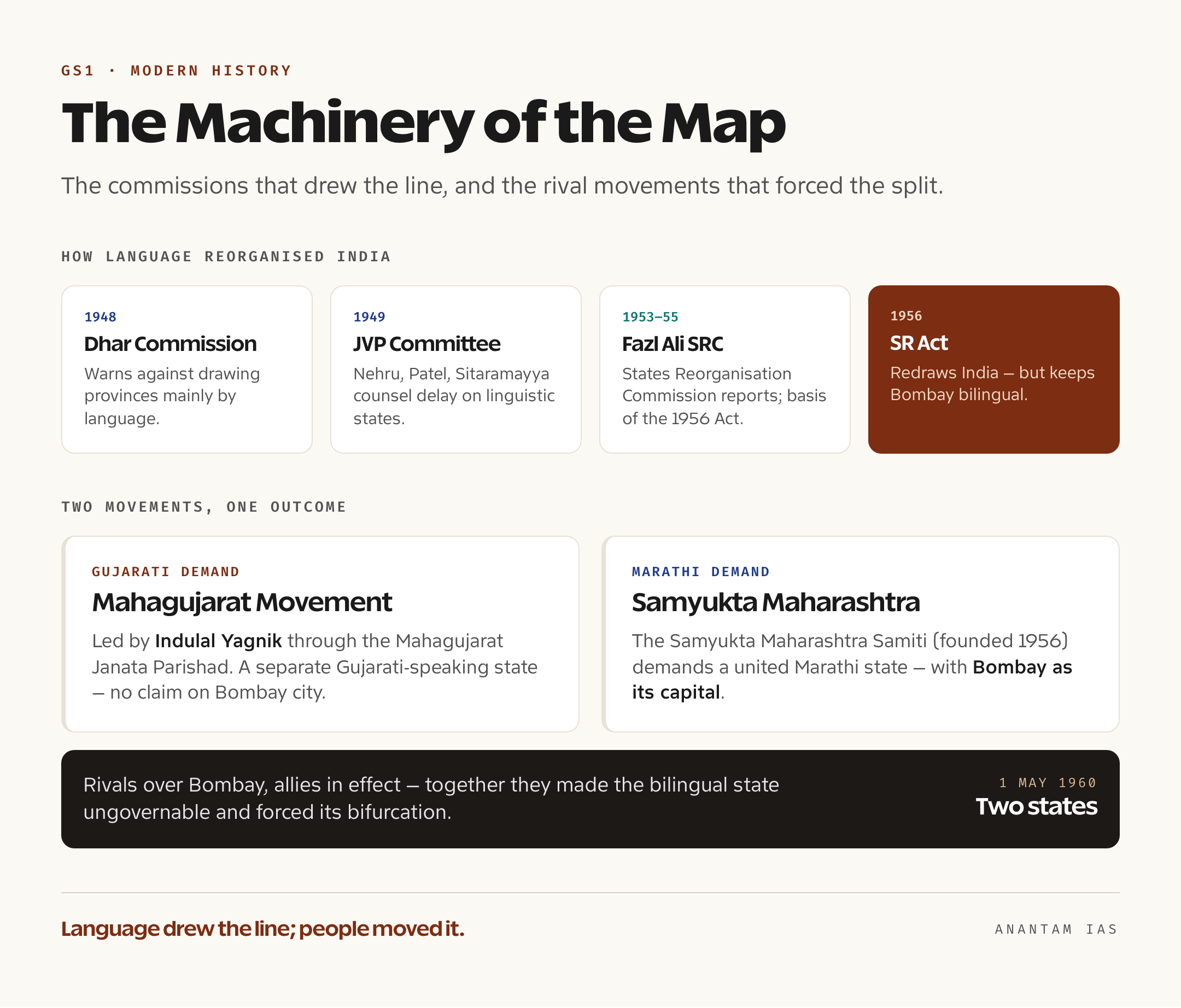
To see why the movement happened, start with the awkward thing it was reacting against — the bilingual Bombay State. When India became independent, the Constitution makers were wary of carving up the country by language. The memory of Partition was raw, and the fear was that linguistic states would feed regional chauvinism and pull a fragile young nation apart. So the Dhar Commission, the Linguistic Provinces Commission set up in 1948, reported that drawing provinces on mainly linguistic lines was not in the larger national interest. The JVP Committee of 1949 — named for its three members, Jawaharlal Nehru, Vallabhbhai Patel and Pattabhi Sitaramayya — echoed the caution, advising that the question be postponed until the republic found its feet.
But the pressure from below would not wait. The turning point came in 1952, when Potti Sreeramulu died after a 56-day fast demanding a separate Telugu-speaking state. His death set off such an upheaval in the Madras Presidency that the government conceded Andhra State in 1953 — the first state created purely on linguistic grounds. The dam had broken. Once one language had won a state of its own, every other major language group asked the obvious question: why not us? To handle the flood of demands, the government appointed the States Reorganisation Commission in 1953 under Justice Fazl Ali, with K. M. Panikkar and H. N. Kunzru as members. Its 1955 report became the basis of the States Reorganisation Act of 1956, the law that redrew most of India’s internal boundaries along language lines and came into force on 1 November 1956.
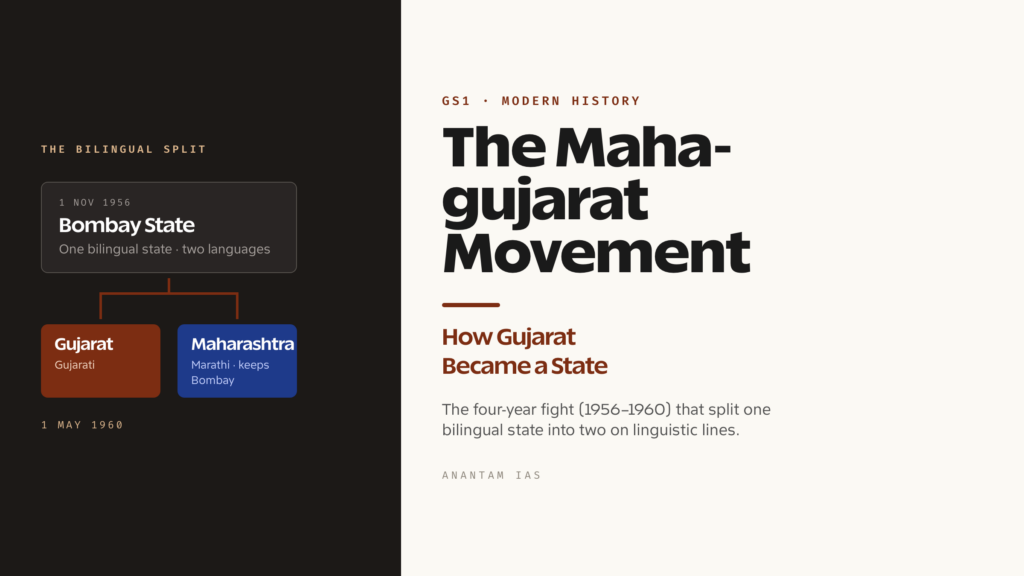
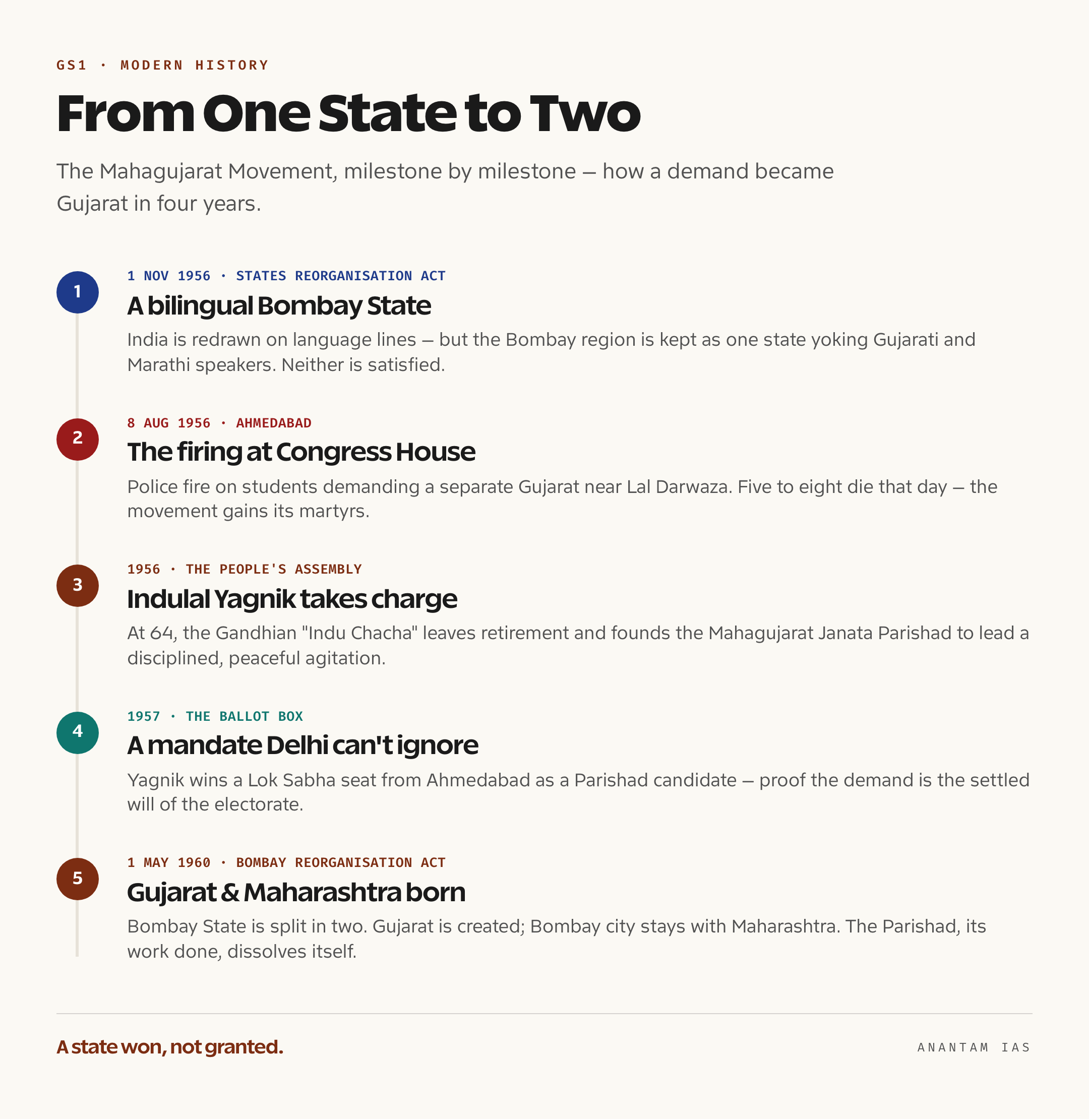
Here is the catch that lit the fuse. For most of India, the 1956 Act delivered linguistic states. For the Bombay region it did the opposite — it kept a single large bilingual Bombay State that yoked together the Gujarati-speaking north (including Saurashtra and Kutch) and the Marathi-speaking south, with the great commercial city of Bombay as the shared prize. Neither linguistic community was satisfied. Marathi speakers wanted a Maharashtra with Bombay as its capital. Gujarati speakers wanted a separate Mahagujarat — “Greater Gujarat” — that would unite all the Gujarati-speaking areas into one state. So the very Act that gave Andhras and Kannadigas their own homelands handed Gujaratis and Marathis a forced marriage instead. The Mahagujarat Movement was the Gujarati half of the resistance to that arrangement, and it would take four years and a fresh law to undo.
The Firing of 8 August 1956 and How a Movement Caught Fire
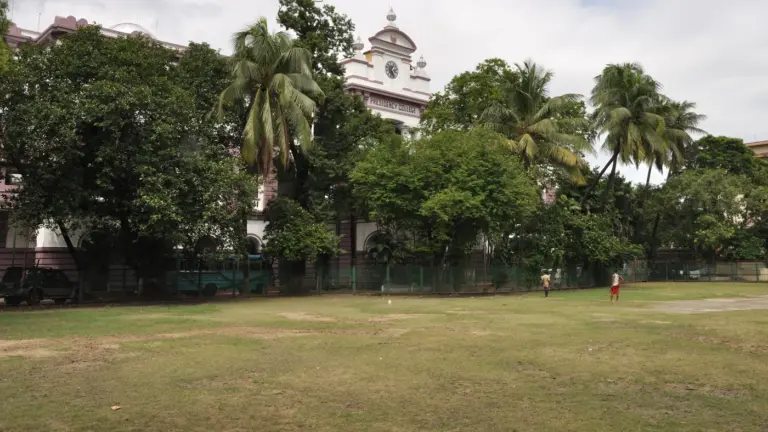
The spark was sudden and bloody. In the first week of August 1956, with the bilingual decision freshly announced, a group of college students in Ahmedabad marched to the Congress House near Lal Darwaza to press the demand for a separate Gujarat. The Chief Minister of Bombay State at the time was Morarji Desai — himself a Gujarati, but a stern loyalist of the Congress high command’s bilingual policy. When the students sought a hearing on 8 August 1956 and the leadership inside refused to engage, the protest turned tense, and the police opened fire. Somewhere between five and eight students were killed that day, and the violence spread. Over the following weeks of August, official figures placed the death toll across the clashes far higher — Morarji Desai himself, answering in the legislature, acknowledged that two dozen-odd people died in the police action between early August and the end of the month.
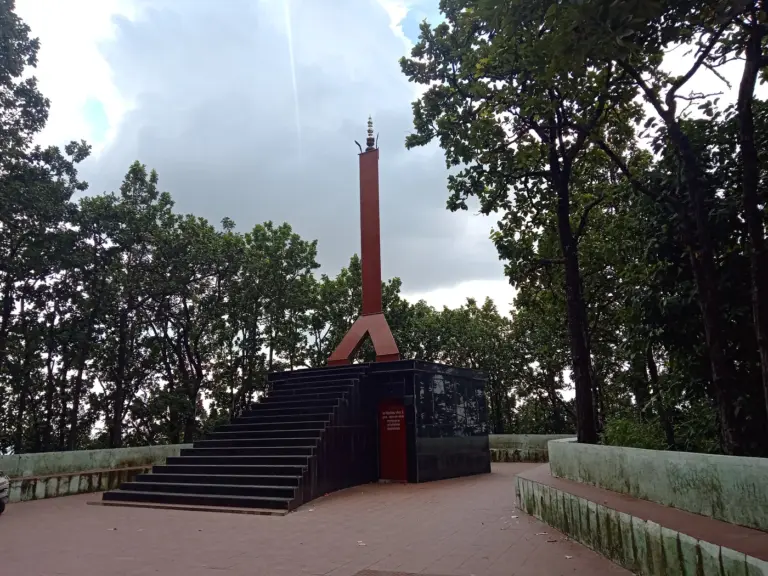
The shootings did to the Mahagujarat cause what Sreeramulu’s death had done to the Andhra cause — they gave it martyrs. A demand that had been an argument among politicians became, overnight, a popular movement with grief and outrage behind it. Students, lawyers, traders and clerks who had watched from the sidelines now poured into the agitation. The young men killed at Congress House were remembered as the movement’s first martyrs, and a Shaheed Smarak — a martyrs’ memorial — would later mark the spot in Ahmedabad. What had been a policy disagreement was now a matter of blood and honour, and no Congress assurance could quietly contain it.
What the movement needed at that moment was a leader who could turn raw anger into sustained organisation, and it found one in an unlikely figure. The man who stepped forward was Indulal Yagnik, and his entry transformed a leaderless eruption into a four-year campaign.
Indulal Yagnik and the Mahagujarat Janata Parishad
Indulal Yagnik was no newcomer to Gujarat’s public life — he was one of its grand old men, which is exactly why his arrival mattered. Born in Nadiad in 1892, he had been a freedom fighter since the Home Rule days, an associate of Gandhi who took down the dictation for the early chapters of Gandhi’s autobiography in jail, an editor of the journals Young India and Navjivan before he handed them to Gandhi, and a tireless organiser of peasants through the Kisan Sabha movement of the 1930s. By 1956 he had largely withdrawn from active politics. The firing of 8 August pulled him out of that retirement. He saw in the leaderless agitation a cause worth a final fight, and at 64 he came back to lead it.
Yagnik’s first act was to give the movement a spine. In 1956 he founded — and became the first president of — the Mahagujarat Janata Parishad, the people’s assembly for Greater Gujarat, which became the umbrella body coordinating the agitation across the Gujarati-speaking districts. The Parishad pulled together students, professionals and political workers cutting across party lines, and it gave the demand a single recognisable voice. Yagnik and fellow leaders such as Dinkar Mehta and Dhanvant Shroff were arrested and held — first at Gaekwad Haveli in Ahmedabad and then in the Sabarmati Central Jail for around three and a half months — but jail only burnished their standing. Affectionately called “Indu Chacha,” Yagnik became the face of Mahagujarat, addressing vast public meetings and keeping the pressure relentless and peaceful.
The genius of the Parishad lay in how it channelled the movement. It kept the agitation broadly within the Gandhian template the public trusted — mass meetings, processions, satyagraha-style civil resistance — rather than letting it curdle into the riots the early firing had threatened. And it turned the demand into an electoral force. When Yagnik contested the 1957 general election from Ahmedabad as a Mahagujarat Janata Parishad candidate and won a seat in the Lok Sabha, the message to Delhi was unmistakable: the demand for a separate Gujarat was not the work of a fringe, it was the settled will of an electorate. A movement that the Congress had hoped to wait out had instead become impossible to ignore at the ballot box.
The Twin That Made It Inevitable: Samyukta Maharashtra
The Mahagujarat Movement never fought alone, and the reason it eventually won is that an even larger movement was pushing the same wall from the other side. Across the bilingual state, Marathi speakers were waging the Samyukta Maharashtra Movement — the campaign for a united Marathi-speaking state — and its central organisation, the Samyukta Maharashtra Samiti, was founded in February 1956 in Pune. Its core demand had an extra edge: not just a Marathi state, but one that kept the city of Bombay, India’s commercial capital, as its own. That claim over Bombay was the single most explosive issue in the whole reorganisation, and it made the Marathi agitation fierce.
It also produced its own martyrs, on a larger scale. When demonstrators were fired upon by police in the heart of Bombay in 1955 and 1956, around 105 people were killed across the agitation — a toll memorialised at Flora Fountain, the city crossing renamed Hutatma Chowk, “Martyrs’ Crossroad,” in their honour. So both halves of the bilingual state were now bleeding for the same principle from opposite directions: Gujaratis wanting out, Marathis wanting out with Bombay. The Congress government in Delhi found itself defending an arrangement that nobody on the ground actually wanted, against two parallel mass movements at once.
This is the part an aspirant should hold onto, because it is the analytical heart of the story. The two movements were rivals over Bombay but allies in effect. Each made the bilingual state more ungovernable, and together they made its survival politically impossible. Nehru’s government, which had genuinely feared that conceding linguistic states would unleash chauvinism, faced a simpler truth: the people of both communities had decided, and they had paid in lives. By 1959-60 the central leadership had accepted that the bilingual experiment had failed and that the only stable settlement was to split Bombay in two — giving each language the state it had been demanding all along.
How Gujarat Was Finally Born: The Bombay Reorganisation Act, 1960
The settlement, when it came, was a piece of legislation. Parliament passed the Bombay Reorganisation Act, 1960, to bifurcate the bilingual Bombay State into two linguistic states, and it took effect on the appointed day of 1 May 1960. Under the Act, the Gujarati-speaking northern territories — including Saurashtra and Kutch — were carved out to form the new State of Gujarat, while the residuary state, comprising the Marathi-speaking areas, became Maharashtra. The contest over Bombay city was resolved in Maharashtra’s favour: it stayed with the Marathi state and became its capital. Gujarat, having no comparable metropolis, began with Ahmedabad as its main city and soon built a new, purpose-designed capital at Gandhinagar.
So 1 May 1960 is the date that closes the story, and it is celebrated to this day as Gujarat Day — and, on the same date, as Maharashtra Day across the border. Gujarat’s first Chief Minister was Jivraj Mehta, a physician and administrator who had once been Gandhi’s doctor, and the new state set about the ordinary business of governance. The Mahagujarat Janata Parishad, having achieved the one thing it was built for, dissolved itself; its purpose was spent. Indulal Yagnik, the man who had given the movement its shape, went back to Parliament, re-elected from Ahmedabad, and remained its grand old man until his death in 1972. A statue of him now stands by the Nehru Bridge in Ahmedabad, in a garden that carries his name.
Step back and the significance is larger than one state’s birthday. The Mahagujarat Movement, with its Maharashtrian twin, completed the second great wave of linguistic reorganisation that the 1956 Act had left unfinished. It proved that even a government deeply suspicious of language-based politics could be moved by sustained, broadly peaceful mass pressure expressed through agitation and the ballot. And it settled, for the Bombay region, the principle that India’s internal map would follow the contours of language. The states that the Mahagujarat and Samyukta Maharashtra movements created in 1960 are the same Gujarat and Maharashtra on the map today — a reminder that the boundaries we now take for granted were, within living memory, fought for and paid for.
For Your Mains Answer
This is a high-value topic for GS Paper 1, which covers the history of modern India, the freedom struggle and post-independence consolidation, and specifically the linguistic reorganisation of states. It also feeds GS Paper 2 wherever federalism, the reorganisation of states under Article 3, and centre-state relations come up, and it is a ready-made example for the Essay paper on themes of national integration, identity and democracy. The skill examiners reward here is the ability to place a single regional movement inside the national story of how India was reorganised — and to show its consequences, not just narrate its events.
How to Build the Answer
Move along a clear chain. Open with the dilemma — independent India’s fear of linguistic states (Dhar Commission, JVP Committee) versus the pressure from below. Show the trigger (Sreeramulu, Andhra in 1953), the corrective machinery (States Reorganisation Commission under Fazl Ali, the 1956 Act), and the specific grievance (the bilingual Bombay State that satisfied neither language). Then narrate the Mahagujarat Movement — the 8 August 1956 firing, Indulal Yagnik and the Mahagujarat Janata Parishad — alongside its Samyukta Maharashtra twin. Close with the resolution (Bombay Reorganisation Act, 1 May 1960) and an evaluation of what it meant for federalism and national integration. That arc — fear, pressure, trigger, grievance, movement, settlement, significance — fits almost any question on the period.
Common Mistakes to Avoid
Don’t treat the Mahagujarat Movement in isolation; its outcome is unintelligible without the Samyukta Maharashtra Movement pushing in parallel. Don’t muddle the dates — the States Reorganisation Act is 1956, but the split of Bombay is the separate Bombay Reorganisation Act of 1960. Don’t say the 1956 Act created Gujarat; it did the opposite, keeping the bilingual state that the movement then had to dismantle. And don’t paint the agitation as a separatist or anti-national one — it worked within the constitutional process and the electoral system, which is precisely why it succeeded.
A Compact Answer Spine
Post-1947 caution on linguistic states (Dhar 1948, JVP 1949) → Sreeramulu’s death and Andhra, 1953 → States Reorganisation Commission (Fazl Ali, 1953-55) → States Reorganisation Act 1956 redraws India but keeps a bilingual Bombay State → Gujaratis demand Mahagujarat, Marathis demand Samyukta Maharashtra (with Bombay) → firing on students, 8 August 1956, Ahmedabad → Indulal Yagnik founds the Mahagujarat Janata Parishad, leads a peaceful four-year agitation, wins the Lok Sabha 1957 → twin movements make the bilingual state untenable → Bombay Reorganisation Act 1960 splits it → Gujarat and Maharashtra born, 1 May 1960.
Diagram or Flowchart Idea
Draw a simple “one becomes two” schematic: a single box labelled “Bilingual Bombay State (1956)” with two arrows fanning out to “Gujarat” and “Maharashtra (with Bombay),” dated 1 May 1960, and two labelled forces pressing on the parent box — “Mahagujarat Movement (Indulal Yagnik)” from one side and “Samyukta Maharashtra Movement” from the other. It captures the whole causal logic — two pressures, one split — in a single glance.
A Balanced-Conclusion Line
A line that lands the marks: “The Mahagujarat Movement showed that linguistic identity, far from threatening the Indian union as the early republic feared, could be accommodated within it — provided the state was willing to redraw its map by the will of its people rather than against it.”
How to Use Data Without Cramming
You need only a handful of anchors, not a chronicle: 1956 (States Reorganisation Act and the firing), 8 August 1956 (the Ahmedabad firing), 1960 (Bombay Reorganisation Act), and 1 May 1960 (Gujarat and Maharashtra created). Pair them with the names that carry the story — Indulal Yagnik and the Mahagujarat Janata Parishad, Morarji Desai, the Samyukta Maharashtra Samiti, Fazl Ali — and attribute plainly, as in “the States Reorganisation Commission under Fazl Ali,” rather than scattering dates without a thread.
FAQ
What was the Mahagujarat Movement? It was the political agitation, running from 1956 to 1960, demanding a separate state for the Gujarati-speaking people — a “Greater Gujarat” or Mahagujarat — to be carved out of the bilingual Bombay State. Led by Indulal Yagnik through the Mahagujarat Janata Parishad, it succeeded when the Bombay Reorganisation Act of 1960 split Bombay State into Gujarat and Maharashtra on 1 May 1960.
Why did the movement start in 1956? Because the States Reorganisation Act of 1956 reorganised most of India on linguistic lines but, for the Bombay region, kept a single bilingual state combining Gujarati and Marathi speakers instead of separating them. Gujaratis felt cheated of the linguistic state that other communities had received, and the police firing on student protesters in Ahmedabad on 8 August 1956 turned that grievance into a mass movement.
Who was Indulal Yagnik and what was his role? Indulal Yagnik, fondly called “Indu Chacha,” was a veteran Gandhian freedom fighter and peasant organiser from Gujarat. He came out of political retirement at 64 to lead the Mahagujarat Movement, founded and headed the Mahagujarat Janata Parishad, kept the agitation peaceful and disciplined, and won a Lok Sabha seat from Ahmedabad in 1957 — converting the demand into an electoral mandate that Delhi could not ignore.
How is the Mahagujarat Movement linked to the Samyukta Maharashtra Movement? They were parallel campaigns within the same bilingual Bombay State — Gujaratis demanding Mahagujarat, Marathis demanding a united Maharashtra that kept Bombay city. Though rivals over Bombay, both movements pushed the same conclusion: the bilingual state was unworkable. Together they forced the central government to bifurcate Bombay State in 1960, creating Gujarat and Maharashtra on the same day.
Practice Questions
Prelims MCQs
- The Mahagujarat Movement (1956-1960) was primarily a demand for which of the following?
(a) A separate Gujarati-speaking state to be carved out of the bilingual Bombay State
(b) The merger of Saurashtra and Kutch into Rajasthan
(c) Special category status for the Gujarat region
(d) The retention of Bombay city within a Gujarati state
Answer: (a) The movement demanded a separate Gujarati-speaking state, “Mahagujarat,” out of the bilingual Bombay State; it did not press a claim over Bombay city, which the Samyukta Maharashtra Movement did. - Consider the following commissions/committees on the reorganisation of states and match them correctly:
1. Dhar Commission — 1948; 2. JVP Committee — 1949; 3. States Reorganisation Commission (Fazl Ali) — 1953. Which are correctly matched?
(a) 1 and 2 only
(b) 2 and 3 only
(c) 1 and 3 only
(d) 1, 2 and 3
Answer: (d) The Dhar Commission reported in 1948, the JVP Committee in 1949, and the States Reorganisation Commission under Fazl Ali was set up in 1953 and reported in 1955. - The bilingual Bombay State that the Mahagujarat Movement opposed was retained under which legislation?
(a) The Bombay Reorganisation Act, 1960
(b) The States Reorganisation Act, 1956
(c) The Government of India Act, 1935
(d) The Andhra State Act, 1953
Answer: (b) The States Reorganisation Act, 1956 reorganised most of India linguistically but kept the Bombay region as a single bilingual state, which is what the movement sought to undo. - Who founded and led the Mahagujarat Janata Parishad during the movement?
(a) Morarji Desai
(b) Jivraj Mehta
(c) Indulal Yagnik
(d) Sardar Vallabhbhai Patel
Answer: (c) Indulal Yagnik, known as “Indu Chacha,” came out of retirement to found and lead the Mahagujarat Janata Parishad, the body that coordinated the agitation. - The States of Gujarat and Maharashtra were created on 1 May 1960 by which Act?
(a) The States Reorganisation Act, 1956
(b) The Bombay Reorganisation Act, 1960
(c) The Bombay State Act, 1957
(d) The Constitution (Seventh Amendment) Act, 1956
Answer: (b) The Bombay Reorganisation Act, 1960 bifurcated the bilingual Bombay State into Gujarat and Maharashtra with effect from 1 May 1960.
Mains Practice Questions
- The reorganisation of states on linguistic lines was both a concession to popular sentiment and a calculated risk for national unity. Discuss with reference to the Mahagujarat and Samyukta Maharashtra movements. (15 marks, 250 words)
- “The States Reorganisation Act of 1956 redrew India’s map but left the Bombay region unfinished.” Examine how the Mahagujarat Movement completed that unfinished business. (15 marks, 250 words)
- Assess the role of leadership and mass mobilisation in the success of the Mahagujarat Movement, with particular reference to Indulal Yagnik and the Mahagujarat Janata Parishad. (15 marks, 250 words)
- The early Indian republic feared that linguistic states would encourage chauvinism and weaken the union. To what extent does the experience of Gujarat’s formation validate or challenge that fear? (10 marks, 150 words)
- Compare and contrast the Mahagujarat Movement and the Samyukta Maharashtra Movement in terms of their demands, methods and outcomes, and evaluate their combined significance for Indian federalism. (15 marks, 250 words)
Tell Google you want more of this.
Add Anantam IAS as a preferred sourceOne tap, and this site shows up more often in your own Top Stories, AI Overviews and AI Mode. Remove it any time.