
Opens in a new tab
Join Anantam IAS Channel on Telegram

TOPIC

Biodiversity Basics

3 UPSC Prelims MCQs tagged "Biodiversity Basics". Free practice with answer keys, explanations, and timed mock tests on Anantam IAS.

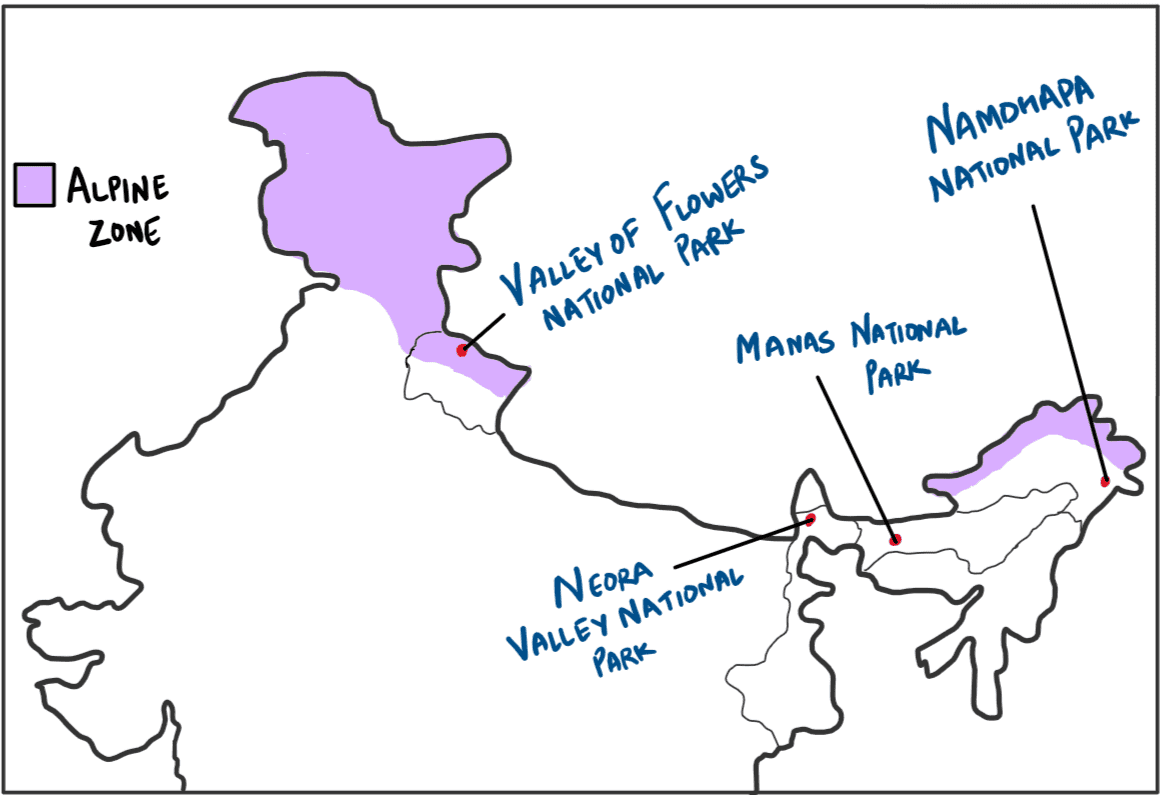
  1. Which one of the following National Parks lies completely in the temperate alpine zone?

    Which one of the following National Parks lies completely in the temperate alpine zone?

    1. AManas National Park
    2. BNamdapha National Park
    3. CNeora Valley National Park
    4. DValley of Flowers National Park
    Answer and explanation

    Correct answer: D

    Manas National Park (Assam): Situated on the banks of the Manas River, it encompasses a range of ecosystems including grasslands, tropical evergreen forests, and semi-evergreen forests.

    Namdapha National Park (Arunachal Pradesh): This park boasts diverse vegetation zones, ranging from tropical evergreen forests at lower elevations to sub-alpine meadows at higher altitudes.

    Neora Valley National Park (West Bengal): This park covers a range of elevations with subtropical broadleaf forests at lower levels and temperate forests at higher reaches.

    The Valley of Flowers National Park (Uttarakhand): On the other hand, is situated at a high altitude (3352 to 3658 metres above sea level) and falls entirely within the temperate alpine zone, known for its meadows, low-growing vegetation, and cooler climate.
    ![National Parks in Temperate Alpine Zone](https://d39jluplm5thpx.cloudfront.net//Alpine_zone_6373449c25.PNG)

    Hence, option D is the correct Answer.

  2. Due to some reasons if there is a huge fall in the population of…

    Due to some reasons if there is a huge fall in the population of species of butterflies, what could be its likely consequence/consequences? 1. Pollination of some plants could be adversely affected. 2. There could be a drastic increase in the fungal infections of some cultivated plants. 3. It could lead to a fall in the population of some species of wasps, spiders and birds. Select the correct answer using the code given below:

    1. A1 only
    2. B2 and 3 only
    3. C1 and 3 only
    4. D1, 2 and 3
    Answer and explanation

    Correct answer: C

    Statement 1 is correct: Butterflies are vital pollinators for many flowering plants. A decline in their population can lead to reduced pollination success, affecting fruit and seed production. This, in turn, can disrupt plant communities that rely on butterflies for pollination, potentially impacting entire ecosystems.

    Statement 2 is incorrect: While some butterfly species may interact with fungi, a decline in butterfly populations is unlikely to cause a drastic increase in fungal infections on cultivated plants. Factors like humidity, temperature, plant health, and fungicide use play a far more significant role in the spread of fungal diseases than butterfly populations.

    Statement 3 is correct: Butterflies are an essential part of the food web, serving as prey for wasps, spiders, birds, and other insectivorous species. A sharp decline in butterfly populations could negatively impact these predators, disrupting the ecological balance and potentially leading to cascading effects on biodiversity.

  3. Which one of the following National Parks has a climate that varies from tropical…

    Which one of the following National Parks has a climate that varies from tropical to subtropical, temperate and Arctic?

    1. ANamdapha National park
    2. BNandadevi National Park
    3. CNeora Valley National Park
    4. DKhangchendzonga National park
    Answer and explanation

    Correct answer: A

    Namdapha National Park is located in Arunachal Pradesh, India, in the eastern Himalayas.

    Due to its significant elevation range, the park experiences a diverse range of climates.

    The southern regions have a tropical to subtropical climate, while the higher elevations transition to temperate and even Arctic conditions.

    ![Namdapha National Park](https://d39jluplm5thpx.cloudfront.net//Namdapha_NP_7001864f15.jpg)